Sell inside the game, without sending anyone to a browser.
The moment a player wants a currency pack is the moment they are playing. Unity and Unreal SDKs put the purchase in your own HUD, drawing on the same catalogue as your web store, so nothing has to be kept in sync by hand.














00 - engines with a documented SDK
00 - catalogue behind in-game and web
00 +- payment methods offered to players
00 %- app-store cut you avoid selling direct
Selling at the moment of intent

The purchase happens in your UI
The SDKs give you the catalogue and the payment flow, not a prefabricated shop screen. You draw the store to match your game, and the player never sees a layout that belongs to someone else.

One catalogue, two surfaces
Items, bundles, currency packs and subscriptions are defined once. The in-game store and the web store read the same list, so a price change or a new bundle does not need shipping twice.
Players pay how they normally pay
Cards and wallets, but also bank redirects, vouchers, buy-now-pay-later and local methods chosen for the player's country — plus crypto and stablecoins where that is what they hold.

Entitlements from webhooks
Your server grants the item on the payment event rather than trusting the client. That is also what makes refunds, chargebacks and subscription lapses revoke access correctly.
Wiring the store into the game
- 01
Build the catalogue
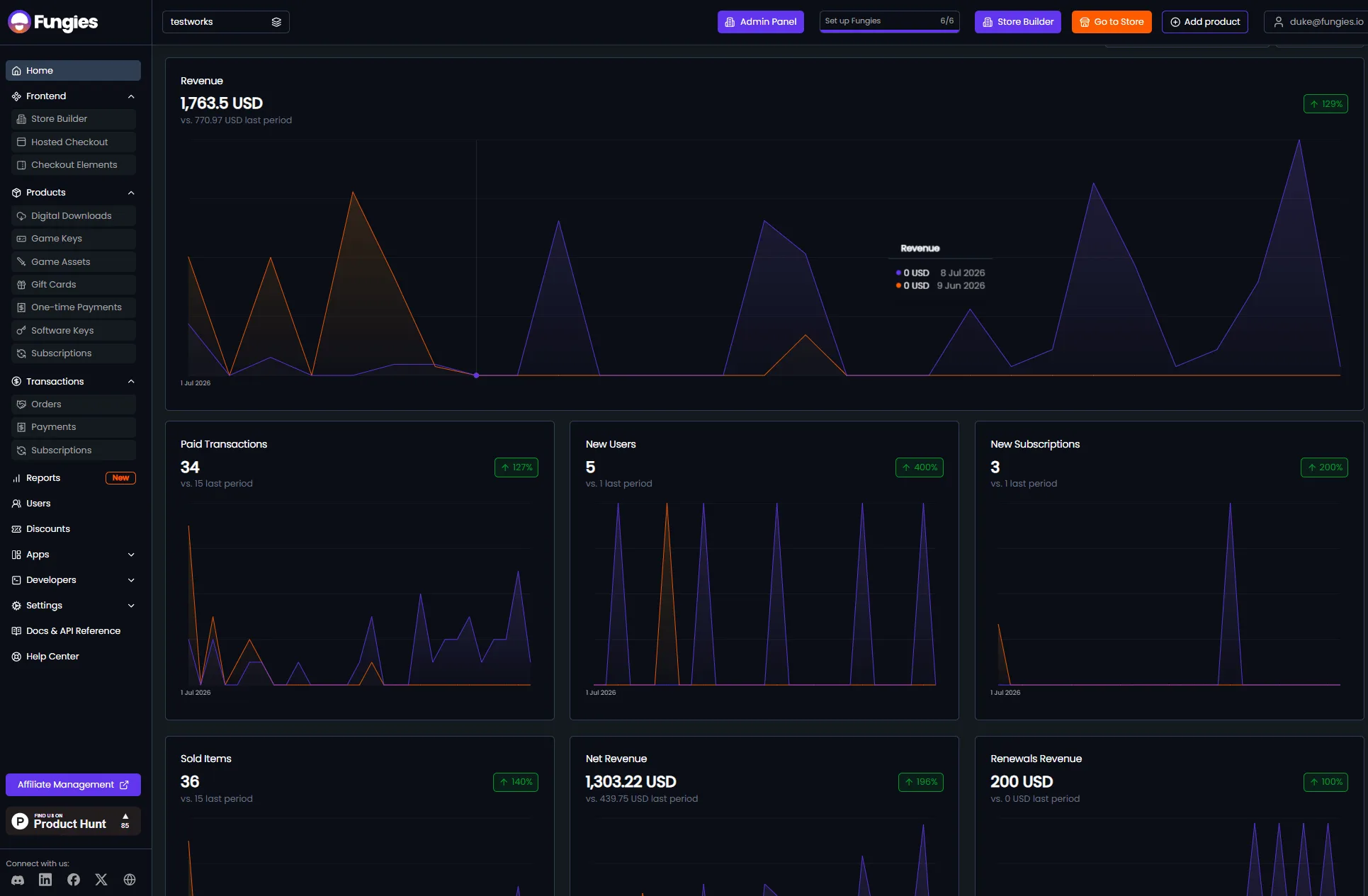
Create the items, bundles and currency packs in the dashboard. This is the same catalogue your web store sells from.
- 02
Drop in the SDK
Add the Unity or Unreal package and authenticate with the API key from the dashboard. It fetches the catalogue and opens the payment flow.
- 03
Draw your own store screen
Lay the shop out in your game's own style. The SDK supplies data and checkout; the interface is yours.
- 04
Grant on the webhook
Your backend listens for the payment event and awards the item. Never fulfil from the client — that is the path an exploit takes.
You could do all of this yourself
Selling digital goods across borders means registering for tax in each market, wiring up a tax engine, and answering for every dispute. As your Merchant of Record, that is our name on the paperwork instead of yours.
What you can sell in-game
- Virtual currency
- Packs at whatever tiers you price them, with the bigger-pack discount handled as ordinary pricing.
- Items and cosmetics
- Individual assets, skins and unlocks, each with its own product record and its own delivery event.
- Bundles and chests
- Group several items into one purchasable offer without duplicating the underlying products.
- Subscriptions and battle passes
- Recurring plans with trials and custom intervals, renewing and lapsing without you writing the billing.
- Unity and Unreal SDKs
- Documented SDKs over the same REST API, so anything the SDK does you can also do server to server.
- Tax on every purchase
- We are the seller of record, so VAT, GST and sales tax on a currency pack sold anywhere are calculated and filed by us.
5% + 50¢
per sale, and nothing else
Negotiable at higher sales volume.
No monthly fee. No minimum. No card to get started.
One rate covers the whole stack. There is no tier that unlocks tax filing and no add-on for the store builder.
- ✓ Payment processing
- ✓ Tax calculation and filing
- ✓ Fraud screening
- ✓ Chargeback handling
- ✓ Store builder and hosting
- ✓ Every platform feature
Teams like yours, already shipping
Nimblebit and Superscale
A Tiny Tower web store, built in hours
Nimblebit sells in-app purchases directly to players instead of paying a 30% app store commission on every one.
Abrams Studios
A three-person studio with its own storefront
The makers of Morels: The Hunt added a branded shop to their existing site with no upfront cost and no maintenance.
Madmind Studio
Selling horror games Steam is awkward about
The studio behind Agony and Succubus opened its own storefront, keeping more of each sale and finally seeing who its players are.
In-game store questions
More for game studios
- Game studios → Own your distribution and keep the store's cut.
- Game keys web shop → Sell Steam and Epic keys straight to players.
- Web store for mobile games → Take IAP direct and skip the app-store commission.
- Game website builder → Launch a game site from a template, no code.
- Developer dashboard → Assets, players, and payment methods in one console.
- Payment integration → Payments already wired, in the game and on the web.
- Managed user acquisition → We run the shop and the campaigns behind it.
Put the shop where the player already is
Build the catalogue once, drop in the SDK, and sell currency, items and passes without a browser in the way.