So, you’ve done it. You’ve poured countless hours into building a SaaS product that solves a real problem. The code is clean, the UI is slick, and you’re ready to change the world—or at least, a small, profitable corner of it. But as you stand on the verge of launching, a wave of administrative dread washes over you. We’re talking about the tangled web of global sales taxes, the ever-present threat of payment fraud, the mind-numbing complexity of currency conversions, and the labyrinthine rules of international compliance. Suddenly, your dream of being a product visionary is overshadowed by the nightmare of becoming an amateur accountant and international law expert.
For indie SaaS developers and small startups, this is a familiar story. The operational overhead of running a global business can stifle growth before it even begins. This is where a Merchant of Record (MoR) comes in. An MoR isn’t just a payment gateway; it’s a comprehensive partner that acts as the legal entity responsible for all your customer transactions. It handles the messy, complicated, and risky parts of selling online, freeing you to focus on what you do best: building great software.
In 2026, choosing the right MoR is one of the most critical decisions a SaaS founder will make. With the digital economy booming and regulations tightening, the right partner can be the difference between scaling globally and drowning in paperwork. This article provides a deep dive into the best merchant of record platforms available today. We’ll explore the top players, compare their features and pricing, and provide the data you need to make an informed choice. Whether you’re looking for a Paddle alternative, a Lemon Squeezy alternative, or just the best all-around SaaS payment provider, this guide is for you.
What is a Merchant of Record and Why is it a Game-Changer for SaaS?
At its core, a Merchant of Record (MoR) is the entity that is legally responsible for selling a product or service to an end customer. When you use an MoR, you are technically selling your product to the MoR provider, who then sells it to your customers around the world. This simple but powerful distinction means the MoR, not your business, is responsible for the entire transaction lifecycle. This includes payment processing, sales tax calculation and remittance, fraud liability, chargeback management, and adherence to local consumer laws.
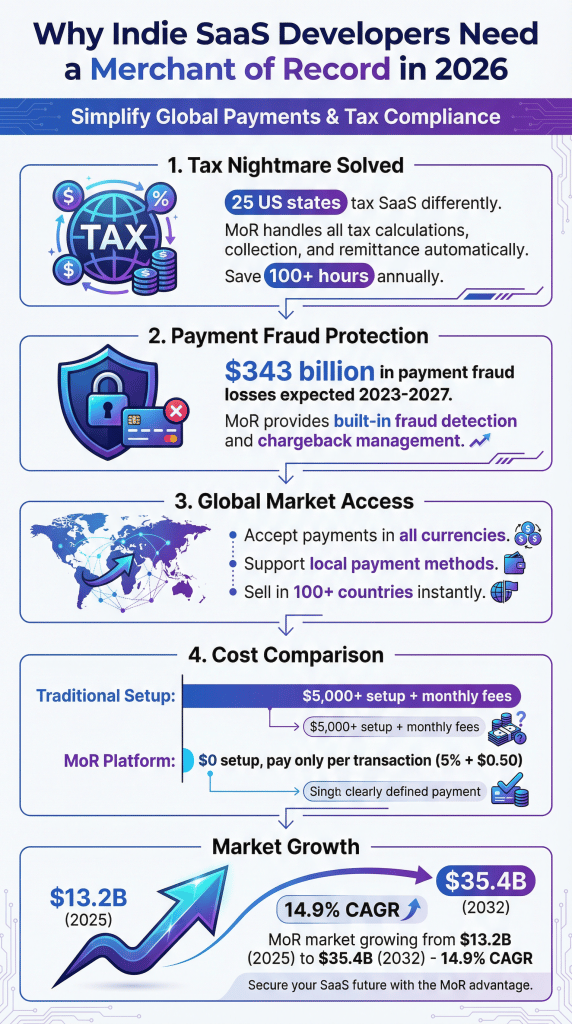
For an indie developer, the single most significant burden an MoR lifts is tax compliance. The global tax landscape is a minefield. As of early 2026, 25 U.S. states consider SaaS taxable, each with its own set of rules, rates, and filing requirements [1]. Add to that the complexities of international VAT, GST, and other consumption taxes, and the task becomes nearly impossible for a small team. A study by BlueSnap found that 31% of companies selling internationally use four or more separate solutions just to manage their global payment needs [2]. An MoR consolidates this entire function into a single, integrated solution.
According to a 2025 report from TaxJar, one of the most common mistakes SaaS businesses make is not realizing they have to collect and remit sales taxes at all, a costly oversight that can lead to significant penalties [3].
Beyond taxes, an MoR provides a critical layer of security and operational efficiency. With online payment fraud losses projected to exceed $343 billion between 2023 and 2027, robust fraud prevention is non-negotiable [4]. MoR platforms invest heavily in sophisticated fraud detection systems and assume the financial liability for chargebacks, protecting your revenue and reputation.
By offloading these complex responsibilities, an MoR allows you to enter new markets with speed and confidence. You can sell to customers in Europe, Asia, or South America without establishing local business entities or hiring tax experts in each region. This agility is a massive competitive advantage for indie developers looking to compete on a global scale.
The Explosive Growth of the SaaS and MoR Markets
The move toward MoR solutions is happening within the context of two rapidly expanding markets. The global SaaS market, valued at $273.55 billion in 2023, is projected to skyrocket to over $1.2 trillion by 2032 [5]. This incredible growth is fueled by the widespread adoption of cloud-based software across every industry. Simultaneously, the Merchant of Record market itself is on a steep upward trajectory. Valued at $13.2 billion in 2025, it is expected to reach nearly $35.5 billion by 2032, growing at a compound annual growth rate (CAGR) of 14.9% [6].

This parallel growth is no coincidence. As more SaaS businesses are born, the need for a sophisticated, compliant SaaS payment gateway becomes more acute. The data clearly shows that as the SaaS industry matures, founders are increasingly recognizing that a DIY approach to payments and compliance is not just inefficient—it’s a direct inhibitor of growth. The rise of the MoR is a direct response to the complexities of the global digital economy.
How to Choose the Best Merchant of Record for Your Business
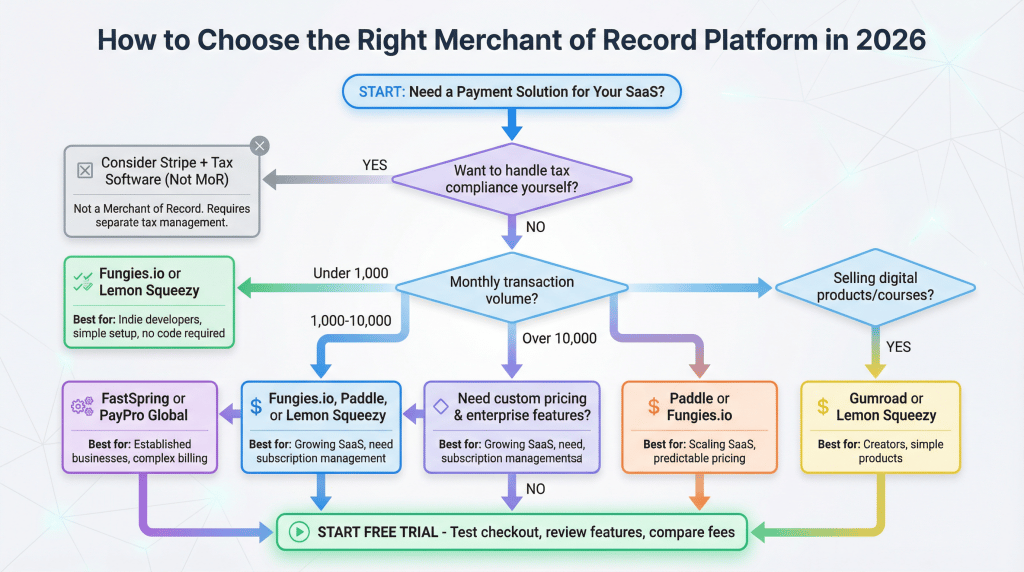
With a growing number of MoR providers to choose from, selecting the right one can feel overwhelming. The best merchant of record for a solo developer launching their first product will be different from the best choice for a scaling business with a dedicated sales team. To help you navigate this decision, we’ve created a flowchart that guides you through the key considerations.
Your decision should be based on a few core factors:
- Business Stage and Volume: Are you just starting out with a handful of customers, or are you processing thousands of transactions per month? Some platforms are built for simplicity and ease of use, while others offer the robust features needed for high-volume operations.
- Product Type: Are you selling a recurring SaaS subscription, a one-time software license, or digital products like e-books and courses? Platforms like Gumroad and Lemon Squeezy are popular among creators, while others like Paddle and FastSpring are more focused on the specific needs of SaaS businesses.
- Pricing Model: Most MoR platforms charge a percentage fee plus a fixed fee per transaction. While this may seem higher than a traditional payment processor like Stripe, it’s crucial to remember that this fee includes tax compliance, fraud protection, and support. For platforms with custom pricing, you’ll need to engage with their sales team to get a quote based on your specific needs.
- Customization and API Access: How much control do you need over the checkout experience and billing logic? Some platforms offer a simple, no-code setup, while others provide extensive APIs for deep integration with your product.
The Top 6+ Merchant of Record Platforms in 2026: A Detailed Review
Here is our in-depth analysis of the best MoR platforms for indie SaaS developers and small businesses in 2026. We’ve ranked them based on their features, pricing, and suitability for the indie developer community.
1. Fungies.io
Best For: Indie SaaS developers, startups, and game developers looking for a powerful, all-in-one MoR solution with transparent pricing and a no-code setup.
Overview:Fungies.io has quickly emerged as a top contender in the MoR space, specifically targeting the needs of the indie developer community. It combines the power of a full-featured SaaS payment provider with the simplicity and ease of use that small teams require. Fungies.io operates as a full Merchant of Record, meaning it handles all the complexities of global sales tax, VAT, fraud, and compliance, allowing developers to get back to building their products. Its focus on a seamless, no-code experience makes it an ideal choice for founders who want to get up and running quickly without a dedicated development team for billing integration.
Key Features:
- Full MoR Service: Complete handling of global tax calculation, collection, and remittance.
- Subscription Management: Robust tools for managing recurring billing, subscription plans, and customer lifecycles.
- Global Payments: Accepts payments in all major currencies and supports a wide range of local payment methods.
- Fraud Prevention & Chargeback Management: Built-in fraud detection and full management of payment disputes.
- No-Code Setup: Get started in minutes with an intuitive dashboard and pre-built checkout components.
- Developer-Friendly API: Offers a comprehensive API for developers who want deeper integration and customization.
Pricing: Fungies.io offers a simple, transparent pricing model: 5% + 50¢ per transaction. There are no monthly fees, setup fees, or hidden costs. This pay-as-you-go model is particularly attractive for startups and indie developers who need predictable costs that scale with their revenue.
Pros & Cons:
| Pros | Cons |
|---|---|
| Transparent, competitive pricing | Newer platform, less brand recognition than giants like Paddle |
| Designed specifically for indie SaaS and game developers | May lack some of the highly specialized enterprise features of PayPro Global |
| Extremely easy to set up and use (no-code) | |
| Full control over customer data and relationships |
2. Paddle
Best For: Established SaaS businesses and scaling startups that need a proven, robust MoR platform.
Overview:Paddle is one of the most well-known and respected names in the Merchant of Record space. It offers a comprehensive platform that handles payments, billing, and tax compliance for thousands of software companies worldwide. As a mature and feature-rich solution, Paddle is an excellent choice for businesses that are scaling quickly and need a reliable partner to manage their revenue infrastructure. It is often seen as the industry standard, making it a frequent benchmark for companies seeking a Paddle alternative.
Key Features:
- Comprehensive Revenue Platform: Manages payments, subscriptions, invoices, taxes, and compliance in one place.
- Localized Checkout: Optimizes checkout experience with local currencies, payment methods, and languages.
- Subscription Management: Advanced features for managing complex subscription logic, including metered billing and dunning.
- Paddle Data Core: Provides unified data and reporting for clear insights into business performance.
Pricing:Paddle’s standard pricing is 5% + 50¢ per transaction, identical to Fungies.io. They also offer custom pricing for businesses with high transaction volumes or unique needs, which may include dedicated support and advisory services.
Pros & Cons:
| Pros | Cons |
|---|---|
| Proven track record with a large customer base | Can be more complex to integrate than simpler solutions |
| Extensive feature set for scaling SaaS businesses | Support has been cited by some users as being slow at times |
| Strong focus on data and analytics | Pricing can become less competitive for very high-volume businesses without a custom plan |
Best For: Digital product creators, course sellers, and SaaS businesses looking for a beautifully designed, easy-to-use MoR.
Overview:Lemon Squeezy has made a name for itself with a strong focus on design and user experience. It serves as a full Merchant of Record, making it a popular choice for creators who want to sell digital products without worrying about sales tax. In 2024, Lemon Squeezy was acquired by Stripe, a move that has brought both opportunities and questions about its future direction [7]. For now, it remains a strong contender, particularly for those who value a polished and user-friendly interface. Its popularity has also led many to search for a Lemon Squeezy alternative as they evaluate their options.
Key Features:
- Full MoR Service: Handles global sales tax and VAT compliance automatically.
- Beautifully Designed Checkout: Offers a highly polished and customizable checkout experience.
- Email Marketing: Includes built-in email marketing tools to engage with customers.
- Affiliate Management: Provides a system for managing and paying affiliates.
Pricing:Lemon Squeezy’s standard pricing is 5% + 50¢ per transaction. This straightforward pricing makes it easy for creators and small businesses to get started.
Pros & Cons:
| Pros | Cons |
|---|---|
| Excellent user interface and design focus | Future direction is uncertain following the Stripe acquisition |
| Great for selling a mix of digital products and SaaS | Some advanced SaaS billing features may be less developed than competitors |
| Built-in email marketing and affiliate tools |
4. FastSpring
Best For: Mid-to-large SaaS and software companies that require a full-service e-commerce partner with extensive features.
Overview:FastSpring is another major player in the MoR space, positioning itself as a global, full-service e-commerce partner for software companies. It offers a comprehensive suite of tools that go beyond basic payment processing, including features for web store creation and branded checkout experiences. FastSpring is designed for businesses that need a high degree of customization and support to manage their global sales operations. As such, it is often considered a powerful FastSpring alternative for businesses outgrowing simpler platforms.
Key Features:
- Full-Service MoR: Manages global payments, tax, compliance, and risk.
- Subscription Management: Supports a wide range of recurring billing models and subscription lifecycle management.
- Branded Storefronts: Provides tools to create and customize online stores and checkout flows.
- Extensive Integrations: Connects with a wide variety of third-party marketing, analytics, and support tools.
Pricing:FastSpring does not publicly list its pricing. Instead, it offers custom pricing based on a company’s sales volume, business model, and specific needs. While this lack of transparency can be a drawback for smaller businesses, it allows FastSpring to tailor its pricing and services to the unique requirements of larger, more complex companies.
Pros & Cons:
| Pros | Cons |
|---|---|
| Highly customizable and feature-rich platform | Pricing is not transparent and likely higher for smaller businesses |
| Strong focus on enterprise-level support and services | Can be overly complex for indie developers and small startups |
| Excellent for businesses with complex billing and e-commerce needs | Requires engaging with a sales team to get started |
5. Gumroad
Best For: Independent creators, artists, and writers selling simple digital products like e-books, music, and tutorials.
Overview:Gumroad has long been a favorite among independent creators for its simplicity and ease of use. While it functions as a Merchant of Record, its feature set is geared more toward one-time digital product sales rather than complex SaaS subscriptions. Gumroad’s mission is to make it as easy as possible for creators to earn a living from their work, and it has succeeded in building a platform that is accessible to anyone, regardless of technical skill. For those seeking a Gumroad alternative with more advanced SaaS features, platforms like Fungies.io or Lemon Squeezy may be better suited.
Key Features:
- Simple Product Setup: Create and sell digital products in minutes with no technical knowledge required.
- Marketplace Discovery: Customers can discover new products through Gumroad’s built-in marketplace.
- Pay-What-You-Want Pricing: Allows creators to offer flexible pricing options to their customers.
- Email Marketing: Basic email tools for communicating with your audience.
Pricing:Gumroad charges 10% + 50¢ per transaction for sales made through your profile or direct links. For sales that come from customers discovering your product through the Gumroad marketplace, the fee increases to 30% per transaction. This higher fee reflects the value of the marketplace traffic but can be a significant cost for creators who rely heavily on discovery.
Pros & Cons:
| Pros | Cons |
|---|---|
| Extremely simple and easy to use | Higher fees compared to most other MoR platforms |
| Built-in marketplace for product discovery | Limited features for complex SaaS subscription management |
| Great for creators with no technical background | 30% fee for marketplace sales can be prohibitive |
| Pay-what-you-want pricing option |
6. PayPro Global
Best For: Enterprise SaaS businesses and software companies that need a comprehensive, high-touch MoR solution with extensive global reach.
Overview:PayPro Global positions itself as a full-service Merchant of Record and e-commerce platform for SaaS and software companies. It offers a comprehensive suite of services that includes not only payment processing and tax compliance but also extensive support for global expansion. PayPro Global is designed for businesses that are serious about scaling internationally and need a partner that can handle the complexities of multi-currency transactions, local payment methods, and diverse regulatory environments. With over 70 payment methods supported, it provides the flexibility needed to maximize conversion rates in different markets.
Key Features:
- Full MoR Service: Comprehensive management of payments, taxes, compliance, and risk across all global markets.
- Over 70 Payment Methods: Supports a wide range of local and international payment options to maximize customer reach.
- Subscription and Billing Management: Advanced tools for managing complex subscription models and billing scenarios.
- Localized Checkout: Provides localized checkout experiences tailored to specific regions and customer preferences.
- Dedicated Support: Offers high-touch support and account management for enterprise clients.
Pricing:PayPro Global does not publicly disclose its pricing. Instead, it offers custom pricing based on the specific needs and scale of each business. This approach allows them to tailor their services and pricing to fit the unique requirements of larger, more complex organizations.
Pros & Cons:
| Pros | Cons |
|---|---|
| Extensive global reach with 70+ payment methods | Pricing is not transparent and requires sales engagement |
| Comprehensive, high-touch support for enterprise clients | Likely overkill for indie developers and small startups |
| Strong focus on international expansion and localization | More complex setup and onboarding process |
| Robust features for complex billing and subscription needs |
Detailed Platform Comparison: Features, Pricing, and Best Use Cases
To make your decision easier, we’ve compiled a comprehensive comparison table that summarizes the key features, pricing, and ideal use cases for each of the six platforms we’ve reviewed.
Comprehensive MoR Platform Comparison Table (2026)
| Platform | Transaction Fee | Fixed Fee | Monthly Fee | Tax Compliance | Fraud Protection | Subscription Management | Global Payments | Chargeback Management | No-Code Setup | Best For |
|---|---|---|---|---|---|---|---|---|---|---|
| Fungies.io | 5% | $0.50 | $0 | ✓ Full | ✓ Full | ✓ Full | ✓ Full | ✓ Full | ✓ Yes | Indie developers & small SaaS |
| Paddle | 5% | $0.50 | $0 | ✓ Full | ✓ Full | ✓ Full | ✓ Full | ✓ Full | Partial | Established SaaS businesses |
| Lemon Squeezy | 5% | $0.50 | $0 | ✓ Full | ✓ Full | ✓ Full | ✓ Full | ✓ Full | ✓ Yes | Digital product creators |
| FastSpring | Custom | Custom | $0 | ✓ Full | ✓ Full | ✓ Full | ✓ Full | ✓ Full | Partial | Mid to large SaaS companies |
| Gumroad | 10% | $0.50 | $0 | Limited | Limited | Limited | ✓ Full | Limited | ✓ Yes | Creators & digital products |
| PayPro Global | Custom | Custom | $0 | ✓ Full | ✓ Full | ✓ Full | ✓ Full | ✓ Full | Partial | Enterprise SaaS businesses |
This table provides a quick reference to help you compare the platforms side-by-side and identify which platform aligns best with your priorities.
Understanding the Tax Compliance Landscape for SaaS in 2026
One of the primary reasons indie SaaS developers turn to a Merchant of Record is to escape the complexity of sales tax compliance. The landscape is challenging and constantly evolving. As of 2026, the United States alone presents a patchwork of regulations that vary significantly from state to state.
US State SaaS Tax Compliance Landscape (2026)
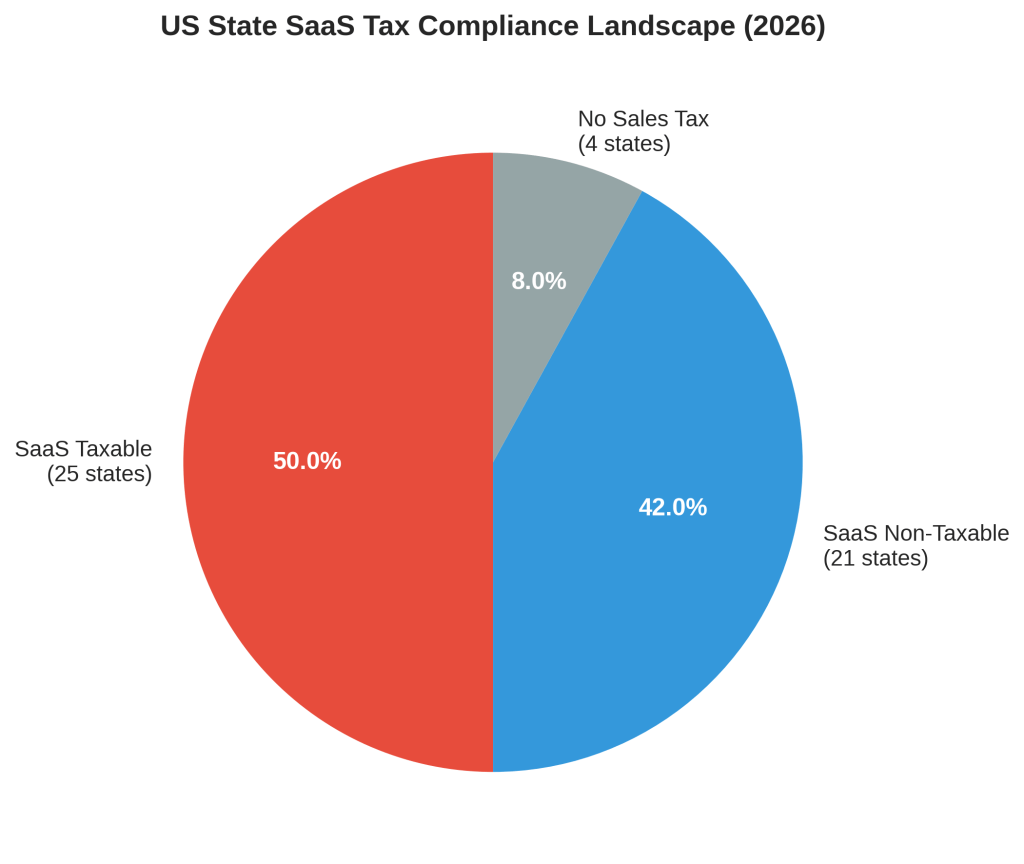
As the chart illustrates, 25 states consider SaaS taxable, 21 states do not, and 4 states have no sales tax at all. This means that for every transaction, you need to know not just where your customer is located, but also the specific tax rules that apply to your product in that jurisdiction. The rules are not static either; states frequently update their definitions of taxable services, and new economic nexus thresholds can be triggered as your business grows.
Beyond the United States, international VAT and GST regulations add another layer of complexity. The European Union, for example, requires businesses to charge VAT based on the customer’s location, not the seller’s. Each country has its own VAT rate, and businesses are required to register, collect, and remit taxes in each jurisdiction where they have customers. For a small team, this is an impossible task without specialized software or a Merchant of Record.
By using an MoR, all of this complexity is handled for you. The MoR is responsible for determining the correct tax rate, collecting the tax from the customer, and remitting it to the appropriate tax authority. This not only saves you time but also protects you from the significant financial and legal risks associated with non-compliance.
Real-World Impact: How MoR Platforms Save Time and Money
To understand the true value of a Merchant of Record, it’s helpful to consider the alternative. If you were to handle payments, taxes, and compliance on your own, you would need to:
- Integrate a payment processor like Stripe or PayPal, which requires development time and ongoing maintenance.
- Implement tax calculation software like TaxJar or Avalara to determine the correct tax rate for each transaction.
- Register for sales tax permits in every state where you have economic nexus, a process that can take weeks or months.
- File regular tax returns in each jurisdiction, which requires meticulous record-keeping and accounting expertise.
- Monitor for fraud and manage chargebacks, which can be a significant drain on resources.
- Stay up-to-date with changing regulations and tax rates, which requires ongoing research and legal consultation.
For a solo developer or small team, this represents hundreds of hours of work per year, not to mention the cost of software subscriptions, legal fees, and the risk of penalties for non-compliance. A study by TaxJar found that businesses lose between 1% and 5% of their total revenue to billing errors and tax mistakes [1]. For a SaaS company generating $500,000 in annual revenue, that’s up to $25,000 lost every year.
In contrast, a Merchant of Record consolidates all of these functions into a single, integrated platform. You pay a transparent fee per transaction, and in return, you get a complete solution that handles everything from payment processing to tax remittance. For most indie developers, the time and cost savings alone justify the fee, even before considering the reduced risk and peace of mind.
Key Considerations When Evaluating MoR Platforms
As you evaluate different Merchant of Record platforms, there are several key factors to keep in mind:
1. Pricing Transparency and Total Cost of Ownership
While most MoR platforms advertise a simple percentage fee, it’s important to understand the total cost of ownership. Some platforms charge additional fees for specific features, such as invoicing, advanced reporting, or premium support. Others offer custom pricing that may be more favorable for high-volume businesses but less transparent for startups. Always ask for a detailed breakdown of all fees and consider how your costs will scale as your business grows.
2. Ease of Integration and Time to Market
For indie developers, time is one of the most valuable resources. A platform that offers a no-code setup or simple API integration can get you to market weeks or even months faster than a complex, enterprise-focused solution. Look for platforms that provide clear documentation, pre-built checkout components, and responsive support to help you get up and running quickly.
3. Feature Set and Scalability
Consider not just your current needs, but also where your business will be in one or two years. If you’re starting with a simple subscription model but plan to add usage-based billing or tiered pricing in the future, make sure the platform you choose can support those features. Similarly, if you plan to expand into new markets, verify that the platform supports the currencies and payment methods your customers will need.
4. Customer Experience and Conversion Optimization
The checkout experience is a critical part of your customer journey. A clunky or confusing checkout can lead to abandoned carts and lost revenue. Look for platforms that offer a polished, customizable checkout experience that can be tailored to match your brand. Features like localized pricing, multiple payment methods, and mobile optimization can significantly improve conversion rates.
5. Data Ownership and Customer Relationships
One of the concerns some founders have about using a Merchant of Record is losing control over customer data and relationships. While the MoR is the legal seller of record, most modern platforms provide you with full access to customer data, transaction history, and analytics. Make sure the platform you choose allows you to maintain direct communication with your customers and gives you the data you need to make informed business decisions.
The Role of MoR in the Broader SaaS Ecosystem
The rise of Merchant of Record platforms is part of a larger trend toward specialization and modularization in the SaaS ecosystem. Just as companies like Stripe revolutionized payment processing by making it accessible to developers, MoR platforms are now doing the same for the entire commerce stack. This shift allows founders to focus on their core competencies—building great products and serving customers—while relying on specialized partners to handle the operational complexities of running a global business.
This trend is reflected in the market data. The Merchant of Record market is growing at nearly 15% per year, significantly faster than the overall payments industry [6]. This growth is driven by the increasing complexity of global commerce, the proliferation of new regulations, and the recognition among founders that trying to do everything in-house is not a sustainable strategy.
Looking ahead, we can expect MoR platforms to continue evolving, adding new features and capabilities to meet the changing needs of SaaS businesses. Areas of innovation may include more sophisticated subscription management tools, deeper integrations with marketing and analytics platforms, and expanded support for emerging payment methods like digital wallets and cryptocurrencies.
Common Misconceptions About Merchant of Record Platforms
Despite the clear benefits, there are still some misconceptions about Merchant of Record platforms that can cause founders to hesitate. Let’s address a few of the most common ones:
Misconception 1: “MoR platforms are too expensive.”
While the percentage fee charged by MoR platforms may seem higher than a basic payment processor like Stripe, it’s important to compare apples to apples. When you factor in the cost of tax software, legal fees, accounting time, and the risk of non-compliance, the total cost of a DIY approach is often higher. Additionally, the time savings alone can be worth the fee, allowing you to focus on revenue-generating activities rather than administrative tasks.
Misconception 2: “I’ll lose control over my customer relationships.”
Modern MoR platforms are designed to be transparent and give you full access to your customer data. While the MoR is the legal seller of record, you maintain direct communication with your customers and have full visibility into transaction history, customer behavior, and analytics. In most cases, customers don’t even know they’re interacting with an MoR; the checkout experience is branded with your company name and logo.
Misconception 3: “MoR platforms are only for large businesses.”
While some MoR platforms do cater to enterprise clients, many are specifically designed for indie developers and small startups. Platforms like Fungies.io, Lemon Squeezy, and Gumroad offer simple, no-code setups and pricing models that scale with your business. There’s no minimum transaction volume or upfront cost, making them accessible to businesses of all sizes.
Misconception 4: “Setting up an MoR is complicated and time-consuming.”
The reality is that most modern MoR platforms can be set up in a matter of hours or days, not weeks or months. Many offer pre-built checkout components, simple API integrations, and step-by-step guides to help you get started. In contrast, setting up your own payment infrastructure, registering for tax permits, and implementing compliance systems can take months and require significant technical and legal expertise.
Actionable Steps: How to Get Started with a Merchant of Record
If you’re convinced that a Merchant of Record is the right choice for your SaaS business, here are the steps to get started:
Step 1: Define Your Requirements
Before you start evaluating platforms, take the time to clearly define your requirements. Consider factors like your target markets, the types of products you’re selling (subscriptions, one-time purchases, usage-based billing), your expected transaction volume, and any specific features you need (like invoicing, affiliate management, or advanced analytics).
Step 2: Research and Shortlist Platforms
Use this guide as a starting point to research the top MoR platforms. Create a shortlist of 2-3 platforms that seem like the best fit for your needs. Visit their websites, read user reviews on sites like G2 and Capterra, and reach out to their sales or support teams with any questions.
Step 3: Test the Checkout Experience
Most MoR platforms offer free trials or sandbox environments where you can test the checkout experience without processing real transactions. Take advantage of this to see how the platform works from both the merchant and customer perspectives. Pay attention to the ease of setup, the quality of the documentation, and the responsiveness of the support team.
Step 4: Compare Pricing and Total Cost
Once you’ve narrowed down your options, do a detailed comparison of the pricing and total cost of ownership. Consider not just the transaction fees, but also any additional costs for features you need, the potential savings from not having to manage taxes and compliance yourself, and the value of your time.
Step 5: Make Your Decision and Launch
After you’ve completed your evaluation, make your decision and commit to launching with your chosen platform. Most MoR platforms offer migration support if you’re switching from another provider, and their teams are typically very helpful in getting you set up and running smoothly.
Step 6: Monitor, Optimize, and Scale
Once you’re live, monitor your key metrics like conversion rates, average transaction value, and customer lifetime value. Use the analytics and reporting tools provided by your MoR platform to identify opportunities for optimization. As your business grows, revisit your platform choice periodically to ensure it’s still meeting your needs and providing good value.
Pricing Comparison: Breaking Down the Numbers
Understanding the true cost of a Merchant of Record platform requires looking beyond the advertised transaction fees. Let’s break down what you can expect to pay at different stages of your business growth.
MoR Platform Pricing Comparison (2026)
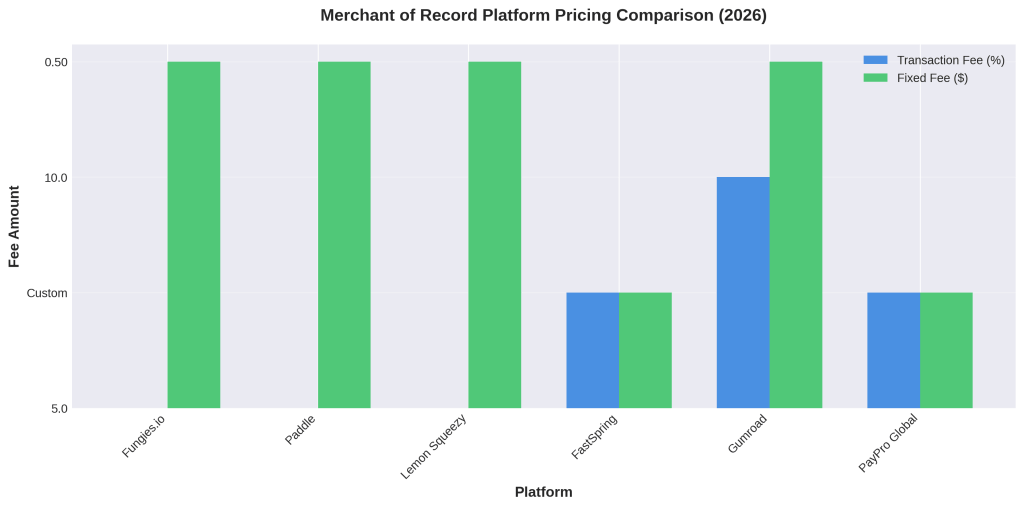
As shown in the chart, Fungies.io, Paddle, and Lemon Squeezy all offer identical transparent pricing at 5% + $0.50 per transaction. This consistency makes it easier to compare these platforms based on features and user experience rather than price alone. Gumroad stands out with a higher 10% fee, which reflects its positioning as a creator-focused platform with built-in marketplace discovery. FastSpring and PayPro Global both offer custom pricing, which typically means higher costs but also more tailored services for enterprise clients.
For a SaaS business processing 1,000 transactions per month at an average transaction value of $50, here’s what you would pay:
- Fungies.io, Paddle, Lemon Squeezy: ($50 × 0.05 + $0.50) × 1,000 = $3,000 per month
- Gumroad: ($50 × 0.10 + $0.50) × 1,000 = $5,500 per month
- FastSpring, PayPro Global: Custom pricing (typically $3,000-$4,000+ per month for this volume)
The difference becomes even more pronounced at higher volumes. At 10,000 transactions per month, the cost difference between a 5% platform and a 10% platform is $25,000 per month, or $300,000 per year. This is why choosing the right platform early can have a significant impact on your long-term profitability.
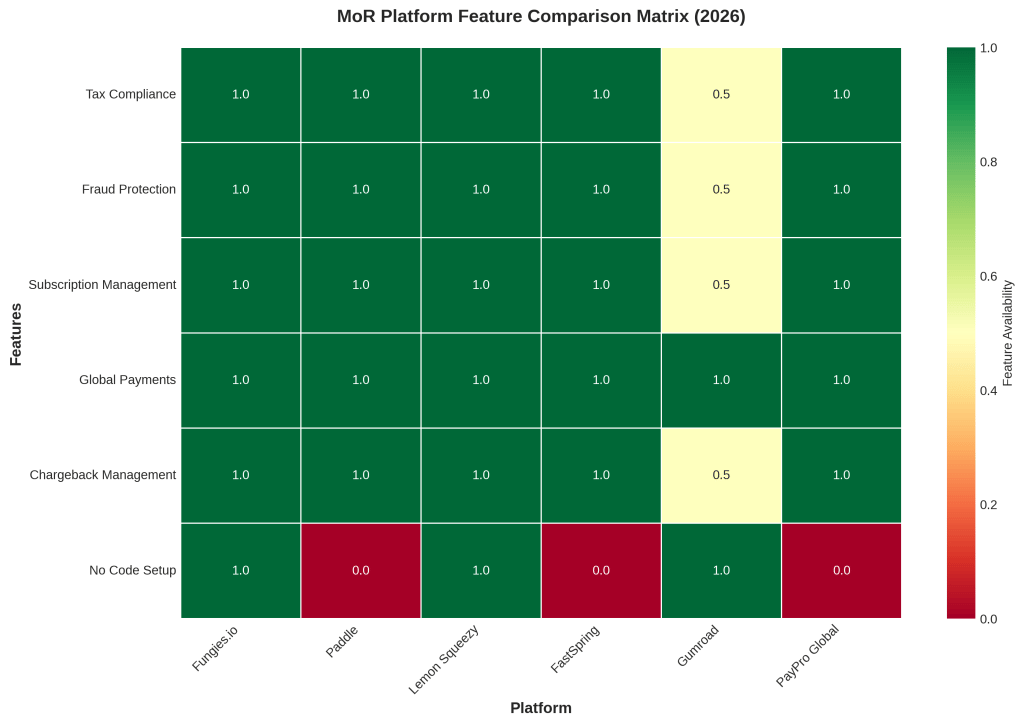
MoR Platform Feature Comparison Matrix (2026)
This heatmap provides a visual representation of feature availability across the top platforms. A score of 1.0 means the feature is fully supported, 0.5 indicates limited support, and 0 indicates no support.
MoR Platform Cost Comparison by Transaction Volume (2026)
This chart illustrates how the total monthly fees can vary between platforms based on your transaction volume. For platforms with custom pricing (FastSpring and PayPro Global), we have omitted them from this chart as their fees are not publicly available.
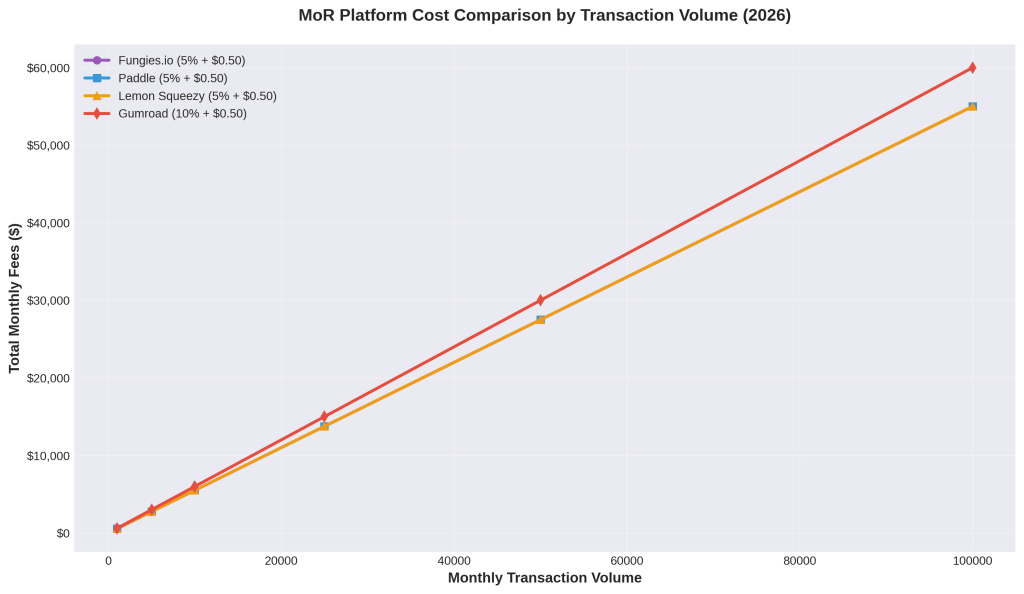
As the chart shows, for most indie developers and startups, the pricing between Fungies.io, Paddle, and Lemon Squeezy is identical. The choice between them comes down to specific features, ease of use, and target audience. Gumroad, with its higher 10% fee, is a more expensive option but may be justified for creators who benefit from its marketplace and simplicity.
Emerging Trends in the MoR Space for 2026 and Beyond
The Merchant of Record landscape is evolving rapidly, driven by technological innovation, changing regulations, and the growing sophistication of SaaS businesses. Here are some of the key trends shaping the industry in 2026 and beyond:
1. AI-Powered Fraud Detection and Risk Management
With payment fraud losses projected to exceed $343 billion between 2023 and 2027, MoR platforms are investing heavily in artificial intelligence and machine learning to detect and prevent fraudulent transactions [4]. Modern systems can analyze hundreds of data points in real-time, including device fingerprinting, behavioral patterns, and transaction history, to identify suspicious activity before it results in a loss. This not only protects revenue but also reduces false positives that can frustrate legitimate customers.
2. Expanded Support for Alternative Payment Methods
Digital wallets are set to hit 5 billion users worldwide in 2026, and MoR platforms are racing to support the full range of payment options that customers expect [8]. This includes not just traditional credit cards and PayPal, but also Apple Pay, Google Pay, regional payment methods like iDEAL in the Netherlands and Alipay in China, and even cryptocurrency payments. The ability to offer localized payment methods can significantly improve conversion rates, particularly in markets where credit card penetration is lower.
3. Deeper Integration with the SaaS Tech Stack
MoR platforms are no longer standalone payment solutions; they’re becoming central hubs that integrate with the entire SaaS tech stack. This includes connections to CRM systems like HubSpot and Salesforce, analytics platforms like Mixpanel and Amplitude, customer support tools like Intercom and Zendesk, and marketing automation platforms like Mailchimp and ActiveCampaign. These integrations enable a more seamless flow of data and a more unified view of the customer journey.
4. Advanced Subscription and Billing Models
As SaaS businesses experiment with new pricing strategies, MoR platforms are expanding their support for advanced billing models. This includes usage-based pricing (where customers pay based on consumption), hybrid models (combining fixed subscriptions with usage fees), tiered pricing with feature gates, and even dynamic pricing that adjusts based on customer behavior or market conditions. The platforms that can support these complex models while maintaining simplicity for the developer will have a significant competitive advantage.
5. Enhanced Analytics and Business Intelligence
Data is the lifeblood of modern SaaS businesses, and MoR platforms are providing increasingly sophisticated analytics and reporting tools. This goes beyond basic transaction reports to include customer lifetime value analysis, cohort analysis, churn prediction, revenue forecasting, and detailed insights into the performance of different pricing plans and customer segments. These insights enable founders to make data-driven decisions about product development, pricing, and growth strategies.
6. Compliance with Emerging Regulations
The regulatory landscape for digital commerce is constantly evolving, with new rules around data privacy, consumer protection, and tax compliance being introduced regularly. MoR platforms are investing in compliance teams and legal expertise to stay ahead of these changes and ensure their customers remain compliant. This includes adapting to new regulations like the EU’s Digital Services Act, evolving data privacy laws, and changes to tax rules in various jurisdictions.
Why Fungies.io is the Best Choice for Indie SaaS Developers in 2026
While all of the platforms we’ve reviewed have their strengths, Fungies.io stands out as the best overall choice for indie SaaS developers and small startups in 2026. Here’s why:
1. Purpose-Built for Indie Developers
Unlike platforms that try to serve everyone from solo creators to enterprise corporations, Fungies.io is specifically designed with the needs of indie developers in mind. This focus is evident in every aspect of the platform, from the no-code setup to the transparent pricing to the developer-friendly API. The team behind Fungies.io understands the challenges faced by small teams and has built a solution that addresses those challenges directly.
2. True No-Code Setup
Many platforms claim to be easy to use, but Fungies.io truly delivers on this promise. You can have a fully functional checkout and subscription system up and running in minutes, without writing a single line of code. For developers who want more control, the comprehensive API provides all the flexibility you need for deep integration with your product.
3. Transparent, Competitive Pricing
At 5% + $0.50 per transaction with no monthly fees or hidden costs, Fungies.io offers pricing that is both transparent and competitive. This pay-as-you-go model means you only pay when you make money, which is ideal for startups that need to manage cash flow carefully. There are no surprises, no additional fees for essential features, and no pressure to commit to a long-term contract.
4. Full MoR Service with No Compromises
Fungies.io provides a complete Merchant of Record service, handling all aspects of global tax compliance, fraud prevention, chargeback management, and regulatory compliance. You get the same level of service and protection as you would from more expensive enterprise platforms, but with the simplicity and affordability that indie developers need.
5. Excellent Support and Community
The Fungies.io team is known for being responsive and helpful, with a strong focus on customer success. Whether you’re just getting started or scaling to thousands of transactions per month, you’ll have access to the support and guidance you need. The growing community of indie developers using Fungies.io also provides a valuable network for sharing experiences and best practices.
6. Built for the Future
Fungies.io is actively investing in new features and capabilities to meet the evolving needs of SaaS businesses. This includes support for advanced billing models, enhanced analytics, and integrations with the tools that developers rely on. By choosing Fungies.io, you’re partnering with a platform that is committed to growing with you.
Final Thoughts: Making the Right Choice for Your SaaS Business
Choosing a Merchant of Record is one of the most important decisions you’ll make as a SaaS founder. The right platform can accelerate your growth, reduce your operational burden, and give you the confidence to compete on a global stage. The wrong platform can slow you down, create unnecessary complexity, and cost you money in hidden fees and lost opportunities.
As you evaluate your options, remember that the best merchant of record for your business is the one that aligns with your specific needs, stage of growth, and long-term vision. For most indie developers and small startups, that platform is Fungies.io. With its transparent pricing, comprehensive feature set, and unwavering focus on the needs of indie developers, Fungies.io provides the perfect foundation for building and scaling a successful SaaS business in 2026.
Whether you’re looking for a Paddle alternative, a Lemon Squeezy alternative, or simply the best SaaS payment gateway for your needs, the platforms we’ve reviewed in this guide represent the top options available today. Take the time to evaluate each one carefully, test their checkout experiences, and choose the partner that will help you achieve your goals.
The future of SaaS is global, and the future of payments is effortless. With the right Merchant of Record by your side, you can focus on what you do best—building great software—while leaving the complexities of commerce to the experts.
Conclusion: The Future of SaaS is Effortless Commerce
In 2026, the question for indie SaaS developers is not if they should use a Merchant of Record, but which one they should choose. The administrative burden of global tax compliance, the financial risk of payment fraud, and the operational headache of managing international payments are simply too great for small teams to handle on their own. The data is clear: the SaaS market is exploding, and the MoR market is growing right alongside it, providing the critical infrastructure that enables this growth.
For the modern indie developer, the goal is to build a business, not a bureaucracy. You need a partner that removes friction, not one that adds it. When evaluating your options, look for a platform that offers transparent pricing, a comprehensive feature set, and a user experience that lets you get back to what matters most: your product and your customers.
While established players like Paddle and FastSpring offer powerful solutions, the new generation of MoR platforms, led by innovators like Fungies.io, is providing compelling alternatives specifically designed for the needs of the indie developer community. With its simple, all-inclusive pricing, no-code setup, and robust feature set, Fungies.io stands out as a top choice for any SaaS founder looking to launch and scale a global business in 2026.
The right SaaS payment provider is more than just a tool; it’s a growth engine. By choosing a Merchant of Record, you are not just offloading a series of administrative tasks; you are unlocking the potential to compete on a global stage, secure in the knowledge that the complexities of commerce are being handled for you.
References
[1] TaxJar. (2025, December 22). Sales tax for SaaS businesses: Four common challenges. Retrieved from https://www.taxjar.com/blog/sales-tax-for-saas-businesses
[2] G2. (2024, September 2). Introducing G2’s New Merchant of Record Software Category. Retrieved from https://research.g2.com/insights/merchant-of-record-software
[3] SaaStr. (n.d.). The most common mistake SaaS companies make on sales tax collection and filings. Retrieved from https://www.saastr.com/the-most-common-mistake-saas-companies-make-on-sales-tax-collection-and-filings/
[4] Juniper Research. (2023). Online Payment Fraud: Market Forecasts, Emerging Threats & Segment Analysis 2023-2027. Retrieved from https://www.juniperresearch.com/researchstore/fintech-payments/online-payment-fraud-research-report
[5] EmailVendorSelection. (2025, December 4). 71+ SaaS Statistics, Trends, and Benchmarks for 2026. Retrieved from https://www.emailvendorselection.com/saas-statistics/
[6] Research and Markets. (2025). Merchant of Record Software Market – Global Forecast 2025-2032. Retrieved from https://www.researchandmarkets.com/reports/6055389/merchant-record-software-market-global
[7] TechCrunch. (2024, July 26). Stripe acquires payment processing startup Lemon Squeezy. Retrieved from https://techcrunch.com/2024/07/26/stripe-acquires-payment-processing-startup-lemon-squeezy/
[8] Juniper Research. (2026). 11 Payment Stats You Need to Know for 2026. Retrieved from https://www.juniperresearch.com/resources/blog/11-payment-stats-you-need-to-know-for-2026/