Choosing between Gumroad and Paddle in 2026? You’re not alone. Both platforms position themselves as Merchant of Record solutions for digital sellers, but they serve fundamentally different audiences. This guide breaks down the real differences in fees, features, and use cases—so you can make the right choice for your business.
At a Glance: Gumroad vs Paddle
Gumroad is built for creators—artists, writers, musicians, and educators selling digital products, courses, and memberships. It’s simple, has no monthly fees, and takes a percentage of each sale.
Paddle is built for SaaS companies—software businesses needing subscription billing, global tax compliance, and enterprise-grade infrastructure. It has more complex pricing but lower effective fees at scale.
Fee Comparison: What You Actually Pay
Gumroad Pricing (2026)
Gumroad uses a straightforward transaction-based model:
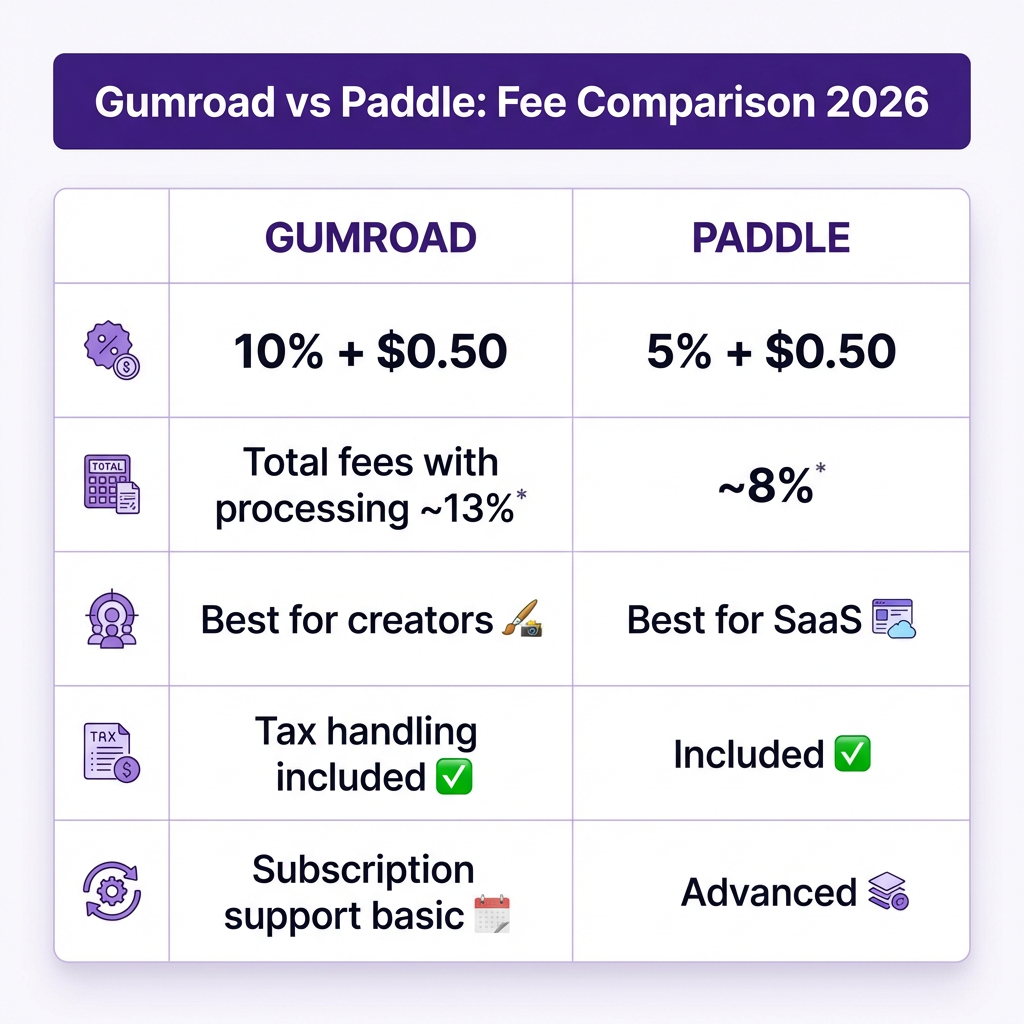
- Direct sales: 10% + $0.50 per transaction
- Gumroad Discover sales: 30% flat fee (includes all processing)
- Payment processing: ~2.9% + $0.30 (included in the 10% for direct sales)
Total effective cost: Approximately 12.9% + $0.80 per transaction for direct sales. On a $50 sale, you pay about $7.25 in fees.
Paddle Pricing (2026)
Paddle’s pricing is more competitive for high-volume sellers:
- Pay-as-you-go: 5% + $0.50 per transaction
- Payment processing: Included in the 5%
- Tax compliance: Included (global VAT, sales tax, GST)
Total effective cost: Approximately 5% + $0.50 per transaction. On a $50 sale, you pay about $3.00 in fees—saving $4.25 per transaction compared to Gumroad.
Feature Comparison
| Feature | Gumroad | Paddle |
|---|---|---|
| Best For | Creators, digital products | SaaS, software, subscriptions |
| Pricing Model | 10% + $0.50 per sale | 5% + $0.50 per transaction |
| Monthly Fee | None | None (pay-as-you-go) |
| Tax Compliance | Yes (MoR since 2025) | Yes (full MoR) |
| Subscriptions | Basic | Advanced (trials, proration) |
| Checkout Customization | Limited | Extensive |
| API & Webhooks | Basic | Developer-first |
| Affiliate Program | Built-in | Available |
| Payout Frequency | Weekly | Monthly (or custom) |
When to Choose Gumroad
Gumroad is the right choice if:
- You sell one-time digital products (ebooks, templates, music, art)
- You’re a creator building an audience, not a SaaS business
- You want zero setup friction—start selling in minutes
- You rely on Gumroad Discover for organic traffic
- Your average order value is under $30 (where Paddle’s savings matter less)
When to Choose Paddle
Paddle is the better fit if:
- You run a SaaS business with recurring subscriptions
- You need advanced billing (trials, upgrades, proration, usage-based)
- You process $5,000+ per month (fee savings add up fast)
- You want deep API integration with your product
- You need enterprise features like custom contracts
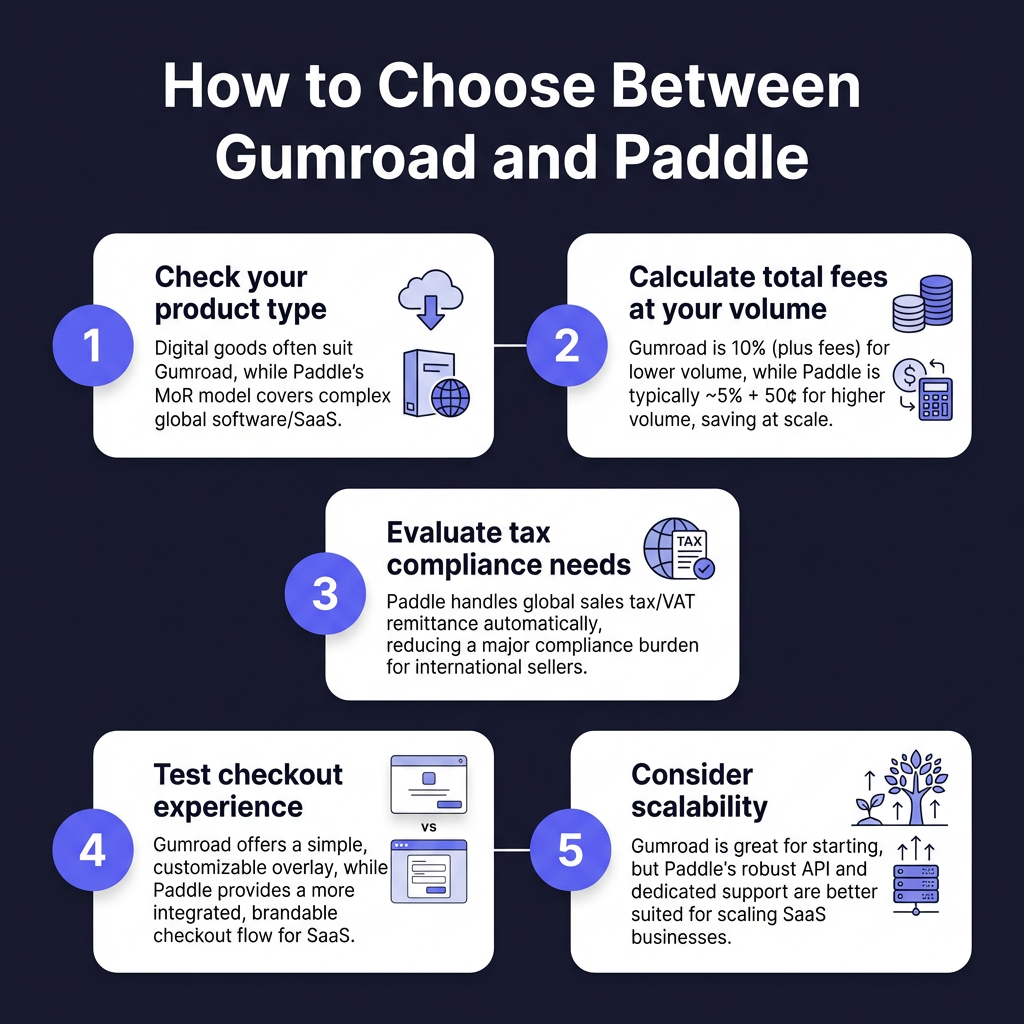
Real-World Cost Analysis
Let’s look at what you’d pay on each platform at different revenue levels:
| Monthly Revenue | Gumroad Fees | Paddle Fees | You Save With Paddle |
|---|---|---|---|
| $1,000 | ~$129 | ~$55 | $74 |
| $5,000 | ~$645 | ~$275 | $370 |
| $10,000 | ~$1,290 | ~$550 | $740 |
| $50,000 | ~$6,450 | ~$2,750 | $3,700 |
At $5,000/month, Paddle saves you $4,440 annually. At $50,000/month, the savings jump to $44,400 per year.
The Hidden Cost of Gumroad Discover
Here’s what many creators miss: Gumroad’s 30% fee for Discover marketplace sales. If a customer finds your product through Gumroad’s marketplace (not your direct link), you pay nearly a third of your revenue.
For a $50 product sold through Discover, you keep just $35. The same sale through Paddle’s pay-as-you-go plan nets you $47.50.
If more than 20% of your sales come from Discover, your effective Gumroad rate approaches 15-18%—significantly higher than Paddle’s 5%.
Tax Compliance: Both Handle It, But Differently
Both Gumroad and Paddle act as Merchant of Record, meaning they handle global tax compliance for you:
- EU VAT: Collected and remitted automatically
- US Sales Tax: Calculated based on customer location
- GST/VAT: Handled in Australia, New Zealand, and other markets
Gumroad added MoR capabilities in 2025, making it competitive with Paddle on tax. However, Paddle’s tax infrastructure is more mature and handles edge cases better—especially for B2B sales with VAT ID validation.
Migration: Switching From One to the Other
Moving from Gumroad to Paddle (or vice versa) requires:
- Exporting customer data and purchase history
- Re-creating products and pricing plans
- Updating checkout links across your site
- Migrating active subscriptions (requires customer consent)
Paddle offers migration assistance for high-volume sellers. Gumroad has no formal migration program.
FAQ
Is Gumroad or Paddle cheaper?
For most sellers, Paddle is cheaper. Gumroad’s 10% + $0.50 plus processing (~2.9% + $0.30) totals ~13% per sale. Paddle charges 5% + $0.50 all-inclusive. At $5,000/month revenue, Paddle saves approximately $370/month.
Can I use both Gumroad and Paddle?
Technically yes, but it’s not recommended. Managing two payment systems creates accounting complexity and a fragmented customer experience. Choose one based on your primary business model.
Does Paddle work for non-SaaS products?
Yes, Paddle supports one-time digital products. However, its strength is subscription billing. For simple one-time sales, Gumroad’s lower setup friction may be worth the higher fees.
What about Gumroad’s free plan?
Gumroad has no monthly fees—you only pay when you sell. This makes it attractive for beginners. Paddle also has no monthly fee on the pay-as-you-go plan.
Which has better customer support?
Paddle offers dedicated account managers for growth-tier customers ($50K+/month). Gumroad provides email support with varying response times. Enterprise Paddle customers get priority support and SLA guarantees.
Conclusion: Which Should You Choose?
Choose Gumroad if you’re a creator selling digital products, courses, or memberships to an audience-first business. Its simplicity and zero upfront cost make it ideal for getting started.
Choose Paddle if you’re building a SaaS business with recurring revenue, need advanced billing features, or process enough volume that fee savings matter. The 5% rate and robust API make it the professional choice for software companies.
And if you want the best of both worlds—creator-friendly simplicity with SaaS-grade features and lower fees—consider Fungies.io as your Merchant of Record alternative.
Ready to Simplify Your Payment Compliance?
Join hundreds of SaaS companies using Fungies.io — automated tax compliance, 50+ payment methods, global Merchant of Record.
No credit card required