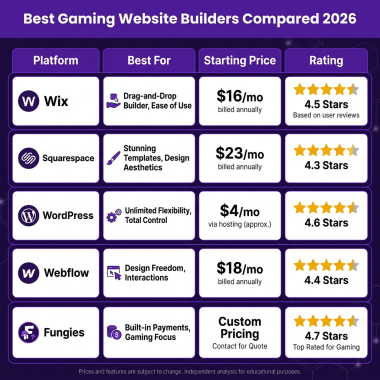
Creating a game website in 2026 has never been more accessible. Whether you’re an indie developer showcasing your latest project, a studio building a community hub, or an entrepreneur launching a gaming platform, the right tools and approach can transform your vision into reality. With over 3 billion gamers worldwide and the gaming industry generating $187 billion annually, having a professional game website is essential for success.
Why Create a Game Website?
A dedicated game website serves multiple critical purposes for developers and gaming businesses. First, it acts as your digital storefront — a centralized hub where players can discover, download, and purchase your games. Second, it builds community through forums, blogs, and news sections that keep players engaged between releases. Third, it establishes credibility; professional websites signal to players, publishers, and investors that you’re serious about your craft.
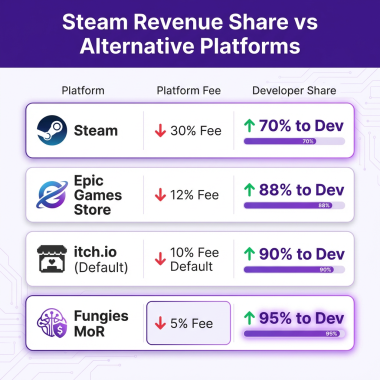
According to recent industry data, game developers with professional websites see 40% higher conversion rates compared to those relying solely on app stores or third-party platforms. Your website becomes an owned asset that you control completely — no algorithm changes, no platform fees, no risk of removal.
Choosing the Right Platform
The foundation of any great game website is the platform you build it on. In 2026, developers have more options than ever, ranging from no-code solutions to custom-built applications. Your choice depends on your technical skills, budget, and specific needs.
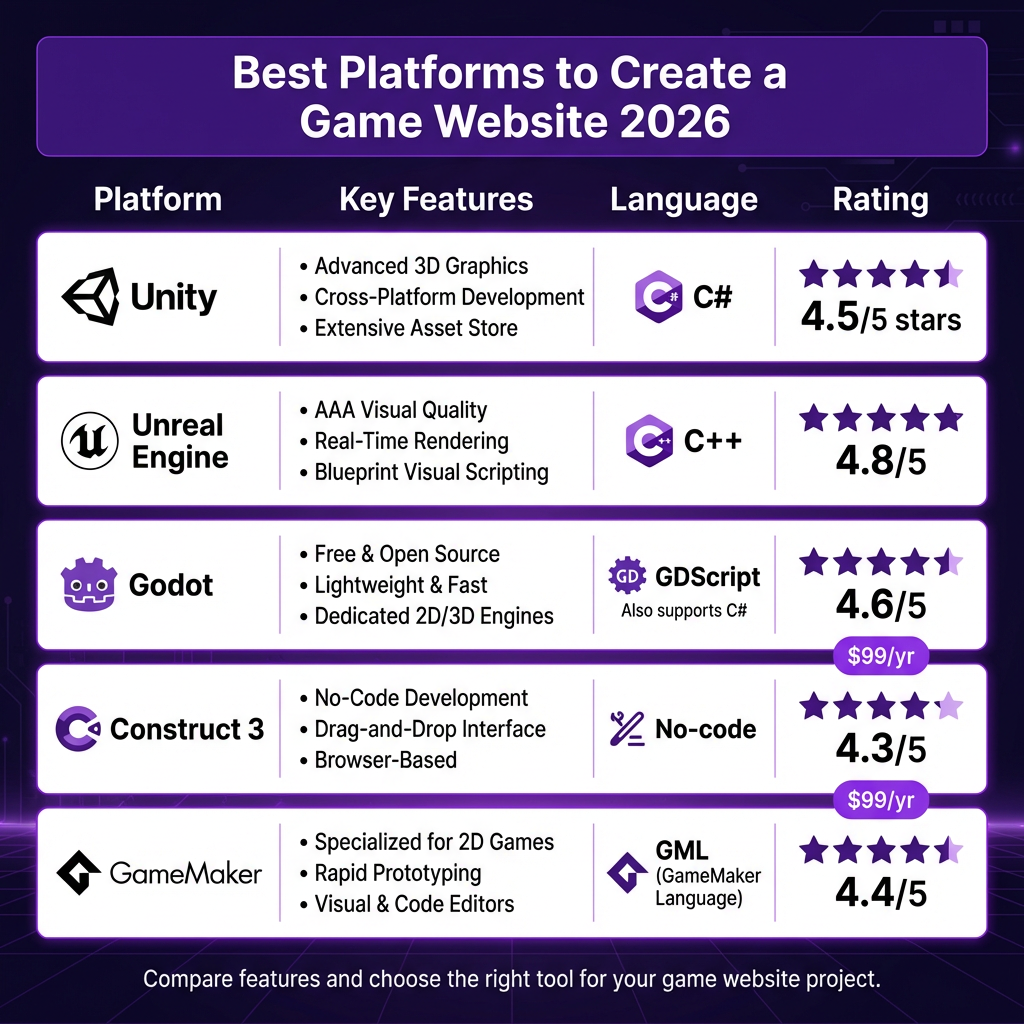
Unity remains the most popular choice for 3D game development, powering over 50% of all mobile games and countless PC and console titles. Its asset store offers thousands of pre-made components, and the learning curve, while steep, is manageable with extensive documentation and community support. Unity’s WebGL export makes it perfect for browser-based game websites.
Unreal Engine dominates the AAA space with its stunning visual capabilities. If your game website needs to showcase high-fidelity graphics or cinematic experiences, Unreal is unmatched. The engine is now free until you hit $1 million in revenue, making it accessible to indie developers.
Godot has emerged as the go-to choice for developers who want a completely free, open-source solution. Its lightweight footprint and intuitive node-based architecture make it perfect for 2D games and smaller 3D projects. The community has grown exponentially, with extensive tutorials and plugins available.
Construct 3 and GameMaker Studio cater to developers who prefer visual scripting or have limited coding experience. These platforms allow rapid prototyping and are particularly popular among solo developers and small teams creating 2D games.
Essential Features for Game Websites
Beyond the game itself, your website needs several key components to succeed. A compelling landing page with high-quality screenshots and trailers is non-negotiable — first impressions matter enormously in the crowded gaming market. Include clear calls-to-action for purchasing, wishlisting, or downloading demos.
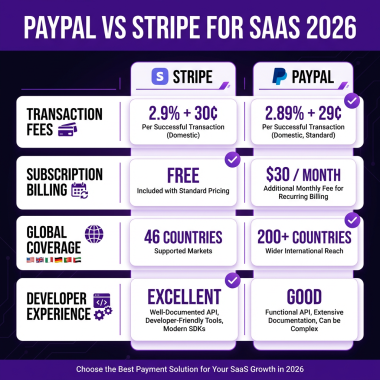
Payment integration is critical for monetization. Modern gamers expect seamless checkout experiences with multiple payment options including credit cards, PayPal, and regional methods. For global distribution, you’ll need to handle tax compliance automatically — calculating and remitting VAT, sales tax, and other obligations across different jurisdictions.
Community features drive long-term engagement. Consider integrating forums, comment sections, or Discord widgets. A regularly updated blog keeps your audience informed about development progress, upcoming features, and behind-the-scenes content. Email newsletter signup forms help you build a direct relationship with your players.
Step-by-Step Guide to Building Your Game Website
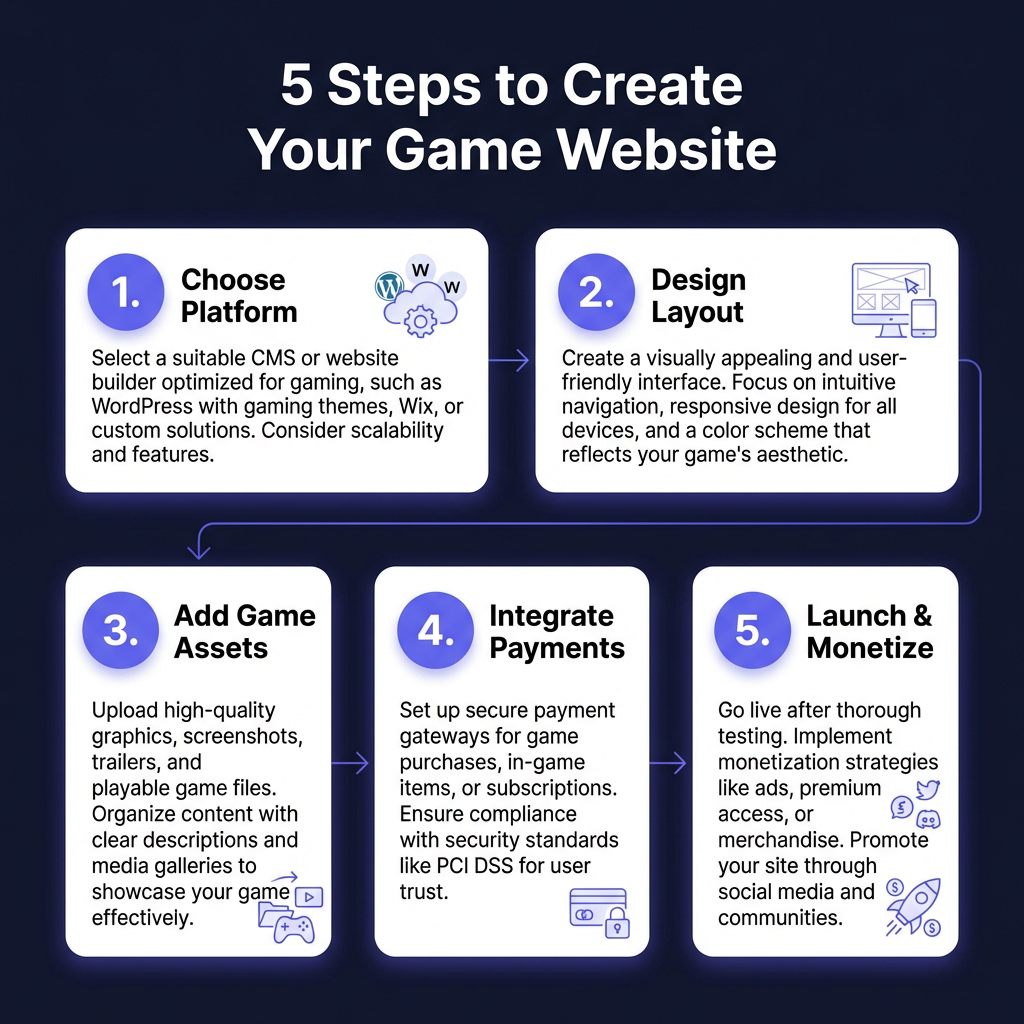
Step 1: Define Your Goals — Before writing a single line of code, clarify what you want your website to achieve. Is it primarily for selling games? Building a community? Showcasing your portfolio? Your goals will dictate every subsequent decision.
Step 2: Choose Your Tech Stack — Based on your goals and technical expertise, select the appropriate platform. For simple sites, WordPress with gaming themes works well. For custom experiences, consider React, Vue.js, or Next.js paired with a headless CMS.
Step 3: Design for Your Audience — Gaming audiences have specific expectations. Dark themes are standard, with accent colors that match your game’s aesthetic. Navigation should be intuitive, with prominent placement of purchase buttons and download links. Mobile responsiveness is essential — over 60% of gaming website traffic comes from mobile devices.
Step 4: Implement Core Functionality — This includes user authentication, game downloads or browser-based play, payment processing, and analytics tracking. Ensure your hosting can handle traffic spikes, especially during launches or sales events.
Step 5: Launch and Iterate — Soft launch to a small group for feedback, then gradually expand. Monitor analytics to understand user behavior, and continuously optimize based on data. A/B test different layouts, pricing displays, and call-to-action placements.
Monetization Strategies for Game Websites
Direct game sales are just one revenue stream. Consider offering premium tiers with exclusive content, early access, or cosmetic items. Subscription models provide predictable recurring revenue — popular options include battle passes, membership programs, or Patreon integration.
Merchandise sales can be surprisingly lucrative for popular games. T-shirts, posters, and collectibles not only generate revenue but also serve as marketing. Affiliate partnerships with hardware vendors, gaming peripherals, or complementary software can provide passive income.
For free-to-play games, in-game purchases remain the dominant monetization method. Ensure your website clearly communicates the free-to-play nature while highlighting premium options. Transparency about pricing and loot box mechanics builds trust with players.
SEO and Marketing Considerations
A beautiful game website is worthless if nobody finds it. Search engine optimization for gaming sites requires specific strategies. Target long-tail keywords related to your game’s genre, mechanics, and unique features. Create content that answers common questions — “games like [popular title],” “best [genre] games 2026,” or “how to play [your game].”
Social media integration is crucial. Embed Twitter feeds, Instagram galleries, and TikTok videos to keep content fresh. Encourage user-generated content through screenshot contests, fan art showcases, or modding communities. These not only engage players but also provide fresh content for search engines.
Email marketing consistently outperforms other channels for game developers. Build your list from day one, offering incentives like exclusive wallpapers, soundtracks, or beta access. Segment your audience based on engagement levels and purchase history for targeted campaigns.
FAQ: Creating Game Websites
How much does it cost to create a game website?
Costs range from $50/year for basic hosting and domain to $5,000+ for custom development. Most indie developers spend $200-500 annually on hosting, domain, and essential plugins.
Do I need coding skills to create a game website?
No-code platforms like WordPress, Wix, or Squarespace allow creation without coding. However, basic HTML/CSS knowledge helps with customization. For complex features, consider hiring a developer or using game-specific platforms like GameJolt or Itch.io.
How do I handle payments and taxes for my game website?
Use a Merchant of Record service like Fungies.io to handle payment processing, tax compliance, and fraud protection automatically. This eliminates the complexity of managing VAT, sales tax, and payment methods across different countries.
What’s the best hosting for game websites?
For small to medium sites, shared hosting from providers like SiteGround or Bluehost works well. For larger sites or browser-based games, consider cloud hosting from AWS, Google Cloud, or Vercel for better scalability and performance.
How long does it take to build a game website?
A basic website can be launched in a weekend using templates. A custom-designed site with full e-commerce functionality typically takes 2-4 weeks. Complex platforms with user accounts, forums, and multiplayer features may require 2-3 months.
Conclusion
Creating a game website in 2026 is an essential investment for any serious game developer. The tools have never been more accessible, and the potential rewards — direct player relationships, higher margins, and complete creative control — make it worth the effort. Start with clear goals, choose the right platform for your needs, and focus on creating an experience that delights your players.
Remember, your game website is a living project. Launch with core functionality, then iterate based on player feedback and analytics. The most successful gaming sites evolve continuously, adding features and content that keep communities engaged for years.
Ready to Monetize Your Game Website?
Join hundreds of game developers using Fungies.io — automated tax compliance, 50+ payment methods, global Merchant of Record.
No credit card required