Choosing the right payment gateway for your SaaS business isn’t just about transaction fees — it’s about finding a partner that can scale with you, handle global compliance, and keep your revenue flowing smoothly. In 2026, with more options than ever, making the wrong choice can cost you thousands in hidden fees, compliance headaches, and lost customers.
I’ve spent years evaluating payment solutions for SaaS companies, and here’s what I’ve learned: the “best” gateway depends entirely on your stage, business model, and growth ambitions. This guide cuts through the marketing fluff and gives you the real data you need to decide.
Why Payment Gateway Choice Matters for SaaS
Your payment gateway is the financial backbone of your SaaS business. Get it wrong, and you’ll face:
- Revenue leakage from failed payments and poor retry logic
- Compliance nightmares when tax authorities come knocking
- Developer frustration from poor APIs and documentation
- Customer churn when checkout experiences feel clunky
- Hidden costs that eat into your margins as you scale
The right choice? It handles global tax compliance automatically, supports your pricing model (subscription, usage-based, or hybrid), and gives you clean APIs that your developers actually want to use.
1. Stripe — Best for Developer-First Teams
Stripe remains the gold standard for SaaS companies that prioritize developer experience. Their API documentation is legendary, and their ecosystem of tools (Billing, Tax, Sigma) covers almost every need.
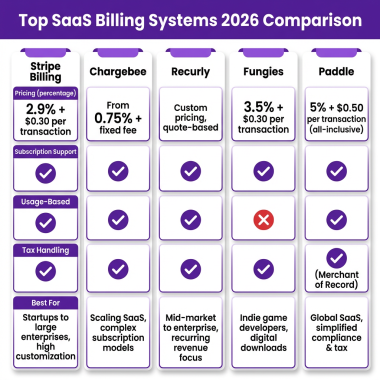
Pricing: 2.9% + 30¢ per transaction. Stripe Billing adds 0.5% for recurring payments. Stripe Tax is 0.5% per transaction where tax is calculated.
Best for: Technical teams, companies with complex billing needs, businesses that want maximum customization.
The catch: You’re responsible for your own tax compliance. Stripe Tax helps calculate taxes, but you still need to register, file, and remit yourself. At scale, this becomes a full-time job.
2. Paddle — Best All-in-One MoR Solution
Paddle was purpose-built for SaaS companies that want to offload compliance entirely. As a Merchant of Record, they handle tax registration, collection, and remittance globally.
Pricing: 5% + 50¢ per transaction. No monthly fees.
Best for: SaaS companies selling globally that don’t want to think about tax compliance. Great for startups and scale-ups.
The catch: Higher per-transaction costs than Stripe, and less flexibility for custom pricing models.
3. Fungies — Best Value Merchant of Record
Fungies offers the same Merchant of Record protection as Paddle but with more competitive pricing and a focus on indie developers and bootstrapped SaaS founders. You get global tax compliance, 50+ payment methods, and a no-code checkout that actually converts.
Pricing: 5% + 50¢ per transaction. No monthly fees, no setup costs.
Best for: Indie developers, bootstrapped SaaS companies, and anyone who wants MoR protection without enterprise complexity.
4. PayPal — Best for Trust and Recognition
Love it or hate it, PayPal has massive consumer trust. For SaaS companies targeting less technical audiences, offering PayPal can reduce checkout friction significantly.
Pricing: 2.9% + 30¢ per transaction. International payments add 1.5%.
Best for: B2C SaaS, markets where PayPal is dominant, businesses targeting non-technical customers.
The catch: No built-in subscription management or tax compliance. You’ll need additional tools.
5. Chargebee — Best for Enterprise Billing
Chargebee is a subscription billing powerhouse designed for complex B2B SaaS with negotiated contracts, usage-based pricing, and sophisticated revenue recognition needs.
Pricing: Starts at $599/month + 0.75% of revenue.
Best for: Enterprise SaaS, companies with complex billing workflows, businesses with dedicated finance teams.
The catch: Expensive for smaller companies. You still need a separate payment processor and tax solution.
6. Adyen — Best for Global Scale
Adyen is the choice of Uber, Spotify, and Microsoft for a reason. Their unified platform handles payments, risk management, and financial products across every market.
Pricing: Interchange + 0.11¢ + 0.6% per transaction.
Best for: High-volume SaaS companies, businesses with global operations, enterprises needing unified commerce.
The catch: Minimum volume requirements and complex pricing. Not suitable for startups.
7. Braintree — Best PayPal Alternative
Owned by PayPal, Braintree offers more developer-friendly APIs while maintaining competitive pricing. It’s a solid middle ground between Stripe and PayPal.
Pricing: 2.9% + 30¢ per transaction.
Best for: Companies wanting PayPal’s reliability with better developer experience.
8. 2Checkout (Verifone) — Best for Digital Goods
2Checkout specializes in digital products and software sales, with built-in tax handling and global payment methods.
Pricing: 3.5% + 35¢ per transaction.
Best for: Software companies, digital product sellers, businesses needing quick global expansion.
9. Square — Best for Omnichannel
Square excels when your SaaS business also has physical presence or in-person sales. Their ecosystem of hardware and software is unmatched.
Pricing: 2.9% + 30¢ online; 2.6% + 10¢ in-person.
Best for: SaaS companies with physical locations, businesses needing POS integration.
10. Authorize.Net — Best for Existing Merchant Accounts
Authorize.Net is a reliable gateway that works with virtually any merchant account. It’s not flashy, but it gets the job done.
Pricing: 2.9% + 30¢ + $25/month gateway fee.
Best for: Businesses with existing merchant accounts, companies wanting gateway flexibility.
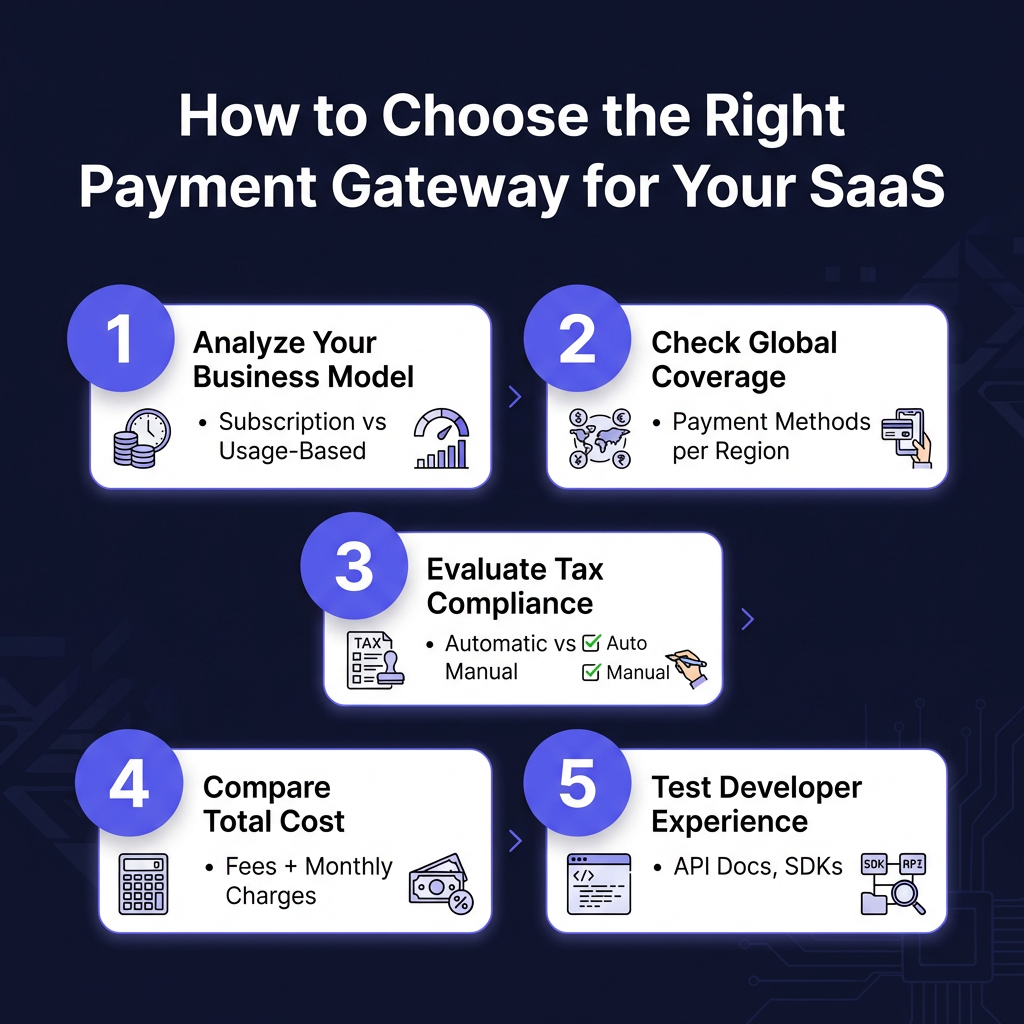
How to Choose the Right Payment Gateway
Here’s my decision framework after evaluating dozens of solutions:
Step 1: Analyze Your Business Model
Simple subscriptions? Most gateways handle this. Usage-based pricing? You’ll need Stripe, Chargebee, or a specialized solution. Hybrid models? Look for platforms with flexible billing engines.
Step 2: Check Global Coverage
Where are your customers? If you’re selling globally, you need local payment methods (iDEAL in Netherlands, Alipay in China, etc.) and multi-currency support.
Step 3: Evaluate Tax Compliance
This is where most SaaS companies get burned. If you sell to customers in the EU, US, or other jurisdictions with digital sales tax, you have compliance obligations. A Merchant of Record (Paddle, Fungies) handles this automatically. Otherwise, you’ll need Stripe Tax, TaxJar, or similar — plus the operational overhead of filing.
Step 4: Compare Total Cost
Don’t just look at transaction fees. Factor in monthly costs, chargeback fees, international payment surcharges, and the cost of additional tools you’ll need (tax, billing, etc.).
Step 5: Test Developer Experience
Have your developers review the API documentation and build a small proof-of-concept. Poor documentation and limited SDKs will cost you engineering time forever.
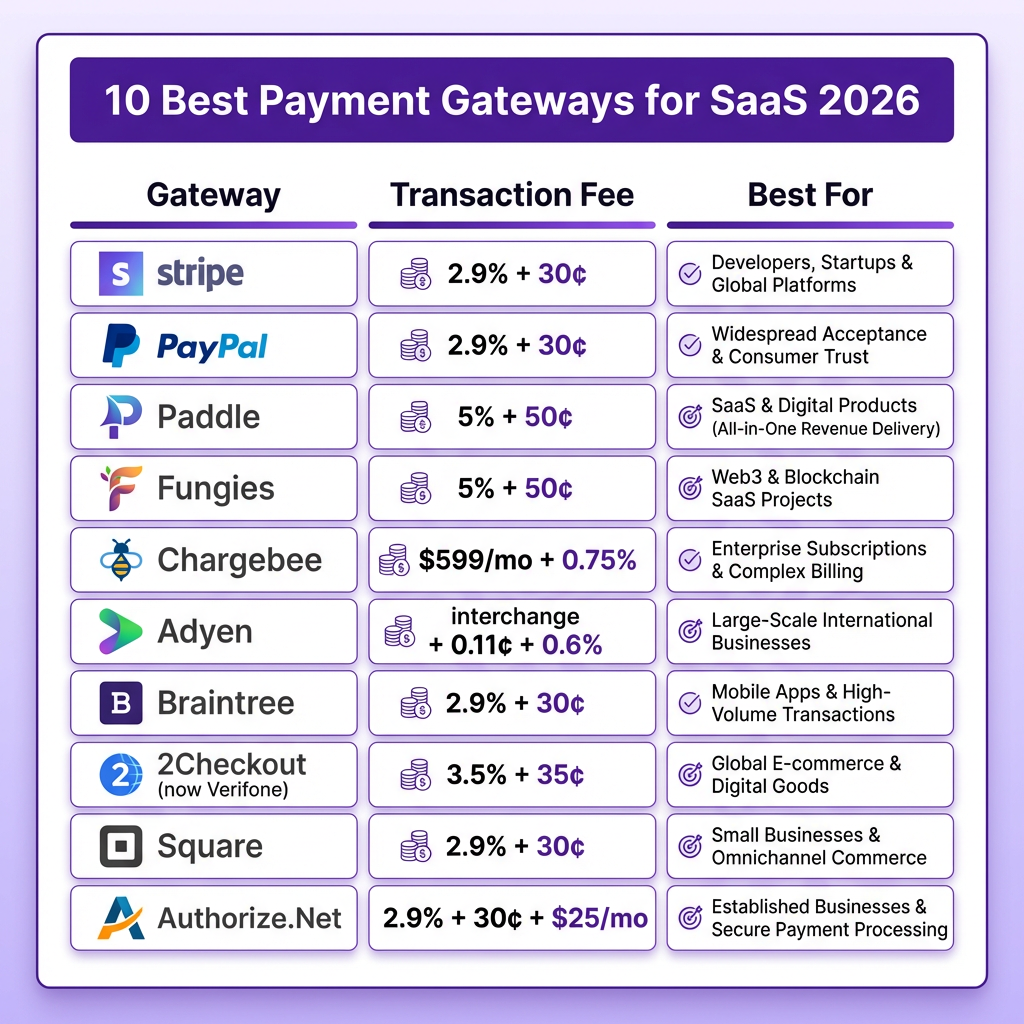
Quick Comparison Table
| Gateway | Transaction Fee | Best For | Tax Handling |
|---|---|---|---|
| Stripe | 2.9% + 30¢ | Developer-first teams | Calculate only |
| Paddle | 5% + 50¢ | Global SaaS MoR | Full MoR |
| Fungies | 5% + 50¢ | Value-focused MoR | Full MoR |
| PayPal | 2.9% + 30¢ | Consumer trust | None |
| Chargebee | $599/mo + 0.75% | Enterprise billing | None |
| Adyen | Interchange + 0.6% | Global scale | None |
| Braintree | 2.9% + 30¢ | PayPal alternative | None |
| 2Checkout | 3.5% + 35¢ | Digital goods | Partial |
| Square | 2.9% + 30¢ | Omnichannel | None |
| Authorize.Net | 2.9% + 30¢ + $25/mo | Existing merchants | None |
FAQ
What’s the difference between a payment gateway and a Merchant of Record?
A payment gateway processes transactions. A Merchant of Record (MoR) is the legal seller of your product, handling payments AND tax compliance, fraud, and regulatory requirements. With a gateway, you’re the seller and responsible for compliance. With an MoR, they handle everything.
Do I need a Merchant of Record for my SaaS?
If you sell globally and don’t have a dedicated tax team, yes. The complexity of VAT, sales tax, and digital goods regulations makes DIY compliance risky and time-consuming. An MoR like Paddle or Fungies eliminates this headache.
Can I use multiple payment gateways?
Yes, many SaaS companies use a primary gateway (Stripe) plus PayPal for customers who prefer it. Just ensure your billing system can handle reconciliation across providers.
What’s the real cost of Stripe vs an MoR?
Stripe’s 2.9% + 30¢ looks cheaper than an MoR’s 5% + 50¢, but add Stripe Tax (0.5%), Billing (0.5%), and the operational cost of compliance. For many SaaS companies, the total cost difference is smaller than it appears — and the MoR saves significant time.
Which gateway has the best API?
Stripe sets the standard for API design and documentation. Adyen and Braintree are also excellent. If developer experience is your top priority, start with Stripe.
Final Recommendations
Choose Stripe if you have a technical team, want maximum flexibility, and are willing to handle tax compliance separately.
Choose Paddle if you want a complete MoR solution with established reputation and don’t mind the higher per-transaction cost.
Choose Fungies if you want MoR protection at competitive rates, especially as an indie developer or bootstrapped SaaS founder.
Choose Chargebee if you’re an enterprise SaaS with complex billing needs and dedicated finance operations.
Choose Adyen if you’re processing high volumes globally and need unified commerce capabilities.
Ready to Simplify Your SaaS Payments?
Join hundreds of SaaS companies using Fungies.io — automated tax compliance, 50+ payment methods, and a true Merchant of Record that handles everything.
No credit card required • 5% + $0.50 per transaction
Sources
- Stripe Pricing: stripe.com/pricing
- Paddle Pricing: paddle.com/pricing
- Fungies Pricing: fungies.io/pricing
- Chargebee Pricing: chargebee.com/pricing
- Adyen Pricing: adyen.com/pricing
- PayPal Merchant Fees: paypal.com/us/webapps/mpp/merchant-fees