10 Best SaaS Payment Processing Solutions in 2026: Complete Comparison
Here’s a number that’ll make you pause: the global SaaS market is projected to reach $512.27 billion by 2026, growing at a steady 5% annually. Yet despite this massive opportunity, most SaaS founders still struggle with one critical decision — choosing the right payment processing solution.
I’ve spent years managing ad campaigns for SaaS companies, and I can tell you this: your payment processor isn’t just a utility. It’s a growth lever. The wrong choice means higher fees, failed international expansions, and customers abandoning carts at the final step. The right choice? Seamless global payments, automated tax compliance, and checkout experiences that actually convert.
In this guide, I’ll break down the 10 best SaaS payment processing solutions for 2026. No fluff, no affiliate bias — just real comparisons based on fees, features, and who each platform actually serves best.
What Is SaaS Payment Processing?
Before diving into the list, let’s get clear on what we’re actually comparing.
SaaS payment processing refers to specialized platforms that handle recurring billing, subscription management, and global payment collection for software-as-a-service businesses. Unlike generic payment processors (think Square for coffee shops), these solutions are built specifically for:
- Recurring subscription billing (monthly, annual, usage-based)
- Global tax compliance (VAT, sales tax, GST)
- Multi-currency support and localization
- Churn reduction through dunning management
- Revenue recognition and financial reporting
The key distinction? Payment processors (like Stripe) handle transactions. Merchant of Record (MoR) platforms (like Paddle or Fungies) handle transactions PLUS take legal liability for tax compliance and regulatory requirements.
Why Your Payment Processor Choice Matters More Than Ever
According to recent industry data, 94% of B2B SaaS companies adjust their pricing annually. Yet most billing systems can’t keep up with pricing iterations, leading to revenue leakage and billing errors.
Here’s what I’ve observed from analyzing countless SaaS payment flows:
- Hidden fees stack up fast. That “2.9% + $0.30” rate from Stripe? Add Stripe Tax ($0.50 per transaction), currency conversion (1-2%), and chargeback fees ($15 each), and you’re looking at 4.5-6% effective rates.
- Tax compliance is non-negotiable. Selling globally means dealing with VAT in 27 EU countries, US sales tax in 46 states, and GST in Australia, India, and Canada. Get it wrong, and you’re facing audits and penalties.
- Checkout friction kills conversions. Every extra field, every redirect, every “create account” requirement drops your conversion rate by 10-20%.
Now let’s look at the solutions that solve these problems.
The 10 Best SaaS Payment Processing Solutions for 2026
1. Fungies — Best for SaaS Startups and Digital Product Sellers
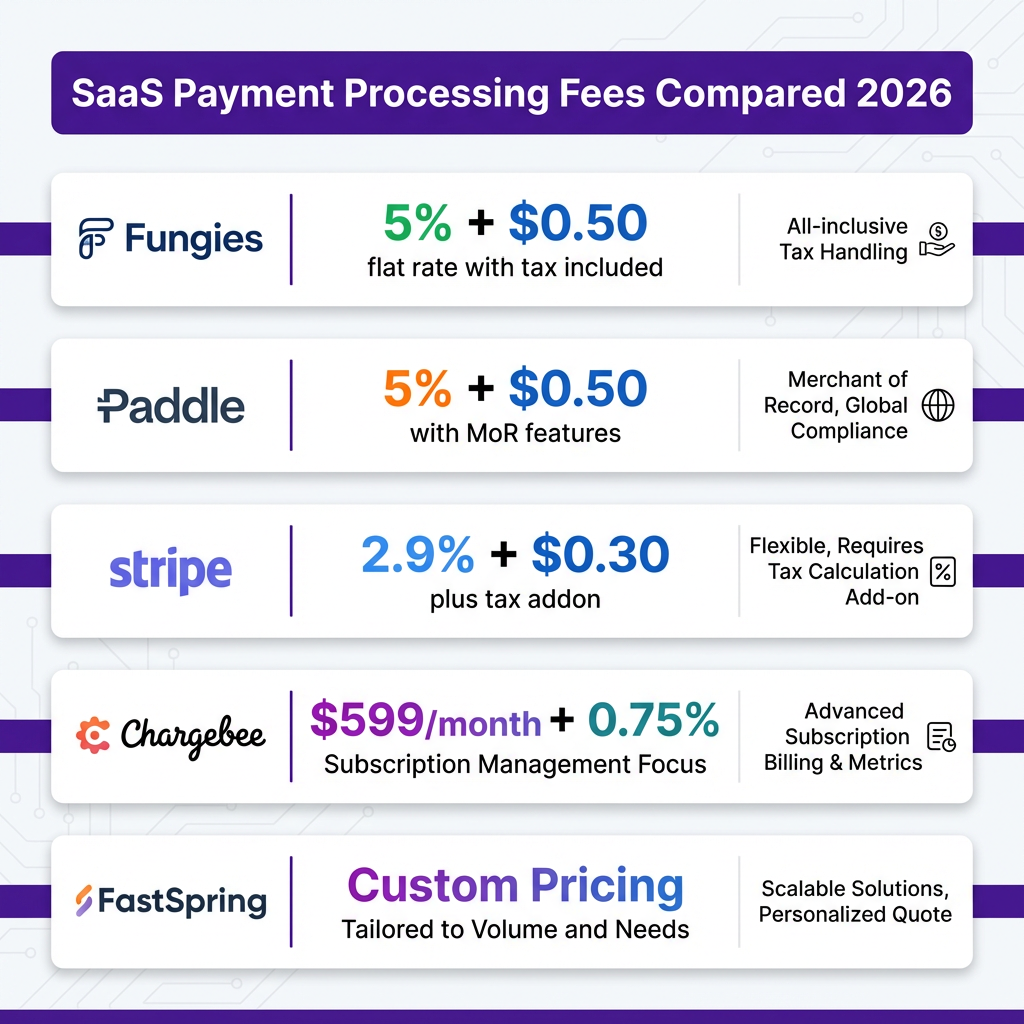
Pricing: 5% + $0.50 per transaction (all-inclusive)
Fungies operates as a Merchant of Record, meaning they handle payment processing, global tax compliance, fraud protection, and chargeback management under one flat rate. No monthly fees, no hidden charges.
Key Features:
- One-click checkout with no-code integration
- Automatic VAT, sales tax, and GST calculation/remittance
- Subscription billing with dunning management
- Global payment methods (cards, PayPal, local methods)
- Developer-friendly API and webhooks
Best For: Indie SaaS founders, digital product sellers, and startups that want global compliance without enterprise complexity.
Why It Stands Out: The flat 5% rate includes everything. Compare that to Stripe’s 2.9% + $0.30 base plus tax add-ons, and Fungies often works out cheaper for international sales while eliminating compliance headaches.
2. Paddle — Best for Established B2C SaaS
Pricing: 5% + $0.50 per transaction (pay-as-you-go)
Paddle has built strong brand recognition in the SaaS space, particularly among subscription software companies. Like Fungies, they operate as a Merchant of Record.
Key Features:
- Complete MoR coverage (tax, compliance, fraud)
- Subscription management and retention tools
- Global payment localization
- Revenue analytics and reporting
Best For: B2C SaaS companies with established product-market fit and predictable growth.
Limitations: Limited B2B invoicing capabilities and less flexibility for enterprise customization. Some users report slower onboarding for complex use cases.
3. Stripe Billing — Best for Developer-Led Companies
Pricing: 2.9% + $0.30 per transaction (plus add-ons)
Stripe needs no introduction. Their Billing product adds subscription management to their core payment processing, making it a popular choice for technical teams.
Key Features:
- Highly flexible API and developer tools
- Support for complex pricing models (usage-based, tiered, hybrid)
- Stripe Tax add-on for automatic tax calculation
- Extensive third-party integrations
Best For: Developer-led SaaS companies with technical resources to build custom billing logic.
Catch: True cost adds up quickly. Stripe Tax is $0.50 per transaction, currency conversion adds 1-2%, and you’re still responsible for tax remittance in most jurisdictions. For a $100 transaction, you could pay $4.20+ in total fees.
4. Chargebee — Best for Revenue Operations Teams
Pricing: Starter (free up to $225K, then 0.75%), Performance ($599/month), Enterprise (custom)
Chargebee focuses specifically on subscription billing operations, making it a favorite among SaaS finance and RevOps teams.
Key Features:
- Advanced subscription lifecycle management
- Revenue recognition and reporting
- Multi-entity support for global companies
- Flexible pricing model configuration
Best For: Mid-market SaaS companies with dedicated revenue operations teams and complex billing requirements.
Note: Chargebee handles billing logic but requires a separate payment processor (usually Stripe). Factor in both sets of fees.
5. FastSpring — Best for Software and Digital Goods
Pricing: Custom quote-based
FastSpring has been in the digital commerce space for years, specializing in software and digital product sales.
Key Features:
- Full MoR capabilities
- Localized checkout experiences
- Subscription and one-time purchase support
- Affiliate management tools
Best For: Software companies and digital goods sellers with custom commercial needs.
Consideration: Quote-led pricing means no transparency until you talk to sales. Better suited for established businesses than early-stage startups.
6. Recurly — Best for Subscription Retention
Pricing: Core ($199/month), Professional ($599/month), Elite (custom)
Recurly built its reputation on subscription billing and churn reduction. Their dunning management and retry logic are industry-leading.
Key Features:
- Advanced dunning management and revenue recovery
- Subscription analytics and churn insights
- Multiple gateway support (redundancy)
- Plan management and proration
Best For: Subscription businesses focused on reducing churn and maximizing lifetime value.
Trade-off: Monthly base fees make it expensive for low-volume businesses. Best suited for SaaS with $50K+ MRR.
7. Adyen — Best for Enterprise Global Commerce
Pricing: Interchange++ or blended rate (custom)
Adyen powers payments for enterprise giants like Microsoft, Spotify, and Netflix. Their unified platform covers online, in-app, and in-person payments.
Key Features:
- Single platform for all channels (online, mobile, POS)
- Extensive local payment method coverage
- Real-time data and analytics
- Revenue optimization tools
Best For: Large enterprises with complex, multi-channel payment needs and high transaction volumes.
Reality Check: Overkill for most SaaS startups. Minimum volumes and technical integration complexity make this an enterprise play.
8. PayPal — Best for Consumer Trust
Pricing: 2.9% + $0.30 (domestic), higher for international
PayPal’s brand recognition is unmatched among consumers. For some demographics, seeing PayPal as an option increases conversion rates.
Key Features:
- Massive consumer trust and recognition
- One Touch checkout for returning users
- Buyer protection and dispute resolution
- Global reach with local payment options
Best For: B2C SaaS targeting consumers who prefer PayPal, or as a secondary payment option.
Downside: Higher fees for international transactions, account freeze risks, and less developer-friendly than modern alternatives.
9. Zuora — Best for Enterprise Subscription Management
Pricing: Custom enterprise pricing
Zuora is the legacy enterprise standard for subscription billing. If you’re a large company with complex multi-entity, multi-currency needs, Zuora is often on the shortlist.
Key Features:
- Enterprise-grade subscription management
- Revenue recognition and ASC 606 compliance
- Multi-entity and complex pricing support
- Professional services and implementation
Best For: Large enterprises with complex billing requirements and dedicated implementation resources.
Honest Assessment: Expensive, complex, and slow to implement. Most modern SaaS companies find better value elsewhere.
10. Alguna — Best for Usage-Based and AI SaaS
Pricing: Usage-based (custom)
Alguna is a newer entrant built specifically for modern SaaS and AI companies with usage-based pricing models.
Key Features:
- Real-time usage metering
- Hybrid billing (subscription + usage)
- No-code pricing configuration
- Automated revenue recognition
Best For: AI and API-first SaaS companies with consumption-based pricing models.
Note: Emerging player with less track record than established alternatives. Best for teams willing to bet on modern architecture.
Side-by-Side Comparison Table
| Platform | Pricing Model | MoR/Tax | Best For | Setup Complexity |
|---|---|---|---|---|
| Fungies | 5% + $0.50 flat | Full MoR included | Startups, indie SaaS | Low (no-code) |
| Paddle | 5% + $0.50 | Full MoR included | B2C SaaS | Medium |
| Stripe Billing | 2.9% + $0.30 + add-ons | Tax add-on ($0.50) | Developer-led teams | High (API) |
| Chargebee | $599/mo + 0.75% | Separate processor | RevOps teams | Medium |
| FastSpring | Custom quote | Full MoR included | Software sellers | Medium |
| Recurly | $199-599/mo | Separate processor | Retention focus | Medium |
| Adyen | Interchange++ | Partial | Enterprise | High |
| PayPal | 2.9% + $0.30 | None | Consumer trust | Low |
| Zuora | Enterprise | Partial | Large enterprises | Very High |
| Alguna | Usage-based | Partial | AI/usage SaaS | Medium |
How to Choose the Right Payment Processor for Your SaaS
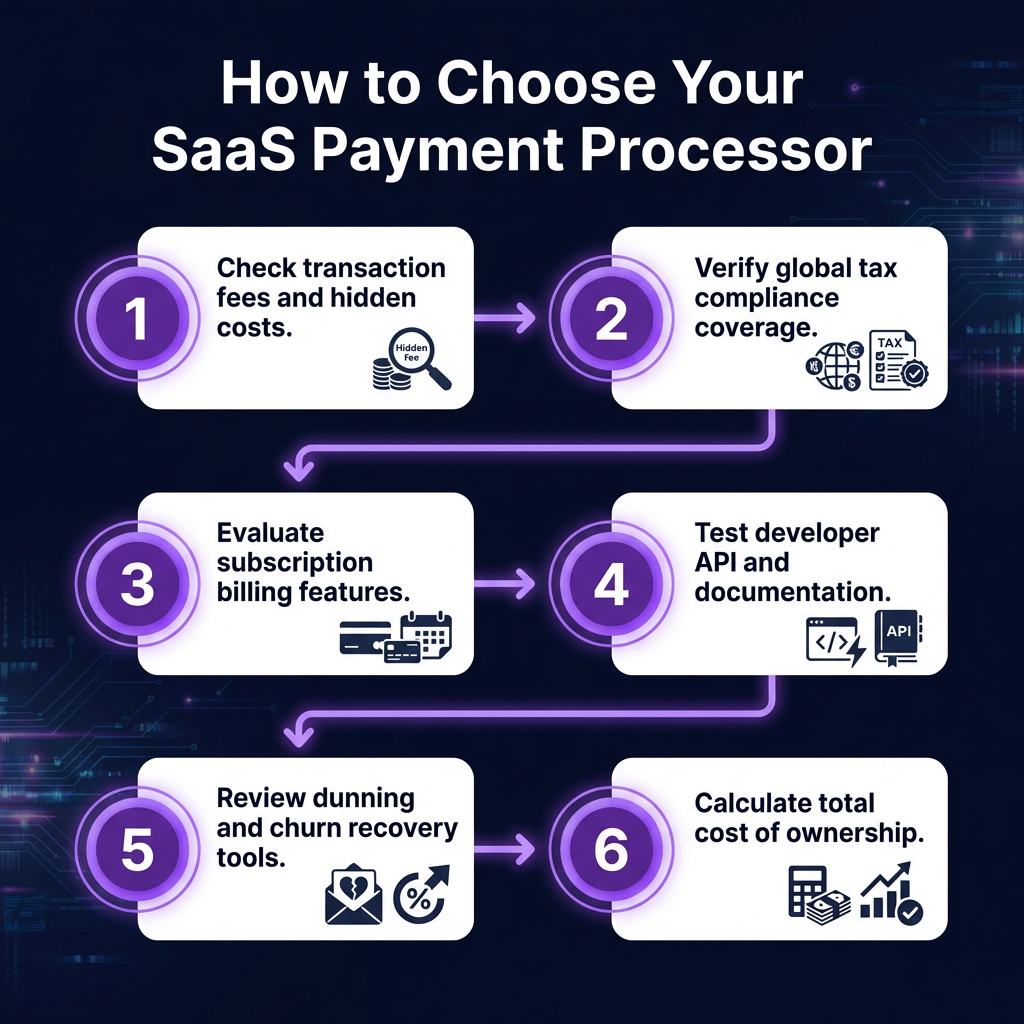
After reviewing hundreds of SaaS payment setups, here’s my decision framework:
Step 1: Calculate True Total Cost of Ownership
Don’t just compare headline rates. Factor in:
- Monthly platform fees
- Transaction fees (including international)
- Tax compliance costs (Stripe Tax, external tax tools, or accountant fees)
- Currency conversion fees
- Chargeback fees and fraud losses
- Engineering time for integration and maintenance
For a SaaS doing $50K MRR with 60% international customers, an MoR like Fungies or Paddle at 5% all-in often beats Stripe’s 2.9% + tax add-ons + currency conversion.
Step 2: Evaluate Your Compliance Exposure
Selling to EU customers? You need VAT collection and remittance. Selling to US customers? 46 states have sales tax requirements. Australia, Canada, India, and others have their own rules.
If you don’t have a finance team dedicated to global tax compliance, an MoR platform that handles this automatically is worth the premium.
Step 3: Match Complexity to Your Stage
Early-stage SaaS: Prioritize speed and simplicity. Choose a platform with no-code checkout and built-in compliance.
Growth-stage SaaS: You need flexibility for pricing experiments, usage-based models, and advanced subscription management.
Enterprise SaaS: Custom contracts, complex invoicing, and revenue recognition requirements may justify Chargebee, Zuora, or a custom Stripe implementation.
Step 4: Test the Developer Experience
Even if you’re not technical, your future developers will thank you for choosing a platform with:
- Clear, comprehensive documentation
- Reliable webhooks for subscription events
- Test environments that mirror production
- Active community and support
Stripe and Fungies consistently score highest here. Zuora and enterprise platforms often require professional services for implementation.
Common Mistakes to Avoid
I’ve seen these errors cost SaaS companies thousands in lost revenue and engineering time:
Mistake #1: Optimizing for the lowest transaction fee. A 0.5% difference in processing fees matters less than checkout conversion rates. A processor with slightly higher fees but better authorization rates and fraud protection often generates more net revenue.
Mistake #2: Ignoring international early. If you have any international traction, build for global payments from day one. Retrofitting tax compliance and multi-currency support is painful.
Mistake #3: Underestimating dunning impact. Failed payments cause 20-40% of SaaS churn. Platforms with strong dunning management (Recurly, Paddle, Fungies) recover significant revenue.
Mistake #4: Choosing based on brand recognition alone. PayPal and Stripe are household names, but that doesn’t mean they’re the best fit for your specific SaaS model.
FAQ: SaaS Payment Processing
What’s the difference between a payment processor and a Merchant of Record?
A payment processor (like Stripe) handles transaction processing but you remain the merchant of record — meaning you’re legally responsible for tax compliance, fraud, and chargebacks. An MoR (like Fungies or Paddle) assumes this liability, handling tax collection, remittance, and regulatory compliance on your behalf.
How much should SaaS payment processing cost?
For most SaaS companies, expect to pay 3-6% of revenue in total payment costs. MoR platforms at 5% all-in are competitive when you factor in tax compliance costs. Pure payment processors at 2.9% + $0.30 often end up costing 4-5% after tax tools, currency conversion, and chargebacks.
Do I need a separate billing platform with Stripe?
Stripe Billing adds subscription management to core Stripe payments. For simple subscriptions, it’s sufficient. For complex pricing, usage-based billing, or advanced revenue recognition, you might need Chargebee, Recurly, or a custom solution alongside Stripe.
What’s better for global SaaS: MoR or payment processor?
For global SaaS without a dedicated finance team, an MoR is usually better. The automatic tax compliance, localized payment methods, and fraud protection justify the slightly higher transaction fees. Once you’re at enterprise scale with internal tax expertise, a payment processor + internal compliance team may be more cost-effective.
Can I switch payment processors later?
Yes, but migration complexity varies. Moving between similar platforms (e.g., Paddle to Fungies) is relatively straightforward. Moving from a pure processor to an MoR (or vice versa) requires more planning around subscription migration and tax handoff. Always export your subscription data regularly regardless of platform.
Final Recommendation
After analyzing fees, features, and real-world fit, here’s my take:
For early-stage SaaS and indie founders: Start with Fungies. The 5% flat rate includes everything you need for global sales without the compliance headaches. You can always migrate to a more complex solution as you scale.
For developer-led teams with technical resources: Stripe Billing gives you maximum flexibility. Just budget for tax compliance tools and accept the higher total cost of ownership.
For established B2C SaaS: Paddle is a solid choice with strong brand recognition and proven subscription tools.
For revenue operations-focused teams: Chargebee provides the billing sophistication and reporting that finance teams need, provided you have the transaction volume to justify the monthly fees.
The bottom line? Don’t overthink it. Pick a solution that handles your current needs and next 12 months of growth, then focus on building a product worth paying for.
Ready to start accepting payments? Create your Fungies account and launch your checkout in under 10 minutes.
Sources
- Dodo Payments — Best Merchant of Record Platforms 2026
- Statista — SaaS Market Forecast 2026
- StackScale — Chargebee vs Recurly vs Stripe Billing Comparison
- Zylo — SaaS Statistics 2026
- LedgerUp — Best Recurring Billing Software 2026
- Hyperline — Best Subscription Billing Solutions 2025
- G2 — Best Subscription Management Software