The digital selling landscape has reached an unprecedented inflection point in 2026. With 2.86 billion people shopping online globally and e-commerce sales projected to hit $7.41 trillion this year, the opportunity for digital sellers has never been greater—or more competitive. The barriers to entry that once protected established retailers have crumbled, replaced by a dynamic ecosystem where agility, technology adoption, and customer-centricity determine success.
What makes 2026 particularly significant is the convergence of multiple transformative forces: artificial intelligence has moved from experimental to essential, social commerce has evolved from novelty to necessity, and cross-border selling has become accessible to businesses of all sizes. For digital sellers, this represents both the greatest opportunity and the most complex operating environment in the history of retail.

Market Overview: The $7.4 Trillion Digital Selling Ecosystem
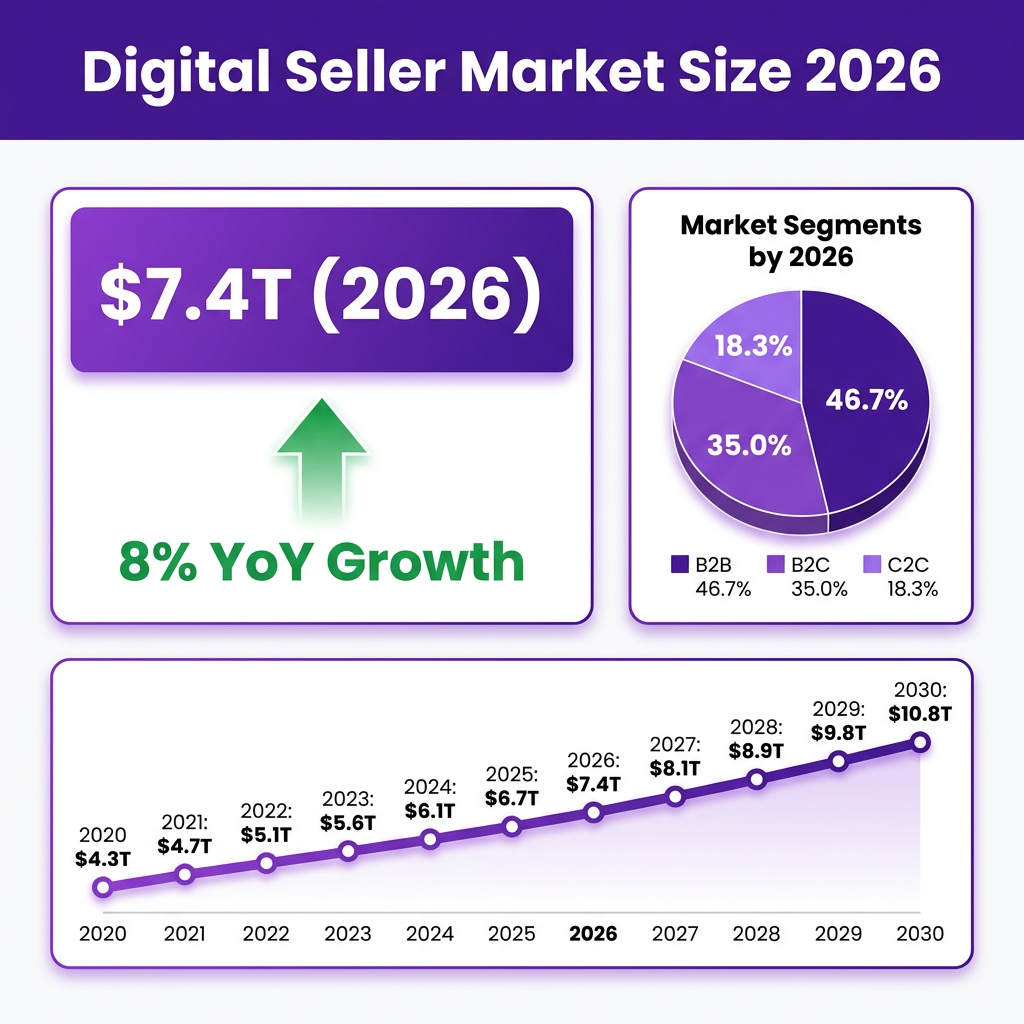
The global e-commerce market has experienced remarkable expansion, growing from an estimated $6.86 trillion in 2025 to a projected $7.41 trillion in 2026—representing an 8% year-over-year increase. This growth trajectory positions e-commerce to account for approximately 22.6% of total global retail sales by 2027, up from just 15% five years ago. The shift is not merely incremental; it represents a fundamental restructuring of how commerce happens worldwide.
Understanding the composition of this market reveals important insights for digital sellers. Business-to-Business (B2B) e-commerce leads transaction volume, capturing 46.7% of the market in 2025, while Business-to-Consumer (B2C) represents the most visible and competitive segment. The Asia-Pacific region dominates global e-commerce revenue with a 54.3% market share, driven primarily by China’s massive digital economy, which accounts for 83% of regional e-commerce sales. India and Southeast Asia represent the fastest-growing sub-regions, fueled by mobile-first consumer adoption and expanding internet penetration.
The United States remains the second-largest e-commerce market globally, with sales expected to exceed $1.17 trillion in 2026. US e-commerce penetration as a share of total retail is projected to reach 18% in 2026, up from 17.1% in 2025. By 2030, Forrester Research forecasts that US e-commerce sales will reach $1.8 trillion, accounting for 29% of total retail sales—nearly doubling its current share.
The digital commerce platform market itself is experiencing explosive growth. Digital commerce platform revenue is anticipated to grow from $16.1 billion in 2026 to $92.2 billion by 2036, registering a 19.1% compound annual growth rate. This reflects the increasing sophistication of selling tools, the rise of headless commerce architectures, and the demand for omnichannel capabilities that unify online and offline experiences.
Key Statistics and Data Points Every Digital Seller Must Know
Data-driven decision making separates successful digital sellers from those struggling to find traction. The following statistics provide a quantitative foundation for strategic planning in 2026:
Global Market Scale: The e-commerce market is valued at $7.41 trillion in 2026, with projections indicating it will reach $8 trillion by 2027 and potentially exceed $13 trillion by 2030 according to Juniper Research. The broader e-commerce market, including B2B transactions, is projected to reach $243.40 trillion by 2034, exhibiting a CAGR of 24.54%.
Consumer Behavior: Over 33% of the world’s population now shops online, with the number of online shoppers expected to cross 3 billion by the end of 2026. Mobile commerce accounts for 60% of total global e-commerce sales, up from 43% in 2018, and is projected to reach 63% by 2028. The global mobile commerce market is valued at $2.4 trillion in 2026 and is expected to reach $5 trillion by 2034.
Social Commerce Explosion: The global social commerce market has reached $2.11 trillion in 2026, growing at a 29.12% CAGR. The US social commerce market was valued at $114.7 billion in 2025 and is projected to grow to $188.3 billion by 2030. TikTok Shop alone is expected to reach $23.41 billion in US e-commerce sales in 2026, representing a 48% year-over-year increase.
Cross-Border Opportunity: Cross-border e-commerce is expected to be valued at $1.74 trillion in 2026, reaching $4.85 trillion by 2033 at an 18.6% CAGR. Cross-border transactions represent approximately 20% of all e-commerce sales worldwide, with fashion being the largest category at $300 billion in cross-border revenue.
AI Integration: The global AI in e-commerce market is valued at $11.21 billion in 2026 and is predicted to reach $74.93 billion by 2035, expanding at a CAGR of 23.59%. Machine learning holds the largest market share at 48.4%, followed by natural language processing and computer vision applications.
Platform Dominance: Amazon and Shopify together account for approximately 50% of US e-commerce—Amazon with 35.7% market share ($440 billion in US sales) and Shopify with 14% (up from 12% in 2024). Among the top 1 million e-commerce websites globally, Shopify captures 28.8% market share.
Consumer Expectations: 58% of shoppers in the US have purchased a product after seeing it on social media. Over 250 million people interact with Facebook Shops monthly, with 1 million users making purchases directly through the platform. More than 70 million people in the US use TikTok Shop, making them the third-highest spenders among social commerce platforms.
Funding Landscape: 212 VC firms are actively investing in e-commerce and marketplaces at the Series A stage, with check sizes ranging from $5K to $350M (median: $2.6M). In 2026 alone, over 74 e-commerce startups have raised $1.5 billion in funding, demonstrating continued investor confidence in the sector.
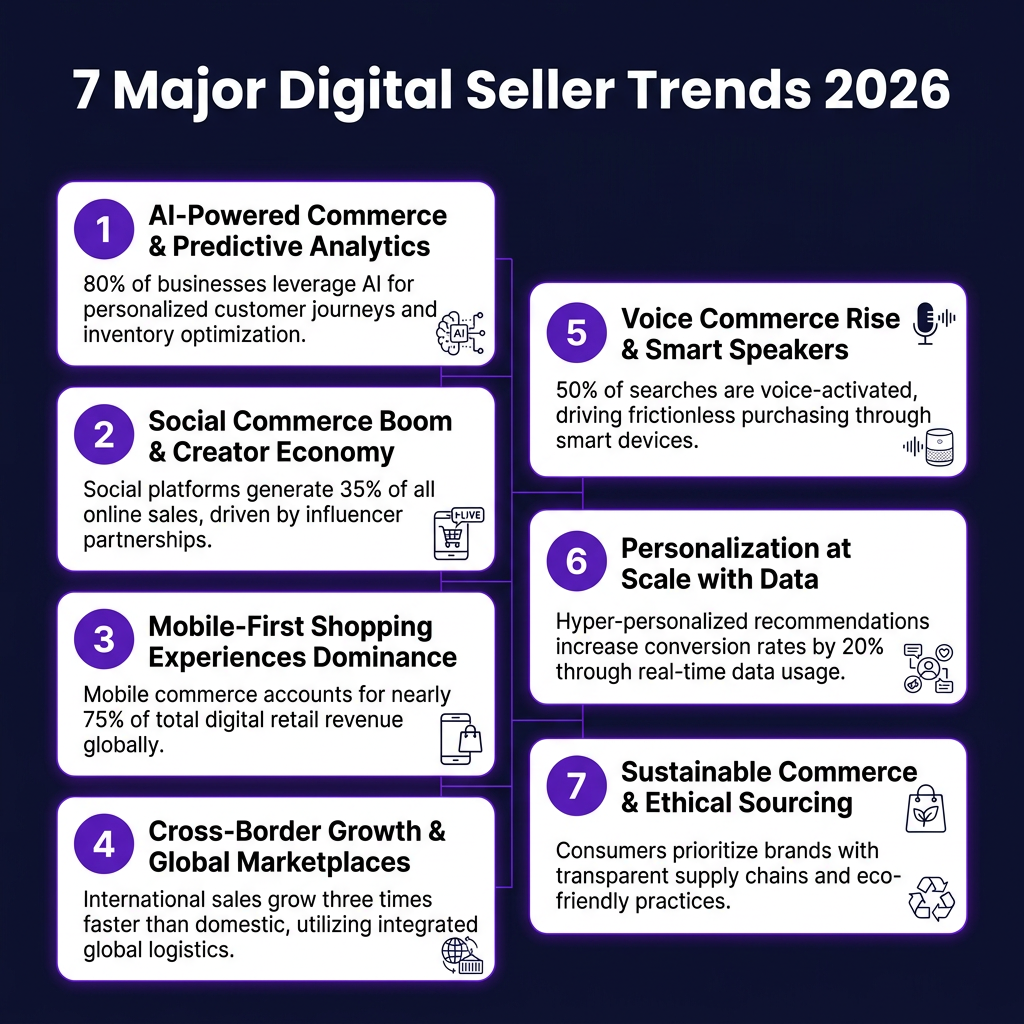
Seven Major Trends Shaping Digital Selling in 2026
The digital selling landscape is being reshaped by seven interconnected trends that are simultaneously creating opportunities and raising the bar for competitive success. Understanding these trends is essential for any seller looking to thrive in the current environment.
1. AI-Powered Commerce Becomes Table Stakes
Artificial intelligence has transitioned from a competitive differentiator to a fundamental requirement for digital selling. In 2026, 51% of consumers report using AI tools for shopping-related activities, and 22% of shoppers already use AI search tools to research new products and brands. The applications are comprehensive: AI-powered product recommendations drive conversion rate improvements of 10-30%, dynamic pricing algorithms optimize margins in real-time, and visual search capabilities allow customers to find products using images rather than text.
For digital sellers, the implication is clear—AI integration is no longer optional. Chatbots with natural language capabilities handle customer service inquiries 24/7, reducing response times from hours to seconds. Predictive analytics forecast demand patterns, optimizing inventory levels and reducing carrying costs. Content generation tools create product descriptions, marketing copy, and personalized email campaigns at scale. Sellers who fail to adopt these capabilities will find themselves at a significant disadvantage against AI-enabled competitors.
2. The Social Commerce Revolution Accelerates
Social commerce has evolved from a supplementary channel to a primary revenue driver. With a $2.11 trillion global market value and 29% annual growth, social platforms have become fully-fledged marketplaces. TikTok Shop’s explosive growth—reaching $23 billion in US sales with 48% year-over-year growth—demonstrates the power of entertainment-driven commerce. Instagram Shopping and Facebook Shops continue to expand their capabilities, while newer entrants like YouTube Shopping and Pinterest Commerce gain traction.
The key insight for digital sellers is that discovery and purchase are increasingly happening in the same place. Consumers no longer follow a linear path from awareness to consideration to purchase; instead, they encounter products organically in their social feeds and buy without leaving the app. This requires sellers to rethink their content strategies, investing in short-form video, influencer partnerships, and native shopping experiences rather than simply driving traffic to external websites.
3. Mobile-First Shopping Dominates
Mobile commerce now accounts for 60% of global e-commerce sales, and this share continues to grow. In the United States, mobile commerce is estimated at $410 billion in 2026, projected to reach $856 billion by 2027. The smartphone has become the primary shopping device for consumers worldwide, particularly in emerging markets where mobile phones often represent the primary internet access point.
This mobile dominance has profound implications for digital sellers. Mobile-optimized websites are no longer sufficient—sellers need mobile-native experiences. One-click purchasing, mobile wallets, and app-based shopping are becoming standard expectations. The rise of 5G networks enables richer mobile experiences, including augmented reality product visualization and live streaming commerce. Sellers must prioritize mobile performance, ensuring fast load times, intuitive navigation, and frictionless checkout processes.
4. Cross-Border E-Commerce Opens New Frontiers
Cross-border e-commerce represents one of the most significant growth opportunities for digital sellers in 2026. Valued at $1.74 trillion and growing at 18.6% annually, cross-border sales allow sellers to access global markets without the capital investment traditionally required for international expansion. Chinese e-commerce businesses lead in cross-border sales, accounting for nearly 40% of cross-border online orders in 37 surveyed countries.
The barriers to international selling have decreased dramatically. Payment processors handle currency conversion and local payment methods. Logistics providers offer end-to-end cross-border fulfillment. Marketplaces like Amazon, eBay, and Alibaba provide established infrastructure for reaching international customers. For sellers, the key challenge is localization—adapting product offerings, marketing messaging, and customer service to local preferences and regulations. Sellers who master cross-border operations can access markets 10-100x larger than their domestic base.
5. Voice Commerce Enters the Mainstream
Voice-activated shopping is becoming increasingly prevalent as smart speaker adoption grows and voice recognition technology improves. By 2026, voice commerce has evolved beyond simple reordering to encompass complex product discovery and comparison shopping. The convenience of hands-free shopping appeals particularly to busy consumers and those with accessibility needs.
For digital sellers, voice commerce requires optimization for conversational queries rather than typed keywords. Product information must be structured to answer natural language questions about features, pricing, and availability. Voice shopping is particularly strong in categories like groceries, household supplies, and entertainment—products that consumers reorder regularly. As voice AI becomes more sophisticated, expect voice commerce to expand into higher-consideration categories.
6. Hyper-Personalization at Scale
Consumers increasingly expect personalized shopping experiences tailored to their preferences, behavior, and context. AI and machine learning enable personalization at a scale previously impossible, from individualized product recommendations to dynamic pricing and customized marketing messages. According to research, 80% of consumers are more likely to purchase from brands that offer personalized experiences.
Digital sellers must invest in data infrastructure and analytics capabilities to deliver personalization effectively. This includes collecting and analyzing customer data across touchpoints, segmenting audiences based on behavior and preferences, and automating personalized content delivery. The goal is to make every customer feel like the shopping experience was designed specifically for them, increasing engagement, conversion rates, and lifetime value.
7. Sustainability as a Competitive Differentiator
Environmental consciousness has become a significant factor in purchasing decisions, particularly among younger consumers. Digital Product Passports (DPPs)—digital records of a product’s lifecycle, materials, and environmental impact—are emerging as a key trend for 2026. Consumers want transparency about supply chains, carbon footprints, and ethical sourcing. The European Union is leading regulatory efforts with requirements for product sustainability information.
For digital sellers, sustainability is no longer just a marketing angle—it is becoming a business requirement. Sellers must document and communicate their environmental practices, offer sustainable product options, and minimize packaging waste. Those who lead on sustainability can command premium pricing and build stronger customer loyalty, while those who ignore it risk losing market share to more environmentally conscious competitors.
Key Players and Competitive Landscape
The digital selling ecosystem is dominated by a handful of platforms that have achieved massive scale, but the competitive landscape remains dynamic with opportunities for specialized and niche players.
Amazon remains the undisputed leader in e-commerce, with a market capitalization exceeding $2 trillion and US sales of approximately $440 billion in 2025, representing a 35.7% share of the US e-commerce market. Amazon’s dominance spans first-party retail, third-party marketplace, fulfillment services, and advertising. The company’s logistics network, Prime membership program, and advertising platform create significant competitive moats. However, Amazon also faces increasing scrutiny from regulators and rising competition from specialized platforms.
Shopify has emerged as the most important platform for independent digital sellers, powering approximately 26.2% of all e-commerce websites globally and capturing 28.8% market share among the top 1 million e-commerce sites. With a 14% share of US e-commerce (up from 12% in 2024), Shopify has become the primary alternative to Amazon for brands seeking to build direct relationships with customers. The company’s ecosystem includes payments, shipping, marketing tools, and enterprise solutions through Shopify Plus.
Alibaba dominates Chinese e-commerce and cross-border trade, with its platforms handling the majority of China’s online retail and a significant portion of global cross-border transactions. The company’s strength in B2B commerce through Alibaba.com complements its consumer-facing Taobao and Tmall marketplaces. For Western sellers, Alibaba represents both a sourcing platform and a channel for accessing Chinese consumers.
Walmart has aggressively expanded its e-commerce capabilities, leveraging its physical store network for omnichannel fulfillment. While its marketplace is still a fraction of Amazon’s size (estimated at roughly $10 billion in GMV), Walmart’s massive customer base and grocery dominance position it as a significant e-commerce player. The company’s Walmart+ membership program and advertising business are growing rapidly.
eBay remains relevant as a marketplace for used goods, collectibles, and niche categories. While its growth has slowed relative to newer platforms, eBay’s global reach and established trust mechanisms make it an important channel for certain seller categories.
Etsy has carved out a dominant position in handmade, vintage, and craft supplies. The platform’s focus on unique, non-commoditized products has created a loyal customer base willing to pay premium prices. Etsy’s acquisition of Depop and Elo7 extends its reach into fashion resale and Latin American markets.
Emerging Platforms: TikTok Shop, Instagram Shopping, and Pinterest Commerce represent the next generation of social commerce platforms. These platforms leverage content discovery and influencer marketing to drive sales, offering sellers access to highly engaged audiences. Live shopping platforms like Whatnot and NTWRK are creating new formats for product launches and exclusive drops.

Challenges and Pain Points Digital Sellers Face
Despite the enormous opportunities, digital sellers face significant challenges that require strategic attention and operational excellence to overcome.
1. Meeting Elevated Customer Experience Expectations
Amazon has trained consumers to expect fast, free shipping, easy returns, and 24/7 customer service. Meeting these expectations is expensive and operationally complex, particularly for smaller sellers. The challenge is compounded by the need to provide consistent experiences across multiple channels—marketplaces, owned websites, social platforms, and physical locations. Sellers must invest in logistics infrastructure, customer service capabilities, and technology systems to meet these expectations while maintaining profitability.
2. Standing Out in Saturated Markets
The low barriers to entry that make e-commerce accessible also create intense competition. Differentiation is increasingly difficult as products become commoditized and price competition intensifies. Sellers must find ways to stand out through brand building, unique product offerings, exceptional customer service, or specialized expertise. The rise of AI-generated content also threatens to flood channels with low-quality listings, making authentic differentiation even more valuable.
3. Converting Cautious Consumers
Economic uncertainty has made consumers more cautious about discretionary spending. Conversion rates have become harder to maintain as shoppers comparison shop more extensively and abandon carts more frequently. The average cart abandonment rate remains above 70%, representing significant lost revenue. Sellers must optimize every aspect of the purchase funnel, from product discovery to checkout completion, while building trust through reviews, guarantees, and transparent policies.
4. Managing Cross-Border Complexity
While cross-border selling offers growth opportunities, it also introduces complexity. Sellers must navigate different tax regimes, customs requirements, and regulatory standards. Currency fluctuations impact margins. Returns and customer service become more complicated across borders. The EU’s Digital Services Act and similar regulations worldwide impose new compliance requirements. Sellers need robust systems for managing these complexities or risk costly mistakes.
5. Keeping Pace with Technology Change
The rapid evolution of e-commerce technology creates both opportunities and challenges. Sellers must continuously evaluate and adopt new tools for marketing, operations, and customer engagement. The rise of AI, in particular, requires significant investment in new capabilities while disrupting established workflows. Smaller sellers may struggle to keep pace with technology investments that larger competitors can absorb more easily.
6. Rising Customer Acquisition Costs
As digital advertising becomes more expensive and privacy regulations limit targeting capabilities, customer acquisition costs continue to rise. The iOS 14.5 privacy changes and the phase-out of third-party cookies have made performance marketing less efficient. Sellers must diversify their acquisition strategies, investing in organic channels, content marketing, and customer retention to maintain growth without breaking the bank on paid advertising.
Opportunities and Growth Strategies for Digital Sellers
Despite the challenges, 2026 presents numerous opportunities for digital sellers who position themselves strategically. The following growth strategies have proven effective across different seller categories and market segments.
1. Embrace Omnichannel Selling
Successful digital sellers no longer rely on a single channel. The most effective approach combines owned websites (for margin and customer relationships), marketplaces (for reach and discovery), social commerce (for engagement and impulse purchases), and potentially physical retail (for brand building and customer experience). Each channel serves different purposes in the customer journey, and integrated omnichannel strategies create synergies that drive growth.
Implementation requires channel-specific optimization while maintaining consistent branding and customer experience. Inventory must be visible and available across channels. Customer data should flow between touchpoints to enable personalization. The goal is to be wherever customers want to shop, removing friction from the purchase process.
2. Invest in AI and Automation
AI is not just for enterprise sellers—affordable AI tools are now available for businesses of all sizes. Priority applications include: product recommendation engines that increase average order value; chatbots that handle routine customer service inquiries; pricing optimization tools that maximize margins; content generation for product descriptions and marketing; and demand forecasting to optimize inventory. Sellers should start with high-impact, low-complexity applications and expand their AI capabilities over time.
3. Build Direct Customer Relationships
While marketplaces provide reach, they also control the customer relationship. Smart sellers use marketplaces for discovery while building direct relationships through owned channels. Email marketing, SMS marketing, and loyalty programs enable ongoing engagement without platform dependency. Subscription models create predictable revenue and increase lifetime value. The goal is to reduce reliance on any single platform while building a durable customer base.
4. Expand Internationally
Cross-border e-commerce offers the highest growth potential for many sellers. Start by identifying markets with demand for your products, compatible regulations, and manageable logistics requirements. Use marketplaces with international reach (Amazon Global Selling, eBay International) to test demand before investing in localized websites. Partner with local fulfillment providers to reduce shipping costs and delivery times. Invest in translation and localization to create authentic local experiences.
5. Leverage Social Proof and Community
In a crowded market, social proof is essential for building trust and driving conversions. Encourage and showcase customer reviews, user-generated content, and testimonials. Build communities around your brand through social media groups, forums, or events. Partner with influencers and micro-influencers who authentically represent your brand values. The most successful digital sellers do not just sell products—they build movements that customers want to be part of.
6. Focus on Retention and Lifetime Value
With rising acquisition costs, retention has become more important than ever. Implement loyalty programs that reward repeat purchases. Use email and SMS marketing to stay top-of-mind with existing customers. Create subscription or replenishment programs for consumable products. Provide exceptional post-purchase support to turn one-time buyers into advocates. The economics of e-commerce favor sellers who can maximize customer lifetime value over those focused solely on acquisition.
Case Studies: Digital Sellers Winning in 2026
Case Study 1: Gymshark – Community-Driven Growth
Gymshark, the fitness apparel brand, has built a $1+ billion business primarily through digital channels by focusing on community building and influencer partnerships. Rather than competing on price, Gymshark invested in creating a lifestyle brand that resonates with fitness enthusiasts. The company’s strategy centers on “Gymshark Athletes”—fitness influencers who authentically promote products to their engaged audiences.
Key success factors include: exclusive product drops that create urgency and social media buzz; a strong presence on TikTok and Instagram where their target audience spends time; investment in user-generated content that showcases real customers; and limited marketplace presence to maintain brand control. Gymshark’s direct-to-consumer model allows them to maintain margins while building deep customer relationships. The brand’s acquisition by General Atlantic at a $1.45 billion valuation validates the community-first approach to digital selling.
Case Study 2: Anker – Product Excellence on Amazon
Anker, the electronics accessories brand, has become one of Amazon’s most successful third-party sellers by focusing relentlessly on product quality and customer satisfaction. Starting with laptop batteries and expanding to charging cables, power banks, and audio equipment, Anker built a reputation for reliable products at fair prices.
Their strategy includes: aggressive quality control with products designed to exceed Amazon’s standards; rapid response to customer feedback with continuous product iteration; strategic use of Amazon’s advertising and promotional tools; expansion into retail partnerships after establishing online dominance; and brand building through consistent quality rather than discounting. Anker’s success demonstrates that sellers can thrive on Amazon’s platform without sacrificing brand equity—by delivering genuine value to customers.
Case Study 3: Allbirds – Sustainability as Strategy
Allbirds built a $1.7 billion valuation by making sustainability central to its brand identity. The footwear company uses natural materials like merino wool and eucalyptus tree fiber, markets its carbon footprint for each product, and has achieved B Corp certification. This sustainability focus resonates strongly with environmentally conscious consumers willing to pay premium prices.
Key elements of their approach: radical transparency about materials and manufacturing processes; product innovation that prioritizes sustainability without compromising comfort; storytelling that educates customers about environmental impact; omnichannel presence with owned stores complementing digital sales; and expansion into new categories while maintaining brand coherence. Allbirds demonstrates that sustainability can be a powerful differentiator in a crowded market when authentically integrated into the business model.
Future Outlook: The Digital Seller Landscape 2026-2030
The next five years will bring continued transformation to digital selling, with several key developments shaping the landscape:
Market Growth Projections
Global e-commerce sales are projected to reach $8 trillion by 2027 and potentially exceed $13 trillion by 2030. By 2030, US e-commerce sales alone will reach $1.8 trillion, accounting for 29% of total retail sales. The Asia-Pacific region will continue to lead in absolute terms, but emerging markets in Africa, Latin America, and Southeast Asia will see the fastest growth rates as internet penetration increases and digital payment infrastructure matures.
Technology Evolution
Artificial intelligence will become deeply embedded in every aspect of digital selling, from product development to customer service. Augmented and virtual reality will transform product visualization, particularly for furniture, fashion, and home improvement categories. Voice commerce will expand beyond simple reordering to complex product discovery. Blockchain technology will enhance supply chain transparency and enable new models for digital ownership. The metaverse, while still emerging, may create entirely new environments for digital commerce.
Regulatory Environment
Digital sellers will face increasing regulatory scrutiny worldwide. Data privacy regulations will continue to expand beyond GDPR and CCPA, limiting how sellers can collect and use customer data. Antitrust actions may reshape platform economics, potentially opening new opportunities for independent sellers. Sustainability reporting requirements will become mandatory in major markets. Tax compliance for cross-border sales will be increasingly automated but also more strictly enforced. Sellers must invest in compliance capabilities to operate effectively.
Platform Dynamics
The platform landscape will continue to evolve. Amazon’s dominance will likely persist, but specialized platforms will gain share in specific categories. Social commerce platforms will mature, potentially challenging traditional e-commerce models. Live shopping will become mainstream in Western markets, following its success in Asia. Decentralized commerce using blockchain and Web3 technologies may emerge as a significant force, though widespread adoption remains uncertain.
Consumer Behavior Shifts
Consumer expectations will continue to rise, with same-day delivery becoming standard in major markets. Sustainability and ethical considerations will increasingly influence purchase decisions. The distinction between online and offline shopping will blur further as omnichannel becomes the default. Personalization will evolve from recommendation engines to fully customized products and experiences. The role of AI in shopping decisions—from discovery to purchase—will expand dramatically.
The Rise of Live Shopping and Interactive Commerce
Live shopping represents one of the most dynamic developments in digital selling, combining entertainment, social interaction, and commerce into a single experience. Popularized in China through platforms like Taobao Live, live shopping has gained significant traction in Western markets in 2026. The format involves hosts showcasing products in real-time, answering viewer questions, and offering limited-time promotions that create urgency and drive impulse purchases.
The conversion rates for live shopping events often exceed traditional e-commerce by 3-5x, with some platforms reporting conversion rates as high as 30% during major events. This performance stems from the combination of social proof, FOMO (fear of missing out), and the ability to see products demonstrated in real-time. For digital sellers, live shopping offers an opportunity to build authentic connections with customers while driving significant sales volume.
Platforms like Whatnot, NTWRK, and even traditional social media platforms have invested heavily in live shopping infrastructure. Amazon Live and YouTube Shopping have expanded their capabilities to compete with dedicated live commerce platforms. The format works particularly well for categories like fashion, beauty, collectibles, and home goods where demonstration and storytelling add value to the product experience.
Sellers looking to leverage live shopping should focus on authentic presentation rather than high-production values. The most successful live shopping hosts build genuine relationships with their audiences over time, creating communities that tune in regularly for both entertainment and shopping. Investment in the right equipment—quality cameras, lighting, and stable internet connections—pays dividends in viewer engagement and conversion rates.
The Impact of Privacy Changes on Digital Advertising
The digital advertising landscape has been fundamentally altered by privacy regulations and platform policy changes. Apple’s iOS 14.5 update, which required apps to request permission before tracking user activity, significantly reduced the effectiveness of targeted advertising on Facebook and other platforms. The phase-out of third-party cookies by major browsers has further complicated attribution and retargeting efforts.
For digital sellers, these changes have driven customer acquisition costs higher while making it more difficult to measure the effectiveness of advertising spend. The traditional model of precise targeting based on user behavior has given way to broader audience targeting and a greater emphasis on first-party data. Sellers must now build their own customer databases and direct relationships to maintain effective marketing capabilities.
The response to these challenges has been multifaceted. Contextual advertising—placing ads based on content rather than user profiles—has seen renewed interest. Server-side tracking and first-party data collection have become technical priorities. Marketing strategies have shifted toward content marketing, influencer partnerships, and community building as alternatives to paid advertising. The sellers thriving in this environment have diversified their acquisition channels and invested in owned audiences.
Looking ahead, privacy regulations will only become more stringent. The EU’s Digital Services Act and similar legislation worldwide will impose additional restrictions on data collection and targeting. Sellers who build sustainable marketing strategies based on customer consent and value exchange will be best positioned for long-term success.
Subscription and Recurring Revenue Models
Subscription commerce has evolved far beyond traditional magazine subscriptions to encompass virtually every product category. From meal kits and beauty boxes to pet supplies and software, subscription models offer sellers predictable revenue streams and increased customer lifetime value. In 2026, subscription e-commerce represents a significant and growing segment of the overall market.
The benefits of subscription models for digital sellers are substantial. Recurring revenue provides cash flow predictability that enables better inventory planning and investment decisions. Customer acquisition costs are amortized over multiple transactions rather than single purchases. The subscription relationship creates ongoing touchpoints for upselling, cross-selling, and gathering customer feedback.
However, subscription commerce also presents unique challenges. Churn management becomes critical—subscription businesses must continuously demonstrate value to retain customers. The initial subscription experience must deliver immediate gratification to prevent early cancellations. Customer service requirements increase as subscribers expect ongoing support and flexibility in their subscriptions.
Successful subscription sellers focus on curation and discovery rather than mere convenience. The most effective subscription boxes surprise and delight customers with products they might not have discovered on their own. Personalization based on customer preferences and feedback improves retention rates significantly. Offering flexibility—pause options, skip-a-month features, and easy cancellation—actually improves long-term retention by building trust.
The Role of Marketplaces vs. Owned Channels
The strategic decision between selling through marketplaces and building owned channels remains one of the most important choices for digital sellers. Each approach offers distinct advantages and trade-offs that sellers must navigate based on their resources, goals, and competitive position.
Marketplaces like Amazon, eBay, and Etsy provide immediate access to massive customer bases and established trust mechanisms. For new sellers, marketplaces offer the fastest path to revenue with minimal upfront investment in technology or marketing. The built-in traffic and conversion optimization of major marketplaces can generate sales that would take years to achieve through owned channels alone.
However, marketplace selling comes with significant costs and constraints. Commission rates typically range from 8-15% on Amazon and even higher on some platforms. Sellers compete directly with identical products, often driving prices down to unsustainable levels. The marketplace controls the customer relationship, limiting sellers’ ability to build direct connections and market to past purchasers. Policy changes can devastate businesses overnight.
Owned channels—websites built on platforms like Shopify, WooCommerce, or BigCommerce—offer greater control and potentially higher margins. Sellers own the customer data, enabling personalized marketing and retention efforts. Brand building is easier when customers interact directly with the seller rather than through a marketplace interface. The economics improve significantly at scale as sellers avoid marketplace commissions.
The most successful digital sellers typically pursue a hybrid strategy. Marketplaces provide discovery and initial customer acquisition. Once relationships are established, sellers work to migrate customers to owned channels through incentives, loyalty programs, and exclusive offerings. This approach captures the benefits of both models while mitigating the risks of marketplace dependency.
Logistics and Fulfillment Innovation
Logistics has become a critical competitive battleground in digital selling. Consumer expectations for fast, free shipping—set by Amazon Prime—have created pressure that smaller sellers struggle to meet. The cost of fulfillment can represent 15-20% of revenue for e-commerce businesses, making optimization essential for profitability.
Third-party logistics (3PL) providers have expanded their services to level the playing field for smaller sellers. Companies like ShipBob, Deliverr (now part of Amazon), and Red Stag Fulfillment offer warehousing, pick-and-pack, and shipping services that enable sellers to offer Prime-like delivery speeds without massive infrastructure investment. These services integrate directly with major e-commerce platforms, automating fulfillment workflows.
Same-day and next-day delivery have become standard expectations in major metropolitan areas. Micro-fulfillment centers located close to urban centers enable rapid delivery for perishable goods and time-sensitive purchases. Crowdsourced delivery services like DoorDash and Uber have expanded beyond food to handle retail deliveries, providing flexible capacity for sellers.
Sustainability has also become a logistics priority. Consumers increasingly expect eco-friendly packaging and carbon-neutral shipping options. Sellers are responding with biodegradable packaging materials, consolidated shipments to reduce transportation emissions, and partnerships with carbon offset providers. These initiatives add cost but can drive customer loyalty and justify premium pricing.
Payment Innovation and Financial Services
The payments landscape has evolved rapidly, with significant implications for digital sellers. Buy Now, Pay Later (BNPL) services like Klarna, Afterpay, and Affirm have become standard checkout options, increasing conversion rates by 20-30% for higher-ticket items. These services appeal particularly to younger consumers who prefer transparent, interest-free installment payments over traditional credit.
Digital wallets—including Apple Pay, Google Pay, and PayPal—now account for a significant and growing share of e-commerce transactions. One-click checkout options reduce friction and cart abandonment. Cryptocurrency payments, while still niche, have gained traction for certain customer segments and product categories.
Embedded financial services have expanded beyond payments to include lending, insurance, and banking. E-commerce platforms now offer working capital loans to sellers based on their sales history. Shipping insurance and product protection plans provide additional revenue streams. These services deepen the relationship between platforms and sellers while addressing real financial needs.
For digital sellers, offering diverse payment options has become essential. The checkout experience must accommodate customer preferences while maintaining security and compliance. Sellers operating internationally must handle currency conversion, local payment methods, and varying fraud patterns across markets. Payment optimization is no longer a back-office function—it is a critical driver of conversion and customer satisfaction.
Key Takeaways for Digital Sellers
- The $7.4 trillion e-commerce market in 2026 represents unprecedented opportunity, but success requires strategic positioning and operational excellence.
- Mobile commerce dominates with 60% of global sales—sellers must prioritize mobile-native experiences over desktop-first approaches.
- Social commerce is exploding at $2.11 trillion and 29% annual growth—sellers must build presence on TikTok, Instagram, and emerging platforms.
- AI integration is now essential—from product recommendations to customer service, sellers must adopt AI tools to remain competitive.
- Cross-border selling offers massive growth potential—the $1.74 trillion cross-border market is growing at 18.6% annually.
- Customer acquisition costs are rising—sellers must focus on retention, loyalty, and lifetime value to maintain profitability.
- Sustainability is becoming a requirement—environmental transparency and ethical practices increasingly drive purchase decisions.
- Omnichannel is the new standard—successful sellers must be present across marketplaces, owned sites, social platforms, and physical retail.
- By 2030, e-commerce will reach $13+ trillion—the sellers who invest in capabilities now will capture disproportionate value from this growth.
Sources and Citations
- SellersCommerce – Ecommerce Statistics In 2026 (Global And U.S. Data): https://www.sellerscommerce.com/blog/ecommerce-statistics
- Craftberry – Global eCommerce Statistics: Latest Data for 2025/2026: https://craftberry.co/articles/global-e-commerce-statistics
- EmberTribe – Ecommerce Statistics: Key Numbers for 2026: https://embertribe.com/blog/ecommerce-statistics
- IMARC Group – E-commerce Market Size, Share, Trends: https://www.imarcgroup.com/e-commerce-market
- Fortune Business Insights – Mobile Commerce Market Size: https://www.fortunebusinessinsights.com/m-commerce-market-111886
- Mordor Intelligence – Mobile Commerce Market Size & Trends: https://www.mordorintelligence.com/industry-reports/m-commerce-market
- Ringly.io – Social commerce statistics 2026: https://www.ringly.io/blog/social-commerce-statistics-2026
- eMarketer – FAQ on social commerce 2026: https://www.emarketer.com/content/faq-on-social-commerce
- Coherent Market Insights – Cross-Border Ecommerce Market: https://www.coherentmarketinsights.com/industry-reports/cross-border-ecommerce-market
- Precedence Research – Artificial Intelligence in E-commerce Market: https://www.precedenceresearch.com/artificial-intelligence-in-e-commerce-market
- Fortune Business Insights – AI in Retail Market: https://www.fortunebusinessinsights.com/artificial-intelligence-ai-in-retail-market-101968
- Statista – Leading e-commerce companies by market cap 2026: https://www.statista.com/statistics/245340/leading-large-cap-e-commerce-companies-market-cap
- Red Stag Fulfillment – Shopify Market Share Stats 2026: https://redstagfulfillment.com/shopify-market-share
- Marketplace Pulse – Amazon and Shopify Are Now Half of U.S. E-Commerce: https://www.marketplacepulse.com/articles/amazon-and-shopify-are-now-half-of-us-e-commerce
- Forrester – US Retail In 2030: E-Commerce Expands: https://www.forrester.com/blogs/us-retail-in-2030-e-commerce-expands-stores-still-matter
- Juniper Research – eCommerce Market to Surpass $13Tn by 2030: https://www.juniperresearch.com/press/ecommerce-market-to-surpass-13tn-by-2030-globally
- F4 Fund – Series A E-commerce Investors 2026: https://f4.fund/investors/ecommerce/series-a
- Future Market Insights – Digital Commerce Platform Market: https://www.futuremarketinsights.com/reports/digital-commerce-platform-market