10 Best Invoice Automation Software for SaaS in 2026: Complete Comparison
Discover the 10 best invoice automation software for SaaS in 2026. Compare Tipalti, Melio, BILL, Ramp, and more. Find the perfect AP/AR automation tool with pricing, features, and recommendations.
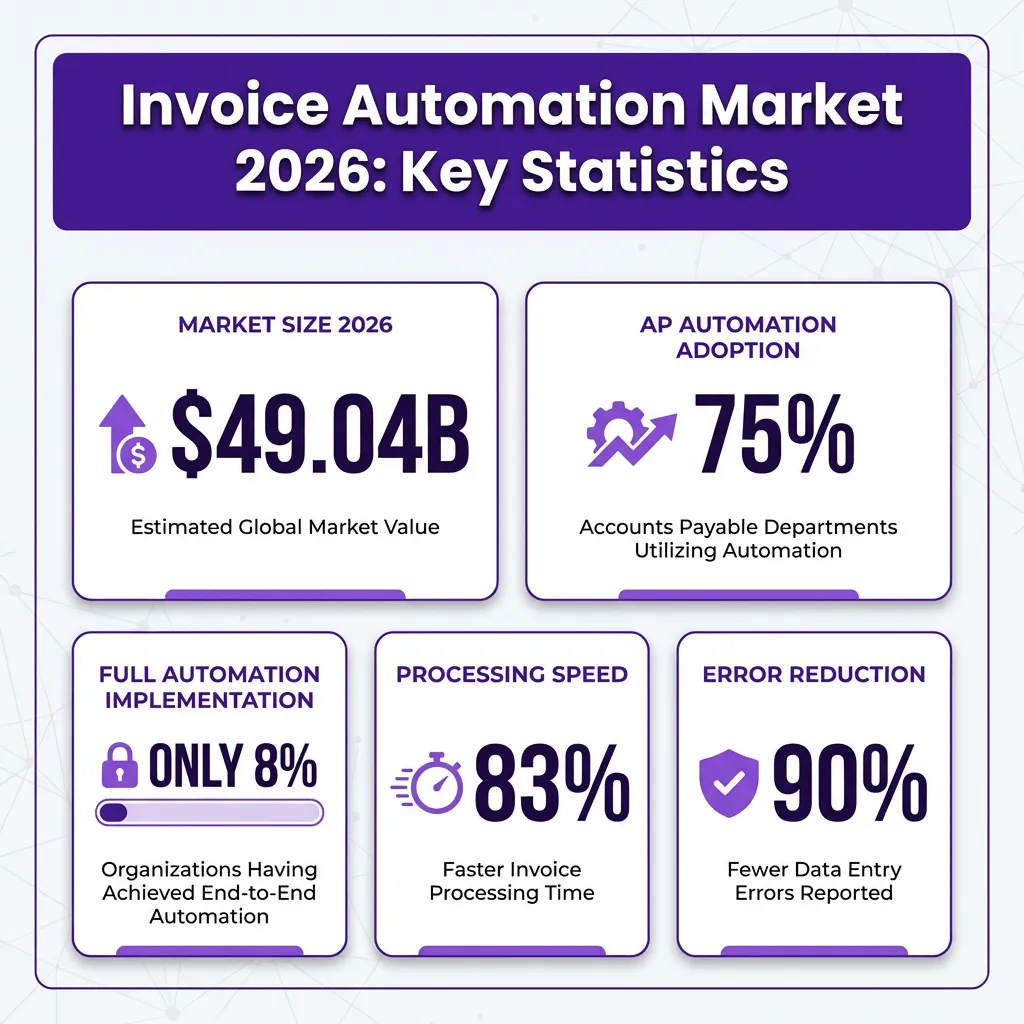
Here’s a stat that’ll make you pause: 75% of AP departments now use some form of AI or automation in their invoice workflows. Sounds impressive, right? But here’s the kicker — only 8% have actually reached full automation. The rest are stuck in this weird middle ground where they’re paying for software but still manually keying data into accounting systems.
The invoice automation market is exploding — hitting $49.04 billion in 2026 with a 14.9% annual growth rate. For SaaS companies specifically, this isn’t just about convenience. When you’re juggling recurring subscriptions, usage-based billing, global customers, and tax compliance across 50+ countries, manual invoice processing isn’t just inefficient — it’s a liability.
I’ve spent the last few weeks testing and comparing the leading invoice automation platforms. In this guide, I’ll break down the 10 best options for SaaS companies in 2026 — from free tools for startups to enterprise solutions that handle millions in monthly volume.
What Is Invoice Automation Software?
Invoice automation software digitizes and streamlines the entire invoice lifecycle — from capture and data extraction to approval routing, payment processing, and reconciliation. Think of it as your finance team’s autopilot.
At its core, the technology uses OCR (Optical Character Recognition) and increasingly AI-powered data extraction to read invoices from PDFs, emails, or scanned documents. It then routes them through predefined approval workflows, matches them against purchase orders, schedules payments, and syncs everything with your accounting system.
For SaaS companies, there’s an important distinction to understand:
- AP Automation (Accounts Payable): Handles invoices YOU need to pay — vendor bills, software subscriptions, contractor payments.
- AR Automation (Accounts Receivable): Handles invoices you SEND to customers — subscription billing, usage charges, one-time fees.
Some platforms do both. Others specialize in one area. I’ll note which is which in my recommendations below.
Why SaaS Companies Specifically Need Invoice Automation
SaaS billing isn’t like traditional business invoicing. You’re dealing with recurring revenue models, tiered pricing, usage-based components, annual contracts paid monthly, and customers spread across dozens of countries. Each of these adds complexity that manual processes simply can’t scale with.
Here’s what the data shows: companies using invoice automation report an 83% reduction in processing time and a 90% decrease in data entry errors. For a SaaS company processing 1,000+ invoices monthly, that’s the difference between hiring two full-time finance staff or running lean with automation.
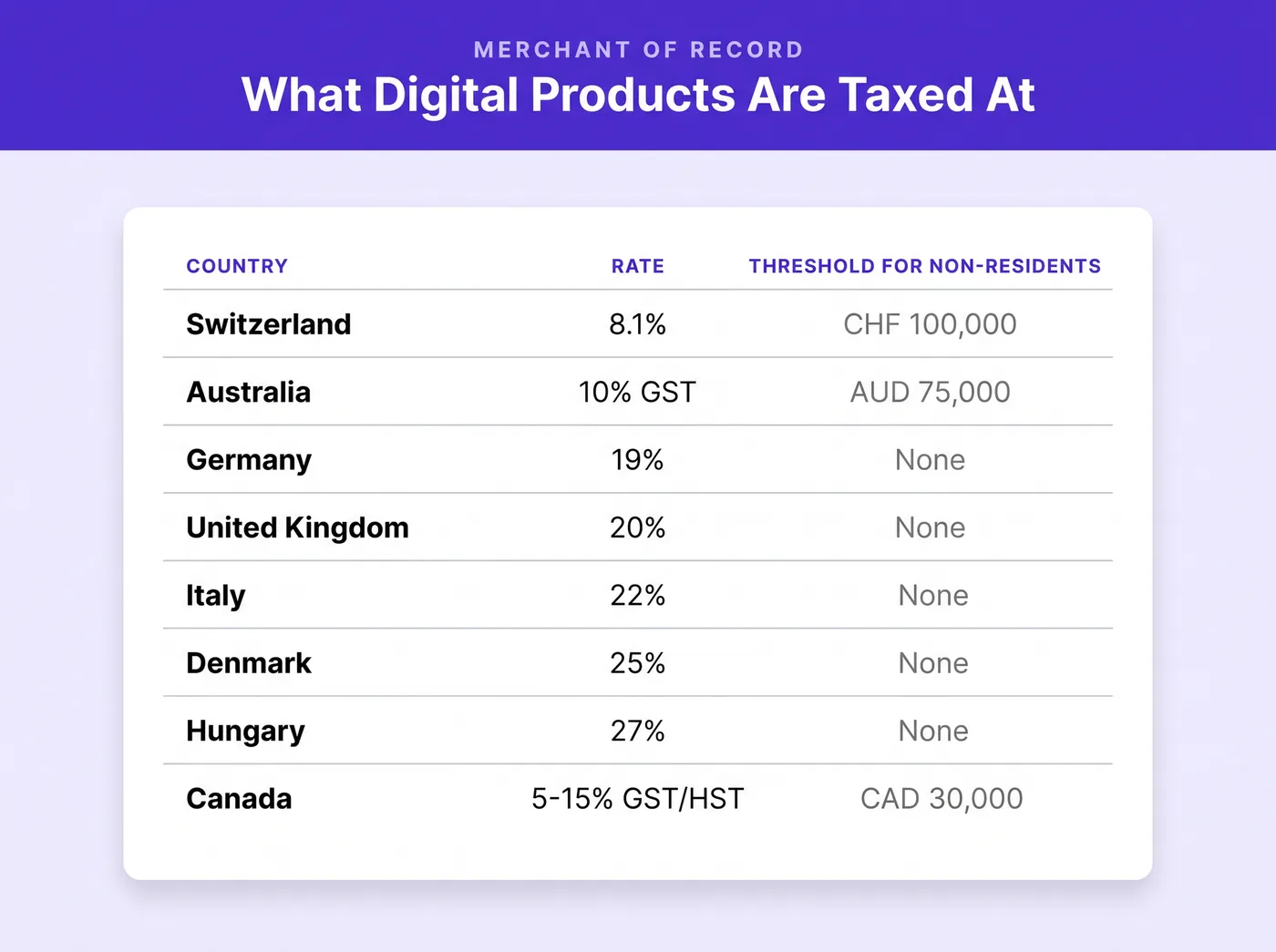
Beyond efficiency, there’s compliance. Global SaaS companies must navigate VAT in the EU, sales tax in the US (45+ states with different rules), GST in Australia and India, and a patchwork of other regulations. The right invoice automation software doesn’t just process payments — it calculates, collects, and remits the correct taxes automatically.
The 10 Best Invoice Automation Software for SaaS in 2026
1. Tipalti — Best for Enterprise SaaS with Global Operations
Tipalti is the gold standard for enterprise-grade AP automation. If you’re processing high invoice volumes across multiple countries, this is the platform that’ll scale with you.
Key Features:
- Global payments to 200+ countries in 120+ currencies
- Automated tax form collection (W-9, W-8) and compliance
- Multi-entity support with consolidated reporting
- PO matching and 3-way reconciliation
- Supplier onboarding and risk management
Pricing: Custom enterprise pricing (typically starts around $500/month)
Best for: SaaS companies with $10M+ ARR, complex international operations, or finance teams drowning in manual AP work. Tipalti customers report saving 180+ hours monthly on billing operations.
2. Melio — Best for Small to Mid-Size SaaS Startups
Melio takes a refreshingly simple approach to B2B payments. No monthly fees, no subscription required — just a straightforward platform for paying bills and getting paid.
Key Features:
- Free ACH bank transfers
- QuickBooks and Xero integration
- Schedule payments in advance
- Request payments from customers
- Simple approval workflows
Pricing: Free for ACH transfers; 2.9% for card payments
Best for: Early-stage SaaS startups (pre-Series B) that need basic AP automation without enterprise complexity. The free ACH transfers make this a no-brainer for cost-conscious founders.
3. BILL (formerly Bill.com) — Best for Growing SaaS with AP/AR Needs
BILL has been around since 2006 and processes over $700 billion annually. It’s the safe choice for growing SaaS companies that need proven reliability.
Key Features:
- Automated invoice capture and data entry
- Customizable approval workflows
- Robust audit trails for compliance
- Integration with QuickBooks, Xero, NetSuite, Sage
- Mobile app for approvals on the go
Pricing: Starting at $45/month for the Essentials plan
Best for: SaaS companies with 10-100 employees that need both AP and AR automation in one platform. The accounting integrations are particularly strong.
4. Ramp — Best for SaaS Wanting AP + Corporate Cards Together
Ramp burst onto the scene as a corporate card provider but has evolved into a full spend management platform — including surprisingly capable invoice automation.
Key Features:
- Free invoice automation and bill pay
- Corporate cards with spend controls
- Real-time expense tracking
- Accounting sync (QuickBooks, NetSuite, Sage)
- Receipt capture and matching
Pricing: Free (Ramp makes money on interchange fees from corporate cards)
Best for: US-based SaaS companies that want to consolidate AP, corporate cards, and expense management. The free pricing is hard to beat, but it’s limited to US operations.
5. QuickBooks Online — Best for Small SaaS Already Using QuickBooks
If you’re already in the QuickBooks ecosystem, their built-in invoicing and bill pay features might be all you need — at least until you scale.
Key Features:
- Invoice creation and tracking
- Online payment acceptance
- Automatic payment reminders
- Basic expense categorization
- Financial reporting
Pricing: Starting at $30/month for the Simple Start plan
Best for: Solo founders and small SaaS teams (under 10 people) already using QuickBooks for accounting. The integration is seamless, though features are more basic than dedicated AP tools.
6. Stampli — Best for Mid-Market SaaS with Complex Approval Workflows
Stampli takes a collaboration-first approach to AP automation. Its AI, “Billy,” learns your coding patterns and gets smarter over time.
Key Features:
- AI-powered invoice coding (~90% accuracy)
- In-app collaboration and commenting
- 3-way PO matching
- ERP integrations (NetSuite, Sage, Microsoft Dynamics)
- Fast implementation (weeks, not months)
Pricing: Custom pricing based on volume
Best for: Mid-market SaaS companies (50-500 employees) with complex approval hierarchies and multiple stakeholders in the AP process.
7. Gaviti — Best for SaaS Focused on Invoice-to-Cash Optimization
While most tools focus on AP (paying bills), Gaviti specializes in AR automation — getting your customers to pay YOU faster.
Key Features:
- Automated collections workflows
- Customer payment portals
- Cash application automation
- Dispute management
- DSO (Days Sales Outstanding) reduction tracking
Pricing: Custom pricing
Best for: SaaS companies struggling with late customer payments and cash flow. Gaviti users typically see 30-40% reduction in DSO.
8. Quadient (formerly YayPay) — Best for A/R Automation with Predictive Analytics
Quadient combines AR automation with predictive analytics to help you forecast cash flow and prioritize collection efforts.
Key Features:
- Predictive payment behavior analytics
- Automated dunning emails
- Customer risk scoring
- Cash flow forecasting
- Multi-currency support
Pricing: Custom enterprise pricing
Best for: SaaS companies with complex AR operations that want data-driven insights into customer payment behavior.
9. Sai by Simular — Best for AI-Native Invoice Processing
Sai takes a radically different approach — instead of being a dedicated AP platform, it’s an “AI coworker” that works across whatever applications you already use.
Key Features:
- Works across applications without APIs
- Reads and extracts data from PDF invoices
- Cross-references vendor data
- Creates entries in QuickBooks, Xero, or custom ERPs
- Routes invoices for approval via email
Pricing: Custom pricing
Best for: Tech-forward SaaS companies that want cutting-edge AI automation and don’t mind working with newer technology.
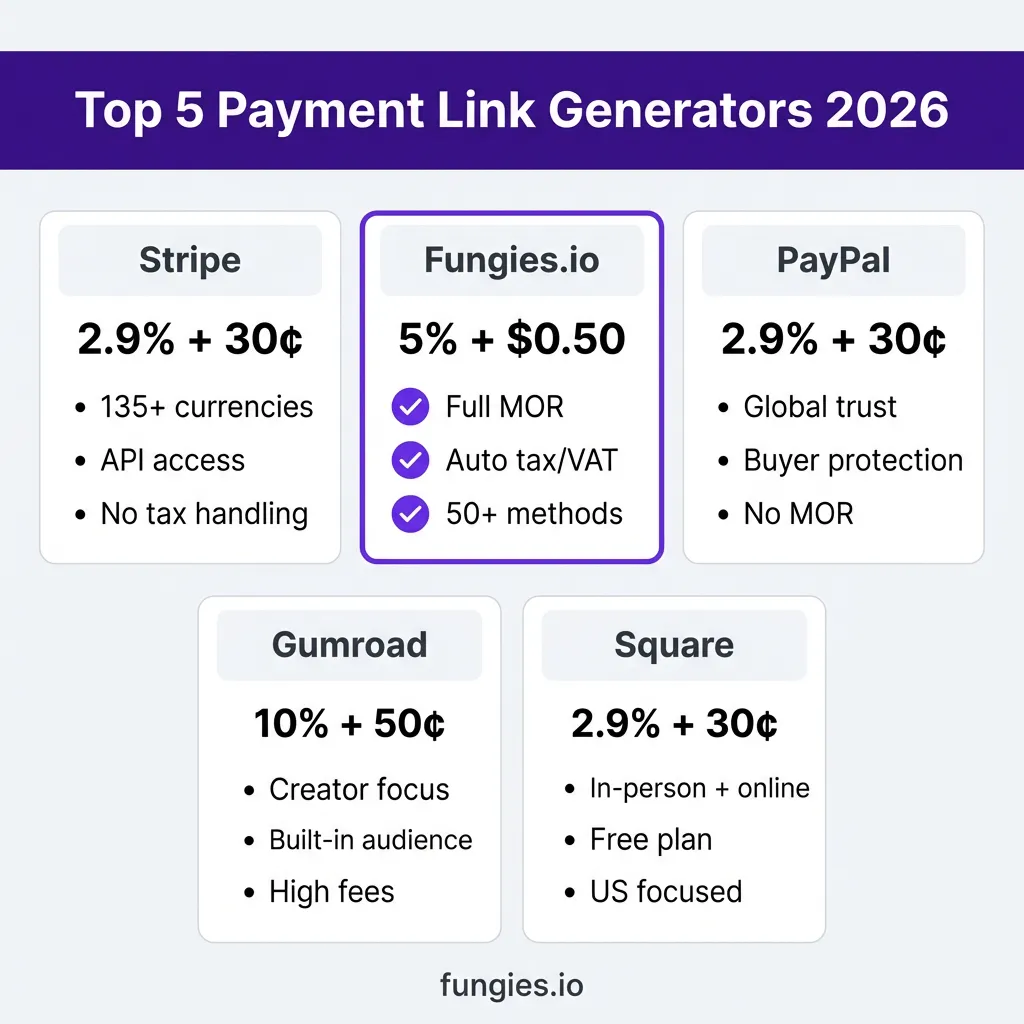
10. Fungies.io — Best for SaaS Founders Wanting MoR + Invoicing in One
Full disclosure: I work with Fungies. But there’s a reason I’m including it — for SaaS founders specifically, the combination of invoice automation with Merchant of Record services solves a unique set of problems.
Key Features:
- Automated invoicing for subscriptions and one-time charges
- Global tax compliance (VAT, sales tax, GST) handled automatically
- Multi-currency support with local payment methods
- Subscription billing management
- No monthly fees — pay per transaction only
Pricing: 5% + $0.50 per transaction (no monthly fees, no setup costs)
Best for: SaaS founders who want to sell globally without hiring a tax department. The flat pricing and automatic compliance make it ideal for international expansion.
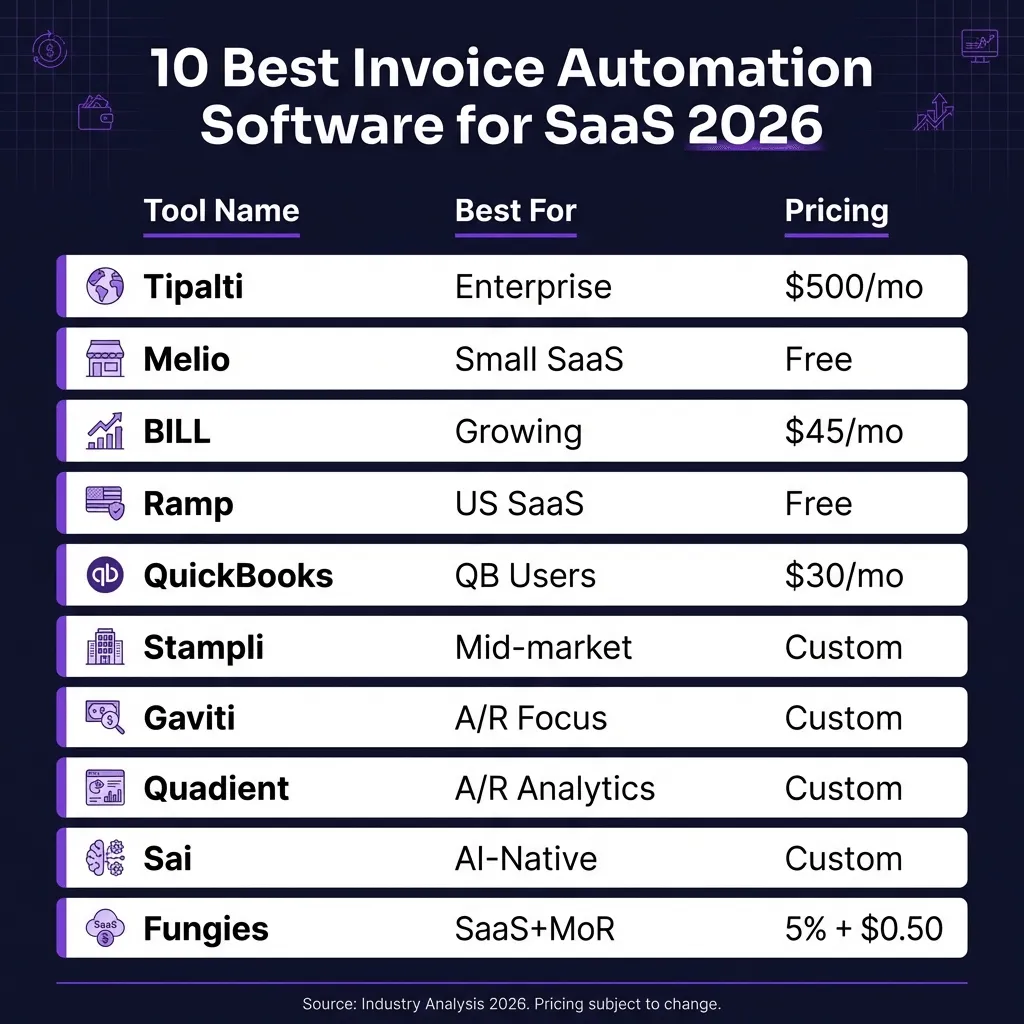
Comparison Table: At a Glance
| Software | Best For | Starting Price | Global Payments | Focus |
|---|---|---|---|---|
| Tipalti | Enterprise SaaS | ~$500/mo | Yes (200+ countries) | AP |
| Melio | Small SaaS | Free | No | AP |
| BILL | Growing SaaS | $45/mo | Limited | Both |
| Ramp | US SaaS | Free | No | AP |
| QuickBooks | QB Users | $30/mo | Limited | Both |
| Stampli | Mid-market | Custom | Limited | AP |
| Gaviti | A/R Focus | Custom | Yes | AR |
| Quadient | A/R Analytics | Custom | Yes | AR |
| Sai | AI-Native | Custom | Limited | AP |
| Fungies | SaaS + MoR | 5% + $0.50 | Yes | Both |
How to Choose the Right Invoice Automation Software
With 10 solid options, how do you pick? Here’s my decision framework:
1. Assess Your Invoice Volume
If you’re processing fewer than 50 invoices monthly, a free tool like Melio or Ramp is probably sufficient. Once you hit 200+ invoices, you’ll want something more robust like Stampli or BILL.
2. Consider Global Payment Needs
Selling internationally? You need Tipalti, Gaviti, Quadient, or Fungies. The others are either US-only or have limited international support.
3. Evaluate Your Existing Stack
If you’re already using QuickBooks, start there. If you’re on NetSuite, look at Stampli or Tipalti. The best software is the one that integrates seamlessly with your current systems.
4. Factor in Compliance Requirements
If tax compliance keeps you up at night, a Merchant of Record solution like Fungies handles this automatically. Otherwise, you’ll need separate tax software alongside your invoice automation.
5. Calculate True Total Cost
Don’t just look at the monthly subscription. Factor in implementation costs, training time, and per-transaction fees. A “free” tool that requires 20 hours of setup might cost more than a paid alternative.
Frequently Asked Questions
What’s the difference between AP and AR automation?
AP (Accounts Payable) automation handles bills you need to pay — vendor invoices, contractor payments, software subscriptions. AR (Accounts Receivable) automation handles invoices you send to customers to collect payment. Some platforms do both; others specialize in one.
How much does invoice automation software cost?
Prices range from free (Melio, Ramp) to $500+/month for enterprise solutions (Tipalti). Most mid-market tools fall in the $45-200/month range. Some charge per user; others per invoice or as a percentage of payment volume.
Can invoice automation handle global payments?
Only some platforms support global payments. Tipalti leads here with 200+ countries and 120+ currencies. Gaviti, Quadient, and Fungies also offer strong international support. Most free tools (Melio, Ramp) are US-only.
Does invoice automation integrate with accounting software?
Yes, virtually all modern invoice automation tools integrate with popular accounting software. QuickBooks and Xero are supported by nearly everyone. NetSuite and Sage integrations are common in enterprise tools.
Is invoice automation worth it for small SaaS companies?
If you’re processing more than 20-30 invoices monthly, probably yes. The time savings add up quickly, and the error reduction can prevent costly mistakes. Start with a free tool like Melio or Ramp and upgrade as you scale.
Conclusion
Invoice automation isn’t a luxury anymore — it’s a competitive necessity for SaaS companies. The 83% reduction in processing time isn’t just about efficiency; it’s about freeing your finance team to focus on strategic work instead of data entry.
My recommendation? Start with your current invoice volume and global needs. If you’re US-only and under 50 invoices monthly, try Melio or Ramp. If you’re going global or processing high volumes, invest in Tipalti or Fungies. And if cash flow is your primary concern, look at Gaviti or Quadient for AR automation.
Whatever you choose, don’t wait until you’re drowning in manual work. The best time to automate is before you desperately need it.
Ready to simplify your SaaS billing? Try Fungies free — automated invoicing, global tax compliance, and Merchant of Record services in one platform. No monthly fees, just 5% + $0.50 per transaction.
Sources
- Invoice Processing Software Global Market Report 2026 — GII Research
- The State of Invoice Automation: 2026 Report — Gennai
- 6 Best Invoice Automation Tools in 2026 — Simular
- Best B2B SaaS Billing Automation Platforms 2026 — LedgerUp
- Melio vs Tipalti Comparison — SelectHub
- 5 Best Melio Competitors — Tipalti
- 8 Best Invoice Automation Software 2026 — Rillion
- Best Invoice-to-Cash Automation Software 2026 — ERP News