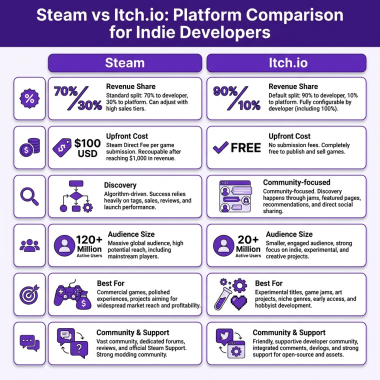
Choosing where to sell your game is one of the most consequential decisions you’ll make as an indie developer. The platform you pick affects your revenue, your relationship with players, and how much control you have over your business. I’ve watched developers agonize over this choice, and honestly, there’s no one-size-fits-all answer. What works for a narrative adventure game won’t work for a competitive multiplayer title.
In 2026, the landscape has shifted dramatically. Steam still dominates, but Epic Games Store has gained serious ground with developer-friendly policies. itch.io remains the darling of experimental indies, while direct sales are becoming viable for established creators. This guide breaks down the real numbers, the hidden costs, and the strategic considerations you need to make the right choice for your game.
The State of Game Distribution in 2026
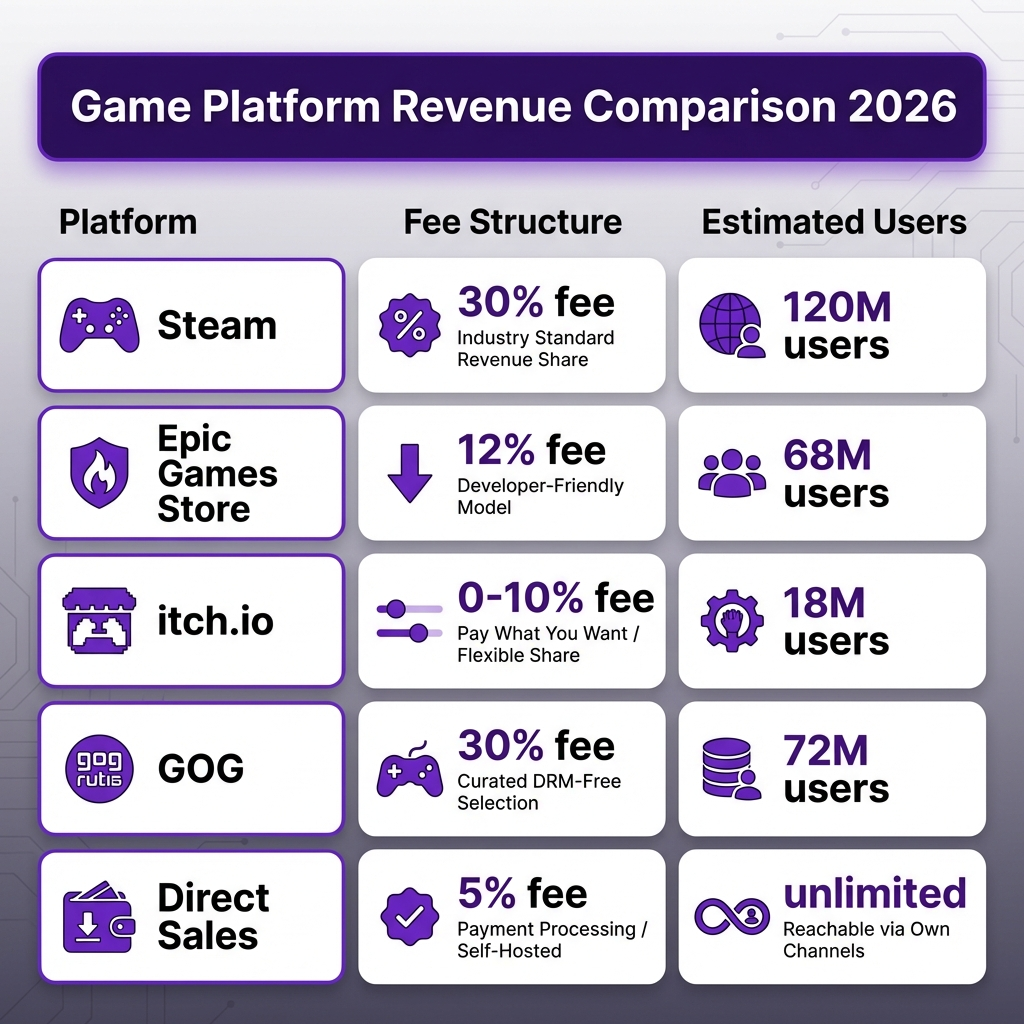
The PC gaming market has never been more fragmented — or more competitive. Steam’s 120 million monthly active users still make it the 800-pound gorilla, but that massive audience comes with a massive caveat: visibility. With over 14,000 games released on Steam in 2025 alone, getting noticed is harder than ever.
Meanwhile, Epic Games Store has quietly built a user base of 68 million monthly active users. Their 12% revenue share (compared to Steam’s 30%) has attracted major publishers and indies alike. And here’s a kicker many developers don’t know: Epic takes 0% on the first $1 million in revenue per game per year. That’s a huge deal for mid-sized indies.
itch.io has carved out a unique position as the anti-Steam. With no mandatory fees and a community that actively seeks out weird, experimental games, it’s become the launchpad for countless indie careers. The trade-off? A smaller audience and less infrastructure for things like multiplayer matchmaking or cloud saves.
Steam: The Default Choice (With Caveats)
Let’s start with the obvious choice. Steam is where PC gaming lives. If someone plays games on PC, they almost certainly have a Steam account. That built-in audience of 120 million monthly active users is unmatched anywhere else in the industry.
But here’s what the cheerleaders don’t tell you: Steam’s 30% cut is just the beginning. You also pay $100 per game for the Direct fee, and if you want any chance of visibility, you’ll need to invest in marketing. The Steam algorithm can make or break your game, and nobody outside Valve fully understands how it works.
What Steam gets right is infrastructure. Steam Workshop for mods, automatic updates, cloud saves, achievements, trading cards, remote play — these features add real value for players. For multiplayer games, Steam’s networking APIs are industry standard. If your game needs these features, Steam isn’t just convenient; it’s practically mandatory.
The revenue share structure has improved slightly. Steam now takes 25% after $10 million in revenue and 20% after $50 million. But let’s be real: most indie games never hit those thresholds. For the vast majority of developers, you’re paying 30%.
Epic Games Store: The Challenger
Epic’s play is simple: attract developers with better economics, attract players with free games. And it’s working. The Epic Games Store has grown from zero to 68 million monthly active users in just a few years, largely through their strategy of giving away high-quality games every week.
The 12% revenue share is the headline, but the real story is the 0% fee on your first $1 million annually. For a game that makes $800,000 in a year, you’d pay Epic nothing. On Steam, you’d pay $240,000. That’s not a small difference — that’s potentially the difference between making a sequel or going back to your day job.
Epic also waives the 5% Unreal Engine royalty for sales through their store. If you’re using Unreal, that’s another significant savings. Combined with the revenue split, Epic becomes very attractive for Unreal-based projects.
The downsides? Epic’s store lacks many of Steam’s community features. No forums, no user reviews (yet), no Workshop. The player base, while growing, is still more casual and less engaged than Steam’s core audience. And getting featured on Epic is even more opaque than Steam — you essentially need to know someone or have a game that fits their current promotional strategy.
itch.io: The Indie Haven
itch.io is fundamentally different from Steam and Epic. It’s not trying to be a massive commercial platform; it’s trying to be a home for games that don’t fit the mainstream mold. The result is a community that actively seeks out weird, experimental, and personal games.
The economics are developer-friendly to a fault. itch.io takes 0% by default. You can choose to give them a cut (up to 30%), but it’s entirely voluntary. Payment processors take their standard fees (usually around 3-5%), but that’s it. No platform tax, no submission fees, no revenue share.
This makes itch.io perfect for prototyping, early access, and experimental releases. Many successful indies launch on itch.io first to build an audience, gather feedback, and generate revenue before committing to Steam’s $100 fee. The “start on itch.io, expand to Steam” strategy has become a standard playbook.
The trade-off is scale. itch.io’s audience is passionate but small — around 18 million registered users, with a much smaller active base. You’re not going to sell a million copies on itch.io. But you might sell a thousand copies to players who genuinely care about your game and will evangelize it when you eventually launch on Steam.
GOG: The Niche Player
Good Old Games has pivoted from its retro focus to become a general PC game store, but its audience still skews toward older, more traditional PC gamers. The 30% revenue share matches Steam, and the curation process is more selective — you can’t just upload any game.
GOG’s selling point is its audience: 72 million registered users who are generally more willing to pay full price for games and less likely to wait for deep discounts. If your game has a retro aesthetic or appeals to classic PC gaming sensibilities, GOG is worth considering. For everyone else, it’s a secondary platform at best.
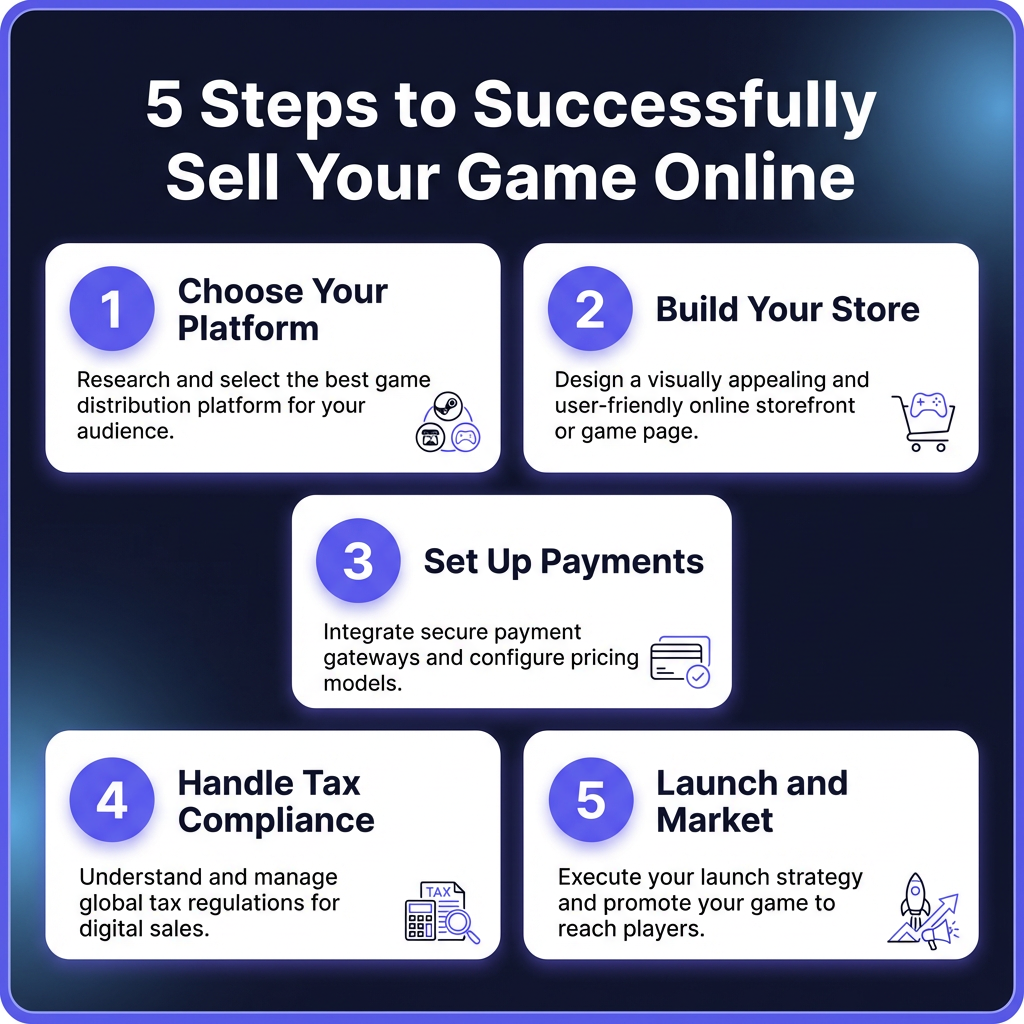
Direct Sales: The Ultimate Control
Selling directly through your own website gives you complete control and the highest margins. You keep 95% or more of your revenue (payment processors take 3-5%). You own the customer relationship. You set the prices, run the sales, and collect the emails.
The challenge is everything else. You need to build and maintain a website. You need to handle payment processing, tax compliance, fraud prevention, and customer support. You need to drive all your own traffic. For most indies, the technical and operational overhead isn’t worth it — at least not initially.
But here’s where it gets interesting: platforms like Fungies.io have made direct sales much more accessible. You can set up a professional game store in minutes, with built-in payment processing, automatic tax compliance, and integration with platforms like Steam for key distribution. The trade-off between control and convenience is becoming less stark.
For established developers with an existing audience, direct sales can be incredibly lucrative. Games like Minecraft and Stardew Valley built empires largely through direct sales before expanding to other platforms. You probably won’t replicate that success, but even a few hundred direct sales can significantly impact your bottom line.
The Multi-Platform Strategy
Here’s the truth: successful indies don’t choose one platform. They use multiple platforms strategically at different stages of their game’s lifecycle.
The proven playbook looks like this: Launch on itch.io for early feedback and initial revenue. Build an audience through devlogs and community engagement. Launch on Steam with that built-in wishlist base. Consider Epic if you have a Unreal-based game or want to pursue exclusivity deals. Maintain direct sales as a high-margin channel for your most engaged fans.
Each platform serves a different purpose. itch.io is for validation and community building. Steam is for scale and infrastructure. Epic is for favorable economics (if you can get in). Direct sales are for margin and customer ownership.
Platform Comparison Table
| Platform | Revenue Share | Users | Best For | Submission |
|---|---|---|---|---|
| Steam | 30% | 120M monthly | Most games | $100 fee |
| Epic Games Store | 12% (0% first $1M) | 68M monthly | Unreal games | Curated |
| itch.io | 0% (voluntary) | 18M registered | Experimental indies | Instant |
| GOG | 30% | 72M registered | Retro/classic PC | Curated |
| Direct (Fungies) | ~5% | Unlimited | Established devs | Instant |
FAQ: Selling Games Online
Should I launch on Steam or itch.io first?
For most indies, itch.io first makes sense. It’s free to publish, so you can validate your game with real players before committing to Steam’s $100 fee. Build an audience on itch.io, gather feedback, and use that momentum for a stronger Steam launch.
Is Epic Games Store better than Steam for indies?
Epic’s revenue share is significantly better (12% vs 30%), but getting onto Epic is harder than Steam. Epic is curated, not open. If you can get on Epic, especially with a Unreal Engine game, the economics are compelling. But don’t count on it as your primary platform.
Can I sell the same game on multiple platforms?
Absolutely, and you should. Just be aware of Epic’s First Run program, which requires exclusivity for 6 months in exchange for 100% revenue. Outside of that, multi-platform releases are standard practice.
How do I handle taxes when selling games directly?
Tax compliance is the biggest headache with direct sales. You need to collect and remit VAT in the EU, sales tax in the US, and comply with various other jurisdictions. Platforms like Fungies.io handle this automatically as a Merchant of Record, making direct sales much more viable.
What’s the realistic revenue difference between platforms?
For a game selling 5,000 copies at $20: On Steam, you’d net about $52,465 after Valve’s 30% cut. On Epic, you’d net about $65,956 after their 12% cut (or $100,000 if under the $1M threshold). On itch.io with 0% platform fee, you’d net about $63,781 after payment processing. Direct sales through Fungies would net about $95,000.
Conclusion: Choose Your Strategy
There’s no single “best” platform for selling games. Steam offers the biggest audience but takes the biggest cut. Epic offers the best economics but is harder to access. itch.io offers the most freedom but the smallest reach. Direct sales offer the highest margins but the most overhead.
Smart developers use all of these platforms strategically. Start on itch.io to validate and build community. Launch on Steam for scale. Pursue Epic for better revenue share. Maintain direct sales for your most engaged fans. The goal isn’t to pick a winner — it’s to build a distribution strategy that maximizes both revenue and player reach.
The tools for selling games independently have never been better. Whether you’re launching your first passion project or scaling your indie studio, there’s a platform (or combination of platforms) that fits your needs. The key is understanding the trade-offs and making informed decisions based on your specific game, audience, and business goals.
Ready to Sell Your Game Directly?
Join hundreds of indie developers using Fungies.io — your own game store, automated tax compliance, and keep more of your revenue.
No credit card required • 5-minute setup