Here’s a number that should make you pause: processing 10,000 customer support tickets with GPT-4.1 costs $16. With GPT-4.1 nano, it’s $0.80. Same task. Same provider. 20x price difference.
LLM API pricing isn’t just about picking the cheapest model. It’s about matching the right model to the right workload. Get it wrong and you’re burning budget on overkill. Get it right and you can cut costs by 80% without sacrificing quality.
This guide breaks down every major LLM API pricing tier as of April 2026. Real numbers. Real workloads. No vendor fluff.

Why LLM API Pricing Matters More Than Ever
AI costs are now a line item on most engineering budgets. A mid-sized SaaS company processing 100,000 API calls daily can spend anywhere from $500 to $20,000 per month depending on model choice. That’s the difference between a junior engineer’s salary and a senior engineer’s salary.
The pricing landscape has shifted dramatically in 2026:
- Google’s Gemini 2.0 Flash hit $0.10 per million input tokens — competing with open-source hosting costs
- OpenAI’s GPT-4.1 family replaced GPT-4o as the default recommendation with 1M token context windows
- Anthropic’s Claude Opus 4 remains the premium option at $15/$75 per million tokens
- Open-source models like Llama 4 now match closed-source quality at a fraction of the cost
Understanding these tiers isn’t optional anymore. It’s infrastructure planning.
LLM API Pricing at a Glance: April 2026
Here’s the complete pricing breakdown for every major model. Prices are per 1 million tokens.
| Model | Provider | Input | Output | Context |
|---|---|---|---|---|
| GPT-4.1 | OpenAI | $2.00 | $8.00 | 1M |
| GPT-4.1 mini | OpenAI | $0.40 | $1.60 | 1M |
| GPT-4.1 nano | OpenAI | $0.10 | $0.40 | 1M |
| GPT-4o | OpenAI | $2.50 | $10.00 | 128K |
| o3 | OpenAI | $2.00 | $8.00 | 200K |
| Claude Opus 4 | Anthropic | $15.00 | $75.00 | 200K |
| Claude Sonnet 4 | Anthropic | $3.00 | $15.00 | 200K |
| Claude Haiku 3.5 | Anthropic | $0.80 | $4.00 | 200K |
| Gemini 2.5 Pro | $1.25 | $10.00 | 1M | |
| Gemini 2.5 Flash | $0.15 | $0.60 | 1M | |
| Gemini 2.0 Flash | $0.10 | $0.40 | 1M | |
| Llama 4 Maverick | Meta (hosted) | $0.20 | $0.60 | 1M |
| Llama 4 Scout | Meta (hosted) | $0.10 | $0.25 | 10M |
| Mistral Large 2 | Mistral | $2.00 | $6.00 | 128K |
| Mistral Small | Mistral | $0.10 | $0.30 | 32K |
Key insight: Output tokens cost 2-5x more than input tokens across all providers. This matters more than you think. A chatbot that generates long responses will cost significantly more than one that processes long inputs but gives short answers.
Provider Breakdown: What You Actually Get
OpenAI: The Safe Default
OpenAI’s April 2026 lineup spans from nano-class models at $0.10/1M tokens up to the full o3 reasoning model. For most production workloads, the GPT-4.1 family has replaced GPT-4o as the default recommendation.
GPT-4.1 is the workhorse. It handles coding, analysis, and long-context tasks with a 1M token context window. The mini variant cuts cost by 80% with surprisingly small quality tradeoffs on structured tasks. The nano variant is built for high-volume, latency-sensitive workloads where you need sub-100ms responses.
Reasoning models (o3, o4-mini) think before answering. They consume more tokens internally (chain-of-thought tokens are billed as output), which means actual costs run 2-5x higher than the per-token price suggests. Use these for complex analysis, math, and multi-step reasoning. Not cost-effective for simple classification or extraction tasks.
Anthropic: The Quality Premium
Anthropic prices on a three-tier system: Haiku (fast and cheap), Sonnet (balanced), and Opus (maximum capability). The gap between tiers is significant — Opus costs 5x more than Sonnet.
Claude Opus 4 at $15/$75 per million tokens is the most expensive mainstream LLM. That price only makes sense for tasks where quality differences directly impact revenue: legal document analysis, complex code generation, research synthesis, and agentic workflows where errors cascade.
Claude Sonnet 4 delivers 80% of Opus’s quality at 20% of the cost. For most applications, this is the sweet spot.
Claude Haiku 3.5 at $0.80/$4.00 fills the high-quality budget slot. It outperforms GPT-4o mini on many benchmarks while costing roughly double.
Google Gemini: The Aggressive Undercutter
Google’s pricing strategy is aggressive. Gemini 2.5 Flash at $0.15/$0.60 per million tokens undercuts nearly everything except open-source models, and it includes a 1M token context window.
Gemini 2.5 Pro at $1.25/$10.00 offers strong reasoning and coding performance. The input pricing undercuts Claude Sonnet and GPT-4.1, but output tokens are priced at $10 per million, making generation-heavy workloads expensive.
Gemini 2.0 Flash and 2.5 Flash are the price-performance leaders. At $0.10-$0.15 per million input tokens, they compete directly with open-source model hosting costs while requiring zero infrastructure management.
Open-Source Models: The Self-Hosting Option
Llama 4, Mistral, and other open-weight models don’t have a single price. Your cost depends on how you host them.
Hosted API pricing: Providers like Together AI, Fireworks, Groq, and AWS Bedrock host open-source models and charge per token. Typical rates for Llama 4 Maverick range from $0.15-$0.30 per million input tokens.
Self-hosting economics: Running Llama 4 Maverick (400B+ parameters, mixture-of-experts) requires multiple high-end GPUs. A typical setup costs $3-8/hour on cloud GPU instances. At sustained high throughput (100+ requests/minute), self-hosting breaks even with API pricing around the 50,000 requests/day mark. Below that, hosted APIs are cheaper.
Real Cost Comparisons by Workload
Raw per-token pricing tells part of the story. Actual costs depend on your workload pattern. Here are three common scenarios with real numbers.
Scenario 1: Chatbot / Conversational AI
Average conversation: 2,000 tokens input (system prompt + history), 500 tokens output per turn, 5 turns per session.
| Model | Cost per Session | Cost per 10K Sessions/Month |
|---|---|---|
| GPT-4.1 | $0.06 | $600 |
| GPT-4.1 mini | $0.012 | $120 |
| Claude Sonnet 4 | $0.068 | $675 |
| Gemini 2.5 Flash | $0.005 | $45 |
| Llama 4 Maverick (hosted) | $0.005 | $55 |
Scenario 2: Document Processing Pipeline
Average document: 8,000 tokens input, 1,000 tokens output (summary + extraction).
| Model | Cost per Document | Cost per 50K Docs/Month |
|---|---|---|
| GPT-4.1 | $0.024 | $1,200 |
| GPT-4.1 nano | $0.001 | $60 |
| Claude Haiku 3.5 | $0.010 | $520 |
| Gemini 2.5 Flash | $0.002 | $90 |
| Gemini 2.0 Flash | $0.001 | $60 |
Scenario 3: Code Generation / Analysis
Average request: 3,000 tokens input (code + instructions), 2,000 tokens output.
| Model | Cost per Request | Cost per 100K Requests/Month |
|---|---|---|
| GPT-4.1 | $0.022 | $2,200 |
| Claude Sonnet 4 | $0.039 | $3,900 |
| Claude Opus 4 | $0.195 | $19,500 |
| Gemini 2.5 Pro | $0.024 | $2,375 |
| Mistral Large 2 | $0.018 | $1,800 |
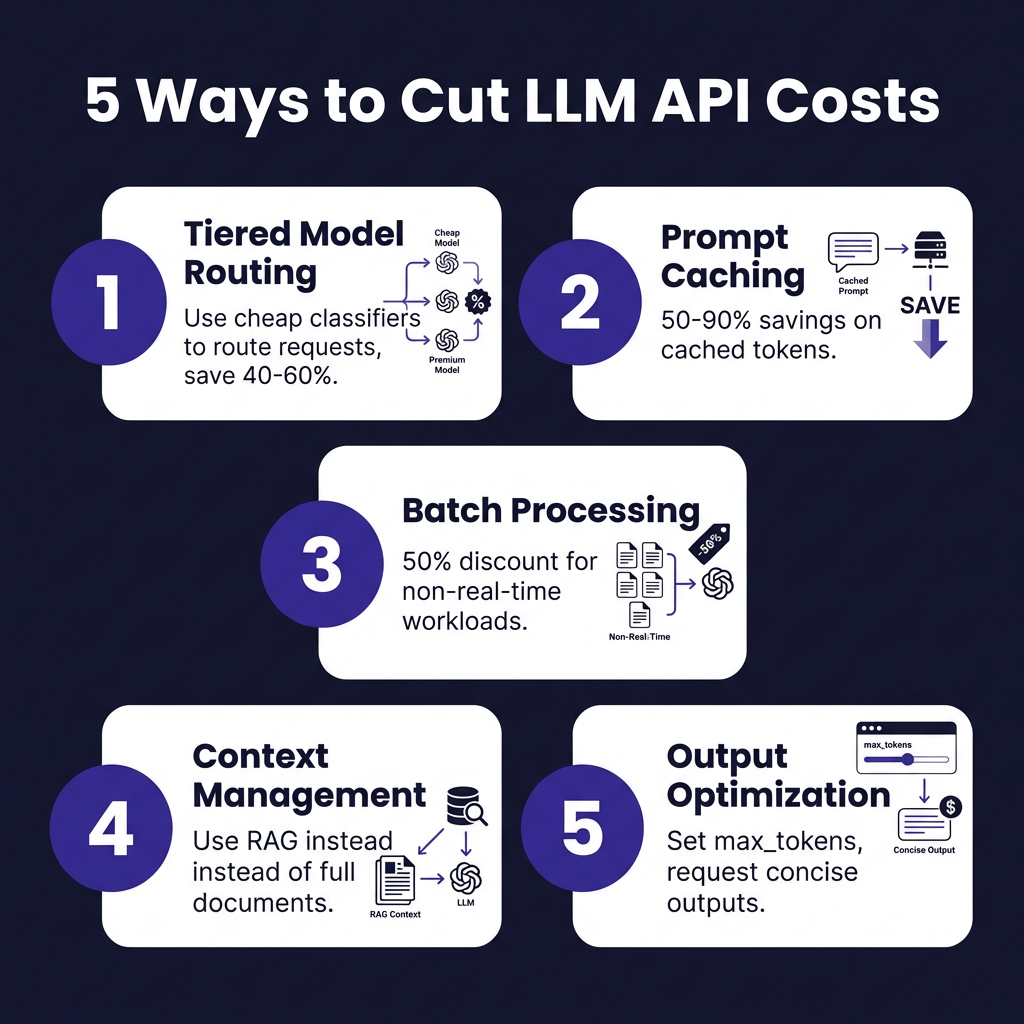
5 Proven Strategies to Cut LLM API Costs
The cheapest model isn’t always the best value. Here’s how to optimize spend without sacrificing quality.
1. Tiered Model Routing
Route requests to different models based on complexity. Use a cheap classifier (GPT-4.1 nano or Gemini 2.0 Flash) to assess request difficulty, then route simple requests to budget models and complex ones to premium models. This typically cuts costs 40-60% compared to using a single model for everything.
2. Prompt Caching
Both OpenAI and Anthropic offer prompt caching for system prompts and repeated context. Cached input tokens cost 50-90% less than fresh tokens. If your system prompt is 2,000+ tokens, caching pays for itself immediately. Anthropic’s prompt caching reduces cached input to $0.30/1M on Sonnet (90% discount).
3. Batch Processing
OpenAI’s Batch API charges 50% less for non-real-time workloads. If your use case can tolerate 24-hour turnaround (nightly report generation, weekly analysis runs), batch processing is the simplest cost reduction available.
4. Context Window Management
Stuffing the full context window costs money. A 100K token input to Claude Sonnet costs $0.30 per request. Trim your context to what’s actually needed. Use RAG to retrieve only relevant chunks instead of passing entire documents.
5. Output Token Optimization
Output tokens cost 2-5x more than input tokens across all providers. Request concise outputs. Use structured output formats (JSON) to avoid verbose prose. Set max_tokens limits to prevent runaway generation.
Which Model Should You Choose? A Decision Framework
| Your Priority | Recommended Model | Why |
|---|---|---|
| Lowest cost, acceptable quality | Gemini 2.0 Flash or GPT-4.1 nano | $0.10/1M input tokens |
| Best price-performance balance | GPT-4.1 mini or Gemini 2.5 Flash | 80% quality at 20% cost |
| Production quality, reasonable cost | GPT-4.1 or Claude Sonnet 4 | Reliable for most tasks |
| Maximum quality, cost secondary | Claude Opus 4 or o3 | Best reasoning and coding |
| High volume, cost-sensitive | Llama 4 Maverick (self-hosted) | Breaks even at 50K req/day |
| Privacy/compliance requirements | Self-hosted Llama 4 or Mistral | Full data control |
Key Takeaways
- Prices vary 20x between the cheapest and most expensive models for the same task
- Output tokens cost 2-5x more than input tokens — optimize your prompts for brevity
- Gemini 2.0 Flash at $0.10/1M tokens is the price floor for mainstream models
- GPT-4.1 mini delivers 80% of GPT-4.1 quality at 20% of the cost — the sweet spot for most use cases
- Claude Opus 4 is 5x more expensive than Sonnet — only worth it for tasks where errors are expensive
- Self-hosting breaks even at ~50,000 requests/day — below that, hosted APIs are cheaper
- Tiered routing can cut costs 40-60% — use cheap classifiers to route requests intelligently
Frequently Asked Questions
What is the cheapest LLM API in 2026?
Google’s Gemini 2.0 Flash and OpenAI’s GPT-4.1 nano are the cheapest mainstream options at $0.10 per million input tokens. For open-source alternatives, Llama 4 Scout via hosted providers starts around $0.10/1M input tokens. Self-hosted open-source models can be even cheaper at high volumes.
How much does it cost to run a chatbot on GPT-4.1?
A typical chatbot session (5 turns, 2,000 token input and 500 token output per turn) costs about $0.06 on GPT-4.1. At 10,000 sessions per month, that’s roughly $600. Using GPT-4.1 mini drops the cost to $120/month with minimal quality loss for most conversational use cases.
Is Claude Opus 4 worth the higher price?
Claude Opus 4 costs 5x more than Claude Sonnet 4. It’s worth the premium for complex reasoning, legal document analysis, advanced code generation, and agentic workflows where errors are expensive. For standard chatbot, classification, and extraction tasks, Sonnet 4 delivers 80% of the quality at 20% of the cost.
How do LLM API prices compare to self-hosting?
Self-hosting breaks even with API pricing at roughly 50,000+ requests per day for large models like Llama 4 Maverick. Below that threshold, hosted APIs are cheaper because you avoid GPU rental and DevOps overhead. The calculation shifts if you have existing GPU infrastructure or strict data privacy requirements.
How can I reduce my LLM API costs?
Five proven strategies: (1) Route simple requests to cheaper models using a classifier. (2) Enable prompt caching for repeated system prompts (50-90% savings on cached tokens). (3) Use batch APIs for non-real-time workloads (50% discount on OpenAI). (4) Trim context to only what’s needed using RAG instead of full documents. (5) Request concise outputs and set max_tokens limits.
Conclusion
LLM API pricing isn’t a simple “cheapest wins” game. It’s about matching model capabilities to your actual needs. A startup processing 1,000 requests daily should probably use Gemini 2.5 Flash and save their budget for growth. An enterprise handling legal document analysis might justify Claude Opus 4 because errors cost more than the API bill.
The data is clear: you can cut costs by 80% or more without sacrificing meaningful quality — if you choose strategically. Start with the decision framework above, measure your actual usage patterns, and iterate.
And if you’re building a SaaS product that needs to handle global payments, tax compliance, and checkout flows without the engineering overhead — check out Fungies.io. We handle the complexity so you can focus on what matters: building great products.
References
- PE Collective – Cross-Provider LLM API Pricing Comparison (April 2026)
- Cloudidr – LLM API Pricing 2026: OpenAI vs Anthropic vs Gemini
- TLDL – LLM API Pricing 2026 — Compare GPT-5, Claude 4, Gemini 2.5, DeepSeek Costs
- OpenAI Official Pricing
- Anthropic Official Pricing
- Google AI Gemini Pricing
- LLM Gateway – OpenAI vs Anthropic vs Google: Real Cost Comparison 2026