Here’s a number that should make every developer pause: LLM API pricing varies by 600x across major providers in 2026. The same prompt that costs $0.05 with one model could run you $30 with another. For startups and indie developers building AI-powered features, this isn’t just trivia—it’s the difference between a profitable product and a money pit.
With 82% of developers now using AI coding assistants daily, understanding LLM API pricing has become a core competency. Whether you’re building a chatbot, automating document processing, or integrating AI into your SaaS product, the model you choose directly impacts your margins.
What Is LLM API Pricing and Why Does Cost Optimization Matter?
LLM API pricing is typically structured around tokens—the units of text that language models process. One token is roughly 4 characters or 0.75 words in English. Providers charge separately for:
- Input tokens: The text you send to the API (prompts, context, instructions)
- Output tokens: The text the model generates (responses, completions)
This dual pricing structure means your costs depend on both how much you ask and how much the model answers. A verbose response from an expensive model can balloon costs quickly.
Why cost optimization matters:
- Margin protection: AI features can eat 30-50% of revenue if unoptimized
- Scalability: What works at 1,000 users breaks at 100,000
- Competitive advantage: Lower costs mean better pricing or higher margins
- Sustainability: Uncontrolled API spend kills startups
The Complete LLM API Pricing Breakdown (April 2026)
We’ve analyzed pricing from all major providers and grouped them into three tiers based on cost and capability. All prices are per 1 million tokens.
Budget Tier: Under $0.50/M Input
| Model | Input | Output | Best For |
|---|---|---|---|
| GPT-5 nano | $0.05 | $0.40 | Simple Q&A, classification |
| DeepSeek V3.2 | $0.25 | $0.38 | Coding, reasoning (Value Score: 209) |
| Gemini 3.1 Flash-Lite | $0.25 | $1.50 | Fast responses, summarization |
| Grok 3 Mini | $0.30 | $0.50 | General purpose, X integration |
Production Sweet Spot: $1.50–$3.00/M Input
| Model | Input | Output | Quality Score |
|---|---|---|---|
| GPT-5.1 | $1.50 | $6.00 | 67 |
| GPT-5.4 | $2.50 | $15.00 | 94 |
| Gemini 3.1 Pro | $2.00 | $12.00 | 94 |
| Claude Sonnet 4.6 | $3.00 | $15.00 | 68 |
Key insight: Gemini 3.1 Pro matches GPT-5.4’s quality score of 94 but costs 20% less on input and 20% less on output. This is the tier where most production applications should live.
Flagship Tier: $5.00–$30.00/M Input
| Model | Input | Output | Quality Score |
|---|---|---|---|
| Claude Opus 4.6 | $5.00 | $25.00 | 85 |
| GPT-5.4 Pro | $30.00 | $180.00 | 91 |
These models deliver cutting-edge performance but at a significant premium. Reserve them for tasks where quality is critical and cost is secondary—complex reasoning, creative writing, or high-stakes analysis.
LLM API Cost by Use Case: Real Math
Let’s break down actual costs for common use cases. We’ll assume 100,000 API calls per month with average token usage.
Use Case 1: Customer Support Chatbot
- Average input: 500 tokens (context + question)
- Average output: 150 tokens (response)
- Monthly volume: 100,000 conversations
| Model | Monthly Cost |
|---|---|
| GPT-5 nano | $8.50 |
| DeepSeek V3.2 | $18.20 |
| Gemini 3.1 Pro | $280.00 |
| GPT-5.4 Pro | $4,200.00 |
The 494x difference between GPT-5 nano and GPT-5.4 Pro is real. For straightforward Q&A, the budget tier is a no-brainer.
Use Case 2: AI Coding Assistant
- Average input: 2,000 tokens (code context + prompt)
- Average output: 500 tokens (generated code)
- Monthly volume: 100,000 suggestions
| Model | Monthly Cost |
|---|---|
| DeepSeek V3.2 | $69.00 |
| GPT-5.4 | $1,000.00 |
| Claude Sonnet 4.6 | $1,350.00 |
DeepSeek V3.2 shines here—it’s 100x cheaper than GPT-5 on output tokens while maintaining strong code generation capabilities. This is why it’s become the darling of developer tools.
Use Case 3: Document Processing & Analysis
- Average input: 8,000 tokens (full documents)
- Average output: 1,000 tokens (analysis)
- Monthly volume: 50,000 documents
| Model | Monthly Cost |
|---|---|
| Gemini 3.1 Flash-Lite | $175,000 |
| Gemini 3.1 Pro | $1,400,000 |
| Claude Opus 4.6 | $3,250,000 |
At scale, even the “cheap” tier gets expensive. This is where optimization strategies become critical.
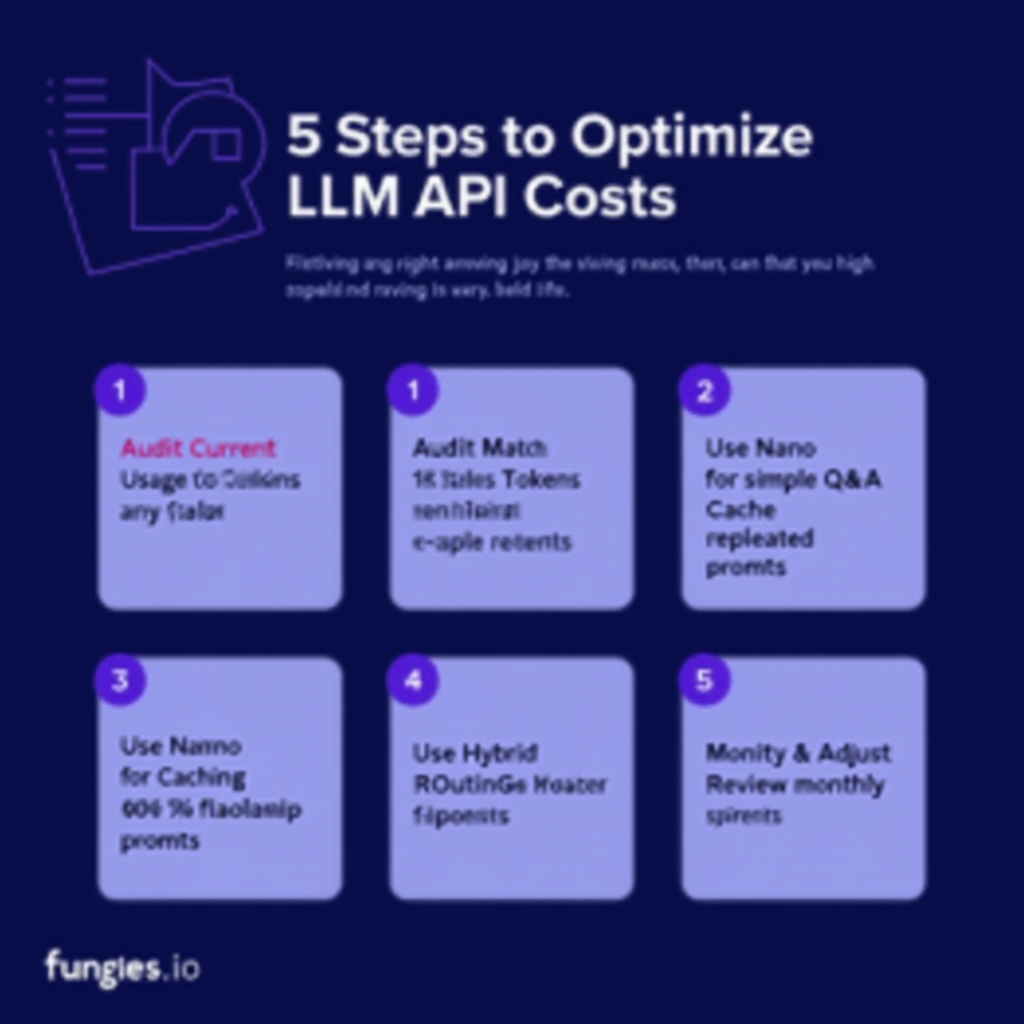
5 Proven LLM API Cost Optimization Strategies
1. Audit Your Current Usage
You can’t optimize what you don’t measure. Track:
- Tokens per endpoint
- Input vs. output ratios
- Peak usage times
- Cost per user action
Most providers offer usage dashboards. Set up alerts when daily spend exceeds thresholds.
2. Match Model to Task Complexity
Don’t use a flagship model for simple tasks. Create a routing logic:
- Tier 1 (nano/flash): Classification, simple Q&A, formatting
- Tier 2 (pro/sonnet): Complex reasoning, multi-step tasks
- Tier 3 (opus/pro): Creative writing, critical analysis, edge cases
3. Implement Aggressive Caching
Cache repeated prompts at multiple levels:
- Exact match cache: Same prompt = same response
- Semantic cache: Similar prompts return cached result
- Session cache: Reuse context within user sessions
Good caching can reduce API calls by 40-60%.
4. Use Hybrid Routing
Route 80% of traffic to budget models and 20% to flagship models. Use the expensive model as a fallback when:
- Budget model confidence is low
- User explicitly requests “expert” mode
- Task is flagged as high-stakes
5. Monitor and Adjust Monthly
LLM pricing changes frequently. New models launch. Your usage patterns evolve. Schedule a monthly review:
- Compare actual vs. projected spend
- Test new models for cost/quality tradeoffs
- Adjust routing thresholds
- Renegotiate enterprise rates if eligible
Deep Dive: When to Use Each Model
DeepSeek V3.2 — The Value King
With a value score of 209 and quality rating of 79, DeepSeek V3.2 offers the best balance of cost and capability. Use it for:
- Code generation and review
- Technical documentation
- Structured data extraction
- Any task where you need “good enough” at rock-bottom prices
Gemini 3.1 Pro — The Production Workhorse
Quality score of 94 at half the cost of GPT-5.4. Ideal for:
- Production chatbots
- Content generation
- Multi-turn conversations
- Applications where consistency matters
GPT-5.4 Pro — The Quality Leader
Highest quality score (91) but at a steep premium. Reserve for:
- Creative writing
- Complex reasoning chains
- High-stakes business decisions
- When “best possible” is worth the cost
Key Takeaways
- 600x pricing variation exists across LLM APIs—use it to your advantage
- DeepSeek V3.2 offers the best value for most development tasks
- Gemini 3.1 Pro matches GPT-5.4 quality at 50% lower cost
- Implement tiered routing to optimize cost without sacrificing quality
- Cache aggressively—it can cut costs by 40-60%
- Review monthly—pricing and models change constantly
Frequently Asked Questions
What is the cheapest LLM API in 2026?
GPT-5 nano is the cheapest at $0.05 per million input tokens. However, DeepSeek V3.2 offers better overall value at $0.25 input / $0.38 output with higher quality scores for coding and reasoning tasks.
How much does it cost to use GPT-5 API?
GPT-5 pricing varies by variant: GPT-5 nano costs $0.05/$0.40 per million tokens, GPT-5.1 is $1.50/$6.00, GPT-5.4 is $2.50/$15.00, and GPT-5.4 Pro is $30.00/$180.00 per million tokens.
Which LLM API has the best price-to-performance ratio?
DeepSeek V3.2 leads with a value score of 209, offering quality 79 performance at budget-tier pricing. For higher quality needs, Gemini 3.1 Pro delivers quality 94 at roughly half the cost of equivalent GPT models.
How can I reduce my LLM API costs?
Five strategies: (1) Audit usage to identify waste, (2) Match simpler models to simpler tasks, (3) Implement caching for repeated prompts, (4) Use hybrid routing (80% budget, 20% flagship), and (5) Monitor and adjust monthly as pricing evolves.
Is DeepSeek cheaper than GPT-5?
Yes, significantly. DeepSeek V3.2 is 100x cheaper than GPT-5 on output tokens ($0.38 vs $38+ per million) and offers competitive quality for coding and technical tasks. This makes it ideal for AI-powered developer tools.
Conclusion
LLM API pricing in 2026 is a landscape of extremes. The gap between budget and flagship models has never been wider, creating both opportunity and risk for developers. The teams that thrive will be those that treat model selection as a strategic decision—not an afterthought.
Start with the value leaders like DeepSeek V3.2 and Gemini 3.1 Pro. Implement smart routing and caching. Measure everything. And remember: the most expensive model isn’t always the best choice for your use case.
Building a SaaS product with AI features? You’ll need a payment infrastructure that scales as efficiently as your LLM costs. Fungies.io handles global payments, tax compliance, and checkout—so you can focus on optimizing your AI stack.