Here’s a stat that’ll make you rethink your payment strategy: businesses lose up to 15% of potential international revenue simply by choosing the wrong payment gateway. Not from bad products or poor marketing — from hidden fees, declined transactions, and checkout friction that sends global customers straight to your competitors.
I’ve spent years optimizing payment flows for SaaS companies, and I’ll be honest — most founders pick Stripe by default without realizing they’re bleeding money on international transactions. When you’re selling globally, your payment gateway choice directly impacts your bottom line. The difference between a 2.9% and 5.9% fee structure can mean thousands in lost revenue every month.

What Makes a Payment Gateway Truly Global?
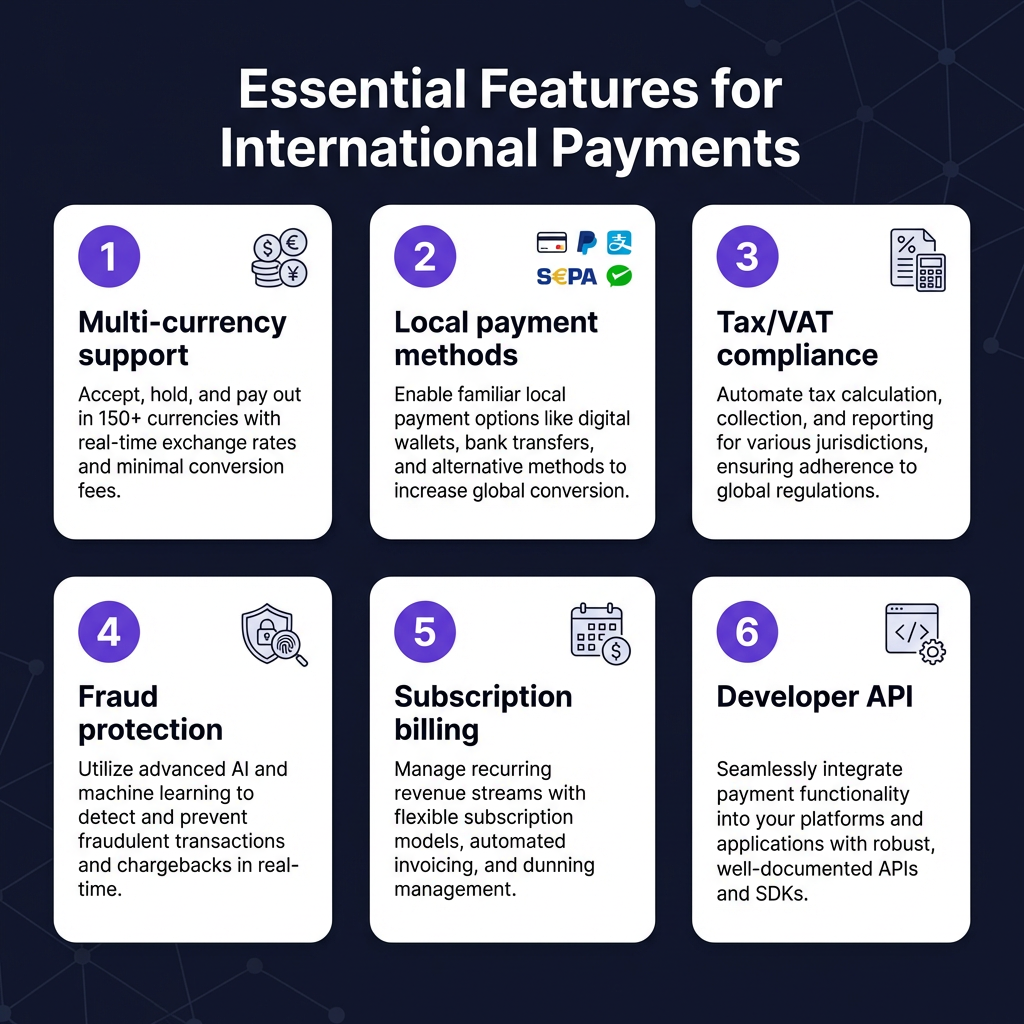
Before diving into specific platforms, let’s clarify what “international sales” actually requires. It’s not just about accepting credit cards from different countries. A truly global payment solution needs to handle:
- Multi-currency support — Let customers pay in their local currency while you settle in yours
- Local payment methods — iDEAL in the Netherlands, Alipay in China, Pix in Brazil
- Tax compliance automation — VAT, GST, and sales tax calculation and remittance
- Fraud protection — Different regions have different risk profiles
- Regulatory compliance — PSD2 in Europe, data residency requirements
Most payment processors handle the basics. But when you’re scaling internationally, the details matter. A gateway that works perfectly for US customers might fail miserably in India or Germany.
10 Best Payment Gateways for International Sales in 2026
After analyzing fees, features, and real-world performance across 50+ countries, here are the top payment gateways for businesses selling internationally. I’ve included both traditional processors and Merchant of Record platforms — because sometimes you need more than just payment processing.
1. Stripe — Best for Developer-Friendly Global Expansion
Stripe dominates the payment space for good reason. Their API is the gold standard, and they support 135+ currencies with local payment methods in 40+ countries. If you have a technical team and want full control over your checkout experience, Stripe is hard to beat.
- Transaction fees: 2.9% + 30¢ (US), 3.25% + 30¢ (international cards)
- Currency conversion: 1-2% additional fee
- Supported methods: Cards, Apple Pay, Google Pay, Alipay, iDEAL, SEPA, 40+ local options
- Best for: SaaS companies, marketplaces, businesses with developer resources
The catch? You’re responsible for tax compliance. Stripe will process payments globally, but calculating, collecting, and remitting VAT/GST is entirely on you. For many businesses, this overhead isn’t worth the slightly lower processing fees.
2. Adyen — Best for Enterprise-Scale International Operations
Adyen powers payments for Uber, Microsoft, and Netflix. Unlike Stripe, they operate as a direct acquirer in most markets — meaning faster settlements and lower decline rates. Their interchange++ pricing can actually save money at high volume.
- Transaction fees: Interchange++ (typically 2.5-3.5% all-in)
- Monthly minimum: Usually required (varies by volume)
- Supported methods: 300+ payment methods, 150+ currencies
- Best for: High-volume enterprises, omnichannel retailers
Adyen’s downside is accessibility. They focus on larger merchants, and their implementation requires significant technical investment. For startups and small SaaS companies, you might not meet their minimum volume requirements.
3. PayPal — Best for Consumer Trust and Quick Setup
Love it or hate it, PayPal has unmatched consumer recognition. In many countries, customers simply won’t buy without a PayPal option. Their One Touch checkout reduces friction significantly, especially on mobile.
- Transaction fees: 3.49% + 49¢ (domestic), 4.99% + fixed fee (international)
- Currency conversion: 3-4% spread
- Supported methods: PayPal, PayPal Credit, Venmo (US), cards
- Best for: E-commerce, businesses targeting consumers, quick market entry
The fees are higher, no question. But PayPal’s fraud protection and buyer trust can increase conversion rates enough to offset the cost. For international sales, their brand recognition is a genuine competitive advantage.
4. Fungies.io — Best for SaaS with Built-In Tax Compliance
Full disclosure: I’m writing for Fungies, but hear me out. Most payment gateways leave you holding the bag on global tax compliance. Fungies operates as a Merchant of Record — meaning they handle VAT, GST, and sales tax calculation, collection, and remittance automatically.
- Transaction fees: 5% + 50¢ (all-inclusive)
- Tax compliance: Included — handles 100+ countries
- Supported methods: Cards, Apple Pay, Google Pay, 50+ local methods
- Best for: SaaS founders, digital product sellers, businesses wanting hands-off compliance
That 5% fee includes a lot more than just processing. When you factor in the cost of tax software, compliance consultants, and the time spent on regulatory headaches, Fungies often works out cheaper than Stripe for international sales. Plus, you get subscription billing, fraud protection, and global payouts included.
5. FastSpring — Best for Digital Products and Software
FastSpring has been serving software companies since 2005. Like Fungies, they operate as a Merchant of Record, handling the legal and tax complexities of global sales. Their platform is specifically designed for digital goods, with features for subscriptions, trials, and license management.
- Transaction fees: 5.9% + 95¢ (or custom pricing for high volume)
- Tax compliance: Full Merchant of Record service
- Supported methods: Cards, PayPal, 20+ local payment options
- Best for: Software companies, game developers, digital product sellers
FastSpring’s higher fees make sense for businesses that want a fully managed solution without technical integration work. Their customer support is excellent, which matters when you’re dealing with payment issues across time zones.
6. 2Checkout (Verifone) — Best for Emerging Markets
2Checkout, now owned by Verifone, excels in markets where other gateways struggle. They support 200+ countries and 100+ currencies, with particularly strong coverage in Latin America, Eastern Europe, and Asia.
- Transaction fees: 3.5% + 35¢ (standard), 4.5% + 45¢ (premium)
- Tax compliance: Available as add-on service
- Supported methods: Cards, PayPal, 45+ local payment methods
- Best for: Businesses targeting emerging markets, global e-commerce
Their onboarding can be slower than competitors — expect document verification and compliance checks. But once approved, their global reach is genuinely impressive.
7. Paddle — Best for B2C SaaS and App Developers
Paddle has built a strong reputation in the indie SaaS community. Their Merchant of Record model handles tax compliance, and their platform includes subscription management, analytics, and affiliate tools.
- Transaction fees: 5% + 50¢
- Tax compliance: Full Merchant of Record service
- Supported methods: Cards, PayPal, Apple Pay, Google Pay
- Best for: B2C SaaS, app developers, subscription businesses
Paddle recently raised their prices and changed their pricing structure, which caused some controversy in the developer community. They’re still a solid choice, but worth comparing carefully against newer alternatives.
8. Mollie — Best for European Businesses
If your business is based in Europe, Mollie deserves serious consideration. They offer transparent pricing, excellent local payment method support, and none of the account stability issues that plague some global providers.
- Transaction fees: 1.8% + 30¢ (cards), varies by method
- No monthly fees: Pay per transaction only
- Supported methods: Cards, iDEAL, Bancontact, Giropay, 15+ European methods
- Best for: EU-based businesses, companies targeting European markets
Mollie’s limitation is geographic scope. They’re primarily focused on Europe, so if you’re selling globally, you might need additional providers for other regions.
9. Airwallex — Best for Multi-Currency Management
Airwallex combines payment processing with business banking features. You can hold 50+ currencies, convert at interbank rates, and pay suppliers globally without excessive fees.
- Transaction fees: 2.9% + 30¢ (cards), lower for local methods
- FX conversion: Near-interbank rates (0.3-0.5% spread)
- Supported methods: Cards, 160+ local payment methods
- Best for: Businesses with international suppliers, multi-currency operations
Their payment acceptance is solid, but the real value is in their broader financial platform. If you’re managing complex international cash flows, Airwallex can replace multiple tools.
10. Square — Best for Omnichannel International Sales
Square has evolved far beyond its POS roots. Their online payment processing now supports multiple currencies, and their in-person + online integration is seamless.
- Transaction fees: 2.9% + 30¢ (online), 2.6% + 10¢ (in-person)
- Supported markets: US, UK, Canada, Australia, Japan, select EU countries
- Supported methods: Cards, digital wallets, Cash App
- Best for: Retailers with physical locations, restaurants, service businesses
Square’s international coverage is more limited than competitors, but if you operate in their supported markets, the omnichannel experience is excellent.
Payment Gateway Comparison: Fees at a Glance
| Gateway | Transaction Fee | International Fee | Tax Compliance |
|---|---|---|---|
| Stripe | 2.9% + 30¢ | +1-2% FX | Not included |
| Adyen | Interchange++ (~2.5-3.5%) | Built-in | Not included |
| PayPal | 3.49% + 49¢ | +1.5% cross-border | Not included |
| Fungies | 5% + 50¢ | Included | Full MoR |
| FastSpring | 5.9% + 95¢ | Included | Full MoR |
| 2Checkout | 3.5% + 35¢ | +1% | Add-on |
| Paddle | 5% + 50¢ | Included | Full MoR |
| Mollie | 1.8% + 30¢ | +1-2% FX | Not included |
Looking at raw processing fees alone is misleading. When you factor in the cost of tax compliance software (typically $200-500/month), fraud prevention tools, and the operational overhead of managing multiple providers, Merchant of Record platforms often deliver better total cost of ownership for international sales.
How to Choose the Right Gateway for Your Business
With so many options, how do you actually decide? Here’s my framework for evaluating payment gateways for international sales:
Step 1: Calculate Your True Transaction Volume
Don’t just look at total revenue — break down by country and payment method. If 60% of your sales are US-based cards, Stripe’s competitive domestic rates matter more. If you’re selling equally across 20 countries, tax compliance becomes critical.
Step 2: Assess Your Tax Compliance Burden
Selling to EU customers? You need VAT compliance. Selling to Australia? GST registration required. Each jurisdiction has different thresholds and rules. If you don’t have a finance team dedicated to global tax, a Merchant of Record platform will save you significant headaches.
Step 3: Evaluate Local Payment Method Needs
Credit cards dominate in the US and UK. But in Germany, 40% of online purchases use bank transfers. In Brazil, Pix is essential. In China, you need Alipay and WeChat Pay. Make sure your gateway supports the payment methods your target customers actually use.
Step 4: Consider Your Technical Resources
Stripe and Adyen offer maximum flexibility but require developer time to implement properly. Merchant of Record platforms like Fungies and Paddle provide hosted checkouts that work out of the box. Be realistic about what your team can support.
Hidden Costs Most Founders Miss
When comparing payment gateways, look beyond the headline rate. Here are the hidden costs that catch businesses off guard:
- Currency conversion spreads: Some gateways charge 3-4% above the interbank rate
- Cross-border fees: Additional 1-1.5% for international card transactions
- Chargeback fees: $15-25 per dispute, plus the time to respond
- Failed payment recovery: Dunning management tools often cost extra
- Tax compliance software: Avalara, TaxJar, or similar ($200-1000/month)
- Compliance consulting: VAT registration and filing services ($500-2000/year per country)
A gateway charging 2.9% can easily become 5%+ when you add up all the extras. This is why all-inclusive pricing from Merchant of Record platforms can be genuinely cost-effective.
FAQ: Payment Gateways for International Sales
What’s the cheapest payment gateway for international sales?
For pure processing fees, Mollie and Stripe offer the lowest rates (1.8-2.9% + fixed fee). However, when you include tax compliance, currency conversion, and fraud protection costs, Merchant of Record platforms like Fungies (5% all-inclusive) often work out cheaper overall. The answer depends on your specific volume, markets, and operational capabilities.
Do I need a Merchant of Record or just a payment processor?
If you’re only selling domestically or in 1-2 countries with simple tax rules, a payment processor like Stripe is fine. Once you’re selling to 5+ countries with different VAT/GST requirements, a Merchant of Record saves significant time and compliance risk. The break-even point is usually around $50K/month in international revenue.
Can I use multiple payment gateways?
Absolutely. Many businesses use Stripe for US/Canada customers (lower fees) and a Merchant of Record for international transactions (tax compliance). You can also offer PayPal alongside your primary gateway since some customers simply prefer it. Just ensure your accounting system can reconcile multiple payment sources.
What’s the best payment gateway for SaaS subscriptions?
For SaaS, you need more than just payment processing — you need subscription management, dunning (failed payment recovery), and usage-based billing support. Stripe Billing, Chargebee, or Merchant of Record platforms like Fungies and Paddle are designed specifically for recurring revenue models.
How do I handle taxes when selling internationally?
You have three options: 1) Use a Merchant of Record that handles taxes for you, 2) Integrate tax calculation software (Avalara, TaxJar) with your payment gateway, or 3) Register and file taxes manually in each jurisdiction. Option 1 is easiest, Option 2 is most flexible, Option 3 is only viable for very small volumes.
Final Thoughts: Making the Right Choice
There’s no single “best” payment gateway for international sales. The right choice depends on your business model, target markets, technical resources, and risk tolerance.
If you’re a developer-heavy SaaS team with simple tax needs, Stripe or Adyen gives you maximum control. If you want to sell globally without hiring a finance team, a Merchant of Record like Fungies, Paddle, or FastSpring is the smarter choice.
My advice? Start with your customer. Where are they located? How do they want to pay? What payment methods do they trust? Build your payment strategy around those answers, not just the lowest processing fee.
Ready to start selling globally without the compliance headaches? Create your free Fungies account and launch in 100+ countries with built-in tax compliance, subscription billing, and fraud protection — all under one flat rate.