Here’s a stat that’ll make you pause: the global recurring billing software market hit $12 billion in 2025 and is growing at 8-9% annually. Yet 40% of subscription businesses still lose revenue to failed payments and involuntary churn. If you’re running a small business with subscription revenue, your billing software isn’t just a back-office tool—it’s the engine that keeps cash flowing.
I’ve spent years evaluating payment infrastructure for SaaS companies. The truth? Most small businesses overpay for features they don’t need or pick tools that break when they scale. This guide cuts through the noise. I’ll compare the 10 best recurring billing software options for small businesses in 2026, with real pricing, actual feature comparisons, and honest assessments of who each tool is really for.
What Is Recurring Billing Software?
Recurring billing software automates the process of charging customers on a regular schedule—weekly, monthly, annually, or whatever interval your business requires. But modern tools do far more than just process payments. They handle subscription management, dunning (failed payment recovery), tax calculation, revenue recognition, and integration with your accounting stack.
The market splits into two camps: pure billing platforms (Stripe, Chargebee) that focus exclusively on subscriptions, and broader business suites (QuickBooks, Zoho) that include billing as one feature among many. For small businesses, the right choice depends on your complexity, growth trajectory, and technical resources.
Why Your Choice of Billing Software Matters
Pick the wrong tool, and you’ll face a painful migration down the road. Here’s what the data shows:
- Checkout abandonment averages 70-80% for digital products, with unexpected costs and complicated forms driving most drop-offs
- Involuntary churn—customers who leave because their payment failed—accounts for up to 40% of all subscription churn
- Payment retry logic can recover 45% of failed payments when done intelligently
- Mobile abandonment hits 86% vs. 73% on desktop, making mobile-optimized checkout critical
The right billing software doesn’t just process payments—it actively works to reduce churn, recover revenue, and scale with your business.
10 Best Recurring Billing Software for Small Business (2026)
I’ve evaluated these platforms based on pricing transparency, feature depth, ease of integration, and real-world suitability for small businesses. Here are my top 10 picks.
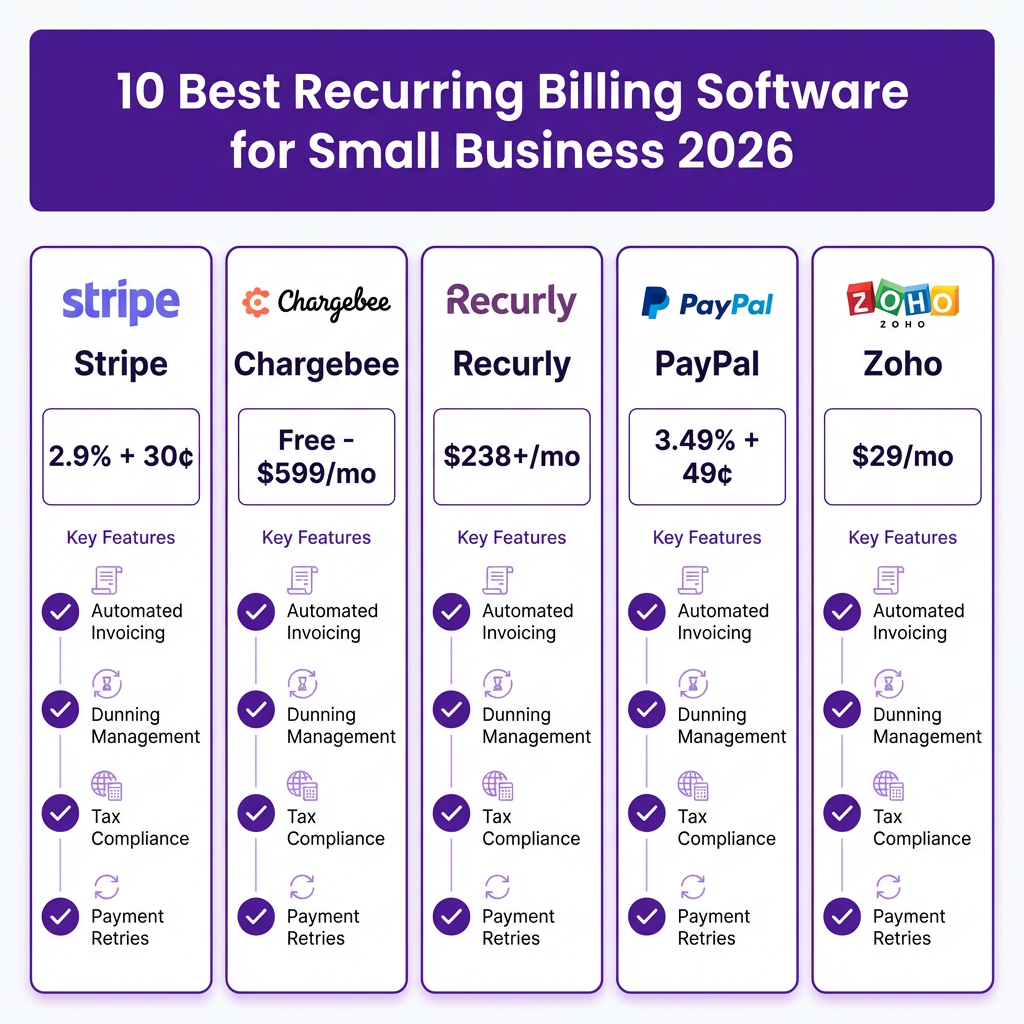
1. Stripe Billing — Best for Developer-First SaaS
Stripe needs no introduction. It’s the default choice for tech-savvy founders, and for good reason. Stripe Billing integrates seamlessly with the broader Stripe ecosystem, supporting 135+ payment methods and 100+ currencies.
Key features:
- Support for flat-rate, tiered, usage-based, and hybrid pricing models
- AI-powered Smart Retries that recover millions in failed payments
- Stripe Tax for automated VAT/GST/sales tax in 100+ jurisdictions
- Native Revenue Recognition for ASC 606/IFRS 15 compliance
- 135+ payment methods and extensive global coverage
Pricing: 0.5% of recurring volume on pay-as-you-go, or flat-rate plans starting at $620/month. Payment processing is 2.9% + $0.30 per transaction.
Best for: Tech-forward SaaS companies that need flexible, API-first billing and plan to scale globally.
2. Chargebee — Best All-Rounder for Growing SaaS
Chargebee strikes the best balance between power and usability. Its Product Catalog 2.0 lets non-technical teams configure complex pricing without engineering help—a huge advantage for small businesses.
Key features:
- Product Catalog 2.0 for no-code pricing configuration
- 35+ payment gateway integrations (not locked to Stripe)
- Built-in dunning with configurable retry logic
- Avalara tax integration for global compliance
- Revenue Recognition add-on for accounting compliance
Pricing: Free Starter tier up to $250K cumulative billing. Performance plan at $599/month + 0.75% overage beyond $100K MRR.
Best for: Small to mid-market SaaS that wants powerful subscription management without building everything in-house.
3. Recurly — Best for High-Volume Subscription Businesses
Recurly has processed over $16 billion in annual subscription volume and boasts a 99.5% uptime SLA. Their AI-driven recovery tools are industry-leading.
Key features:
- AI-powered churn mitigation and Smart Dunning (45% recovery rate)
- 99.5% uptime SLA with credits for downtime
- Support for 140+ currencies and 20+ payment gateways
- Advanced Revenue Recognition and reporting dashboards
- Recurly Compass AI agents for workflow automation
Pricing: Starter at $238/month + 1.25% + $0.10 per transaction. Professional at $399/month + 1.5% + $0.10.
Best for: High-growth subscription businesses that need enterprise-grade reliability and advanced recovery features.
4. PayPal — Best for Quick Setup and Brand Trust
PayPal’s subscription features are basic compared to dedicated billing platforms, but its brand recognition and one-click checkout can boost conversion rates—especially for consumer-facing products.
Key features:
- One-click PayPal checkout with 200+ million active accounts
- Built-in buyer protection reduces chargeback risk
- Basic subscription management and retry logic
- Global reach in 200+ markets
- No monthly fees—pay only per transaction
Pricing: 3.49% + $0.49 per USD transaction. Higher rates for international payments.
Best for: Small businesses just starting with subscriptions that want minimal setup friction and maximum consumer trust.
5. Zoho Billing — Best Budget Option
Zoho Billing offers surprising depth for its price point. If you’re already in the Zoho ecosystem, it’s a no-brainer. Even as a standalone product, it competes well with pricier alternatives.
Key features:
- Free tier up to $5K monthly billing
- Tight integration with Zoho CRM, Books, and Desk
- Support for fixed, tiered, and usage-based billing
- Basic self-service customer portal
- Multi-currency support
Pricing: Free up to $5K/month. Paid plans start at $29/month flat—no per-transaction fees.
Best for: Bootstrapped startups and small businesses that need functional billing without breaking the bank.
6. Square — Best for Omnichannel Businesses
Square shines if you sell both online and in-person. Its unified system handles POS and online subscriptions in one place—rare among dedicated billing platforms.
Key features:
- Unified POS and online payment processing
- Subscription management with card-on-file
- Instant transfers to bank accounts
- Customizable checkout UI
- Free invoicing software included
Pricing: 2.9% + $0.30 for online payments. No monthly fees for basic features.
Best for: Small businesses with both physical and digital sales that want one system for everything.
7. GoCardless — Best for B2B and Direct Debit
GoCardless specializes in bank debit (ACH, SEPA, Bacs)—the payment method with the lowest failure rates and fees. For B2B subscriptions, this can mean significant savings.
Key features:
- Direct debit in 30+ countries with 97% first-time success rate
- “Success+” AI-driven retry optimizer
- Lower fees than card processing (0.5% + $0.05)
- Integration with Xero, QuickBooks, and major accounting tools
- Direct Debit Guarantee protects against failed pulls
Pricing: Standard: 0.5% + $0.05 (max $5). Advanced: 0.75% + $0.05. Pro: 0.9% + $0.05.
Best for: B2B SaaS and service businesses where customers prefer bank transfers over cards.
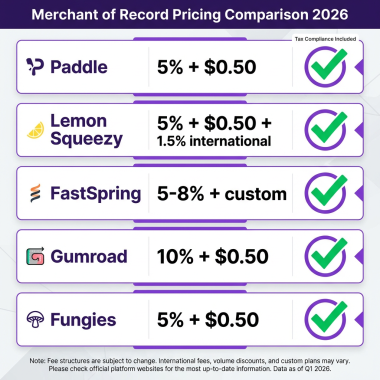
8. Paddle — Best for Merchant-of-Record Simplicity
Paddle acts as the merchant of record, handling payments, tax compliance, and fraud prevention in one package. This simplifies operations but comes with less flexibility.
Key features:
- Merchant-of-record model handles tax compliance globally
- Built-in subscription management and dunning
- SOC 2 Type 2 certified
- Support for 200+ countries
- Flat-rate pricing (custom quotes)
Pricing: Custom flat-rate pricing based on volume. Typically higher than Stripe but includes tax handling.
Best for: Digital product sellers who want to outsource compliance complexity entirely.
9. FastSpring — Best for Digital Goods and Software
FastSpring focuses specifically on software and digital products. Its merchant-of-record model and global tax handling make it popular with indie developers and software companies.
Key features:
- Merchant-of-record with global tax compliance
- Hosted checkout with localization
- Subscription and one-time purchase support
- Affiliate management built-in
- 200+ country support
Pricing: Transaction-based, typically around 4.9% + $0.30 per transaction. No monthly fees.
Best for: Software companies and digital product sellers wanting a complete commerce solution without building infrastructure.
10. Wave — Best Free Option for Basic Needs
Wave offers genuinely free invoicing and accounting software. While its recurring billing features are basic, they’re sufficient for simple subscription models and service businesses.
Key features:
- Completely free invoicing and accounting
- Recurring invoice scheduling
- Credit card and bank payment acceptance
- Basic customer management
- Mobile app for on-the-go invoicing
Pricing: Free for invoicing and accounting. Pay only payment processing fees (2.9% + $0.30 for cards).
Best for: Freelancers and micro-businesses with simple recurring billing needs and tight budgets.
Feature Comparison Table
| Platform | Starting Price | Free Tier | Usage-Based | Tax Automation | Best For |
|---|---|---|---|---|---|
| Stripe | 0.5% + 2.9%+30¢ | No | Yes | Yes (Stripe Tax) | Developer-first SaaS |
| Chargebee | Free / $599/mo | Yes ($250K) | Yes | Yes (Avalara) | Growing SaaS |
| Recurly | $238/mo + 1.25% | No | Yes | Yes | High-volume subs |
| PayPal | 3.49% + 49¢ | Yes | No | Basic | Quick setup |
| Zoho | $29/mo | Yes ($5K/mo) | Yes | Limited | Budget-conscious |
| Square | 2.9% + 30¢ | Yes | Limited | No | Omnichannel |
| GoCardless | 0.5% + 5¢ | No | No | No | B2B direct debit |
| Paddle | Custom flat rate | No | Yes | Yes (MoR) | Digital products |
| FastSpring | ~4.9% + 30¢ | No | Yes | Yes (MoR) | Software sales |
| Wave | Free + processing | Yes | No | No | Freelancers |
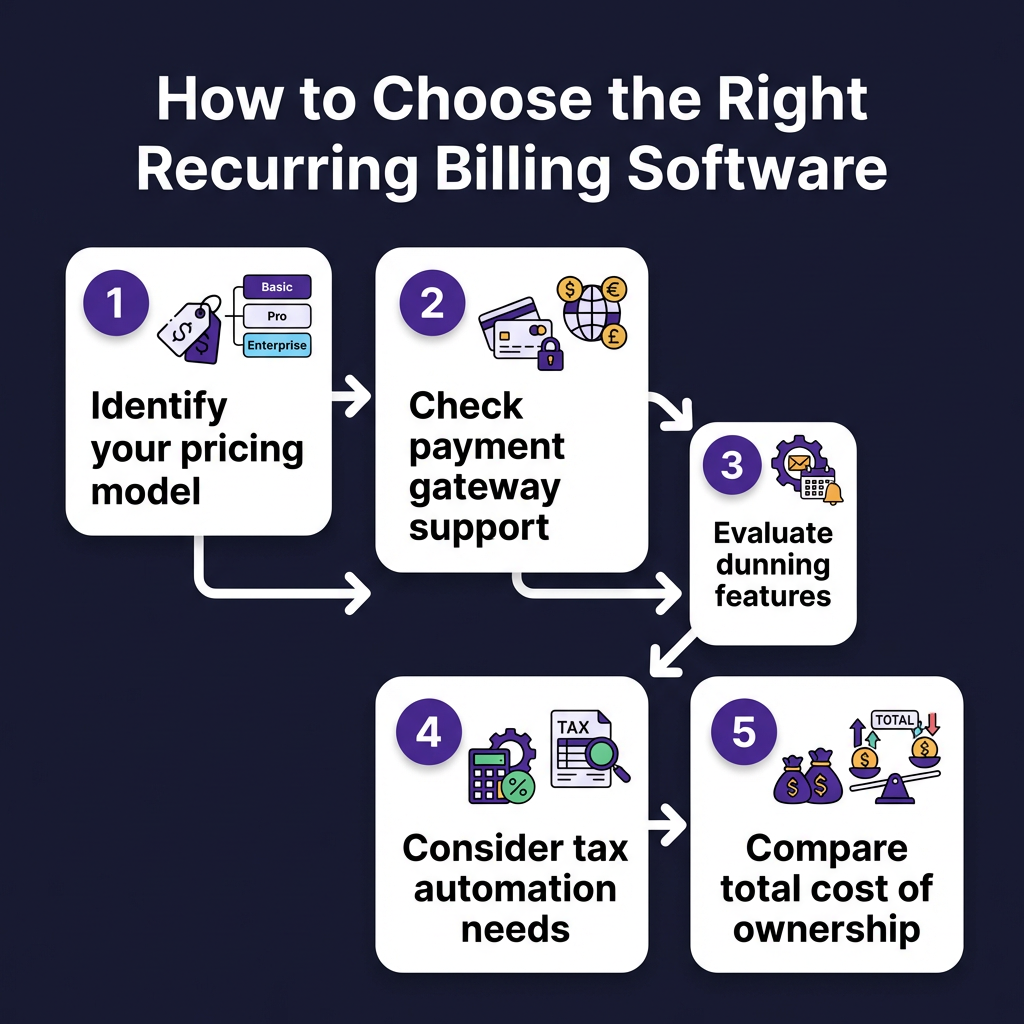
How to Choose the Right Recurring Billing Software
With ten solid options, how do you pick? Here’s my decision framework:
1. Identify Your Pricing Model
Simple flat-rate subscriptions? Most platforms handle this. Usage-based or hybrid pricing? You’ll need Stripe, Chargebee, or Recurly. Complex enterprise contracts with ramps and milestones? Look at Chargebee or specialized tools like Maxio.
2. Check Payment Gateway Support
Stripe locks you into their ecosystem. Chargebee gives you 35+ gateway options. If you have specific regional payment method requirements, this matters more than you think.
3. Evaluate Dunning and Recovery Features
Failed payments kill subscription businesses. Recurly leads here with AI-driven recovery. Stripe’s Smart Retries are solid. Basic tools like Wave or PayPal offer minimal recovery help.
4. Consider Tax Automation Needs
Selling globally? You need automated tax calculation and remittance. Stripe Tax, Chargebee’s Avalara integration, or merchant-of-record solutions (Paddle, FastSpring) handle this. Simple domestic businesses might not need it.
5. Calculate Total Cost of Ownership
Don’t just look at monthly fees. Factor in:
- Payment processing fees (typically 2.9% + $0.30)
- Platform fees (percentage of revenue or flat monthly)
- Add-on costs (tax, revenue recognition, advanced features)
- Engineering time for integration and maintenance
FAQ: Recurring Billing Software for Small Business
What’s the difference between recurring billing and subscription management?
Recurring billing focuses on the payment processing side—charging cards, handling failures, and managing invoicing. Subscription management is broader, covering plan changes, proration, customer lifecycle, and access control. Most modern platforms combine both.
Can I switch billing platforms later?
Yes, but it’s painful. You’ll need to migrate customer payment methods (often requiring customers to re-enter cards), transfer subscription data, and reconcile historical records. Choose a platform that can scale with you for at least 2-3 years to avoid early migration.
Do I need a developer to set up recurring billing?
It depends. Stripe and Recurly require technical integration. Chargebee, Zoho, and PayPal offer no-code setup options for basic use cases. If you have a WordPress site or use Shopify, there are plug-and-play solutions too.
What’s merchant of record (MoR) and do I need it?
A merchant of record handles payments, tax compliance, and fraud prevention as the legal seller. Platforms like Paddle and FastSpring act as MoR, simplifying your operations but at higher fees. You need it if you want to outsource compliance complexity, especially for global sales.
How much should I budget for recurring billing software?
For a small business doing $10K/month in subscription revenue, expect to pay $100-400/month in total fees (platform + payment processing). At $100K/month, budget $1,000-2,000/month. Enterprise-level tools with custom pricing can negotiate better rates at scale.
Conclusion: Start Simple, Plan to Scale
Honestly, most small businesses overthink this decision. If you’re just starting, pick a tool that gets you live this week—not the one with every feature you might need in three years. Zoho’s free tier, PayPal’s simplicity, or Stripe’s pay-as-you-go model all work for early-stage businesses.
As you grow, your needs will clarify. You’ll know if you need usage-based billing, advanced dunning, or global tax support. The good news: all the platforms I’ve reviewed can scale to millions in revenue. The key is picking one that matches your current complexity without locking you into limitations you’ll hit in six months.
For SaaS founders specifically, I’d recommend starting with Fungies if you want a complete merchant-of-record solution that handles payments, tax, and compliance in one simple integration. It’s built for digital product sellers who want to focus on growth, not billing infrastructure.