Here’s a number that should wake you up: DeepSeek V3.2 costs $0.28 per million output tokens, while OpenAI’s GPT-5 Pro costs $120. That’s not a typo. That’s a 428x price difference for AI models that are closer in capability than most developers realize.
If you’re building AI-powered features into your SaaS, choosing the wrong LLM API can burn through your runway before you hit product-market fit. In 2026, with over 311 models available across OpenAI, Anthropic, Google, DeepSeek, and others, the pricing landscape is more complex—and more exploitable—than ever.
This guide breaks down the real costs, quality scores, and value rankings you need to make smart API decisions. No marketing fluff. Just numbers.
Why LLM API Pricing Matters More Than Ever
By mid-2026, 85% of developers regularly use AI tools for coding. But here’s what changed: AI features are no longer experimental—they’re core product functionality. And that means API costs moved from “R&D expense” to “cost of goods sold.”
Consider this scenario: Your SaaS processes 10,000 user queries daily, each averaging 500 input tokens and 800 output tokens. With GPT-5 Pro, that’s roughly $1,140 per day in API costs. With DeepSeek V3.2, it’s $4.06. Over a year, that’s $416,000 vs $1,482—for the same volume.
The quality gap? Measurable but narrowing. Claude Opus 4.6 scores 100 on quality benchmarks. DeepSeek V3.2 scores 79. Is that 21-point difference worth 428x the cost? For many use cases, absolutely not.
How LLM API Pricing Works
Before diving into comparisons, you need to understand the pricing mechanics:
- Input tokens (your prompts, context, instructions): Cheaper because they only need to be processed once
- Output tokens (the model’s response): 2-5x more expensive because each token requires a full forward pass through the model
- Context window: Larger windows let you send more data per request but increase proportional costs
Most providers quote prices per million tokens. A typical API call might use 1,000-5,000 tokens total. Scale that to thousands of daily users, and your choice of provider becomes a strategic business decision.
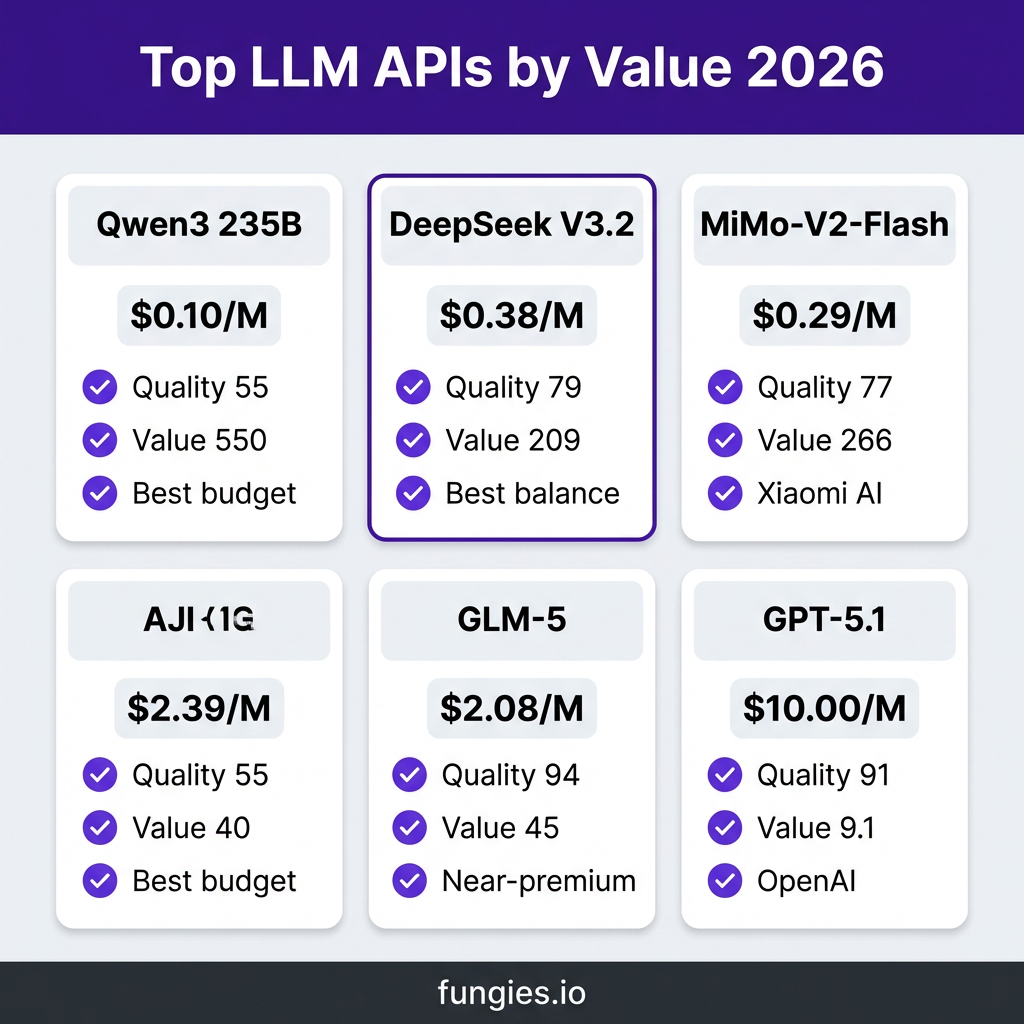
Top 10 LLM APIs Ranked by Value (Quality Per Dollar)
Value score = quality points per $1 of output cost. Higher is better. These rankings come from live pricing data as of April 2026.
| Rank | Model | Provider | Quality Score | Output Cost (per 1M) | Value Score |
|---|---|---|---|---|---|
| 1 | Qwen3 235B | Qwen | 55 | $0.10 | 550.0 |
| 2 | Llama 3.1 8B | Meta | 23 | $0.05 | 460.0 |
| 3 | Llama 3 8B | Meta | 17 | $0.04 | 425.0 |
| 4 | GPT-OSS 120B | OpenAI | 62 | $0.19 | 326.3 |
| 5 | GPT-OSS 20B | OpenAI | 45 | $0.14 | 321.4 |
| 6 | MiMo-V2-Flash | Xiaomi | 77 | $0.29 | 265.5 |
| 7 | DeepSeek V3.2 | DeepSeek | 79 | $0.38 | 209.0 |
| 8 | Kimi K2.5 | Moonshot AI | 89 | $2.00 | 44.5 |
| 9 | GLM-5 | Z.AI | 94 | $2.08 | 45.2 |
| 10 | GPT-5.1 | OpenAI | 91 | $10.00 | 9.1 |
The pattern is clear: Chinese providers (Qwen, DeepSeek, Xiaomi) dominate the value rankings. OpenAI’s newer open-source models (GPT-OSS) offer competitive value, but their flagship GPT-5 series ranks near the bottom for cost efficiency.
Premium Tier: When Quality Trumps Cost
Sometimes you need the absolute best output, regardless of price. Here’s how the premium tier stacks up:
| Model | Provider | Quality | Input (per 1M) | Output (per 1M) | Context |
|---|---|---|---|---|---|
| Claude Opus 4.6 | Anthropic | 100 | $5.00 | $25.00 | 1.0M |
| GPT-5.2 | OpenAI | 96 | $1.75 | $14.00 | 400K |
| GPT-5.2 Pro | OpenAI | 96 | $21.00 | $168.00 | 400K |
| GLM-5 | Z.AI | 94 | $0.60 | $2.08 | 203K |
| GPT-5.1 | OpenAI | 91 | $1.25 | $10.00 | 400K |
| Gemini 3 Pro | 91 | $2.00 | $12.00 | 66K |
Key insight: GLM-5 delivers 94% of Claude Opus’s quality at 8% of the output cost. If you’re building a premium AI feature and need top-tier quality, GLM-5 is the cost-optimized choice. Claude Opus 4.6 only makes sense when you need that final 6% of quality and have the budget to pay 12x more for it.
Provider Deep Dive: What You Get at Each Tier
OpenAI: The Safe Choice (With a Premium)
OpenAI’s pricing spans the widest range. Their GPT-OSS models (open-source) offer excellent value at $0.14-$0.19 per million output tokens. But their flagship GPT-5 series commands premium prices—up to $168 per million for GPT-5.2 Pro.
Best for: Teams that prioritize reliability and brand recognition over cost optimization. OpenAI’s infrastructure is battle-tested, and their models consistently rank in the top 3 for quality.
Anthropic: Quality Leader, Price Follower
Claude Opus 4.6 sits at the top of the quality leaderboard with a perfect 100 score. But that quality comes at $25 per million output tokens—second only to GPT-5.2 Pro in price. Claude Sonnet 4.5 offers a middle ground at $15 per million with an 81 quality score.
Best for: Use cases where output quality directly impacts revenue—legal document analysis, medical applications, high-stakes content generation.
DeepSeek: The Value Champion
DeepSeek V3.2 delivers a 79 quality score at just $0.38 per million output tokens. That’s 209x cheaper than Claude Opus for 79% of the quality. Their pricing has forced the entire industry to reconsider cost structures.
Best for: High-volume applications where good-enough quality is sufficient—chatbots, content summarization, internal tools, prototyping.
Google Gemini: The Context King
Gemini 3 Flash offers a 1 million token context window at just $3 per million output tokens. No other major provider matches this combination of context size and price. Gemini 3 Pro delivers 91 quality at $12 per million.
Best for: Applications processing large documents—legal contracts, research papers, codebase analysis, long-form content generation.
Chinese Providers (Qwen, Xiaomi, Moonshot): The Disruptors
Qwen’s 235B model tops the value rankings with a 550 value score. Xiaomi’s MiMo-V2-Flash delivers 77 quality at $0.29 per million. Moonshot’s Kimi K2.5 scores 89 quality at $2.00 per million. These providers are reshaping price expectations.
Best for: Cost-conscious teams willing to work with emerging providers. Note: Some enterprises have compliance concerns with Chinese-hosted models—verify your requirements.
Real-World Cost Scenarios
Let’s put these numbers into context with three common SaaS scenarios:
Scenario 1: Customer Support Chatbot
Volume: 50,000 conversations/month, 1,000 tokens average per conversation (500 input, 500 output)
| Model | Monthly Cost | Annual Cost |
|---|---|---|
| DeepSeek V3.2 | $31.50 | $378 |
| GPT-5.1 | $656.25 | $7,875 |
| Claude Opus 4.6 | $1,500 | $18,000 |
Scenario 2: AI Writing Assistant
Volume: 10,000 documents/month, 3,000 tokens average (1,000 input, 2,000 output)
| Model | Monthly Cost | Annual Cost |
|---|---|---|
| DeepSeek V3.2 | $95 | $1,140 |
| GPT-5.1 | $2,187.50 | $26,250 |
| Claude Opus 4.6 | $5,000 | $60,000 |
Scenario 3: Code Generation API
Volume: 100,000 code completions/month, 2,000 tokens average (500 input, 1,500 output)
| Model | Monthly Cost | Annual Cost |
|---|---|---|
| DeepSeek V3.2 | $71.25 | $855 |
| GPT-5.1 | $1,562.50 | $18,750 |
| Claude Opus 4.6 | $3,750 | $45,000 |
The pattern is consistent: DeepSeek costs 15-20x less than GPT-5.1 and 40-50x less than Claude Opus. For bootstrapped SaaS founders, that’s the difference between profitable unit economics and burning cash.
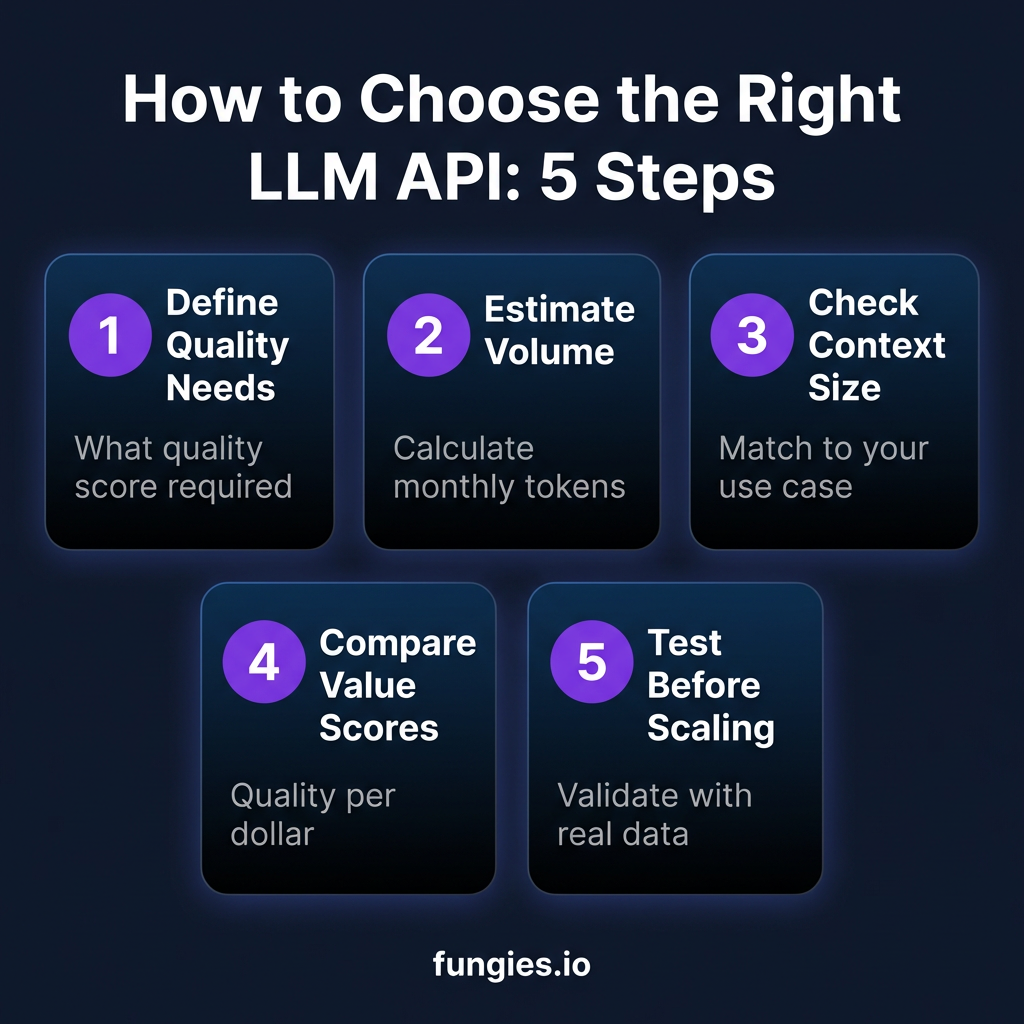
Key Takeaways: How to Choose Your LLM API
- For prototypes and MVPs: Start with DeepSeek V3.2 or Qwen3. Get 75-80% of premium quality at 5% of the cost.
- For production SaaS with tight margins: Use GPT-OSS 120B or GLM-5. Quality scores above 90 with reasonable pricing.
- For premium features where quality sells: Claude Opus 4.6 or GPT-5.2. Justify the cost through higher conversion or retention.
- For document-heavy applications: Gemini 3 Flash. The 1M context window is unmatched for the price.
- For coding assistants: GPT-5.2-Codex or Claude Sonnet 4.5. Code quality matters more than raw benchmark scores.
Frequently Asked Questions
What’s the cheapest LLM API for high-volume usage?
DeepSeek V3.2 at $0.38 per million output tokens offers the best balance of quality (79) and cost. For pure cost optimization, Qwen3 235B at $0.10 per million is the cheapest option with acceptable quality (55).
Is GPT-5 worth the premium over GPT-5.1?
GPT-5.2 scores 96 quality vs GPT-5.1’s 91—a 5.5% improvement. But GPT-5.2 costs 40% more per token. For most applications, GPT-5.1 offers better value. Only upgrade to GPT-5.2 if you can measure the quality difference in your specific use case.
Are Chinese LLM APIs safe to use?
From a technical standpoint, yes—DeepSeek, Qwen, and Moonshot offer reliable APIs with good uptime. From a compliance standpoint, verify your industry’s data residency requirements. Some enterprises restrict data processing to specific regions. Always review the provider’s data handling policies.
How do I estimate my LLM API costs?
Calculate: (Input tokens × Input price + Output tokens × Output price) × Monthly requests. Most applications use 2-4x more output tokens than input. Add 20% buffer for retries and error handling. Tools like CostGoat offer real-time calculators with your actual usage patterns.
Should I use multiple LLM providers?
Yes. Many teams use a tiered approach: cheap models (DeepSeek) for initial filtering and routing, mid-tier (GPT-5.1) for standard requests, and premium (Claude Opus) for high-value interactions. This “model routing” strategy can cut costs 60-80% while maintaining quality.
Conclusion: Make Cost a Feature, Not a Bug
LLM API pricing isn’t just an operational detail—it’s a competitive advantage. The teams building profitable AI features in 2026 are the ones who treat model selection as seriously as they treat product design.
Start with value-ranked models for 80% of your use cases. Reserve premium APIs for the 20% where quality directly impacts revenue. Monitor your costs weekly, not monthly. And always be testing—this market moves fast, and yesterday’s expensive model is today’s budget option.
Building a SaaS that needs global payments, tax compliance, and a smooth checkout? Get started with Fungies—we handle the financial infrastructure so you can focus on choosing the right AI models.
References
- CostGoat LLM API Pricing Comparison – Live pricing data for 311+ models
- Faros AI: Best AI Coding Agents 2026 – Developer productivity research
- BenchLM: LLM API Pricing Comparison 2026 – Quality benchmarking methodology
- CloudIDR: LLM API Pricing 2026 – OpenAI vs Anthropic vs Gemini comparison
- PE Collective: Cross-Provider LLM API Pricing – Enterprise cost analysis
- JetBrains Developer Ecosystem 2025 – AI adoption statistics