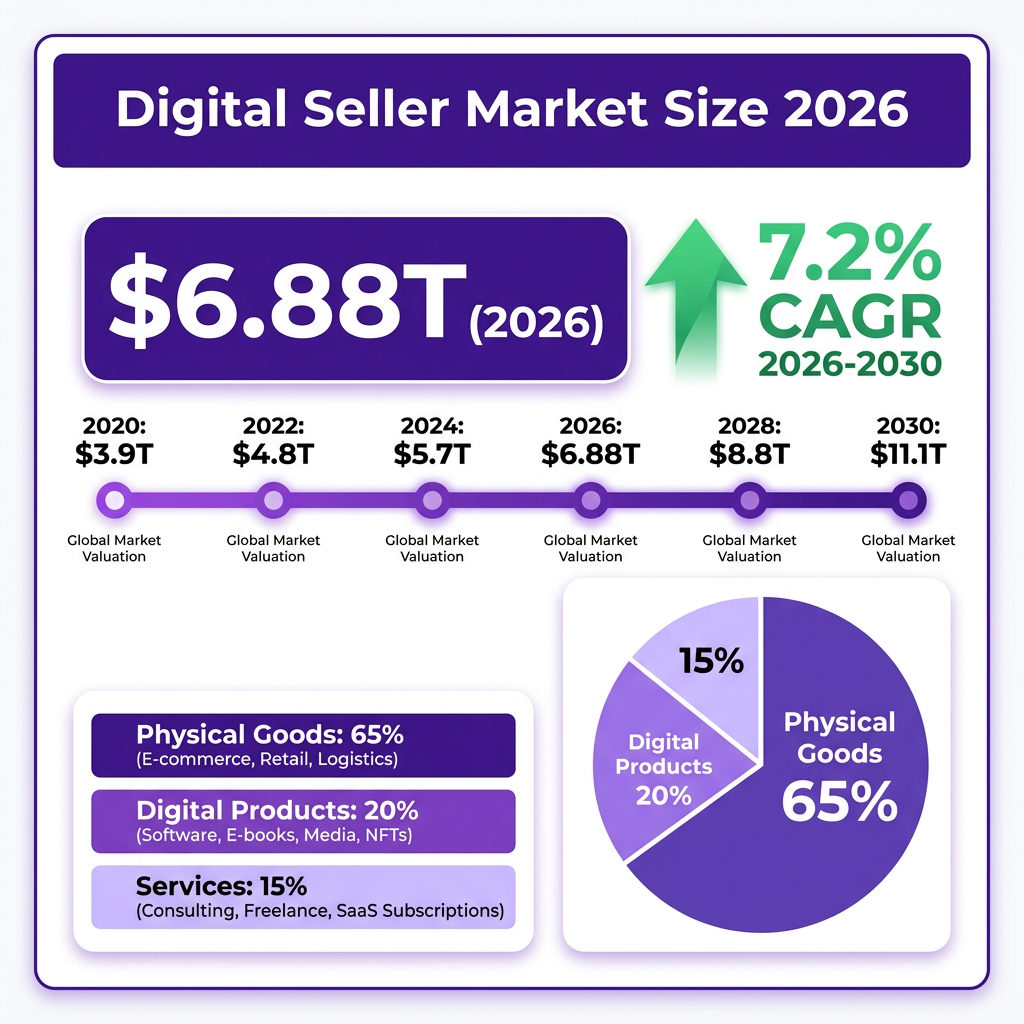
The digital selling revolution has reached unprecedented scale. In 2026, global e-commerce sales are projected to hit $6.88 trillion, representing a 7.2% year-over-year increase from 2025’s $6.42 trillion figure. With over 2.86 billion digital buyers expected to make purchases online this year, the digital seller ecosystem has become the dominant force in global retail, accounting for more than 20% of total global retail sales. For entrepreneurs, established businesses, and independent creators, understanding the digital seller landscape isn’t optional—it’s essential for survival and growth in the modern economy.
But this isn’t just about big numbers. The digital selling landscape is undergoing fundamental transformation. AI-powered selling tools are reshaping how merchants interact with customers. Social commerce is exploding, with platforms like TikTok and Instagram becoming primary sales channels. Cross-border e-commerce is breaking down geographical barriers, while new regulations are changing how sellers operate across borders. Whether you’re selling physical products, digital downloads, or subscription services, the rules of engagement have changed—and they’re continuing to evolve at breakneck speed.

Market Overview: The $6.88 Trillion Digital Seller Ecosystem
The digital seller market in 2026 represents one of the most significant economic shifts in modern history. What began as a niche channel for tech-savvy early adopters has evolved into the primary retail infrastructure for the global economy. Understanding this market requires examining its scale, growth trajectory, and the forces driving its expansion.
The Scale of Global E-Commerce
The numbers tell a compelling story. Global e-commerce revenue is projected to reach $3.88 trillion in 2026 according to Statista’s market forecast, with the broader e-commerce ecosystem—including all digital transactions—reaching the $6.88 trillion mark. This represents a fundamental shift in how commerce operates, with digital channels now accounting for over one-fifth of all retail sales worldwide.
The United States leads in absolute market volume, with projected e-commerce revenue of $1.22 trillion in 2026. However, the growth story is truly global. Asia-Pacific markets continue to expand rapidly, with China maintaining its position as the world’s largest e-commerce market by volume. Europe represents a mature but growing market, while emerging economies in Africa, Latin America, and Southeast Asia are experiencing explosive digital adoption rates that are creating entirely new seller opportunities.
The user base is equally impressive. By 2026, over 2.86 billion people are expected to shop online globally—representing more than 33% of the world’s population. User penetration is projected at 54.3% in 2026, climbing to 58.1% by 2030. This means that more than half of all internet users are now active digital buyers, and that number continues to grow as internet access expands into previously underserved regions.
Growth Trajectory and Projections
The digital seller market shows no signs of slowing. The compound annual growth rate (CAGR) for e-commerce is projected at 6.84% through 2030, which would push the market volume to $5.05 trillion by the end of the decade. This sustained growth is driven by several factors: increasing internet penetration in developing markets, the continued shift of traditional retail online, and the emergence of new product categories and sales channels.
Looking further ahead, U.S. e-commerce sales alone are expected to reach $1.8 trillion by 2030, representing 29% of all retail sales in the country according to Forrester research. While this suggests that over 70% of retail will still occur in physical stores, the growth trajectory clearly favors digital channels. For sellers, this means that establishing a robust digital presence is no longer a growth strategy—it’s a defensive necessity.
The average revenue per user (ARPU) in e-commerce is expected to reach $1,100 in 2026, indicating that not only are more people shopping online, but they’re also spending more per transaction. This metric is particularly important for sellers evaluating market opportunity and pricing strategies. Higher ARPU suggests that consumers are becoming more comfortable with larger online purchases, opening opportunities for premium products and higher-value transactions.
Market Segmentation
The digital seller market isn’t monolithic. It comprises several distinct segments, each with its own dynamics and opportunities. Physical goods still dominate, representing approximately 65% of total e-commerce volume. However, digital products—including software, courses, templates, and media—represent a rapidly growing segment valued at $9.8 billion in 2026 and projected to reach $18.3 billion by 2033. Services sold online, from consulting to creative work, comprise the remaining market share.
Marketplaces have become the dominant sales channel, accounting for 67% of global e-commerce. Amazon, eBay, Alibaba, and emerging platforms like TikTok Shop and Instagram Shopping are where most digital selling occurs. However, direct-to-consumer (DTC) sales through owned websites and stores are growing rapidly as sellers seek to reduce platform dependency and build direct customer relationships. The software market alone generated over $742 billion in revenue in 2025, a 5.5% increase from 2024, demonstrating the scale of digital product opportunities.
Key Statistics and Data Points
Data-driven decision making is essential for digital sellers. Here are the key statistics shaping the market in 2026, organized by category for easy reference and strategic planning.
Market Size and Revenue Statistics
- Global e-commerce sales: $6.88 trillion projected for 2026 (7.2% YoY growth)
- E-commerce market revenue: $3.88 trillion in 2026 (Statista)
- U.S. e-commerce revenue: $1.22 trillion (largest single market)
- Digital products market: $9.8 billion in 2026, growing to $18.3 billion by 2033
- Software market revenue: $742 billion in 2025 (5.5% increase from 2024)
- Mobile app market: $330.6 billion in 2025, CAGR of 14.3% through 2030
- Video streaming market: $119 billion in 2025
- eLearning sector: $320.96 billion in 2025
- Creator economy value: $234.65 billion projected for 2026
- Digital media spending: $560 billion globally in 2024 (12.5% YoY increase)
User and Consumer Statistics
- Global online shoppers: 2.86 billion in 2026 (33% of world population)
- Projected online shoppers by end of 2026: 3 billion
- E-commerce user penetration: 54.3% in 2026, rising to 58.1% by 2030
- Expected e-commerce users by 2030: 4.1 billion
- Average revenue per user (ARPU): $1,100 in 2026
- Mobile commerce share: Nearly 60% of all e-commerce sales
- Cross-border marketplace shoppers: 27% of U.S. consumers
- Content creators globally: Over 207 million
Growth and Performance Metrics
- E-commerce CAGR (2026-2030): 6.84%
- Social commerce growth rate: 30% per year
- B2B e-commerce growth: 14.5% CAGR through 2026
- Marketplace share of e-commerce: 67%
- Global retail sales via e-commerce: 20%+
- U.S. retail sales via e-commerce by 2030: 29%
- Social commerce market value by 2026: €2.9 trillion
- Social commerce ROI: 300-500% within 12 months when executed well
Platform and Channel Statistics
- Product discovery via Instagram: 83% of consumers
- Consumers purchasing digital products in 2020: 2 billion
- Digital product CAGR through 2030: 6.2%
- Marketplace startups with funding: Over 1,085 tracked companies
- Digital adoption platform funding (2025): $15 million across 1 round
These statistics paint a clear picture: the digital seller market is massive, growing, and increasingly sophisticated. For sellers, the opportunity is clear, but so is the competition. Success requires understanding not just the market size, but the trends shaping how selling actually works in 2026.
Major Trends Shaping Digital Selling in 2026
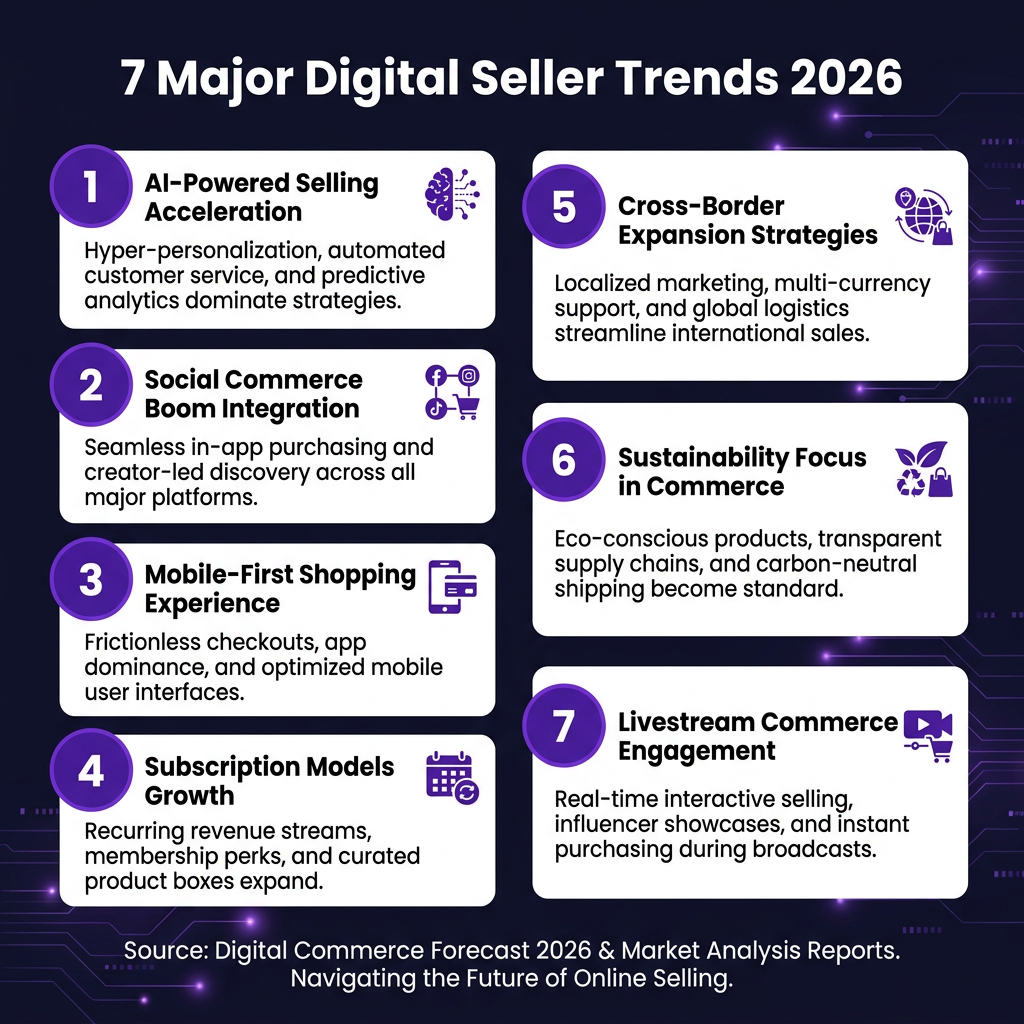
The digital seller landscape is being reshaped by seven major trends that are fundamentally changing how products are discovered, marketed, sold, and delivered. Understanding these trends is essential for any seller looking to compete effectively in 2026 and beyond.
1. AI-Powered Selling and Personalization
Artificial intelligence has moved from buzzword to business essential for digital sellers. AI agents and machine learning algorithms are now handling everything from product recommendations to customer service to dynamic pricing. Search interest in “AI agent” has tripled in the past year, and a growing number of consumers already trust AI to help them make purchase decisions.
For sellers, AI offers unprecedented capabilities. Predictive analytics can forecast demand with remarkable accuracy, optimizing inventory and reducing waste. Natural language processing powers chatbots that handle customer inquiries 24/7. Computer vision enables visual search, letting customers find products by uploading images. Dynamic pricing algorithms adjust prices in real-time based on demand, competition, and inventory levels.
By 2027, 20% of B2B sales organizations will use customer digital twins—AI-powered simulations of customer behavior—to improve revenue and customer experience. For digital sellers, this means that AI isn’t just a tool for efficiency; it’s becoming a competitive necessity. Sellers who fail to adopt AI-powered tools will find themselves at a significant disadvantage against competitors who can offer personalized experiences at scale.
2. The Social Commerce Explosion
Social commerce is growing at 30% per year and is expected to be worth €2.9 trillion by 2026. This isn’t just about advertising on social platforms—it’s about completing entire transactions within the social media experience. TikTok Shop, Instagram Shopping, Facebook Marketplace, and Pinterest Shopping have turned social feeds into storefronts.
The statistics are compelling: 83% of consumers discover products via Instagram, making it the platform with the highest social commerce conversion rate. Micro-influencers with 1,000-100,000 followers deliver the best ROI, with higher engagement rates than macro-influencers. Well-executed social commerce strategies deliver average ROI of 300-500% within 12 months.
For digital sellers, this trend represents both opportunity and challenge. The opportunity is access to massive, engaged audiences where product discovery happens organically. The challenge is that social commerce requires a different approach than traditional e-commerce—content is king, authenticity matters, and the feed truly is replacing the online store as the primary shopping interface.
3. Mobile-First Shopping Dominance
Mobile commerce now accounts for nearly 60% of all e-commerce sales. This shift has profound implications for digital sellers. Mobile optimization is no longer a nice-to-have—it’s the primary interface through which customers interact with your brand. Sellers who haven’t optimized for mobile are essentially closing their doors to the majority of potential customers.
The mobile-first trend extends beyond responsive design. It includes mobile payment options like Apple Pay and Google Pay, one-click purchasing, app-based shopping experiences, and SMS marketing. Voice search, increasingly popular on mobile devices, is changing how customers find products. Sellers need to optimize for conversational queries and natural language.
For digital product sellers, mobile presents unique opportunities. Digital products can be delivered instantly to mobile devices. Courses can be consumed on smartphones. Apps and mobile-optimized software have become primary product categories. The mobile-first trend isn’t just about adapting existing products—it’s about creating products designed specifically for mobile consumption.
4. Subscription and Recurring Revenue Models
The subscription economy has transformed digital selling. From software-as-a-service (SaaS) to subscription boxes to membership communities, recurring revenue models are becoming the preferred approach for digital sellers. The predictability of subscription revenue makes business planning easier, improves cash flow, and typically results in higher customer lifetime value.
For digital product sellers, subscriptions are particularly powerful. Software licenses, course access, template libraries, and content memberships all lend themselves to subscription models. The key is providing ongoing value that justifies the recurring charge. Successful subscription businesses focus on retention as much as acquisition, investing in customer success and community building.
The trend toward subscriptions is also changing pricing psychology. Customers are becoming more comfortable with ongoing payments in exchange for continuous value. This shift opens opportunities for sellers who might have previously relied on one-time purchases to explore recurring revenue models. The challenge is maintaining product quality and freshness to prevent churn.
5. Cross-Border E-Commerce Expansion
Digital selling has broken down geographical barriers. Cross-border e-commerce is growing rapidly, with 27% of U.S. consumers having purchased from cross-border marketplaces in the past year. For sellers, this means access to global markets without the traditional costs of international expansion.
However, cross-border selling comes with complexity. Different tax regulations, shipping requirements, and consumer protection laws apply in different markets. Currency conversion, language localization, and cultural adaptation are essential for success. The European Union’s new product safety regulations and changes to de minimis exemptions for low-value parcels in both the US and EU are increasing regulatory requirements and costs for cross-border sellers.
For digital product sellers, cross-border expansion is simpler than for physical goods. Digital products don’t face shipping challenges, customs duties, or inventory logistics. However, they do require attention to local regulations, payment preferences, and cultural differences. The opportunity is significant—sellers who successfully navigate cross-border complexity can access markets that would have been unreachable just a few years ago.
6. Sustainability and Ethical Selling
Consumers are increasingly making purchasing decisions based on sustainability and ethics. This trend is particularly strong among younger demographics, who prioritize environmental impact and social responsibility when choosing where to spend their money. For digital sellers, sustainability manifests differently than for physical goods sellers, but it’s no less important.
Digital product sellers can emphasize the environmental benefits of their products—no shipping, no packaging, no physical waste. Carbon-neutral hosting, ethical AI practices, and transparent business operations are becoming selling points. For sellers of digital services, fair labor practices and diverse hiring are increasingly important to customers.
The sustainability trend also intersects with the rise of secondhand and circular economy marketplaces. While this primarily affects physical goods, digital sellers can participate by creating products that enable reuse, repair, and sharing. Digital platforms that facilitate secondhand transactions are themselves significant opportunities for sellers focused on sustainability.
7. Livestream Commerce and Real-Time Selling
Livestream commerce—selling products through live video broadcasts—has exploded in popularity, particularly in Asian markets. The trend is now gaining traction globally, with platforms like TikTok, Instagram, and Amazon all investing heavily in live shopping features. Livestream commerce combines entertainment, social interaction, and instant purchasing in a way that traditional e-commerce cannot replicate.
For digital sellers, livestream commerce offers unique advantages. Digital products can be demonstrated in real-time, with immediate delivery upon purchase. Courses can be previewed through live excerpts. Software can be showcased with live tutorials. The format creates urgency and social proof that drives conversions.
The challenge is that livestream commerce requires a different skill set than traditional selling. Sellers must be comfortable on camera, able to engage audiences in real-time, and capable of handling technical aspects of live broadcasting. However, the engagement rates and conversion rates for livestream commerce often significantly exceed traditional e-commerce, making it worth the investment for many sellers.
Key Players and Competitive Landscape
The digital seller ecosystem is dominated by several major platforms, each with distinct strengths, weaknesses, and ideal use cases. Understanding the competitive landscape is essential for sellers choosing where to focus their efforts.
Amazon: The Undisputed Giant
Amazon remains the dominant force in digital selling, accounting for the largest share of e-commerce transactions globally. With over 300 million active customer accounts and more than 2 million sellers, Amazon offers unparalleled reach. The platform’s logistics network, Prime membership program, and trusted brand make it the default choice for many sellers.
However, Amazon’s dominance comes with challenges. Competition is intense, with millions of sellers competing for visibility. Amazon’s fees—including referral fees, fulfillment fees, and advertising costs—can significantly impact margins. The platform’s control over customer relationships means sellers have limited ability to build direct connections with buyers. Recent fee increases and policy changes have pushed some sellers to diversify beyond Amazon.
Shopify: The Independence Platform
Shopify has emerged as the leading platform for sellers who want to own their customer relationships. With over 4 million merchants using the platform, Shopify powers a significant portion of independent e-commerce stores. The platform’s ease of use, extensive app ecosystem, and focus on merchant success have made it the go-to choice for DTC brands.
Shopify’s Marketplace Connect allows sellers to integrate their Shopify stores with Amazon and eBay, managing multi-channel sales from a single dashboard. This hybrid approach—owning the direct relationship while leveraging marketplace reach—is increasingly popular among successful sellers. Shopify’s continued investment in logistics, payments, and AI tools positions it well for continued growth.
eBay: The Marketplace Pioneer
eBay, one of the original online marketplaces, continues to serve a significant role in the digital seller ecosystem. While no longer the dominant force it once was, eBay maintains strong positions in specific categories including collectibles, automotive parts, and secondhand goods. The platform’s auction format and global reach continue to attract specific seller and buyer demographics.
For sellers, eBay offers lower fees than Amazon in many categories and a more established global shipping infrastructure. The platform’s focus on unique and hard-to-find items creates opportunities for sellers with specialized inventory. However, eBay’s smaller customer base and lower traffic volumes mean it’s typically a secondary channel rather than a primary focus for most sellers.
Etsy: The Creative Marketplace
Etsy has carved out a unique position as the marketplace for handmade, vintage, and creative goods. With over 90 million active buyers, Etsy offers sellers access to a highly engaged audience specifically looking for unique, non-mass-market products. The platform’s community focus and brand values attract sellers and buyers who prioritize craftsmanship and individuality.
For digital product sellers, Etsy has expanded beyond physical goods to include digital downloads—printables, templates, planners, and design assets. This expansion has created new opportunities for creators who can produce digital products that fit Etsy’s aesthetic and values. However, increased competition and fee changes have made some sellers reconsider their Etsy strategy.
Social Platforms: The New Commerce Giants
TikTok Shop, Instagram Shopping, Facebook Marketplace, and Pinterest Shopping represent the fastest-growing segment of digital selling. These platforms leverage their massive user bases and engagement metrics to drive commerce directly within the social experience. TikTok Shop, in particular, has seen explosive growth, becoming a major sales channel for sellers targeting younger demographics.
The advantage of social commerce is discovery. Products can go viral organically, reaching millions of potential customers without traditional advertising costs. The challenge is the ephemeral nature of social media success—today’s viral product can be forgotten tomorrow. Successful social commerce sellers invest heavily in content creation and community building.
Digital Product Specialized Platforms
Beyond general e-commerce platforms, specialized platforms serve specific digital product categories. Gumroad and LemonSqueezy focus on digital downloads and software sales. Udemy, Teachable, and Coursera dominate online courses. Patreon and Ko-fi enable creator monetization. App Store and Google Play are essential for mobile app sellers.
For digital sellers, choosing the right platform depends on the product type, target audience, and business model. Many successful sellers use multiple platforms—selling courses on Udemy while also offering them on their own site, for example. Platform diversification reduces dependency risk while maximizing reach.

Challenges and Pain Points
While the digital seller market offers enormous opportunities, it also presents significant challenges. Understanding these pain points is essential for developing strategies to overcome them.
1. Rising Customer Acquisition Costs
Customer acquisition costs (CAC) have risen dramatically across all digital channels. Increased competition for advertising inventory, privacy changes that limit targeting capabilities, and platform algorithm updates have made it more expensive to reach potential customers. Sellers who previously relied on Facebook or Google ads for growth are finding that their acquisition economics no longer work.
The response to rising CAC requires a shift in strategy. Organic content marketing, community building, and referral programs become more important when paid acquisition is expensive. Customer retention and lifetime value optimization matter more than ever—it’s often more profitable to keep existing customers than to acquire new ones. Sellers are increasingly investing in email marketing, loyalty programs, and customer success initiatives.
2. Increased Competition and Market Saturation
The low barriers to entry that make digital selling attractive also create intense competition. In popular categories, thousands of sellers compete for the same customers. Differentiation becomes increasingly difficult when competitors can quickly copy successful products and pricing strategies. Market saturation in some categories has driven down prices and margins.
Successful sellers respond to competition by focusing on differentiation that can’t be easily copied. Brand building, community development, and exceptional customer service create sustainable competitive advantages. Niche specialization allows sellers to dominate smaller markets rather than competing in crowded mass markets. Innovation—whether in product features, business models, or customer experience—creates temporary monopolies that can be profitable before competitors catch up.
3. Platform Dependency and Policy Changes
Most digital sellers rely heavily on third-party platforms—whether Amazon, Etsy, Shopify, or social media platforms. This dependency creates vulnerability. Platform policy changes can instantly impact seller businesses. Fee increases, algorithm updates, account suspensions, and category restrictions have all caused significant problems for sellers.
The solution is platform diversification and direct customer relationships. Sellers who can drive traffic to their own websites are less vulnerable to platform changes. Email lists, social media followings, and community memberships create direct connections that don’t depend on platform algorithms. While platform diversification requires more effort, it significantly reduces business risk.
4. Regulatory Complexity and Compliance
Digital sellers face an increasingly complex regulatory environment. Tax obligations vary by jurisdiction, with economic nexus laws requiring sales tax collection in multiple states and countries. Data privacy regulations like GDPR and CCPA impose strict requirements on how customer data is collected and used. Product safety regulations, intellectual property laws, and consumer protection rules all apply to digital commerce.
The European Union’s new product safety regulations for non-food products and changes to de minimis exemptions for low-value parcels are particularly impactful for 2026. These changes increase compliance costs and administrative burden for sellers. The response requires investment in compliance infrastructure—whether through software solutions, legal counsel, or marketplace programs that handle compliance on behalf of sellers.
5. Logistics and Fulfillment Pressures
For sellers of physical goods, logistics and fulfillment remain major challenges. Rising shipping costs, delivery time expectations, and inventory management complexity create operational headaches. The end of free return policies by many retailers is changing customer expectations and seller economics. Tariff uncertainty and supply chain disruptions continue to impact international sellers.
The trend toward decentralized warehousing and distributed inventory is one response to these challenges. Sellers are storing inventory closer to customers to reduce shipping times and costs. Third-party logistics (3PL) providers offer scale economies that individual sellers can’t achieve. For digital product sellers, these challenges don’t apply—one of the significant advantages of selling digital goods.
Opportunities and Growth Strategies
Despite the challenges, the digital seller market offers significant opportunities for sellers who position themselves correctly. Here are the key growth strategies for 2026.
1. AI-Enhanced Selling Operations
AI tools have democratized capabilities that were previously available only to large enterprises. Small sellers can now access AI-powered copywriting, image generation, customer service chatbots, and demand forecasting. The key is identifying specific use cases where AI can improve efficiency or effectiveness, then implementing tools that address those needs.
For digital product sellers, AI offers particular opportunities. AI can help create digital products—generating course content, designing templates, or writing ebooks. AI-powered personalization can improve product recommendations and marketing messaging. Automated customer service can handle common questions while freeing up human time for complex issues. The sellers who master AI integration will have significant advantages over those who don’t.
2. Community-Driven Commerce
Building community around products creates sustainable competitive advantages that are difficult to replicate. Communities provide social proof, generate user-generated content, drive word-of-mouth referrals, and create switching costs for customers considering alternatives. For digital product sellers, communities can also provide feedback for product improvement and generate ideas for new products.
Successful community building requires authentic engagement and genuine value creation. Communities aren’t just marketing channels—they’re spaces where customers connect with each other and with the brand around shared interests. Investment in community management, exclusive content, and community events pays dividends in retention and lifetime value.
3. International Expansion
The global nature of digital commerce creates expansion opportunities that would have been impossible for small sellers just a decade ago. English-language products can find markets in dozens of countries. Payment processors handle currency conversion and local payment methods. Marketplaces provide infrastructure for cross-border selling.
For digital product sellers, international expansion is particularly attractive. Digital products face none of the shipping, customs, or inventory challenges that complicate international sales of physical goods. The primary requirements are localization—translating content, adapting marketing, and understanding local preferences—and compliance with local regulations.
Markets in Asia-Pacific, Latin America, and Africa are experiencing rapid e-commerce growth. Sellers who establish presence in these markets early can build strong positions before competition intensifies. The key is understanding local market dynamics rather than simply replicating what works in domestic markets.
Case Studies and Success Stories
Real-world examples demonstrate what’s possible in the digital seller market. These case studies illustrate successful strategies and provide actionable insights for sellers looking to grow their own businesses.
Case Study 1: Digital Product Creator to Seven-Figure Business
A solo creator started selling Notion templates on Etsy in 2022, initially as a side project. By focusing on high-quality designs and exceptional customer service, they built a loyal customer base. In 2024, they expanded to their own Shopify store, using Etsy as a discovery channel while building direct customer relationships through their website.
The key to their success was product line expansion. Starting with simple templates, they progressively added more complex products—course materials, business systems, and productivity workflows. They also introduced a membership program offering exclusive templates and community access for a monthly fee. By 2026, the business generates over $750,000 annually, with 60% of revenue coming from recurring subscriptions.
The lessons from this case study are clear: start simple, focus on quality, build direct customer relationships, and progressively expand your product line. The shift from one-time sales to recurring revenue transformed the business economics and created sustainable, predictable growth.
Case Study 2: Amazon Seller to Multi-Channel Brand
A physical products seller started on Amazon in 2020, selling kitchen accessories. They achieved rapid growth by identifying underserved niches and optimizing their Amazon listings. However, by 2023, they recognized the risks of platform dependency and began diversifying.
Their diversification strategy included launching their own Shopify store, expanding to Walmart Marketplace, and building an email list of over 100,000 customers. They invested in content marketing and social media to drive traffic to their owned channels. They also developed proprietary products that couldn’t be easily copied by competitors.
By 2026, their revenue is split evenly between Amazon and other channels. More importantly, they own their customer relationships on non-Amazon channels, giving them marketing options and margin improvements that pure Amazon sellers can’t achieve. The business now generates over $5 million annually with healthy margins.
Case Study 3: Social Commerce Viral Success
A small skincare brand achieved explosive growth through TikTok Shop in 2025. Their strategy focused on creating authentic, educational content that demonstrated product benefits without feeling like advertising. They partnered with micro-influencers who genuinely loved their products, rather than paying for sponsored posts.
A single viral video generated over $200,000 in sales in one week. Rather than treating this as a one-time event, they invested heavily in content creation, building an internal team capable of producing daily TikTok content. They also optimized their TikTok Shop presence for conversion, ensuring that viral traffic converted to sales.
By 2026, the brand has expanded beyond TikTok to Instagram Shopping and their own website, but TikTok remains their primary growth driver. The business has grown from zero to over $3 million in annual revenue in just two years. The key lesson: social commerce rewards authenticity and consistent content creation.
Future Outlook and Predictions
The digital seller market will continue evolving rapidly through 2030. Here are the key predictions for the future of digital selling.
Market Growth Projections
By 2030, global e-commerce sales are projected to exceed $8 trillion, with the market potentially reaching $5.05 trillion in core revenue according to Statista’s forecasts. U.S. e-commerce alone will approach $1.8 trillion, representing nearly 30% of all retail sales. The number of digital buyers will grow to over 4.1 billion, with user penetration exceeding 58%.
These projections suggest continued strong growth, though at a moderating pace as the market matures. The most significant growth will come from emerging markets and new product categories. Digital products, in particular, are expected to grow faster than physical goods as consumers become increasingly comfortable with digital ownership.
Technology Disruptions
AI will transform digital selling in ways we’re only beginning to understand. By 2028, digital twins and AI agents will handle significant portions of the selling process—from product discovery to customer service to dynamic pricing. Sellers who embrace AI will operate with efficiency levels that manual processes can’t match.
Augmented reality (AR) and virtual reality (VR) will change how customers experience products before purchase. Virtual try-on for fashion, AR visualization for furniture, and immersive product demonstrations will become standard. Digital product sellers will create VR experiences that showcase software, courses, and digital content in entirely new ways.
Blockchain and Web3 technologies may reshape digital ownership and verification. NFTs and digital certificates of authenticity could become important for verifying the legitimacy of digital products. Decentralized marketplaces might emerge as alternatives to centralized platforms, though adoption timelines remain uncertain.
Regulatory Evolution
Regulatory pressure on digital commerce will increase. Data privacy regulations will likely expand beyond current GDPR and CCPA frameworks. Tax compliance will become more complex as jurisdictions refine their approaches to digital commerce. Platform regulations may limit the power of major marketplaces, potentially creating opportunities for smaller sellers and alternative platforms.
Sustainability regulations will affect how products are sold and delivered. Carbon disclosure requirements, packaging regulations, and circular economy mandates will impact seller operations. Digital product sellers will benefit from their inherently lower environmental impact, potentially gaining advantages in markets where sustainability is regulated.
Consumer Behavior Shifts
Consumer expectations will continue rising. Same-day delivery will become standard for physical goods. Instant delivery of digital products is already expected and will become universal. Customer service will need to be 24/7, immediate, and personalized. The gap between customer expectations and seller capabilities will be a key competitive battleground.
Privacy concerns will drive changes in how sellers collect and use customer data. First-party data strategies will become essential as third-party cookies and tracking are phased out. Sellers who build direct relationships and earn customer trust will have advantages in this privacy-focused future.
Key Takeaways
- The digital seller market is massive and growing: With $6.88 trillion in projected 2026 sales and 2.86 billion online shoppers, the opportunity has never been larger.
- AI and social commerce are transforming selling: Sellers who master AI tools and social commerce strategies will have significant advantages over those who don’t.
- Platform diversification reduces risk: Relying on a single platform creates vulnerability. Building direct customer relationships provides stability and better margins.
- Mobile-first is non-negotiable: With 60% of e-commerce happening on mobile devices, optimization for mobile experiences is essential.
- Recurring revenue models offer stability: Subscription and membership models create predictable revenue and higher customer lifetime value.
- International expansion is increasingly accessible: Digital products, in particular, can reach global markets without the logistics challenges of physical goods.
- Community and authenticity drive sustainable growth: In a world of intense competition, genuine connections with customers create defensible competitive advantages.
- Regulatory complexity requires proactive compliance: Tax, privacy, and product safety regulations are increasing. Sellers need systems to manage compliance.
- The future belongs to agile, data-driven sellers: Markets will continue changing rapidly. Sellers who can adapt quickly based on data will thrive.
- Digital products offer unique advantages: No inventory, no shipping, instant delivery, and global reach make digital products an attractive category for new sellers.
Sources and Citations
- Statista Market Forecast – eCommerce Worldwide: https://www.statista.com/outlook/emo/ecommerce/worldwide
- Quantumrun E-commerce Business Statistics 2026: https://www.quantumrun.com/consulting/ecommerce-business-statistics/
- SellersCommerce Ecommerce Statistics 2026: https://www.sellerscommerce.com/blog/ecommerce-statistics/
- Swell Digital Product Sales Statistics 2025: https://www.swell.is/content/digital-product-sales-statistics
- Whop Digital Products Statistics 2026: https://whop.com/blog/digital-product-statistics/
- Digital Commerce 360 – Top 15 Ecommerce Trends 2026: https://www.digitalcommerce360.com/2026/01/06/top-15-ecommerce-trends-to-watch-in-2026/
- Search Engine Land – Top 4 Ecommerce Trends 2026: https://searchengineland.com/guide/top-ecommerce-trends-2026
- Webinterpret Ecommerce Industry 2026: https://webinterpret.com/en/blog/ecommerce-industry-in-2026
- ClickForest Social Commerce Strategies 2026: https://www.clickforest.com/en/blog/social-commerce-strategies
- BigCommerce Social Commerce 2026: https://www.bigcommerce.com/articles/omnichannel-retail/social-commerce/
- Forrester Global E-Commerce Forecast 2024-2028: https://www.carat.fiserv.com/en-us/lp/forrester-global-retail-ecommerce-forecast/
- Yahoo Finance – E-commerce Sales to Hit $1.8 Trillion by 2030: https://finance.yahoo.com/news/e-commerce-sales-hit-1-124659304.html
- Retail Dive – US E-commerce Sales Forecast 2030: https://www.retaildive.com/news/online-retail-sales-ecommerce-forecast-2030/812833/
- Voyado Inside E-commerce 2026 Report: https://voyado.com/resources/guides/inside-e-commerce/
- Searchanise Ecommerce Trends and Challenges 2026: https://searchanise.io/blog/ecommerce-trends/
- SolveIt 12 E-commerce Challenges 2026: https://solveit.dev/blog/e-commerce-challenges
- Flipflow 2030 Future of Digital Commerce: https://www.flipflow.io/en/blog-en/2030-future-digital-commerce/
- Growth List – Funded Marketplace Startups 2026: https://growthlist.co/marketplace-startups/
- Gelato Selling Platforms 2026: https://www.gelato.com/blog/most-popular-selling-platforms
- Forbes Advisor Best E-Commerce Platforms 2026: https://www.forbes.com/advisor/business/software/best-ecommerce-platform/