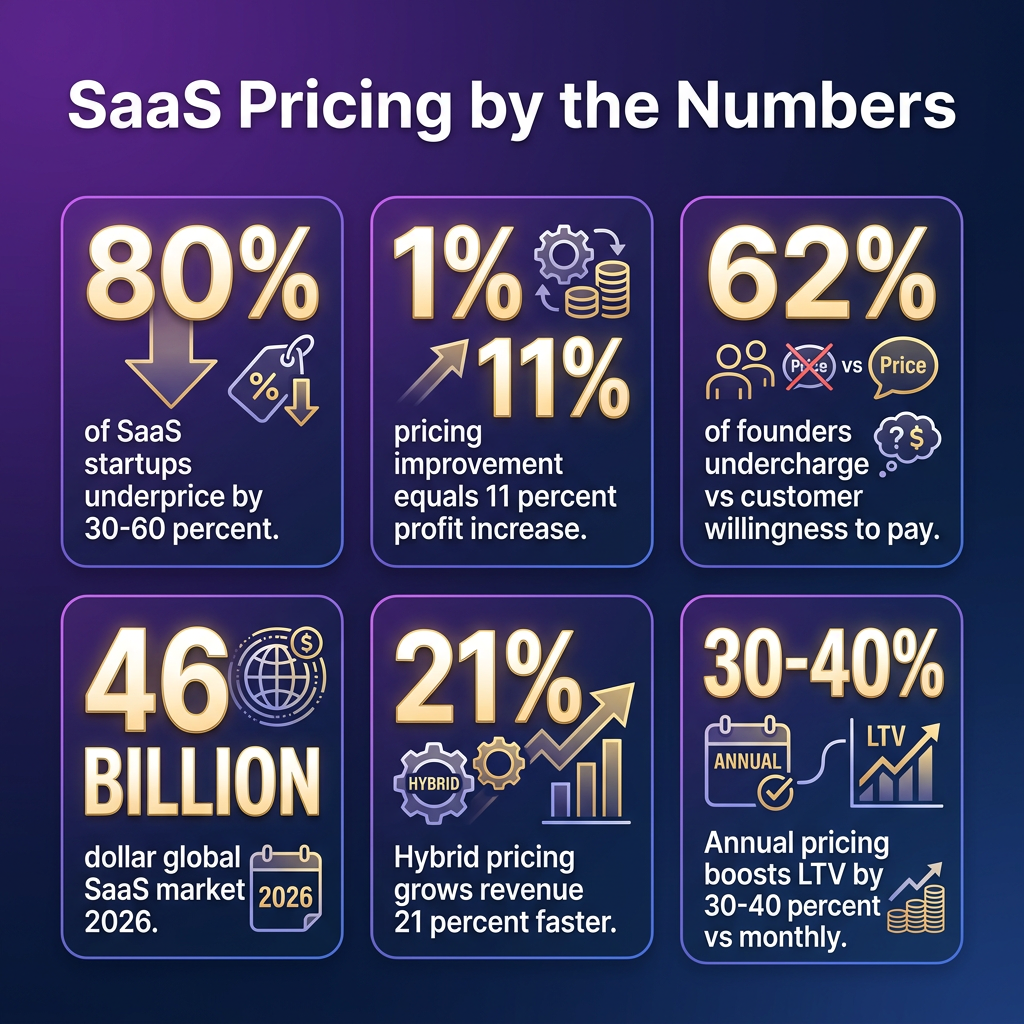
80% of SaaS startups underprice their product by 30–60%. Not because they don’t understand value — but because they set prices in the first week, never revisited them, and built their entire go-to-market around a number they pulled from fear rather than data.
If you’re a first-time SaaS founder trying to figure out what to charge, this guide gives you a practical framework. Not theory. The actual steps: how to pick your pricing model, how to research what customers will pay, how to structure tiers that drive expansion, and when to raise prices without blowing up your churn.
The SaaS market is worth $466 billion in 2026. You’re competing in it. Your pricing strategy is either an asset or a silent drag on everything else you’re doing.
Why SaaS Pricing Is Different (And Why First-Time Founders Get It Wrong)
Traditional software had one-time licensing fees. SaaS is different: you’re pricing a relationship, not a product. Your customer pays monthly or annually, and their willingness to keep paying depends entirely on the value they perceive over time.
This changes everything about how you should think about pricing.
A study of 512 SaaS businesses showed that optimizing pricing (monetization) is 4x more effective at driving growth than focusing on customer acquisition. Yet the average executive team spends only 11.5 hours over their entire business lifetime on pricing strategy — and pays for it with 10–15% of potential revenue left on the table.
The most common first-time founder pricing mistakes:
- Cost-plus pricing: Adding a margin on top of your hosting/development costs. This ignores what the customer actually values.
- Competitive anchoring: Copying a competitor’s pricing without understanding their cost structure, customer base, or product scope.
- Fear pricing: Setting prices low because you’re scared people won’t pay. This attracts the wrong customers and signals low quality.
- One-and-done pricing: Setting prices at launch, then never revisiting them even as the product matures.
SaaS companies that raise prices annually grow 15–25% faster than those that don’t. Yet only 30% of SaaS companies have raised prices in the last 12 months.
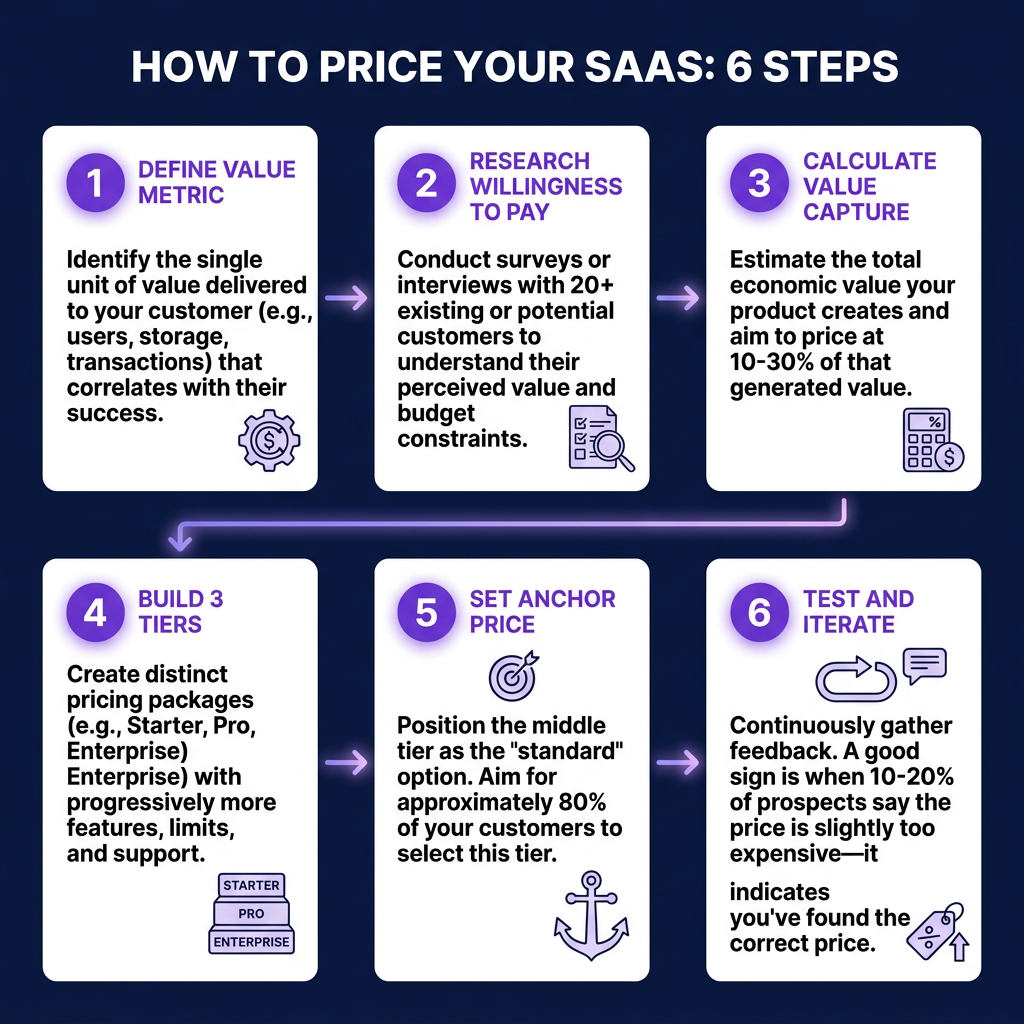
How to Price Your SaaS Product: The 6-Step Framework
Here’s the framework that actually works for early-stage SaaS founders. It doesn’t require a pricing consultant or a PhD in behavioral economics. It requires honest conversations with customers and some disciplined thinking.
Step 1: Define Your Value Metric
A value metric is what you charge for. Not features — the unit of value your customers actually care about. This is the most important decision in your entire pricing architecture.
Examples of well-chosen value metrics:
- Intercom charges by number of contacts (because engagement drives their value)
- Stripe charges per transaction (because usage = value delivered)
- Zoom charges per host (because hosts are the power users who drive adoption)
- HubSpot charges per contact (because the database is the core asset)
SaaS companies that use strong value metrics grow at 2x the rate of those that don’t. If your pricing model doesn’t scale with the value you deliver, you’re either leaving money on the table or churning customers who feel overcharged.
Ask yourself: as a customer gets more value from my product, what measurable thing increases? That’s your value metric.
Step 2: Research Willingness to Pay
You cannot guess this. You have to ask.
The Van Westendorp Price Sensitivity Meter is the gold-standard method for solo founders. It uses four questions:
- At what price would this be so cheap you’d question the quality?
- At what price would this start to seem like good value for money?
- At what price would it start to seem expensive (but still worth it)?
- At what price would it be too expensive to consider?
Survey 20–30 of your target customers (not friends, not investors — actual target customers). The “acceptable price range” sits between answers 2 and 3. Most founders find their gut price sits at the bottom of that range or below it.
62% of SaaS companies undercharge by 20% or more relative to actual customer willingness to pay. The research usually reveals there’s room to charge more — sometimes a lot more.
Step 3: Calculate Your Value Capture Rate
Price-to-value ratio is the key concept. You should capture 10–30% of the value you deliver.
Example: Your tool saves a marketing team 5 hours per week. At $75/hour blended rate, that’s $375/week or ~$20,000/year in time saved. Pricing at $149/month ($1,788/year) means you’re capturing ~9% of the value. That’s reasonable — but there’s room to go higher.
If you’re solving a $10,000/year problem, charging $50/month ($600/year) means you’re capturing 6% of the value. You could comfortably be at $150–200/month.
Research from Price Intelligently consistently shows: a 1% improvement in pricing strategy produces an 11% improvement in profit. No other lever in your business comes close.
Step 4: Choose Your Pricing Model
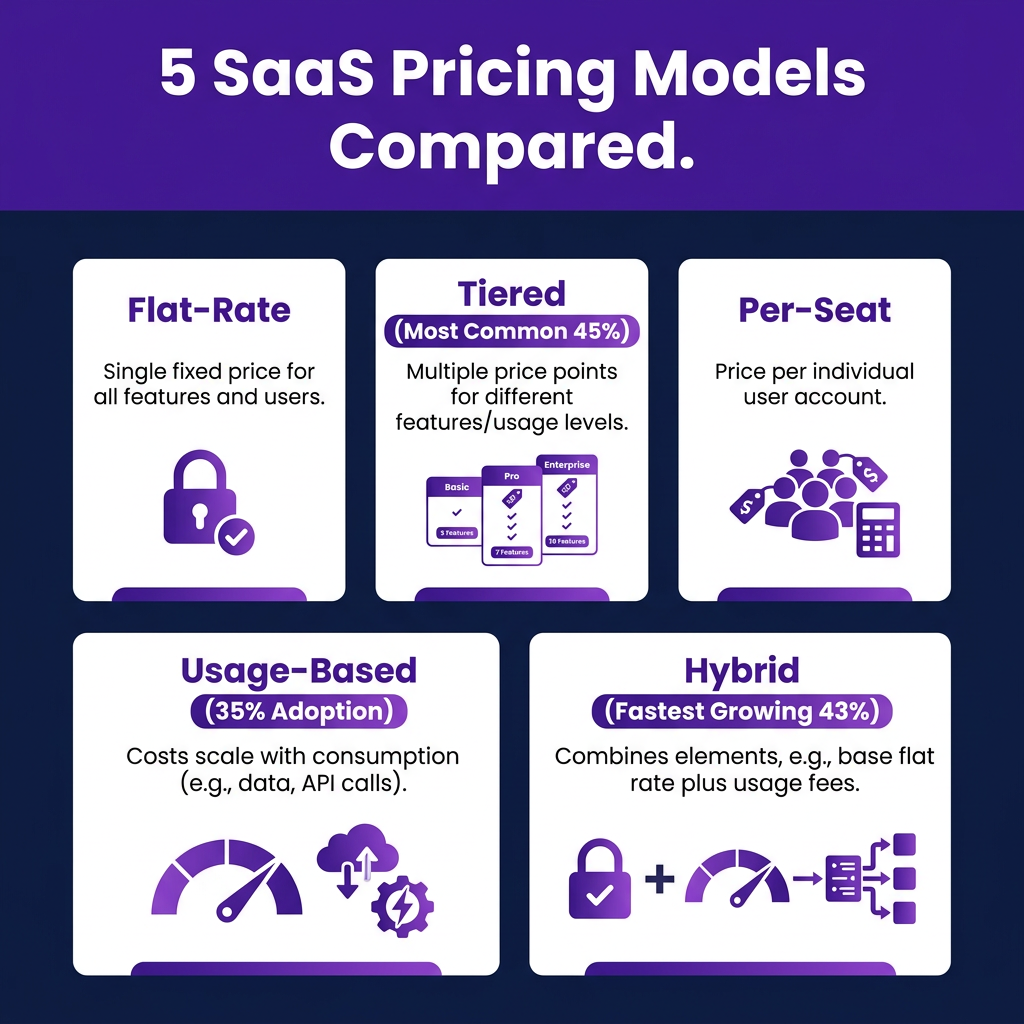
The model is the structure — how you charge, not just how much. Here are the five main models and when each makes sense:
| Model | Best For | Adoption (2026) | Typical ARPU | Main Risk |
|---|---|---|---|---|
| Flat-Rate | Simple products, single use case | ~8% (pure) | $20–$99/mo | Leaves money on table at scale |
| Tiered (3 plans) | Most B2B SaaS, clear upgrade paths | ~45% | $49–$499/mo | Plan confusion if tiers aren’t sharp |
| Per-Seat | Team tools, collaboration software | ~45% (component) | $15–$75/seat | Customers limit seats to save cost |
| Usage-Based | Infrastructure, APIs, AI tools | ~35% | Variable | Revenue unpredictability |
| Hybrid | Complex B2B, enterprise, AI SaaS | ~43% | $99–$2,000/mo | Communication complexity |
For most first-time founders building B2B SaaS: start with tiered pricing, 3 plans. It’s the model 80% of the market understands intuitively. It creates natural upgrade paths. It lets you serve multiple customer segments without building multiple products.
Usage-based is the right move if you’re building infrastructure, APIs, or AI tools where usage directly maps to value. Hybrid models are winning in 2026 — 43% of SaaS companies now use a base fee plus usage components, projected to reach 61% by end of 2026.
Step 5: Structure Your 3 Tiers
The most important insight about tiered pricing: 80% of customers buy the middle tier. Design your entire pricing page around that fact.
The three-tier structure that works:
- Starter — Makes the product accessible, limits the key value metric, no team features. The anchor that makes your middle plan look like a bargain.
- Pro (your main product) — Full value metrics, essential team features, the plan you want 70–80% of customers on. Price it at 3–4x Starter.
- Enterprise/Scale — Unlimited or custom value metrics, SSO, SLAs, priority support, custom contract. Price it at 3–5x Pro or “Contact Us”.
Visually highlight your Pro tier as “Most Popular” or “Recommended.” This isn’t manipulation — it’s a genuine signal to customers about the value profile you’ve optimized for. Conversion rates drop 15–20% when you offer more than 3 paid tiers. Keep it simple.
One pricing rule that’s counterintuitive: if you’re building B2B SaaS and your instinct is to start below $50/month, pressure-test that. It’s usually fear, not data. The $50–$200/month range for a Pro plan is where the math starts to work for unit economics.
Annual vs Monthly Pricing: The 30–40% LTV Multiplier
This is one of the highest-leverage decisions in your pricing strategy, and most founders underinvest in it.
Annual plans do three things at once:
- Improve cash flow — you get 12 months of revenue upfront
- Reduce churn — annuals churn at 3–5x lower rates than monthly
- Increase LTV by 30–40% — the compounding effect of lower churn is massive
Standard practice: offer annual billing at a 15–20% discount vs monthly. That’s two months free. The math works because you more than make it back in reduced churn and CAC payback acceleration.
The mistake founders make: burying the annual option. Put it front and center on your pricing page with a clear “Save 20%” badge. Default the toggle to annual. The companies that actively promote annual plans (rather than just offering them) see 3–4x higher annual plan adoption rates.
Psychological Pricing Tactics That Actually Work in B2B
Not all psychology tricks work in B2B — enterprise buyers see through the cheap stuff immediately. But a few work really well:
The Decoy Effect
Make one tier clearly worse value to push buyers toward your preferred tier. A tier that’s 70% of the features for 90% of the price makes the full-featured tier look like the obvious choice.
Charm Pricing (With Limits)
$149/month works better than $150/month in B2C. In B2B, the effect is weaker — but rounding up to $150 to simplify invoicing can actually increase trust with finance teams who prefer round numbers.
The 10% Rule for Pushback
This one’s from Price Intelligently data: if 10–20% of your prospects say your price is too high, you’re probably priced correctly. If fewer than 10% push back, you’re almost certainly underpriced. If more than 30% push back, check whether you have a pricing problem or a messaging problem.
Anchor High
Always show pricing from highest to lowest (left to right). The first number a buyer sees sets the anchor. If they see $1,499/month first, then $499/month looks affordable. If they see $49/month first, everything above it feels expensive.
How to Raise Prices Without Blowing Up Churn
Founders avoid price increases more than almost any other decision. They shouldn’t. The playbook for raising prices without significant churn is well-established:
| Tactic | Detail | Effect on Churn |
|---|---|---|
| 30-day advance notice | Email all existing customers 30 days before increase | Reduces churn by ~40% vs no notice |
| Grandfather clause | Lock in current customers at old price for 6–12 months | Converts potential churners to loyal advocates |
| New features justification | Pair increase with a meaningful feature release | 80%+ acceptance when tied to clear value add |
| Apply to new customers first | New customers get new pricing, existing get phased increase | Minimal disruption, maximum revenue capture |
| Annual lock-in before increase | Offer an annual lock-in at current pricing before the increase | Converts monthly churners to committed annuals |
Grandfathered pricing (never raising prices on existing customers forever) costs SaaS companies 5–10% of potential revenue annually. You don’t need to do that. Communicate clearly, give people time to adjust, and most customers will accept reasonable increases — especially if you’ve been adding value.
Pricing for Fungies: The MoR Advantage
One thing that first-time SaaS founders often overlook: how your payment infrastructure affects your effective pricing strategy globally.
If you’re selling software internationally, you’re dealing with:
- EU VAT (up to 27% in Hungary)
- US sales tax across 46 states
- Currency conversions and local price sensitivity
- Localized payment method support
A Merchant of Record like Fungies handles all of this automatically. You set your prices, we handle the tax compliance, collection, and remittance in every jurisdiction. This means you can implement regional pricing (which increases global revenue by 25–40% while only reducing average unit price by 15–20%) without building a massive tax infrastructure.
For first-time founders, this is a real strategic advantage: you can launch with global pricing from day one, test price points across markets, and focus on your product while your MoR handles the compliance complexity.
Key Takeaways
- 80% of SaaS startups underprice. Start with willingness-to-pay research (Van Westendorp survey, 20+ customers) before you pick a number.
- Price at 10–30% of value delivered, not cost-plus or competitor-copied. Find your value metric first — it changes everything else.
- Use 3-tier pricing for most B2B SaaS. Design for the middle tier. That’s where 80% of customers land and where your unit economics need to work.
- Promote annual plans actively. Annual billing reduces churn 3–5x and improves LTV by 30–40%. Default the toggle to annual on your pricing page.
- Raise prices annually. SaaS companies that raise prices grow 15–25% faster. Give 30 days’ notice, grandfather existing customers, tie it to new features.
Frequently Asked Questions
What’s the best pricing model for a first-time SaaS founder?
Tiered pricing with 3 plans is the best starting point for most B2B SaaS founders. It’s familiar to buyers, creates upgrade paths, and lets you serve multiple customer segments without overcomplicating your offering. Start here, then layer in usage-based components as you understand your value metric better.
How do I know if I’m charging too little for my SaaS?
If fewer than 10% of your prospects say your price is too high, you’re almost certainly underpriced. Other signals: a high volume of easy closes with no pricing objections, customers who expand usage without upgrading, and NPS scores that are high but revenue metrics that are lagging. The Van Westendorp survey will give you actual data on willingness to pay.
Should I offer a free plan or just a free trial for my SaaS?
Free trials (14 days) convert at 10–30% to paid. Freemium converts at 2–5%. For most B2B SaaS, a free trial is the stronger model because urgency drives action. Freemium works when your product has strong viral/network effects and you can afford to support free users at scale (think Slack, Dropbox). If you’re pre-scale, default to free trial unless you have a specific PLG motion.
How often should I revisit my SaaS pricing?
Quarterly review, annual adjustment. Review your pricing metrics quarterly (churn by tier, expansion rate, conversion rate by plan, NPS by price point). Make actual pricing changes annually, or when you hit a significant product milestone. Grandfathering existing customers for 6–12 months during a price increase reduces churn significantly and preserves the relationship.
Conclusion
Pricing is the highest-leverage variable in your SaaS business. A 1% improvement in pricing generates more profit than a 1% improvement in acquisition, retention, or cost reduction — combined.
The framework is straightforward: define your value metric, research willingness to pay, price at 10–30% of value delivered, build 3 tiers that drive expansion, and revisit pricing annually. Don’t copy competitors. Don’t price from fear. Price from data.
If you’re building a SaaS product and want global payment infrastructure that handles tax compliance, local payment methods, and MoR obligations so you can focus on your pricing strategy — get started with Fungies for free. No setup fees, MoR from day one.
References
- Athenic — SaaS Pricing Strategy 2026: Finding Your Sweet Spot
- culta.ai — 40 SaaS Pricing Statistics for 2026
- SaaS Factor — The 2025 SaaS Pricing Playbook
- Monolit — 7 Pricing Mistakes That Kill SaaS Startups
- NxCode — SaaS Pricing Strategy Guide 2026
- Monetizely — Complete Guide to SaaS Pricing Models 2025–2026
- CRV — SaaS Pricing Models for Series A Founders
- ProductQuant — Best Pricing Experimentation Tools for SaaS in 2026