Here’s the truth about selling PDFs online: most creators overthink the creation and underthink the platform. They spend weeks crafting the perfect ebook, guide, or template — then upload it to the first site they find and wonder why sales trickle in at a glacial pace.
The platform you choose matters more than you think. It affects your fees, your customer experience, your ability to scale, and even whether you wake up to angry emails about VAT compliance. I’ve seen creators lose 30% of their revenue to hidden fees and another 20% to chargebacks because they picked the wrong tool.
In this guide, I’ll break down the 10 best platforms to sell PDFs online in 2026. I’ve tested most of these personally, talked to creators using them, and analyzed the real costs — not just the marketing fluff. Whether you’re selling a $5 checklist or a $500 comprehensive guide, there’s a platform here that fits your needs.
What Makes a Great PDF Selling Platform?
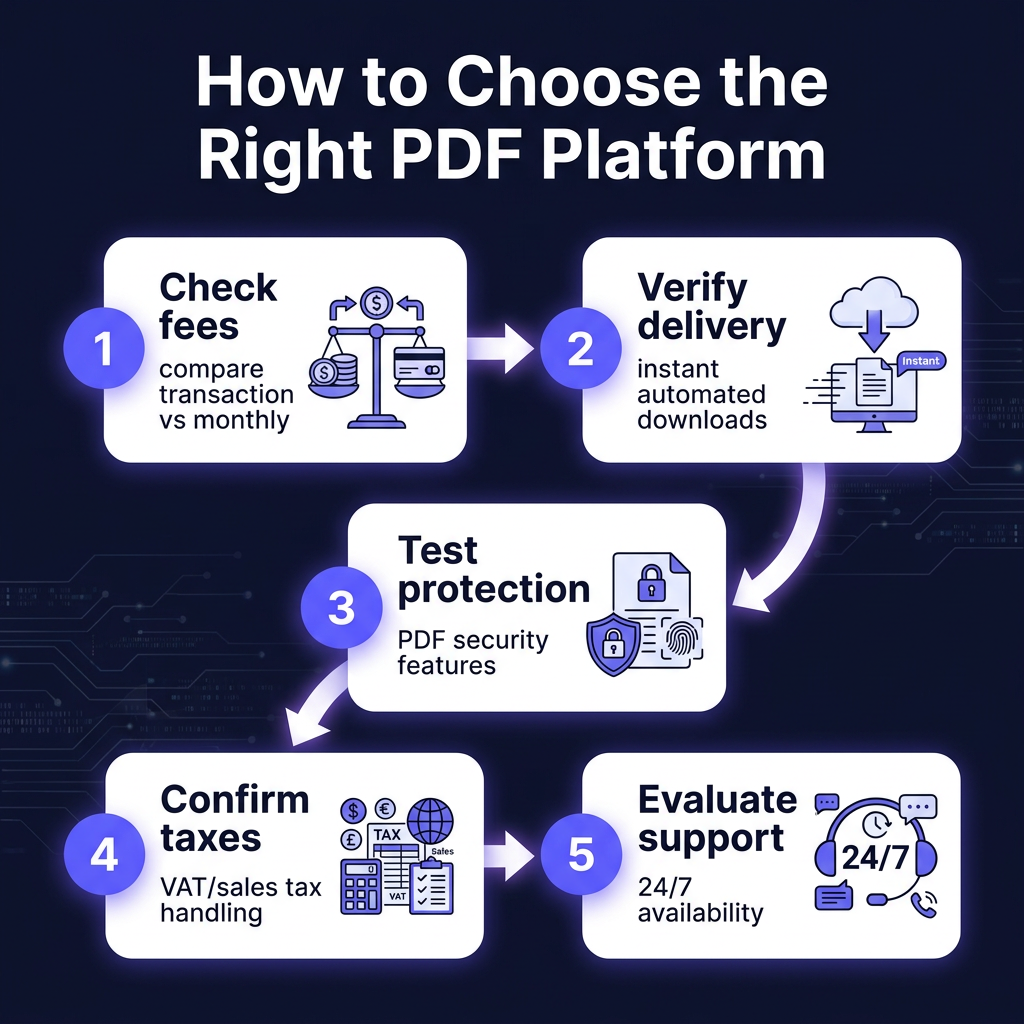
Before diving into the list, let’s establish the criteria. A great PDF platform needs to nail five things:
- Low, transparent fees: You should know exactly what you’ll pay before you make a sale. No hidden currency conversion markups or surprise charges.
- Instant delivery: Customers expect their PDF immediately after purchase. Anything less feels unprofessional.
- File protection: Basic download limits, PDF stamping, or access controls to prevent casual piracy.
- Tax compliance: If you’re selling globally (and you should be), the platform should handle VAT and sales tax or make it easy for you to do so.
- Marketing tools: Discount codes, affiliate programs, email integration — the features that actually drive sales.
1. Gumroad — Best for Beginners
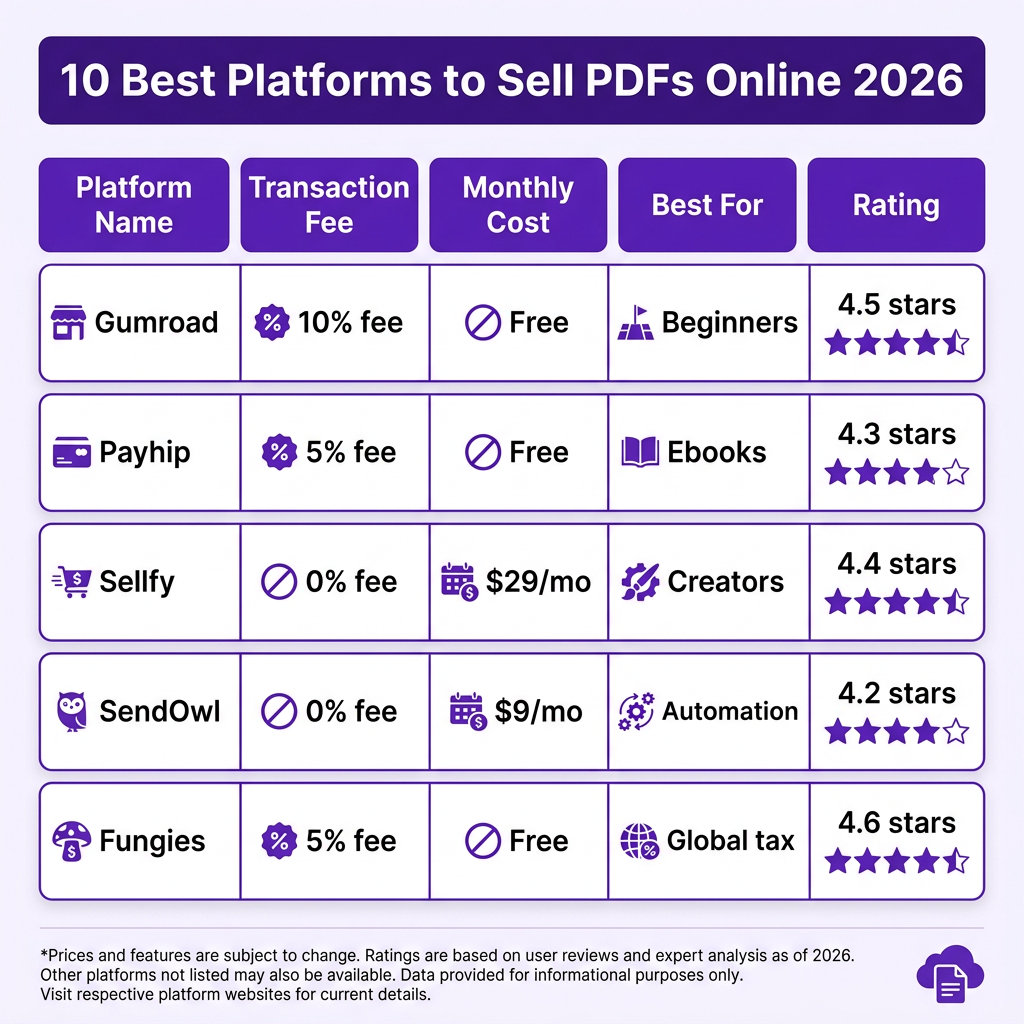
Gumroad is the default choice for most creators starting out, and for good reason. It’s free to start, takes about 10 minutes to set up, and has a built-in audience of buyers browsing the marketplace.
Pricing: 10% fee on all sales (plus payment processing). No monthly cost.
Best for: First-time sellers, creators who want discoverability, those testing product-market fit.
The catch: That 10% fee adds up fast. Sell a $50 PDF, and Gumroad takes $5. Sell 100 of them, and you’ve given away $500. Plus, you’re responsible for your own tax compliance — Gumroad doesn’t handle VAT or sales tax collection.
2. Payhip — Best for Ebooks and Simple PDFs
Payhip flies under the radar but has quietly built one of the most creator-friendly platforms. The free plan includes unlimited products, and the 5% transaction fee is half of Gumroad’s.
Pricing: 5% fee on free plan; $29/month for 0% fees.
Best for: Ebook authors, simple PDF sales, creators wanting lower fees than Gumroad.
Standout feature: Payhip has a “PDF stamping” feature that automatically adds the buyer’s email to each page of the PDF. It’s not bulletproof protection, but it discourages casual sharing.
3. Sellfy — Best for Creators Building a Brand
Sellfy positions itself as more than a checkout tool — it’s a full storefront for creators. You get a customizable shop page, the ability to sell subscriptions alongside PDFs, and even print-on-demand integration.
Pricing: Starts at $29/month with 0% transaction fees on higher plans.
Best for: Creators selling multiple product types, those wanting a branded storefront, established sellers.
Reality check: The monthly cost means you need consistent sales to justify it. If you’re selling one $10 PDF per month, Sellfy isn’t worth it. If you’re doing $500+ monthly, the math starts working.
4. SendOwl — Best for Automation
SendOwl is the nerdy choice — and I mean that as a compliment. It’s built for sellers who want deep automation: drip content, license key generation, affiliate management, and integrations with every email tool under the sun.
Pricing: Starts at $9/month with 0% transaction fees.
Best for: Tech-savvy sellers, those with complex product funnels, creators using advanced marketing automation.
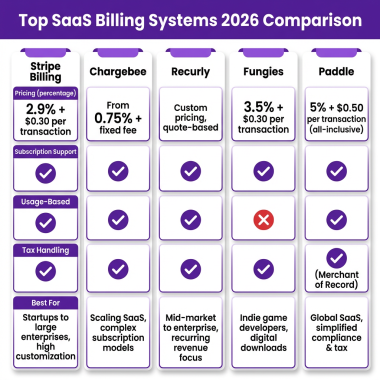
5. Fungies — Best for Global Sales and Tax Compliance
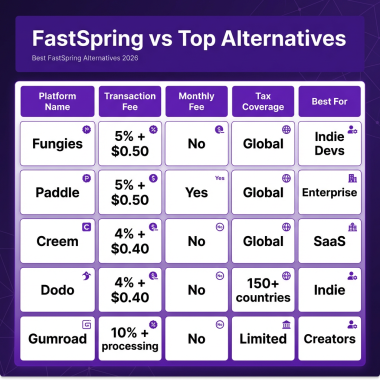
Full disclosure: I work with Fungies. But I’m including them because they solve a real problem that other platforms ignore: global tax compliance. If you’re selling PDFs to customers in the EU, UK, or US states with digital sales tax, you’re legally required to collect and remit VAT/sales tax. Most platforms leave you to figure this out yourself.
Pricing: 5% + $0.50 per transaction. No monthly fees.
Best for: Sellers targeting global audiences, those wanting tax handled automatically, creators who’d rather create than manage compliance.
The tax angle: Fungies acts as a Merchant of Record, meaning they handle VAT, sales tax, and compliance in 100+ countries. You get paid; they deal with the tax authorities. For sellers doing any meaningful volume internationally, this alone is worth the fee.
6. Easy Digital Downloads (WordPress) — Best for WordPress Sites
If you already have a WordPress site, Easy Digital Downloads (EDD) turns it into a full digital product store. You own everything, control everything, and pay no transaction fees to a third party.
Pricing: Free core plugin; paid extensions from $99/year.
Best for: WordPress users, those wanting full ownership, sellers with technical skills.
The trade-off: You’re responsible for security, updates, backups, and — you guessed it — tax compliance. EDD has extensions for tax calculation, but you’re still on the hook for filing and remittance.
7. Shopify — Best for Scaling to Physical Products
Shopify is overkill if you’re only selling PDFs. But if you plan to expand into courses, merchandise, or physical products, it’s the platform that grows with you.
Pricing: $39/month plus 2.9% + $0.30 per transaction.
Best for: Sellers planning to diversify, those wanting enterprise-grade features, established businesses.
8. Lemon Squeezy — Best for Software and Digital Products
Lemon Squeezy started as a platform for software but works beautifully for PDFs too. They handle tax compliance (like Fungies) and have a clean, modern checkout experience.
Pricing: 5% + $0.50 per transaction. No monthly fees.
Best for: Tech-focused creators, those wanting tax compliance without monthly costs, SaaS-adjacent sellers.
9. Etsy — Best for Built-in Traffic
Etsy has 90+ million active buyers. List your PDF there, and you’re tapping into a massive marketplace of people already looking to buy digital products.
Pricing: $0.20 listing fee + 6.5% transaction fee + payment processing.
Best for: Printable planners, templates, design assets, creators wanting immediate traffic.
The downside: You’re competing in a crowded marketplace. Your $15 planner is next to 500 similar listings. Plus, Etsy’s algorithm changes can crush your visibility overnight.
10. Amazon KDP — Best for Ebooks
If your PDF is actually a book, Kindle Direct Publishing gives you access to the world’s largest ebook marketplace. The reach is unmatched.
Pricing: 35% royalty for books priced $0.99-$2.98; 70% for $2.99-$9.99.
Best for: Fiction and nonfiction books, authors wanting maximum distribution.
Reality check: You’re locked into Amazon’s ecosystem. You can’t build an email list from KDP sales, you can’t offer upsells, and you have zero control over pricing promotions.
Sell PDFs Globally Without the Tax Headache
Fungies.io handles VAT, sales tax, and compliance automatically — so you can focus on creating great PDFs.
5% fee • No monthly cost • Global tax compliance included
Platform Comparison: The Real Numbers
Let’s talk actual costs. Say you sell a $25 PDF and make 100 sales per month ($2,500 revenue). Here’s what each platform takes:
| Platform | Monthly Cost | Fees on $2,500 | You Keep |
|---|---|---|---|
| Gumroad | $0 | ~$250 (10%) | ~$2,250 |
| Payhip | $0 | ~$125 (5%) | ~$2,375 |
| Sellfy | $29 | ~$29 (monthly) | ~$2,471 |
| SendOwl | $9 | ~$9 (monthly) | ~$2,491 |
| Fungies | $0 | ~$175 (5% + $0.50) | ~$2,325* |
| Easy Digital Downloads | $8.25 | Payment processing only | ~$2,425 |
| Shopify | $39 | ~$111 (2.9% + $0.30) | ~$2,350 |
| Lemon Squeezy | $0 | ~$175 (5% + $0.50) | ~$2,325* |
| Etsy | $20 | ~$182 (6.5% + listing) | ~$2,298 |
| Amazon KDP | $0 | ~$875 (35%) or ~$750 (70%) | ~$1,625-$1,750 |
*Fungies and Lemon Squeezy include tax compliance handling in their fees. For sellers with international customers, this can save significant accounting costs.
FAQ: Selling PDFs Online
What’s the cheapest platform to sell PDFs?
For low volume (under $1,000/month), Payhip’s 5% fee beats most alternatives. For higher volume, SendOwl at $9/month with 0% fees is hard to beat — assuming you don’t need tax compliance.
Do I need to charge sales tax on PDFs?
In most jurisdictions, yes. Digital products are taxable in the EU, UK, and an increasing number of US states. Platforms like Fungies and Lemon Squeezy handle this automatically. Others leave you to figure it out.
How do I protect my PDFs from piracy?
Complete protection is impossible, but you can discourage casual sharing. Use PDF stamping (Payhip offers this), set download limits, and consider watermarking. For high-value PDFs, some creators use hosted viewing instead of downloadable files.
Can I sell PDFs on my own website?
Yes — Easy Digital Downloads for WordPress or even simple PayPal buttons work. Just remember: you’re responsible for delivery, security, and tax compliance.
What’s the best platform for beginners?
Gumroad is the easiest to start with, but Payhip gives you lower fees for similar simplicity. If you expect international sales, start with a platform that handles tax compliance — it’s much harder to retrofit later.
Bottom Line: Choose Based on Your Stage
If you’re just testing the waters, start with Gumroad or Payhip. They’re free, fast to set up, and let you validate your PDF idea without commitment.
If you’re selling internationally or scaling past $1,000/month, the tax compliance and lower fees of platforms like Fungies or SendOwl become worth it. The 5% you save on fees plus the accounting costs you avoid on taxes often pays for itself.
And if you’re building a serious brand around your digital products, invest in a proper storefront with Sellfy or Shopify. The professional presentation and ownership are worth the monthly cost once you have consistent sales.
The key is matching the platform to your current needs — not the needs you imagine having in two years. You can always migrate as you grow.