You’ve shipped your product. You’ve got users. And now you need to charge them — from Poland, India, Brazil, or wherever home is. Then you open a browser tab and discover that Stripe requires a local business entity, PayPal is a compliance nightmare, and every payment guide on the internet assumes you already have a US bank account.
Here’s the thing: roughly 70% of startup founders globally are outside the US. Yet nearly every payments tutorial starts with “open a Stripe account.” That gap — between where founders actually are and what most payment infrastructure assumes — is exactly why Merchant of Record platforms have exploded in 2025–2026.
This guide breaks down exactly how non-US founders can accept global payments, handle tax compliance, and get paid — without forming a US LLC, without spending months on legal setup, and without losing 6%+ of every transaction in hidden fees.
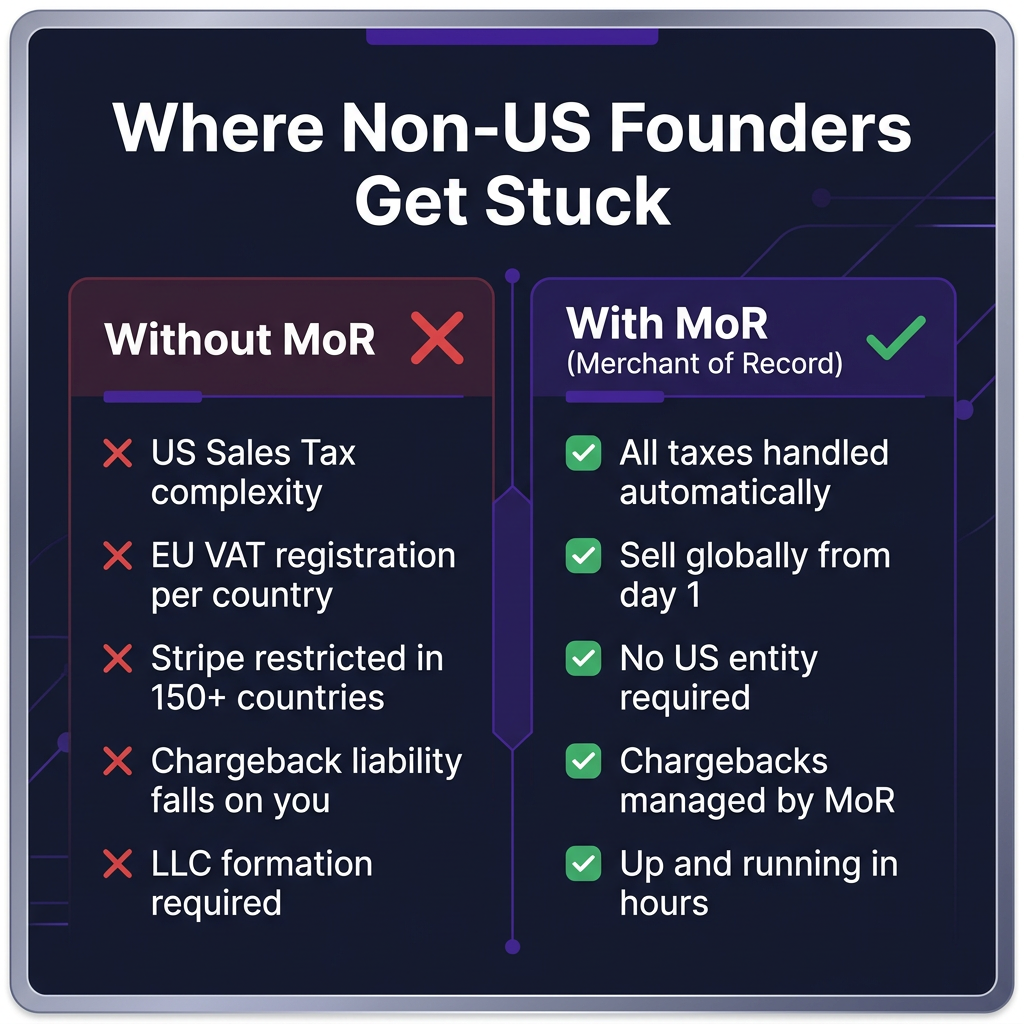
The Problem: Why Stripe Doesn’t Just Work for Non-US Founders
Stripe is available in 46 countries as of 2026. That sounds like a lot until you realize there are 195 countries in the world — and that even within those 46, the experience varies massively depending on your local banking setup.
For founders in India, for example, Stripe onboarding is invite-only. For many Eastern European, African, and Southeast Asian countries, the onboarding process requires documentation that takes weeks. And in countries like Pakistan, Bangladesh, Nigeria (standard tier), or Vietnam, Stripe simply doesn’t operate at all for merchant accounts.
But even if you can open a Stripe account in your country, you’re still facing:
- US Sales Tax nexus complexity — once you hit $100K in a state, you owe tax there. Each of 45 taxable US states has its own rules.
- EU VAT registration — selling digital services to EU customers legally requires VAT registration, or using the OSS scheme.
- Chargeback liability — every dispute you lose costs you $15 regardless, plus the transaction value.
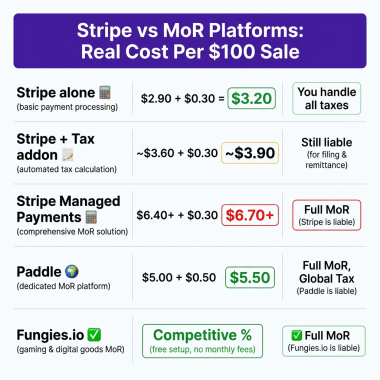
- Currency conversion fees — Stripe adds 1% on top of the 1.5% international card surcharge, so a €100 sale from a European customer actually costs you ~5.4% + $0.30.
The math adds up fast. At 1,000 transactions per month with an average order of $50, those fees compound into thousands of dollars in avoidable costs every year.
What Is a Merchant of Record — and Why It Solves This
A Merchant of Record (MoR) is the legal entity that takes responsibility for your transactions. Instead of you being the seller of record (with all the tax, chargeback, and compliance obligations that entails), the MoR platform becomes the legal seller.
You build the product. They handle the transaction infrastructure.
Practically, this means:
- They register for sales tax in US states on your behalf
- They handle EU VAT, Australian GST, Japanese Consumption Tax, and 60+ other tax jurisdictions
- They absorb chargeback liability (within reason)
- They handle currency conversion and local payment methods
- They deal with fraud detection and PCI compliance
And critically for non-US founders: you don’t need a US LLC to use most MoR platforms. You sign up with your existing business entity — or even as a sole trader in some cases — and the MoR platform sits between you and your global customers.
This is why founders from Poland, Romania, India, Brazil, and dozens of other countries are moving to MoR platforms. The alternative — forming a US LLC, getting an EIN, opening a US bank account, and managing multi-state tax compliance yourself — can take 3–6 months and cost $2,000–$5,000 in setup fees before you earn a single dollar.
Which MoR Platforms Work for Non-US Founders
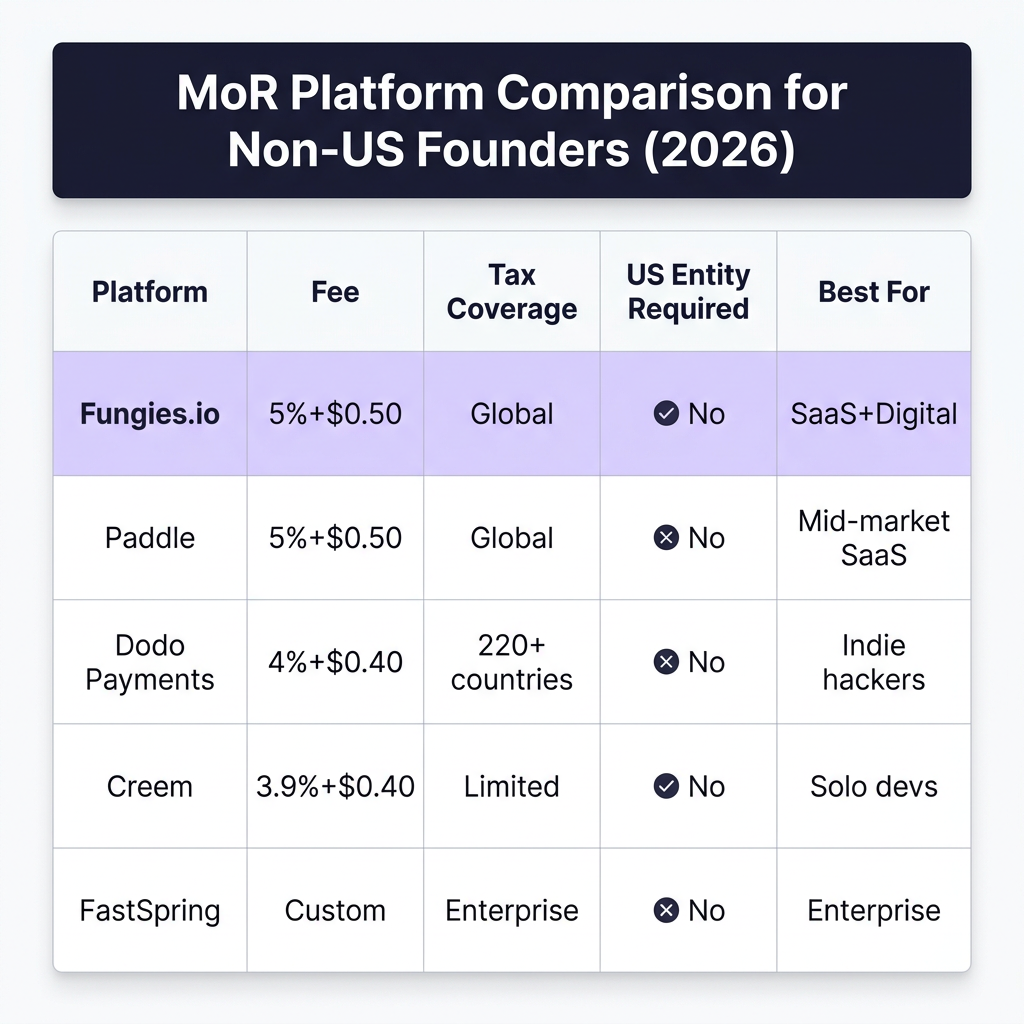
Not all Merchant of Record platforms are equal. Some cater to enterprise software companies with six-figure annual contracts. Others were built specifically for indie hackers and bootstrapped SaaS teams. Here’s how the main options break down for non-US founders in 2026:
| Platform | Fee | Tax Coverage | US Entity Required? | Non-US Friendly? | Best For |
|---|---|---|---|---|---|
| Fungies.io | 5% + $0.50 | Global (60+ jurisdictions) | No | ✅ Yes | SaaS, digital products, game devs |
| Paddle | 5% + $0.50 | Global (140+ countries) | No | ✅ Yes | Mid-market SaaS companies |
| Dodo Payments | 4% + $0.40 (+ 1.5% intl) | 220+ countries | No | ✅ Yes | Indie hackers, AI builders |
| Creem | 3.9% + $0.40 | Good, narrower footprint | No | ✅ Yes | Solo developers, early-stage |
| FastSpring | Custom (contract-based) | Global, enterprise-grade | No | ⚠️ Enterprise focus | Enterprise software companies |
| LemonSqueezy | 5% + $0.50 | Global | No | ✅ Yes (post-Stripe acq.) | Creators and indie devs |
One thing to notice: every platform on this list requires zero US entity. That’s the core value proposition of the MoR model — the platform’s legal entity is the US presence, not yours.
How Merchant of Record Tax Handling Actually Works
When a customer in California buys your SaaS tool for $99, here’s what happens under a MoR model:
- The customer pays $99 + applicable California sales tax (for SaaS, this varies by product category)
- The MoR platform collects the full amount
- The platform pays California its owed tax and remits the net to you
- You receive your revenue minus the platform fee
You never see the tax. You never file in California. You never get a demand letter from the California Department of Tax and Fee Administration. The MoR eats all of that operational overhead.
The same logic applies in Europe. When a German customer buys your product, the MoR handles German VAT (currently 19% for digital services). You don’t need to be registered for VAT in Germany. You don’t need to file a German VAT return. The platform handles it under their VAT registration.
This isn’t theoretical. The EU’s 2015 VAT rules for digital services made this extremely consequential. Any business selling digital services to EU consumers — even one person in Romania buying a $10 plugin — technically owes EU VAT. For a solo founder managing their own compliance, that means registering for VAT OSS in an EU country, filing quarterly returns, and potentially dealing with audits. For a founder using a MoR, it means none of that — the platform handles it.
Countries Where Non-US Founders Commonly Run Into Problems
Some geographies are particularly tricky for direct payment processing. Here’s where founders most often hit walls — and how MoR platforms solve it:
India
Stripe is available in India but with significant friction. RBI (Reserve Bank of India) regulations require Indian businesses to comply with FEMA (Foreign Exchange Management Act) when receiving international payments. For a SaaS company selling globally, this creates complex reporting requirements and restrictions on holding foreign currency. Many Indian founders use a MoR to sidestep this entirely — they receive INR payouts while the platform handles the international transaction layer.
Eastern Europe (Poland, Romania, Czech Republic, etc.)
These countries are Stripe-supported, but EU VAT compliance is still a challenge. A Polish founder selling to EU customers theoretically needs to handle OSS VAT registration. With a MoR, that burden disappears. The platform handles EU VAT on your behalf under their own registration.
Latin America (Brazil, Colombia, Mexico)
Brazil has Stripe, but Brazil’s local payment ecosystem (Boleto, Pix) is heavily preferred by local customers. Mexico and Colombia have mixed support. MoR platforms with strong LATAM coverage can handle local payment methods that direct Stripe integration can’t easily support.
Africa and Middle East
Outside of South Africa and the UAE (where Stripe has extended network access), most African countries have no Stripe support at all. MoR platforms that operate through local banking partners can process payments from these regions where Stripe simply can’t.
What You Actually Give Up With an MoR (Honest Assessment)
MoR platforms are powerful, but they’re not free lunches. Here’s what you’re trading off:
| Trade-off | What it means in practice | How significant? |
|---|---|---|
| Higher base fees vs Stripe | 5% + $0.50 vs Stripe’s 2.9% + $0.30 for domestic US | Medium — but Stripe’s real cost with tax + international is often higher |
| Less checkout control | You use the MoR’s checkout UI (though many support embedding) | Low — most modern MoRs have good embedded checkout options |
| Platform risk | If the MoR goes under or changes terms, you need to migrate | Low-medium — mitigate by choosing established platforms |
| Revenue reporting complexity | Your accounting shows MoR payouts, not individual transactions | Low — most MoRs provide detailed transaction exports |
| Customer relationship | The MoR is technically the seller; their name may appear on receipts | Low for SaaS, higher for brand-sensitive physical products |
The key insight: for most non-US founders, the 5% MoR fee is cheaper in total than the combination of Stripe’s base rate + international fees + tax compliance costs + accounting overhead. When you price in the $2–5K/year you’d spend on a tax compliance tool like TaxJar or Avalara, the MoR math often wins decisively.

How to Get Started: From Zero to First Global Payment in 24 Hours
Here’s the practical path if you’re a non-US founder ready to start accepting global payments today.
Step 1: Pick your MoR platform
For most indie SaaS founders and digital product creators, Fungies.io is the cleanest starting point. The setup is designed for developers — you get an embeddable checkout widget, subscription billing, and full tax handling without enterprise contracts or lengthy onboarding calls. At 5% + $0.50, the fee is predictable.
If you’re specifically focused on minimizing fees and your customer base is primarily in the US, Dodo Payments’ 4% + $0.40 base (before international add-ons) is worth evaluating. If you’re building for a broader creator economy, LemonSqueezy remains a viable option despite the Stripe acquisition uncertainty.
Step 2: Sign up with your existing entity
Most MoR platforms accept businesses incorporated outside the US. You’ll typically need:
- Your company registration documents
- A valid business bank account (in your local currency is fine)
- A government-issued ID for identity verification
- Your product or website URL
No US EIN. No US SSN. No US bank account required.
Step 3: Configure your products and pricing
Set up your pricing in your preferred currency (USD is recommended for global reach, but many platforms support multi-currency pricing). Configure subscription intervals if applicable — monthly, annual, or usage-based.
Step 4: Embed or link your checkout
Most modern MoR platforms offer two integration options:
- Hosted checkout link — generate a link, paste it in your pricing page, done. Zero code required.
- Embedded widget — drop a script tag into your app and the checkout appears inline. Better conversion, slightly more setup.
For most founders just starting out, the hosted link gets you live in under an hour.
Handling Payouts to Non-US Bank Accounts
One question every non-US founder has: how do I actually get paid?
MoR platforms handle payouts differently. Most support:
- Wire transfers to international bank accounts (typically weekly or bi-weekly)
- Wise (formerly TransferWise) integration for lower-fee currency conversion
- PayPal payouts (less common, higher fees)
- Local bank payouts in selected markets
Fungies.io, Paddle, and most major MoR platforms support payouts to international bank accounts in most major currencies. You’ll typically receive your earnings in USD, EUR, or GBP and convert to local currency yourself — or receive directly in your local currency if the platform supports it.
A practical tip: open a Wise Business account if you’re dealing with multiple currencies. It gives you local bank details in USD, EUR, GBP, and other major currencies, which can simplify the payout process significantly.
Key Takeaways for Non-US Founders
- You don’t need a US LLC to sell globally — Merchant of Record platforms handle the legal seller relationship on your behalf, regardless of where you’re incorporated
- The true cost of Stripe for international SaaS is often 5–7% — once you add international card fees, currency conversion, tax compliance tools, and chargeback costs, MoR pricing is frequently comparable or cheaper
- Tax compliance is the hidden killer — US multi-state sales tax + EU VAT alone can be a $3–5K/year problem for a solo founder; MoR platforms absorb this entirely
- Time to first payment with a MoR can be under 24 hours — vs. 3–6 months to set up a US LLC, EIN, and bank account
- Platform risk is manageable — choose established platforms with real track records (Fungies.io, Paddle, Dodo Payments) rather than very early-stage alternatives
FAQ
Can I use a Merchant of Record if I’m incorporated in India, Poland, or Brazil?
Yes. Most major MoR platforms — including Fungies.io, Paddle, and Dodo Payments — accept businesses incorporated outside the US. You’ll need your local business registration, a business bank account, and identity verification. No US entity required.
Do I still need to file taxes in my home country when using a MoR?
Yes — you still owe income tax on your earnings in your home country, as normal. What the MoR handles is sales tax and VAT in the countries where your customers are located. Your domestic income tax obligations are separate and unaffected.
What happens to my customers’ tax receipts when I use a MoR?
The MoR issues tax-compliant receipts to your customers on your behalf. Customers receive invoices that show the correct tax treatment for their jurisdiction. For B2B customers in the EU who need VAT invoices, most MoR platforms support reverse charge VAT handling.
Is a Merchant of Record worth it if I have fewer than 100 customers?
Almost certainly yes for non-US founders. Even at small scale, the compliance obligations of selling globally directly (US sales tax, EU VAT) create real risk. The cost of getting it wrong — back taxes, penalties, account freezes — is much higher than the MoR fee. Start with a MoR and move on if and when your scale genuinely justifies a different structure.
Start Selling Globally Today
If you’re a non-US founder who’s been delaying payments setup because the options felt complicated or US-centric, the MoR model exists exactly for this situation. You don’t need a Delaware LLC. You don’t need a US bank account. You don’t need to understand 45 different US state tax rules.
Pick a Merchant of Record platform, connect your product, and start earning revenue from customers anywhere in the world — in under 24 hours.
Start with Fungies.io free — no credit card, no US entity required →
References
- Stripe Supported Countries 2026 — Dodo Payments
- Real Cost of Stripe for Non-US Founders — Corporatee
- Cheapest Merchant of Record Pricing Comparison — Dodo Payments
- Best MoR for SaaS 2026 — Creem
- EU VAT on Digital Services — European Commission
- Selling SaaS Globally — Paddle
- Reddit: Non-US founder Stripe challenges — r/SaaS