Here’s a stat that’ll make you rethink your growth strategy: email marketing delivers an average ROI of $36 for every $1 spent. For SaaS companies specifically, that number climbs even higher — because unlike e-commerce, SaaS businesses rely on ongoing relationships, not one-time transactions.
But here’s the catch. Most SaaS founders pick their email tool based on what worked for their friend’s Shopify store. That’s a mistake. SaaS email marketing is different. You need behavioral triggers, product-event integration, and onboarding sequences that actually convert free trials to paid users.
What Makes Email Marketing Different for SaaS?
Before diving into the tools, let’s get clear on what SaaS teams actually need from email marketing software. It’s not just about sending newsletters.
SaaS email marketing revolves around three core use cases: onboarding new users to activation, nurturing leads from trial to paid, and reducing churn through proactive engagement. Each requires different capabilities than traditional email marketing.
For onboarding, you need event-based triggers — emails that fire when users complete (or skip) specific actions in your product. For lead nurturing, you need sophisticated segmentation based on product usage, not just demographics. For churn prevention, you need to identify at-risk users and trigger win-back sequences automatically.
The 10 Best Email Marketing Tools for SaaS in 2026
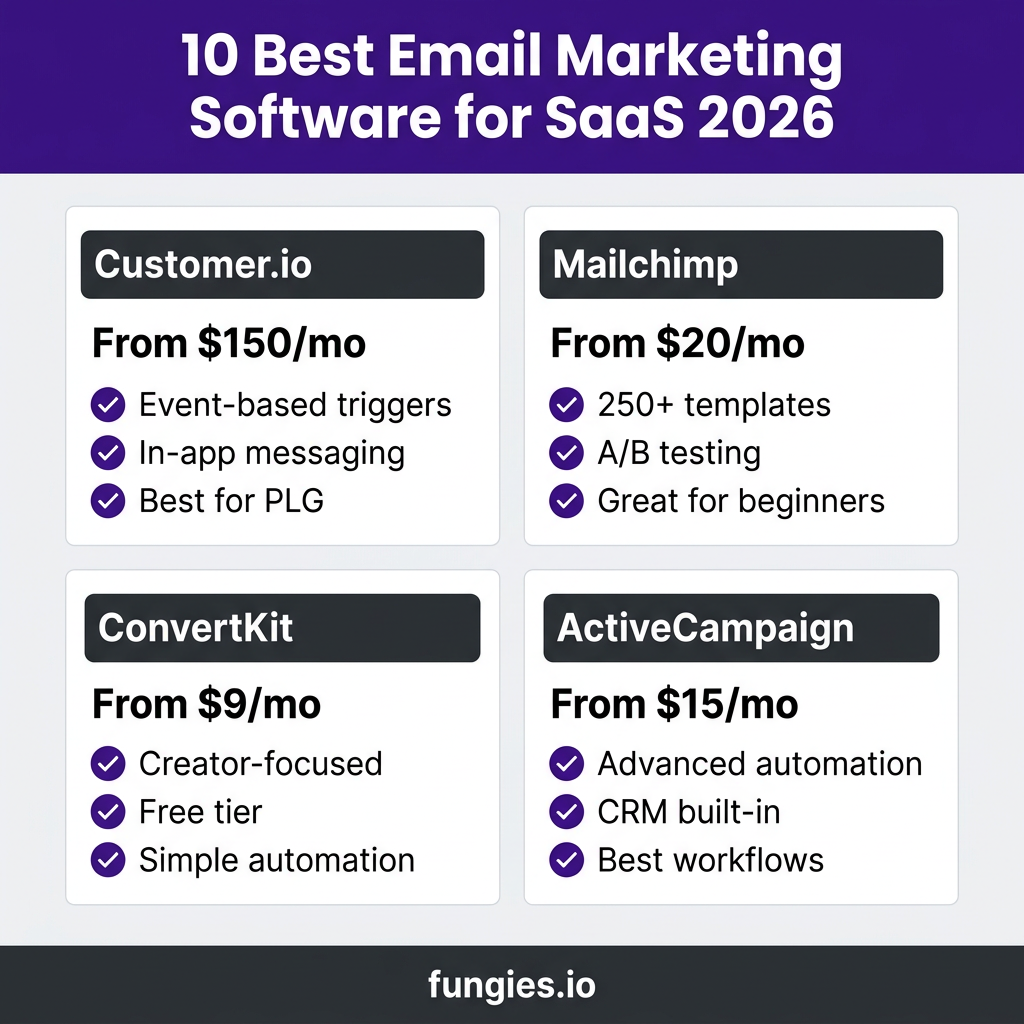
1. Customer.io — Best for Product-Led Growth
Customer.io takes a fundamentally different approach than traditional email platforms. Instead of organizing around contacts and campaigns, it thinks in events and behaviors. When a user completes their third project but hasn’t invited a team member within 48 hours, Customer.io can trigger a collaboration guide via email and show an in-app tooltip simultaneously.
This behavioral messaging approach is unmatched for SaaS companies practicing product-led growth. The platform integrates with Segment, Rudderstack, and directly via API, making it easy to pipe product data into messaging workflows.
- Key features: Event-based triggers, in-app messaging, SMS, push notifications, webhook actions
- Pricing: Starts at $150/month for up to 5,000 profiles
- Best for: SaaS companies with technical teams who want precise behavioral targeting
2. Mailchimp — Best for Beginners
Mailchimp remains the entry point for many SaaS founders, and for good reason. The platform has evolved significantly beyond its newsletter roots, now offering marketing automation, landing pages, and even basic CRM functionality.
For early-stage SaaS with straightforward email needs — welcome sequences, product updates, and basic nurture campaigns — Mailchimp delivers solid value. The template library is extensive, and the drag-and-drop editor is genuinely intuitive.
However, Mailchimp’s segmentation capabilities lag behind dedicated SaaS tools. You can segment by tags and basic behavior, but complex product-event triggers require workarounds.
- Key features: 250+ templates, A/B testing, basic automation, landing pages, CRM
- Pricing: Free up to 500 contacts; paid plans from $20/month
- Best for: Early-stage SaaS founders who need simplicity over sophistication
3. ConvertKit — Best for Creator-Led SaaS
ConvertKit built its reputation serving creators, but it’s increasingly popular among SaaS companies with content-driven acquisition strategies. If your SaaS grows through educational content, newsletters, and community building, ConvertKit deserves serious consideration.
The platform excels at tag-based segmentation and visual automation builders. You can create sophisticated sequences based on subscriber behavior without touching code. The free tier is genuinely useful — up to 1,000 subscribers with core features included.
Where ConvertKit falls short is deep product integration. Unlike Customer.io or Intercom, it doesn’t natively track in-app behavior. You’ll need Zapier or similar tools to connect product events to email triggers.
- Key features: Visual automation, tag-based segmentation, landing pages, commerce integration
- Pricing: Free up to 1,000 subscribers; paid from $9/month
- Best for: Content-driven SaaS and creator-founded startups
4. ActiveCampaign — Best for Advanced Automation
ActiveCampaign consistently ranks highest for automation sophistication. The platform combines email marketing with a full CRM, creating a unified system for marketing and sales teams. For SaaS companies with sales-assisted motions, this integration is valuable.
The automation builder supports complex conditional logic, split testing within automations, and predictive sending based on individual engagement patterns. You can build workflows that would require custom development on simpler platforms.
The tradeoff is complexity. ActiveCampaign has a steeper learning curve than Mailchimp or ConvertKit. You’ll invest time upfront understanding the platform’s capabilities.
- Key features: Advanced automation, built-in CRM, predictive sending, split automation testing
- Pricing: Starts at $15/month for 1,000 contacts
- Best for: SaaS with sales teams and complex nurture sequences
5. HubSpot Marketing Hub — Best All-in-One
HubSpot needs no introduction. The platform offers comprehensive marketing automation, CRM, content management, and analytics in one integrated system. For SaaS companies already using HubSpot CRM, the Marketing Hub is a natural extension.
The email capabilities are robust: drag-and-drop editor, personalization tokens, A/B testing, and detailed analytics. Where HubSpot shines is connecting email to the broader customer journey — you can see exactly how email touches influence pipeline and revenue.
The downside? Cost. HubSpot gets expensive quickly as you scale. The free tier is limited, and paid plans start at $20/month but jump significantly for advanced features.
- Key features: Full CRM integration, advanced analytics, content management, meeting scheduling
- Pricing: Free tier available; paid from $20/month, scales with contacts
- Best for: SaaS companies wanting integrated marketing and sales platforms
6. Klaviyo — Best for E-commerce Hybrid SaaS
Klaviyo dominates e-commerce email marketing, but it’s increasingly relevant for SaaS companies with transactional components or hybrid business models. If your SaaS also sells physical products, courses, or digital downloads, Klaviyo’s e-commerce heritage becomes an asset.
The platform excels at predictive analytics — identifying which customers are likely to churn, which are ready to upgrade, and what products they might buy next. These capabilities transfer well to SaaS churn prediction and expansion revenue.
Note Klaviyo’s 2025 pricing changes: they now charge based on active profiles rather than email volume. This can increase costs if you maintain large inactive lists.
- Key features: Predictive analytics, e-commerce integration, SMS marketing, advanced segmentation
- Pricing: Free up to 250 profiles; paid from $20/month
- Best for: SaaS with e-commerce components or hybrid business models
7. Brevo (formerly Sendinblue) — Best Value for Money
Brevo offers perhaps the best value proposition in email marketing. The platform charges based on email volume rather than contacts, meaning you can maintain large lists without escalating costs. For SaaS with extensive free tiers or large user bases, this pricing model is advantageous.
The feature set is comprehensive: email campaigns, automation, SMS, chat, and CRM. While not as sophisticated as ActiveCampaign or Customer.io, Brevo covers the essentials well at a lower price point.
Deliverability is solid, and the template library is adequate for most needs. The automation builder supports basic triggers and workflows, though complex behavioral sequences may require compromises.
- Key features: Email + SMS + chat, CRM, transactional email, landing pages
- Pricing: Free up to 300 emails/day; paid from $9/month
- Best for: Budget-conscious SaaS with large contact lists
8. Loops — Best Modern API-First Option
Loops is the new entrant making waves among developer-focused SaaS companies. Built with modern API architecture from the ground up, Loops prioritizes clean integration and developer experience.
The platform focuses specifically on SaaS use cases: onboarding emails, product updates, and transactional messaging. The API is well-documented, and the SDKs make integration straightforward for technical teams.
As a newer platform, Loops lacks some advanced features of established competitors. But for teams prioritizing clean code and modern architecture, it’s worth evaluating.
- Key features: Modern API, SaaS-focused templates, clean UI, developer-friendly
- Pricing: Free tier available; paid plans scale with usage
- Best for: Technical founders who prioritize API quality
9. Resend — Best for Transactional Email
Resend focuses on one thing and does it exceptionally well: delivering transactional emails to the inbox. Founded by the team behind React Email, Resend brings developer-centric design to email infrastructure.
While primarily a transactional email provider, Resend recently expanded into marketing email capabilities. The platform offers excellent deliverability, detailed analytics, and a clean API that developers love.
For SaaS companies that have outgrown SendGrid or Amazon SES, Resend offers a modern alternative with better developer experience and competitive pricing.
- Key features: Transactional + marketing email, excellent deliverability, React Email integration
- Pricing: Free up to 3,000 emails/month; paid from $20/month
- Best for: SaaS prioritizing deliverability and developer experience
10. Encharge — Best SaaS-Specific Automation
Encharge is built specifically for SaaS companies, with features designed around common SaaS use cases: trial conversion, user onboarding, and feature adoption. The platform integrates deeply with popular SaaS tools like Stripe, Segment, and product analytics platforms.
The automation builder is intuitive, with pre-built templates for SaaS scenarios like “trial ending soon” and “feature adoption nudge.” You can trigger emails based on billing events, product usage, and user properties without complex setup.
Encharge is smaller than competitors, which means fewer integrations and a smaller community. But for pure SaaS email automation, the specialization is valuable.
- Key features: SaaS-specific automation, Stripe integration, behavior-based triggers
- Pricing: Starts at $79/month for up to 2,000 subscribers
- Best for: SaaS companies wanting purpose-built automation
Email Marketing Software Comparison Table
| Tool | Starting Price | Free Tier | Best For | Key Strength |
|---|---|---|---|---|
| Customer.io | $150/mo | No | PLG SaaS | Behavioral triggers |
| Mailchimp | $20/mo | 500 contacts | Beginners | Ease of use |
| ConvertKit | $9/mo | 1,000 subs | Creator SaaS | Content automation |
| ActiveCampaign | $15/mo | No | Sales-led SaaS | Advanced automation |
| HubSpot | $20/mo | Limited | All-in-one | CRM integration |
| Klaviyo | $20/mo | 250 profiles | Hybrid models | Predictive analytics |
| Brevo | $9/mo | 300 emails/day | Budget SaaS | Value pricing |
| Loops | Usage-based | Yes | Developer SaaS | Modern API |
| Resend | $20/mo | 3,000 emails | Deliverability | Transactional focus |
| Encharge | $79/mo | No | SaaS-specific | Purpose-built |
How to Choose the Right Email Marketing Software
Picking the right tool depends on your SaaS stage, technical resources, and specific use cases. Here’s a framework to guide your decision.
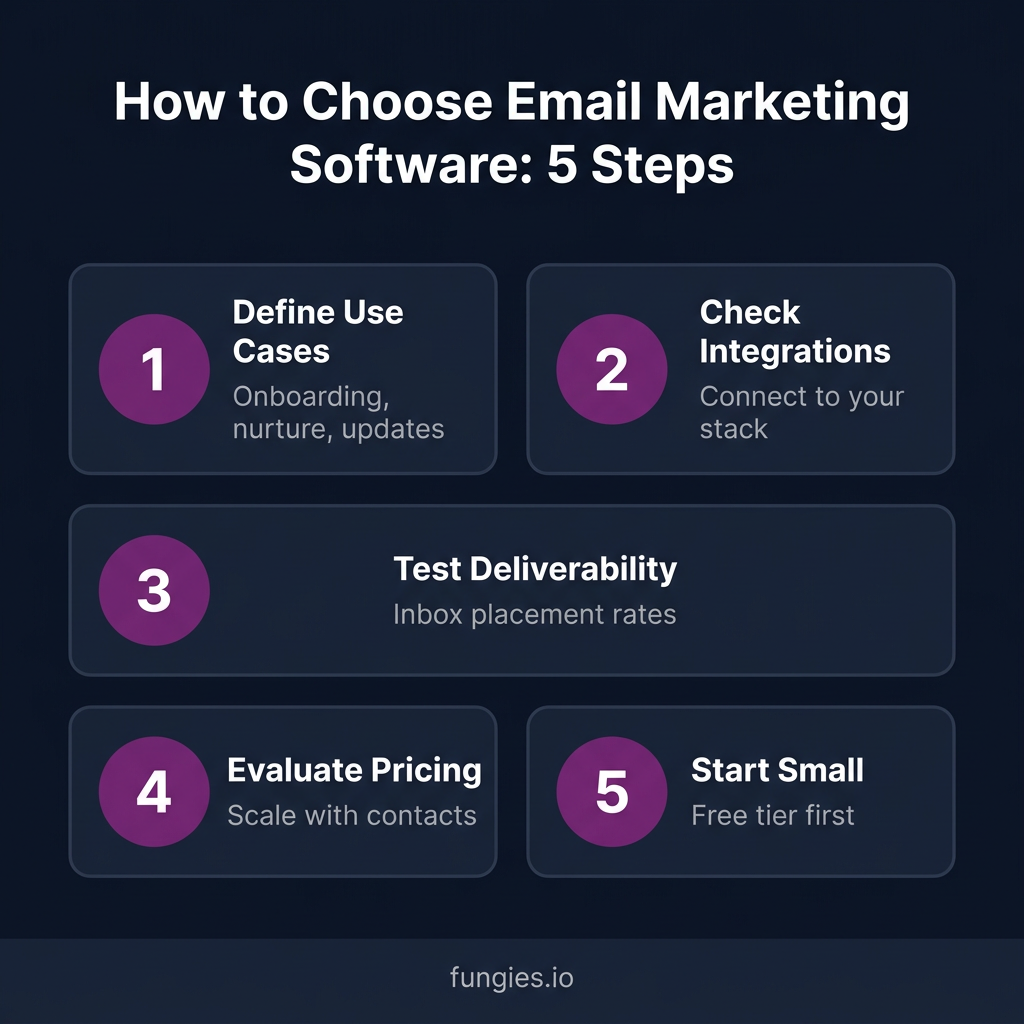
Define Your Primary Use Cases
Start by listing what you’ll actually use email for. Onboarding sequences? Product updates? Nurture campaigns? Churn prevention? Different tools excel at different things. Customer.io and Encharge shine for behavioral triggers. ConvertKit excels at content-driven nurture. Resend dominates transactional delivery.
Evaluate Integration Requirements
Your email tool doesn’t exist in isolation. It needs to connect to your product, analytics, CRM, and billing systems. Check native integrations before committing. Tools like Customer.io and Encharge have deep SaaS integrations. Others may require Zapier or custom API work.
Test Deliverability Early
All the features in the world don’t matter if your emails land in spam. Most platforms offer free trials — use them to send test campaigns and check inbox placement. Tools like Mailchimp and ActiveCampaign have established sender reputations. Newer platforms like Resend focus specifically on deliverability.
Consider Pricing at Scale
That $9/month starter plan looks attractive until you hit 10,000 contacts. Understand how pricing scales. Klaviyo charges by active profiles. Brevo charges by email volume. Customer.io charges by profiles plus data points. Model costs at your projected growth to avoid surprises.
Start Small and Iterate
Don’t overthink the decision. Most email platforms offer free tiers or trials. Start with one that meets your immediate needs, implement basic sequences, and upgrade or switch as you learn what works. Your first email tool won’t be your last — and that’s okay.
FAQ: Email Marketing for SaaS
What’s the best free email marketing tool for SaaS startups?
ConvertKit offers the most generous free tier with up to 1,000 subscribers and core automation features. Mailchimp’s free tier supports up to 500 contacts. Brevo allows 300 emails per day on their free plan. For pure transactional email, Resend offers 3,000 emails monthly free.
How much should SaaS companies spend on email marketing software?
Early-stage SaaS can start with free tiers up to $50/month. Growth-stage companies typically spend $100-500/month depending on list size and feature needs. Enterprise SaaS may invest $1,000+ monthly for advanced automation and dedicated support. Given email’s 36:1 ROI, most SaaS under-invest in this channel.
Should SaaS use the same tool for transactional and marketing email?
It depends on volume and requirements. For early-stage SaaS, using one platform (like Mailchimp, Brevo, or Customer.io) for both simplifies operations. At scale, separating transactional (password resets, receipts) from marketing (campaigns, newsletters) can improve deliverability. Tools like Resend specialize in transactional, while others focus on marketing.
What’s more important: automation features or deliverability?
Deliverability wins. The most sophisticated automation is worthless if emails don’t reach inboxes. Prioritize platforms with strong sender reputations and deliverability tools. Once you’ve ensured inbox placement, layer in automation to improve relevance and timing.
How do I migrate from one email platform to another?
Most platforms offer import tools for contacts and templates. The critical step is warming up your new sending domain — start with low volumes to engaged subscribers, gradually increasing over 2-4 weeks. Maintain your old platform during transition to avoid disruption. Export automation workflows as documentation, though you’ll likely rebuild them in the new platform.
Conclusion: Start Sending
Email marketing remains the highest-ROI channel for SaaS growth. The tools listed here can all drive results — the difference is in how well they match your specific needs, team capabilities, and growth stage.
Don’t let analysis paralysis delay action. Pick a platform, set up your onboarding sequence, and start measuring results. You can always switch tools as you grow, but you can’t recover lost time spent not engaging your users.
Ready to grow your SaaS with better payments and billing? Get started with Fungies.io — we handle the complexity so you can focus on growth.