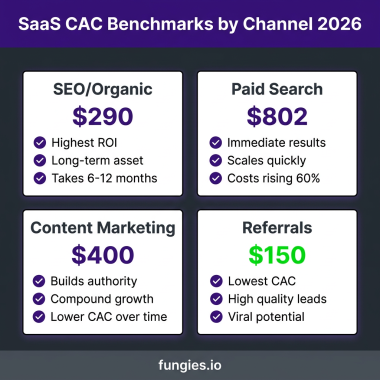
Here’s a stat that should wake you up: Dropbox grew from 100,000 to 4 million users in just 15 months without spending a dollar on traditional marketing. Their secret? A referral program so effective it achieved a 3900% growth rate and reduced customer acquisition costs by 60% compared to paid ads.
Honestly, most SaaS founders I talk to are burning cash on Facebook and Google ads while ignoring the most powerful growth channel available: their own users. If you’re spending $300 to acquire a customer who pays $99/year, you’re doing it wrong. Viral growth isn’t magic — it’s mechanics. And in this guide, I’ll show you exactly how to build those mechanics into your product.
What Is Viral Growth in SaaS?
Viral growth happens when your existing users become your primary acquisition channel. Instead of paying for ads, you engineer your product so that using it naturally leads to new user signups. Think about it: every time someone shares a Dropbox file with a non-user, they’re effectively running a marketing campaign for Dropbox — except it’s authentic, trusted, and free.
The math behind viral growth is surprisingly simple. It’s measured by something called the viral coefficient (or K-factor). Here’s how it works: if your K-factor is 0.5, every 10 users you acquire will bring in 5 new users through referrals. If your K-factor hits 1.0 or higher, you’ve achieved self-sustaining growth — each user brings in at least one more user, and your product grows exponentially without additional marketing spend.
Dropbox achieved a K-factor of 0.35. While that might sound modest, combined with their other channels, it drove 35% of all daily signups at peak. Slack’s viral mechanics were even more subtle — they built sharing into the core product experience, so teams naturally pulled in other teams.
Why Viral Growth Matters More Than Ever in 2026
Customer acquisition costs have jumped 40-60% between 2023 and 2025. Privacy changes, increased competition, and ad platform algorithm shifts have made paid acquisition a bloodbath. According to recent benchmarks, the average B2B SaaS CAC now sits at $1,200 — and that’s just for the initial signup, not a paying customer.
Meanwhile, referred customers bring 25% higher lifetime value and churn 30-50% less than customers acquired through paid channels. They’re more engaged, more loyal, and more likely to refer others themselves. It’s a compound effect: your best customers become your best marketers, who bring in more of your best customers.
Here’s what the data shows about viral growth impact:
| Metric | Paid Acquisition | Viral/Referral |
|---|---|---|
| Average CAC | $233-$1,200 | $0-$50 |
| Conversion Rate | 2-5% | 10-30% |
| Customer LTV | Baseline | +16-25% |
| Churn Rate | Baseline | -30-50% |
| Time to Payback | 12-18 months | 3-6 months |
The Four Pillars of SaaS Viral Growth
After analyzing dozens of successful viral SaaS companies, I’ve identified four core strategies that consistently drive exponential growth. You don’t need to implement all four — most successful companies master one or two. But understanding all of them helps you choose the right approach for your product and audience.
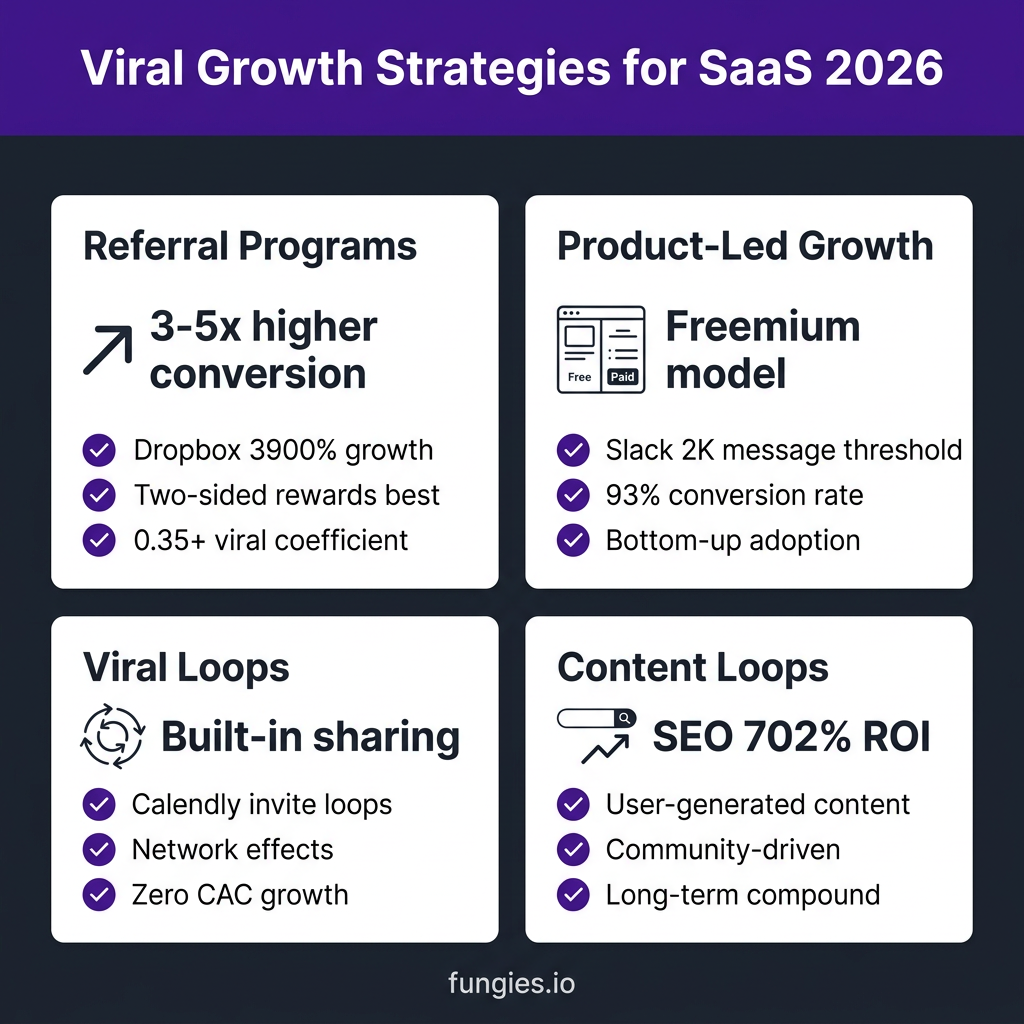
1. Referral Programs: The Dropbox Model
Dropbox’s referral program is the gold standard for a reason. They didn’t just add a “refer a friend” button and hope for the best. They engineered every aspect of the experience to maximize sharing.
The genius was in their two-sided reward structure. Both the referrer and the new user got 500MB of free storage. This wasn’t just generous — it was strategic. The referrer felt good about helping a friend. The friend felt grateful for the bonus. Both associated positive feelings with Dropbox. According to Nielsen, 88% of people trust recommendations from people they know above all other forms of marketing.
Dropbox also integrated referrals into their onboarding flow. New users discovered the program during setup, when they were most excited about the product. They made it a “pro tip” rather than a sales pitch. And they provided multiple sharing options — email, social media, and direct links — with pre-written messages that sounded human, not corporate.
The results speak for themselves: 2.8 million invites sent per month at peak, $48 million saved in marketing spend, and a program that still drives growth nearly two decades later.
2. Product-Led Growth: The Slack Playbook
Slack became the fastest SaaS company to reach $1 billion ARR by executing one of the most effective product-led growth strategies in software history. They didn’t sell to executives — they grew bottom-up. Individual teams adopted the free product, fell in love with it, and pulled it into their organizations.
The key insight came from their data analysis. Slack discovered that teams who exchanged 2,000 messages had a 93% conversion rate to long-term paid users. Every product decision was oriented around getting teams to that activation threshold as quickly as possible. The onboarding, the design, the tone of voice — everything was engineered to drive engagement.
Slack’s freemium model was equally strategic. The free plan was genuinely useful — not a crippled demo. Teams could use it indefinitely for small groups. But as teams grew and hit the message history limit, they naturally upgraded. The product sold itself.
What made Slack truly viral was network effects. You can’t use Slack alone — you need a team. So every user inherently brought in more users just by using the product. When Sarah invited her design team to a Slack channel, they all had to sign up. When that team collaborated with engineering, they pulled them in too. The product spread organically through professional networks.
3. Viral Loops: The Calendly Approach
Calendly is one of the clearest examples of how a simple product, when designed intelligently, can achieve massive adoption without traditional marketing. They didn’t win because they had the most features — they won because they removed friction from a universal problem: scheduling meetings.
Calendly’s viral loop is beautifully simple. When you send someone a Calendly link to book a meeting, they experience the product before they even sign up. They see how easy it is to find a time that works for both of you. They think, “This is so much better than email ping-pong.” And many of them sign up on the spot.
Every Calendly link is a marketing touchpoint. The free version includes a “Powered by Calendly” badge on booking pages. It’s subtle — not intrusive — but it drives awareness. When someone books through Calendly, they’re exposed to the brand. If they have scheduling pain (and who doesn’t?), they remember Calendly.
The invite-based acquisition loop fueled Calendly’s early growth. Recipients see the value immediately, and the product naturally spreads through professional networks. It’s zero-CAC growth at its finest.
4. Content Loops: The SEO Multiplier
While not viral in the traditional sense, content loops deserve mention because they compound over time like viral growth. B2B SaaS companies achieve a 702% ROI from SEO with a break-even time of just 7 months — the highest content marketing ROI of any sector.
The content loop works like this: you create valuable content that ranks in search engines. Users find your content, sign up for your product, and some of them create their own content (case studies, tutorials, integrations) that drives more search traffic. It’s a self-reinforcing cycle.
Notion mastered this approach. Their template gallery isn’t just a feature — it’s a content engine. Users create and share templates, which rank in Google and drive new user acquisition. Each template is a landing page, a use case demonstration, and a conversion tool all in one.
How to Implement Viral Growth: A 6-Step Framework
Now that you understand the strategies, let’s talk implementation. Building viral growth isn’t about copying Dropbox’s exact playbook — it’s about adapting the principles to your specific product and audience. Here’s the framework I use with SaaS companies:
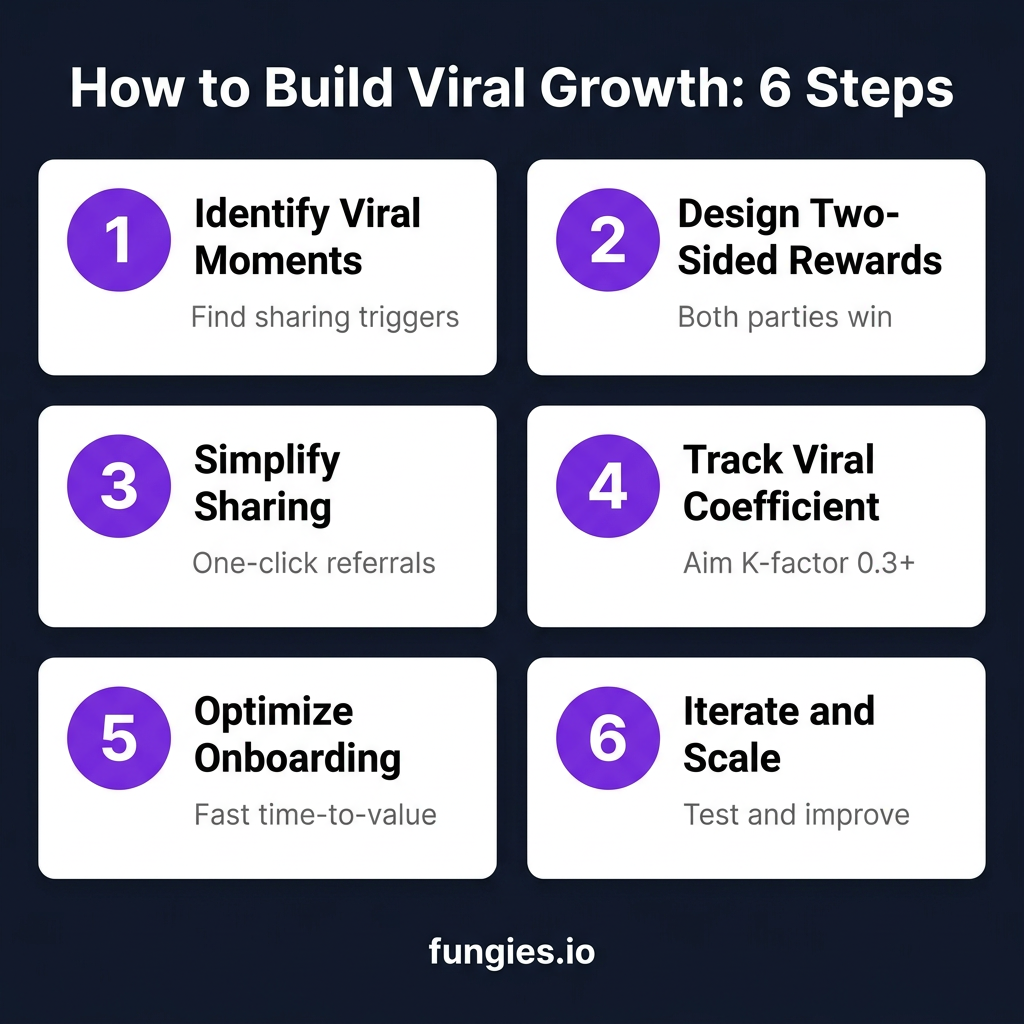
Step 1: Identify Your Viral Moments
Viral growth happens at specific moments in your user journey. You need to find where users naturally want to share your product or invite collaborators. For Dropbox, it was file sharing. For Slack, it was team collaboration. For Calendly, it was scheduling.
Ask yourself: When do users feel the most value from your product? When are they most likely to tell someone about it? When do they need to involve others to get full value? These are your viral moments. Map them out and design your viral mechanics around them.
Step 2: Design Two-Sided Rewards
One-sided rewards (only the referrer gets something) feel transactional and spammy. Two-sided rewards create positive associations for both parties. The referrer feels good about helping a friend. The friend feels grateful for the bonus.
Your rewards should align with your product’s core value. Dropbox gave storage because that’s what users wanted. Notion gives credits toward premium features. Morning Brew gives exclusive swag and event access. The reward should feel valuable enough to motivate sharing but not so generous it attracts low-quality users.
Step 3: Simplify Sharing to One Click
Friction kills viral growth. Every extra step in your sharing flow drops conversion by 20-30%. Your referral program should work with one click. Pre-write messages that sound human. Provide multiple sharing channels. Make it easier to share than not to share.
Dropbox tested dozens of message variations to find what resonated. They learned that messages sounding like they came from a friend outperformed corporate-sounding invites by 3x. Test your messaging constantly.
Step 4: Track Your Viral Coefficient
You can’t improve what you don’t measure. Track these metrics from day one:
- Viral coefficient (K-factor): How many new users each existing user generates
- Share rate: Percentage of users who share your product (5-9% is typical)
- Referral conversion rate: How many referred leads become paying customers
- Time to referral: How long it takes users to refer after signup
- Referred customer LTV: Lifetime value of users acquired through referrals
Aim for a K-factor above 0.3 as a starting point. Above 0.5 is strong. Above 1.0 is exponential growth territory.
Step 5: Optimize Onboarding for Activation
Viral growth doesn’t work if users don’t stick around. Slack’s 2,000-message threshold is famous for a reason — they identified the exact moment when users converted to long-term customers. Then they optimized everything to get users to that moment faster.
Find your activation metric. What action correlates with long-term retention? It might be inviting team members, creating a project, or integrating with another tool. Whatever it is, make it the focus of your onboarding. Remove friction. Provide guidance. Celebrate progress.
Step 6: Iterate and Scale
Dropbox didn’t launch a perfect referral program on day one. They experimented constantly — testing messaging, rewards, timing, and placement. Every two weeks they reviewed results and iterated. Over several months, they optimized their way to 3900% growth.
Start small. Test with your first 100 users. Watch what happens. Talk to successful referrers and ask why they shared. Talk to non-referrers and ask what would motivate them. Then iterate. Perfection is the enemy of launch.
Common Viral Growth Mistakes to Avoid
I’ve seen dozens of referral programs fail. Here are the most common mistakes — and how to avoid them:
The Complexity Trap
If you need more than one sentence to explain your referral program, it’s too complex. Dropbox succeeded with: “Give friends 500MB, get 500MB.” Clear, simple, compelling. Test your program by explaining it to someone unfamiliar with your product. If they can’t immediately repeat it back accurately, simplify.
The Cheap Rewards Problem
Don’t insult your users with worthless incentives. Digital stickers and badges aren’t enough in 2026. Your rewards should make people think “Wow, really?” not “That’s it?” Calculate the lifetime value of referred customers. You can afford to be generous — referred users typically have higher retention and lower support costs.
The Communication Gap
Users need transparency at every step. Create a simple dashboard showing how many friends they’ve invited, who’s signed up, and what rewards they’ve earned. Send confirmation emails when referrals succeed. Celebrate milestones. Remind them of unclaimed rewards. Nothing frustrates users more than thinking they’ve earned rewards only to discover their referrals “didn’t count” for mysterious reasons.
Ignoring Product-Market Fit
Here’s the hard truth: a referral program won’t fix a product nobody wants. If users won’t refer friends even with incentives, you might not have product-market fit. A referral program that takes off organically is the ultimate product-market fit indicator. Focus on building something worth sharing first.
Real-World Viral Growth Case Studies
Let’s look at three companies that adapted the Dropbox playbook for their own contexts:
Notion: Time-Limited Urgency
Notion took Dropbox’s permanent rewards and added urgency. Their referral credits expire after 30 days. This seems counterintuitive — why make rewards temporary? The genius is in the psychology. Permanent rewards feel less valuable because you can always claim them “later.” Expiring credits create urgency. Notion saw referral rates jump 3x after adding expiration dates.
Morning Brew: Milestone Gamification
Morning Brew transformed referrals into a game with milestone rewards: 3 referrals gets you stickers, 10 gets a t-shirt, 25 gets a premium hoodie, 50 gets exclusive event invites. The first reward is achievable — almost everyone can think of 3 friends. But once you have 3, you’re so close to 10 that it feels wasteful to stop. This “completion bias” drives users up the reward ladder.
Robinhood: Waitlist Position as Reward
Robinhood revolutionized waitlist marketing by making position in line the reward itself. Every referral moved you up approximately 2,000 spots. Users could see their exact position and watch it improve in real-time. They also created FOMO with movement notifications: “You’ve fallen back 5,000 spots this week. Invite friends to jump ahead.” This loss aversion was incredibly effective.
FAQ: SaaS Viral Growth Strategies
What is a good viral coefficient for SaaS?
A viral coefficient (K-factor) above 0.3 is a solid starting point for SaaS companies. Above 0.5 indicates strong viral mechanics. Above 1.0 means self-sustaining growth where each user brings in more than one additional user. Dropbox achieved 0.35, which combined with other channels drove 3900% growth.
How long does it take to see results from a referral program?
Most SaaS companies see initial results within the first month of launching a referral program. Dropbox saw 35% of daily signups coming from referrals at peak within the first few months. The compound effect typically kicks in after 3-6 months as referred users begin referring others themselves.
What’s better: cash rewards or product credits?
For SaaS products, product credits or feature upgrades typically outperform cash rewards. Cash attracts users who are gaming the system for money rather than genuinely interested in your product. Product rewards align incentives — users who want more of your product are exactly the users you want to acquire.
Can B2B SaaS achieve viral growth?
Absolutely. Slack, Notion, Calendly, and Zoom are all B2B SaaS companies with strong viral growth. B2B viral growth often looks different than B2C — it spreads through professional networks rather than social networks. The principles are the same: identify viral moments, design two-sided rewards, and remove friction from sharing.
How do I calculate my viral coefficient?
The formula is: Viral Coefficient = Average Number of Referrals per User × Referral Conversion Rate. If each user sends an average of 3 invites and 10% of invited users convert, your K-factor is 0.3. Track this metric weekly and optimize your program to improve it over time.
Your Viral Growth Action Plan
Stop reading. Start implementing. Here’s what to do in the next 48 hours:
- Define your two-sided value: What specific rewards make sense for your product and users? Make sure both referrer and referred win.
- Map your triggers: Walk through your user journey. Find 3-4 natural moments where mentioning referrals would be helpful, not annoying.
- Write human messages: Draft sharing templates that you’d actually send to friends. Read them out loud. Do they sound like you or a robot?
- Set up basic tracking: Measure viral coefficient from day one. Track invites sent, conversion rate, and time to conversion.
- Launch small: Test with your first 100 users. Watch what happens. Talk to users. Then iterate.
Viral growth isn’t magic — it’s mechanics. The playbook is proven. The psychology is timeless. The only thing missing is your execution.
Ready to turn your users into your growth engine? Start building with Fungies today — and implement these viral growth strategies to scale your SaaS without burning cash on ads.
Sources
- Dropbox Referral Program Case Study – TheFlyy
- How Dropbox Used Referrals to Grow from 100K to 4M Users – Waitlister
- Slack’s $27B Product-Led Growth Strategy – IdeaPlan
- How Calendly Harnesses PLG and Virality for Growth – OpenView
- CAC Benchmarks by Channel for 2025 – Phoenix Strategy Group
- 10 Key Referral Program Metrics to Track – Prefinery
- 60+ SaaS Marketing Statistics & Benchmarks for 2026 – Oliver Munro