Affiliate programs drive 16% of all e-commerce revenue globally — yet most digital product creators either ignore the channel entirely or set it up wrong and wonder why nothing happens. If you’re selling SaaS, digital downloads, online courses, or templates, an affiliate program is one of the few growth levers that compounds over time without burning your ad budget.
Here’s the thing nobody tells you: setting up an affiliate program for digital products is fundamentally different from setting one up for physical goods or enterprise software. Your commission structure, the platforms you use, the affiliates you recruit, and the assets you give them — all of it needs to be calibrated for digital margins and digital buying behavior.
This guide covers exactly how to do it. We’ll go through platform choices, commission strategies, affiliate recruitment, and the tactical stuff that actually moves the needle — with real numbers and real examples from the space.
Why Affiliate Programs Work Especially Well for Digital Products
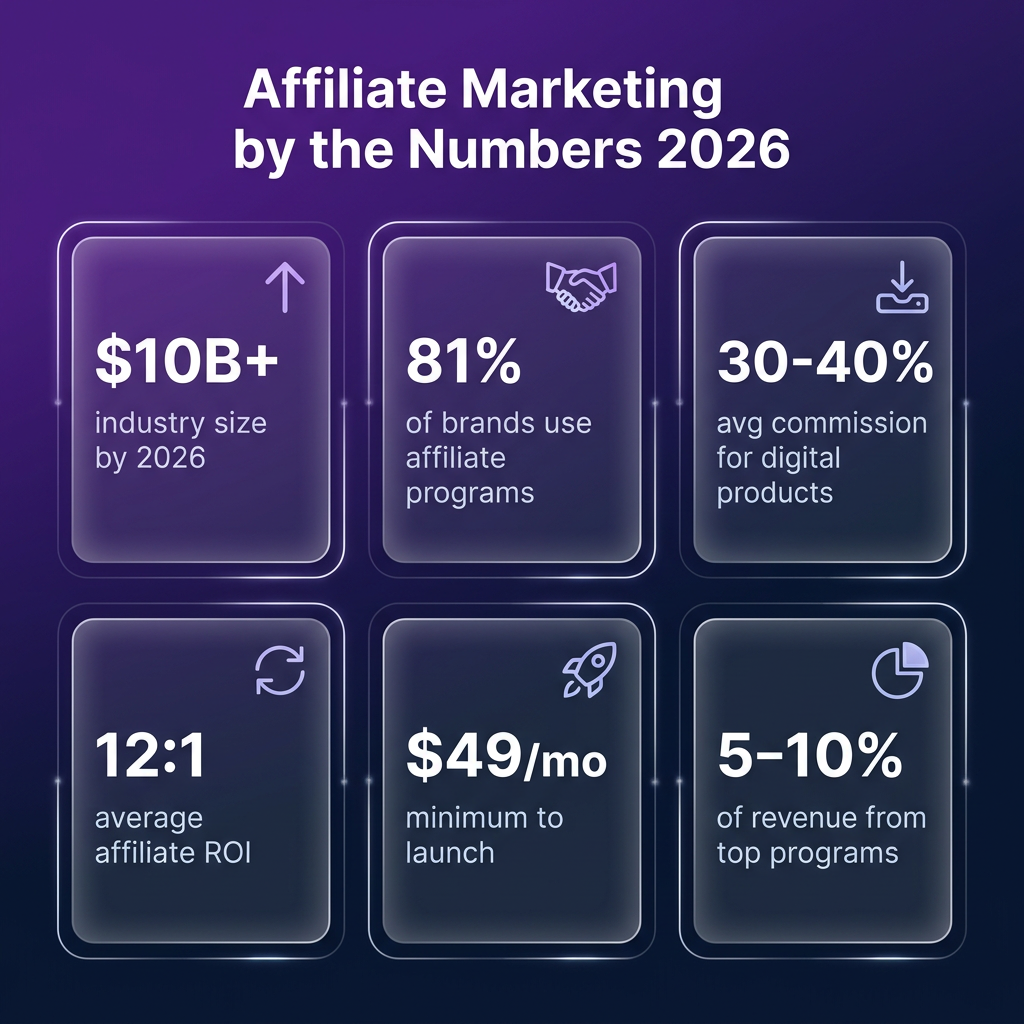
Digital products have gross margins between 70% and 95%. That’s the starting point for why affiliate marketing makes so much sense here. When your cost of goods sold is essentially zero (or close to it), you can afford to pay meaningful commissions — 20%, 30%, even 40% — and still come out well ahead on customer acquisition cost.
Compare that to physical products where margins are often 30-50%, leaving less room for affiliate cuts. Or enterprise SaaS with long sales cycles where attribution becomes a mess. Digital products are clean: someone clicks a link, buys a $49 course or a $29/month SaaS plan, and you can immediately pay the affiliate their $15 or $12.
The numbers back this up. The affiliate marketing industry is projected to exceed $10 billion in annual spend by 2026, with 81% of brands now running some form of affiliate or referral program. For SaaS specifically, top-performing programs drive 5-10% of total ARR through the affiliate channel alone. For digital product creators, the ceiling is even higher — some solo creators run 20-30% of their revenue through affiliates.
One more structural advantage: affiliates are essentially an outsourced sales and content team. When someone writes a “best tools for online course creators” roundup and includes your product with an affiliate link, that review lives on Google indefinitely. You’re not paying per click or per impression — you’re paying per result.
Choosing the Right Affiliate Platform
Your first real decision is which platform to run your affiliate program on. This matters a lot more than people realize — the wrong choice means bad UX for your affiliates, broken tracking, or paying 20-30% of commissions in platform fees.
Here are the main players worth considering in 2026, with honest assessments:
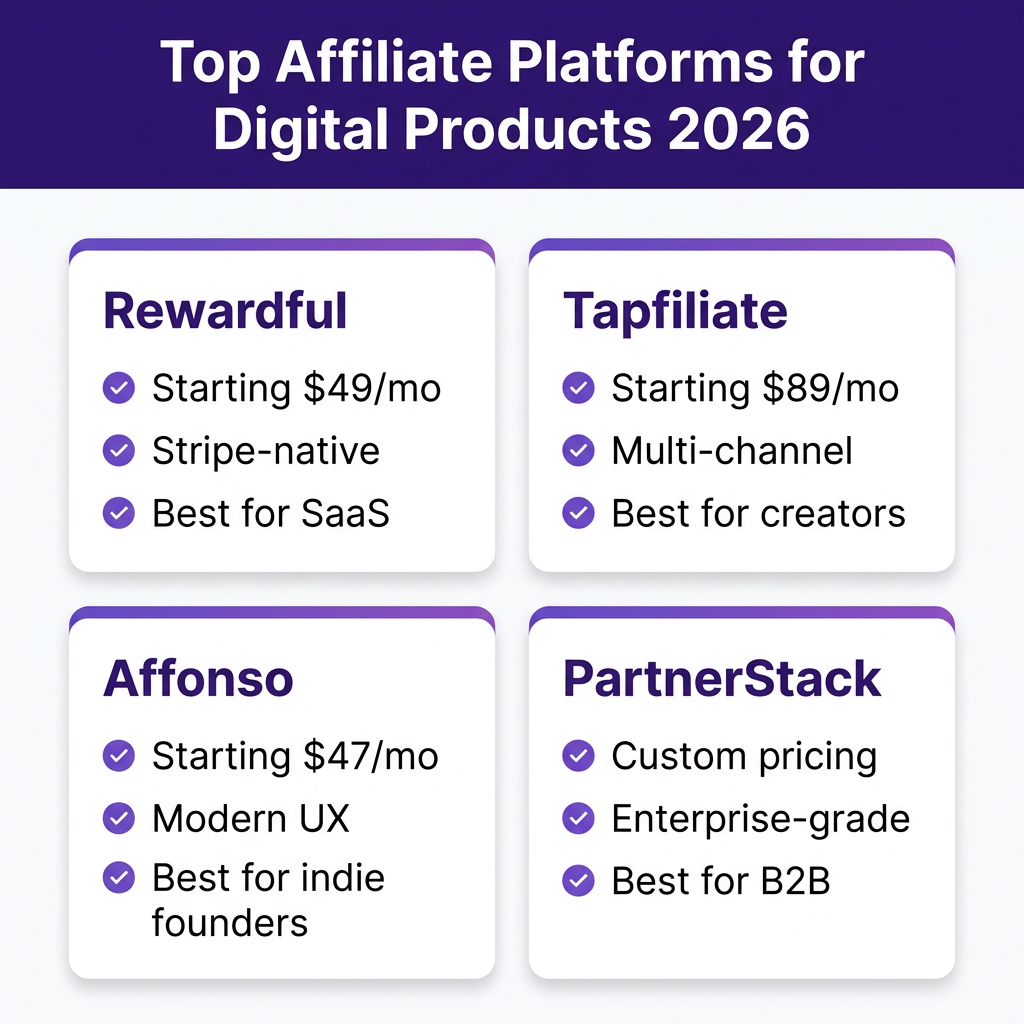
Rewardful — Best for Stripe/Paddle SaaS
Rewardful is the fastest path to a live affiliate program if you’re already on Stripe. It connects directly to Stripe’s subscription data, so commissions on recurring revenue just work — no custom webhooks, no spreadsheets. Plans start at $49/month, unlimited affiliates on all plans, and zero transaction fees at the entry tier.
The tradeoff: it’s built for simplicity. If you need complex commission tiers, coupon tracking, or a marketplace to recruit affiliates, Rewardful will feel limiting. It’s the right pick for early-stage SaaS founders who want affiliate tracking running in an afternoon, not a week.
Tapfiliate — Best for Multi-Channel Digital Products
Tapfiliate gives you more flexibility than Rewardful without jumping to enterprise pricing. The Launch plan starts at $89/month (or $74/month annually). You get multiple commission structures, coupon code tracking, white-label affiliate portals, and integrations with Shopify, WooCommerce, Stripe, PayPal, and more.
It works well for creators selling on multiple platforms — maybe a Shopify store for one product and a direct checkout for another. The dashboard is clean, and the affiliate onboarding flow is one of the better ones in this tier.
Affonso — Best for Indie Founders
Affonso is a newer entrant that’s been gaining ground with indie SaaS founders and digital creators. It starts at around $47/month, has a modern UI, built-in Stripe integration, and supports both one-time and recurring commissions. The affiliate portal looks professional out of the box, which matters — affiliates are more likely to actually use it.
What stands out is the fraud detection and the ability to set up multi-tier programs. If you want to give affiliates a reason to recruit sub-affiliates, Affonso handles this cleanly.
PartnerStack — Best for B2B / Enterprise
PartnerStack is in a different category. It’s not just affiliate tracking — it’s a full partner ecosystem platform covering affiliates, referral partners, resellers, and agency partners. Custom pricing, typically starting at $500+/month. It also has a marketplace where affiliates can discover your program.
Unless you’re running a B2B SaaS with serious partner channel ambitions and a dedicated partnership manager, PartnerStack is overkill. Skip it until you’re past $1M ARR and have a real use case for the full partner stack.
| Platform | Starting Price | Best For | Payment Integration | Affiliate Marketplace | Transaction Fee |
|---|---|---|---|---|---|
| Rewardful | $49/month | Stripe/Paddle SaaS | Stripe, Paddle | No | 0% (entry plan) |
| Tapfiliate | $89/month ($74/yr) | Multi-platform creators | Stripe, PayPal, WooCommerce | No | 0% |
| Affonso | ~$47/month | Indie founders/SaaS | Stripe | No | 0% |
| PartnerStack | Custom (~$500+/mo) | B2B SaaS | Custom | Yes | Custom |
| Paddle (built-in) | Included with Paddle | MoR users | Paddle native | No | Paddle fees apply |
One thing worth noting: if you’re already using a Merchant of Record like Fungies.io, your MoR may have built-in affiliate or referral tools. Check before adding a separate platform — you might be able to avoid an extra $50-100/month.
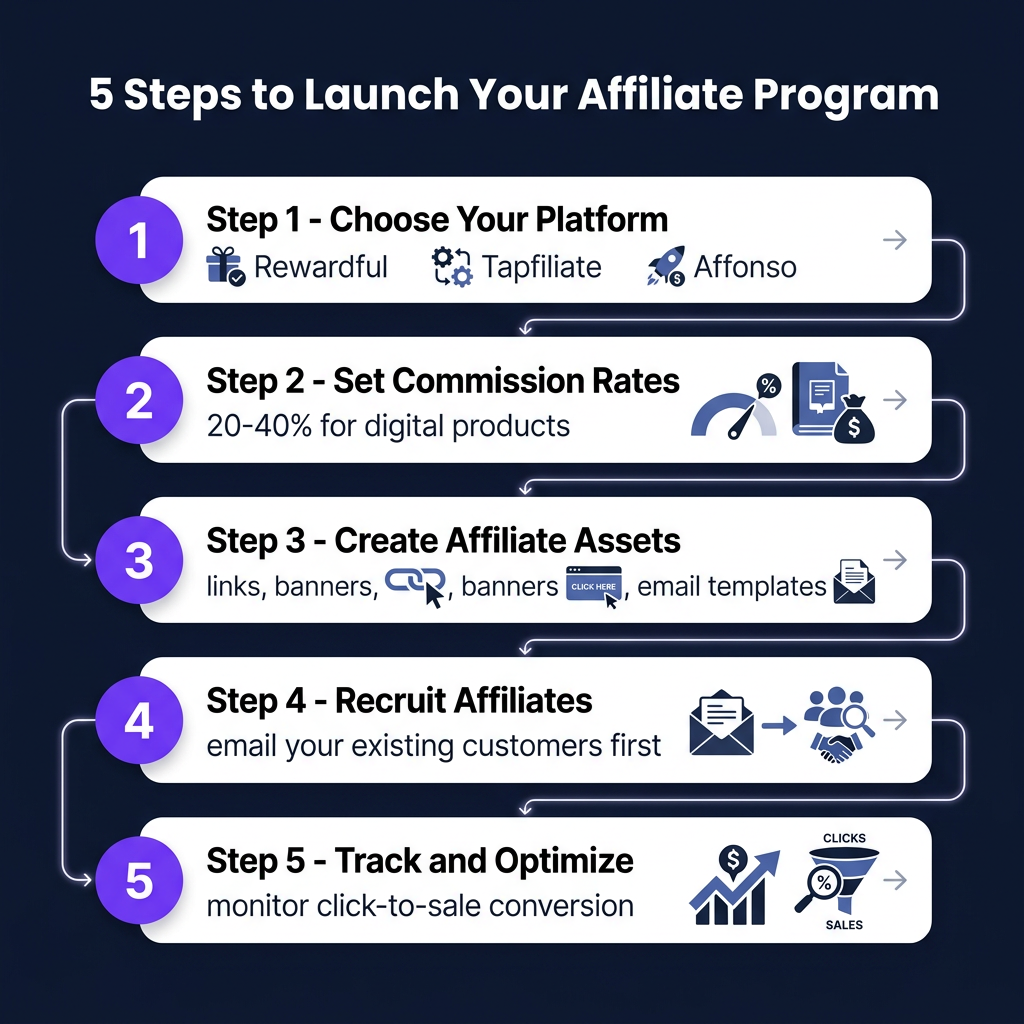
Setting Up Your Commission Structure
Commission rates make or break affiliate recruitment. Too low and top affiliates won’t bother. Too high and you’re training customers to wait for a coupon.
Here’s what actually works for digital products in 2026:
One-Time Commission for Single-Purchase Products
For ebooks, templates, Notion packs, design assets, and similar one-time purchases, offer 30-50% commission. This sounds high but remember — your margin is close to 100% on digital goods. A $97 ebook with a 40% affiliate commission costs you $38.80 to acquire a customer you couldn’t have reached otherwise. Your CAC from paid ads is probably higher.
Don’t overthink the exact number. 30% is the market floor that serious affiliates expect. 40-50% is where you start standing out.
Recurring Commission for SaaS / Subscriptions
For subscription products, the standard is 20-30% recurring for the lifetime of the customer. Rewardful’s own benchmark data shows the average SaaS affiliate commission is 25% recurring.
Lifetime recurring commissions are the most attractive to serious content creators and bloggers — they’re building an asset, not a one-time paycheck. The tradeoff is you’re paying forever, but you’re only paying when the customer is paying you. It’s perfectly aligned.
Some programs offer a hybrid: higher one-time payment (e.g., 40% of first payment) plus a smaller recurring (10-15%). This works if affiliates are more deal-hunters than relationship builders. Test both.
Tiered Commission (Optional but Powerful)
Tiered commissions reward your best affiliates and create a reason to keep promoting. Example structure:
- Tier 1 (0-5 sales/month): 25% commission
- Tier 2 (6-20 sales/month): 30% commission
- Tier 3 (21+ sales/month): 40% commission
This works especially well with Tapfiliate and Affonso, both of which have native tier support. Rewardful requires some workarounds. Don’t add tiers until you have enough affiliates to make them meaningful — usually 20+ active affiliates.
The 5-Step Launch Playbook
Step 1: Set Up Your Platform and Tracking
Pick your platform (start with Rewardful or Affonso if you’re early-stage), connect it to your payment processor, and do a test conversion. This sounds obvious but I’ve seen founders spend weeks on commission strategy before testing whether the tracking actually fires. Test first. A misfire here means paying zero commissions — or the wrong ones.
Set your cookie window to at least 60 days, preferably 90. A reader might discover your product through an affiliate’s review, sit on it for 6 weeks, and then convert. If your cookie is 7 days, you just stiffed your affiliate.
Step 2: Build Your Affiliate Asset Kit
Your affiliates need materials to work with. Bare minimum kit:
- Unique tracking link (auto-generated by your platform)
- Email swipe copy (2-3 versions, different angles)
- Banners in 3-4 standard sizes (728×90, 300×250, 160×600)
- Product description (50 words, 150 words, 300 words)
- Key stats and proof points (ratings, customer count, results)
Optional but high-value: a short demo video or walkthrough that affiliates can embed or link to. If you can record a 3-minute product demo and share it, your conversion rates from affiliate traffic will go up noticeably.
Step 3: Recruit Your First Affiliates
The single best source of your first affiliates is your existing customer base. These people already use your product, they already trust it, and they’re most credible when recommending it.
Send an email to your active customers. Not a generic “join our affiliate program” blast — something personal. Explain that you’re launching an affiliate program, you thought of them specifically, and you’d love to have them as a partner. Include the commission rate and a direct sign-up link.
From 200 customers, you’ll typically get 10-20 affiliate sign-ups. 3-5 of them will actually promote your product. That’s normal.
Other solid channels for affiliate recruitment:
- Niche bloggers and YouTubers who already cover your category
- Newsletter writers with relevant audiences (find them on Beehiiv, Substack)
- Indie Hackers / Product Hunt communities — great for SaaS tools
- Your Twitter/X and LinkedIn followers who regularly engage
- Complementary tools’ customers — if you integrate with Notion, reach out to Notion influencers
Step 4: Set Up Payouts
Affiliates need to trust that they’ll actually get paid. Use PayPal or Wise for manual payouts at first. Most platforms support automated payouts once you hit volume — Tapfiliate does PayPal and bank transfer automation; Rewardful uses Stripe payouts; Affonso supports Wise and PayPal.
Run payouts monthly, on a 30-day delay (to account for refunds). Communicate this clearly in your affiliate terms. Nothing kills an affiliate relationship faster than mysterious payment delays.
Step 5: Track, Communicate, and Optimize
Send affiliates a monthly email with their stats: clicks, conversions, commission earned. Most affiliate platforms don’t do this automatically — you’ll need to pull the numbers and send it yourself. Affiliates who get regular updates promote more. It’s that simple.
Track your conversion rate by affiliate source. A blogger with 500 clicks and 10 conversions (2% CVR) is worth more than one with 5,000 clicks and 20 conversions (0.4% CVR). Quality of referral traffic matters enormously for digital products.
| Product Type | Recommended Commission | Cookie Window | Payout Frequency | Best Affiliate Type |
|---|---|---|---|---|
| SaaS (monthly sub) | 20-30% recurring | 60-90 days | Monthly | Bloggers, review sites |
| Online Courses | 30-50% one-time | 30-60 days | Monthly | YouTubers, educators |
| Templates/Assets | 40-50% one-time | 30 days | Monthly | Design bloggers, creators |
| Ebooks/Guides | 40-50% one-time | 30 days | Monthly | Bloggers, newsletter writers |
| Plugins/Dev tools | 20-30% recurring | 60-90 days | Monthly | Dev bloggers, YouTube |
Common Mistakes That Kill Affiliate Programs
A few patterns that consistently tank affiliate programs — most of them are avoidable:
Setting commissions too low. 10% recurring might sound like a lot to you but it won’t move the needle for anyone but your most loyal fans. If you want serious bloggers and content creators to put in the work to rank for your product, you need to make it worth their time. 20% minimum for SaaS, 30% minimum for one-time products.
Not providing assets. If an affiliate has to write their own copy, shoot their own screenshots, and figure out your value prop themselves — most won’t bother. They have dozens of programs competing for their attention. Make it easy.
No affiliate communication. The programs that die are the ones where affiliates sign up, get their link, and never hear from you again. A monthly email update, a Slack or Discord channel for your top affiliates, a quarterly “what’s new” briefing — any of this dramatically improves activation and retention.
Manual tracking. If you’re doing affiliate tracking in a spreadsheet or via coupon codes alone, you’re going to have attribution disputes and angry affiliates. Use a proper platform from day one.
No clear terms. Define upfront: what counts as a qualifying sale, what happens on refunds (commission clawed back?), what’s the minimum payout threshold, what promotional methods are prohibited. A clear affiliate agreement prevents 90% of the friction later.
Integrating Affiliate Programs with Fungies.io (Merchant of Record)
If you’re using Fungies.io as your Merchant of Record for global payments, you can layer an affiliate platform on top using Stripe-native tools like Rewardful or Affonso — since Fungies routes through Stripe Connect. The conversion event fires in Stripe when a sale completes, and the affiliate platform picks it up.
The practical benefit: your affiliate commissions are automatically calculated on the revenue that actually reaches you (after Fungies handles VAT, sales tax, and currency conversion). You’re not accidentally paying commissions on tax portions.
For digital product sellers who need global tax compliance handled and want to run affiliate programs simultaneously, using Fungies as MoR plus Rewardful or Affonso is a clean, lightweight stack that doesn’t require engineering resources to maintain.
Key Takeaways
- Digital products have 70-95% margins — that makes affiliate commissions of 30-50% economically viable while still beating your paid CAC.
- Start with Rewardful or Affonso (both ~$47-49/month) for simplicity; move to Tapfiliate when you need multi-channel tracking or tiered commissions.
- Your first affiliates come from your existing customers — send a personal email to 200 active users and expect 3-5 who actively promote.
- Cookie window should be 60-90 days — digital products often have longer consideration cycles than impulse purchases.
- Send monthly updates to affiliates — programs that communicate regularly have 3-5x higher affiliate activation rates than those that go dark after signup.
FAQ
How much does it cost to set up an affiliate program for digital products?
You can launch with a platform like Rewardful or Affonso for $47-49/month. That’s your only fixed cost — there are no transaction fees on the affiliate commissions themselves. If you’re self-hosting with something like Easy Affiliate (WordPress plugin), you can start for free, though you’ll need to manage payouts manually. Budget a few hours for setup and expect to spend $50-100/month on the platform once you’re live.
What commission rate should I offer for a digital product affiliate program?
For one-time digital products (courses, ebooks, templates), offer 30-50% commission. For subscription SaaS, offer 20-30% recurring. These rates are high enough to attract serious affiliates — bloggers and content creators who actually generate traffic — while still being profitable given digital margins. Don’t go below 20% if you want active promotion from anyone beyond your most loyal fans.
What’s the difference between an affiliate program and a referral program?
An affiliate program targets external promoters — bloggers, YouTubers, content creators, review sites — who promote your product to an audience they’ve built. A referral program targets your existing customers and rewards them for bringing in friends. Both are valuable. Affiliate programs typically scale further because you’re leveraging others’ existing audiences. Many tools (including Rewardful) handle both in the same interface.
How do I find affiliates for my digital product?
Start with your own customer base — email your active users and ask. Then look for bloggers and YouTubers in your niche who publish comparison posts and tool roundups (search “best [your category] tools” and email everyone ranking on page 1). Communities like Indie Hackers, Product Hunt, and relevant Slack/Discord groups are also strong sources for early affiliates, especially for SaaS tools targeting builders and founders.
Start Your Affiliate Program Today
An affiliate program for your digital product doesn’t need to be complicated. Pick a platform that integrates with your payment stack, set a commission rate that makes affiliates want to work with you, and email your top customers first. You can be live in a day.
The compounding nature of affiliate content — reviews that rank, YouTube videos that accumulate views, newsletter mentions that get archived — means the sooner you start, the sooner that flywheel begins turning.
If you’re building a digital product or SaaS and want global payments with tax compliance handled automatically, try Fungies.io free — and stack your affiliate program on top from day one.
References
- Tapfiliate vs Rewardful vs PartnerStack 2026 — FindAffiliates
- Best Rewardful Alternatives 2026 — Affonso
- State of SaaS Affiliate Programs — Rewardful
- Affiliate Commission Guide 2026 — Rewardful
- Ultimate Guide to SaaS Affiliate Marketing — Trackier
- Affiliate Marketing Software Pricing 2026 — StackScored