Here’s a stat that’ll make you reconsider your OpenAI subscription: open source LLMs now hit 89% on LiveCodeBench and 96% on AIME 2025 — rivaling the best proprietary models. In April 2026 alone, seven major open source models dropped from Meta, Alibaba, Google, Mistral, and others. The gap between open and closed-source AI has effectively closed.
Running LLMs locally isn’t just for privacy paranoiacs anymore. Developers are ditching API bills, eliminating latency, and keeping sensitive data on-device. Whether you’re building AI agents, coding assistants, or just want ChatGPT without the $20/month fee, local open source models are now a genuinely practical choice.
Why Run Open Source LLMs Locally in 2026?
Before diving into the rankings, let’s be clear about what “local” gets you:
- Zero API costs — Pay once for hardware, run unlimited inference
- No network latency — Sub-100ms responses vs. 500ms+ round-trips
- Data privacy — Your prompts never leave your machine
- Full customization — Fine-tune, quantize, modify weights
- No rate limits — Process thousands of tokens without throttling
The trade-off? You need the right hardware. But with a $1,149 Mac Mini M4 32GB running 7B models at 28-35 tokens/sec, the barrier to entry has never been lower.
How We Ranked These Models
Every model on this list was evaluated across five dimensions:
| Criteria | Weight | Measurement |
|---|---|---|
| Benchmark Performance | 30% | MMLU, SWE-Bench, LiveCodeBench scores |
| Coding Ability | 25% | HumanEval, code completion quality |
| Reasoning | 20% | Math (GSM8K, AIME), logic tasks |
| Hardware Efficiency | 15% | VRAM requirements, tokens/sec |
| License Freedom | 10% | Apache 2.0, MIT vs. restrictive terms |
The 10 Best Open Source LLMs for Local Deployment
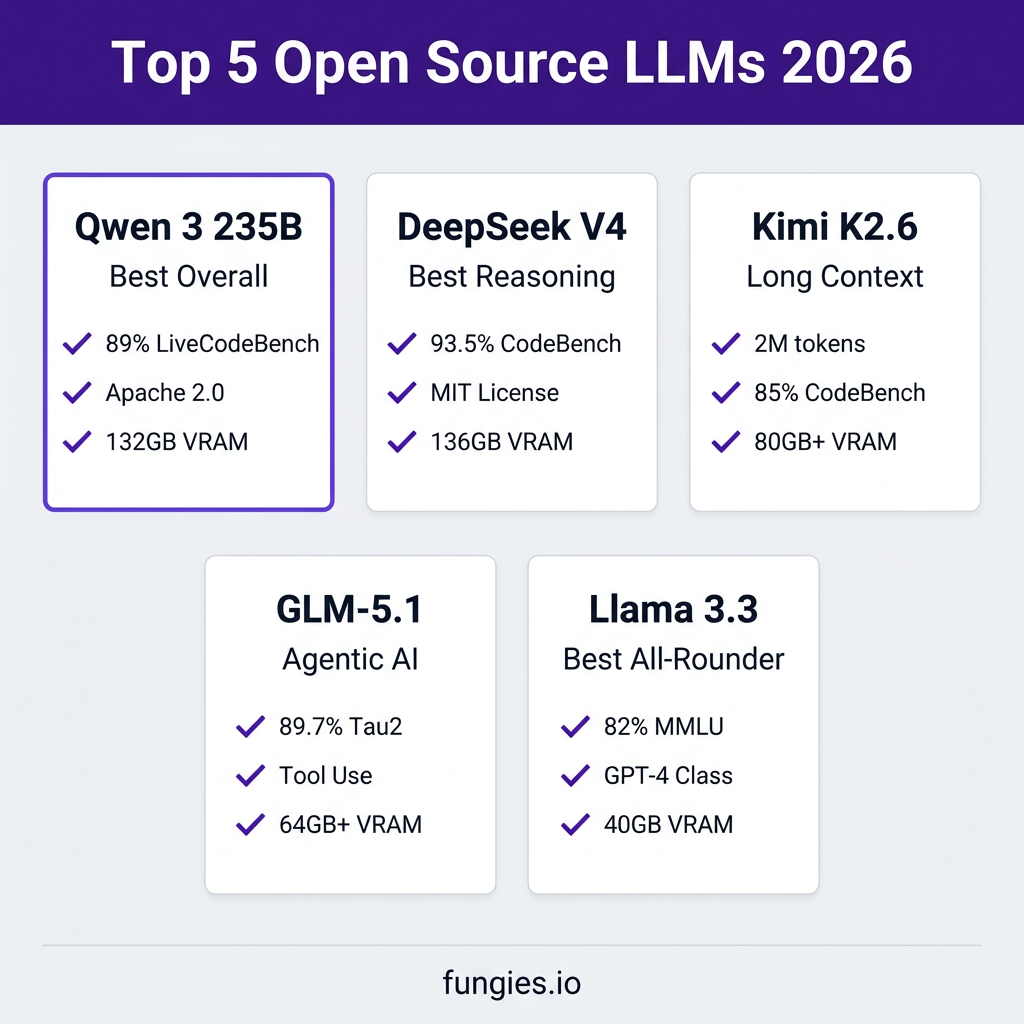
1. Qwen 3 235B-A22B — Best Overall for Reasoning and Coding
Alibaba’s Qwen 3 235B-A22B is the current king of open source LLMs. With a Mixture-of-Experts architecture activating only 22B parameters per token, it delivers frontier-level performance at manageable compute costs.
| Metric | Score |
|---|---|
| MMLU-Pro | 88.5% |
| LiveCodeBench | 89% |
| SWE-Bench | 40.0% |
| VRAM (Q4) | ~132 GB |
| License | Apache 2.0 |
Best for: Enterprise agents, complex coding tasks, long-context reasoning
Hardware requirement: Dual RTX 4090s or Mac Studio M5 Max 128GB
2. DeepSeek V4 Pro — Best for Math and Technical Reasoning
DeepSeek V4 Pro (Max) currently leads BenchLM’s Chinese leaderboard at 87, with exceptional performance on math and coding benchmarks. The 671B parameter model (37B active) uses advanced MoE architecture.
| Metric | Score |
|---|---|
| GSM8K | 96.0% |
| SWE-Bench | 67.8% |
| LiveCodeBench | 93.5% |
| VRAM (Q4) | ~136 GB |
| License | MIT |
Best for: Mathematical reasoning, competitive programming, research
Hardware requirement: 4x RTX 4090 or enterprise H200/B200 cluster
3. Kimi K2.6 — Best for Long-Context Workflows
Moonshot AI’s Kimi K2.6 dominates long-context tasks with support for up to 2 million tokens. It matches GPT-4 class performance on reasoning while maintaining impressive coding capabilities.
| Metric | Score |
|---|---|
| Long-context accuracy | Industry-leading |
| LiveCodeBench | 85% |
| SWE-rebench | 43.8% |
| Context window | 2M tokens |
| License | Apache 2.0 |
Best for: Document analysis, codebases, multi-turn conversations
Hardware requirement: 80GB+ VRAM for full context
4. GLM-5 / GLM-5.1 — Best for Agentic AI
Zhipu AI’s GLM-5 series excels at tool use, planning, and agentic workflows. GLM-5 (Reasoning) debuted at #1 on WhatLLM’s Quality Index with 49.64, dethroning Kimi K2.5.
| Metric | Score |
|---|---|
| Quality Index | 49.64 |
| Tau2-Bench (Agentic) | 89.7% |
| SWE-rebench | 42.1% |
| LiveCodeBench | 89% |
| License | Commercial-friendly |
Best for: AI agents, autonomous workflows, multi-step tasks
Hardware requirement: 64GB+ VRAM
5. Llama 3.3 70B — Best All-Rounder for Single-GPU Setups
Meta’s Llama 3.3 70B remains the go-to choice for developers wanting GPT-4 quality on a single GPU. It matches GPT-4 (2023) on MMLU while being widely supported across all inference frameworks.
| Metric | Score |
|---|---|
| MMLU | 82% |
| HumanEval | 86.0% |
| MBPP | 88.4% |
| VRAM (Q4) | ~40 GB |
| License | Llama 3.3 Community |
Best for: General-purpose use, production deployments, fine-tuning
Hardware requirement: RTX 4090 (24GB) with Q4 quantization or dual-GPU setup
6. Gemma 3 27B — Best Mid-Range Model
Google’s Gemma 3 27B offers the best capability-to-hardware ratio in the mid-range segment. It supports multimodal inputs and runs comfortably on consumer hardware.
| Metric | Score |
|---|---|
| MMLU | ~78.6% |
| HumanEval | 87.8% |
| VRAM (Q4) | ~16 GB |
| Multimodal | Yes (vision) |
| License | Gemma Terms of Use |
Best for: Single-GPU deployments, vision tasks, cost-conscious setups
Hardware requirement: RTX 4080/4090 or MacBook Pro M4 Max
7. Mistral Small 3.1 24B — Best 7B-Class Performance
Mistral Small 3.1 punches above its weight class with 128K context support and strong instruction-following. It’s the sweet spot for 16GB VRAM setups.
| Metric | Score |
|---|---|
| Context window | 128K tokens |
| VRAM (Q4) | ~16 GB |
| Instruction following | Excellent |
| License | Apache 2.0 |
Best for: Chatbots, RAG applications, long-document processing
Hardware requirement: RTX 4060 Ti 16GB or Mac Mini M4 Pro
8. Phi-4 14B — Best Small Model for Reasoning
Microsoft’s Phi-4 delivers remarkable reasoning performance for a 14B model. The MIT license makes it ideal for commercial applications.
| Metric | Score |
|---|---|
| Reasoning (relative to size) | Class-leading |
| VRAM (Q4) | ~8-10 GB |
| Model size | 14B parameters |
| License | MIT |
Best for: Edge deployment, reasoning tasks, commercial products
Hardware requirement: RTX 3060 12GB or Mac Mini M4 base
9. MiMo-V2.5-Pro — Best for Agentic Coding
Xiaomi’s MiMo-V2.5-Pro (released as Hunter Alpha) is purpose-built for agentic coding and long-horizon reasoning tasks. It’s a dark horse in the open source race.
| Metric | Score |
|---|---|
| Coding benchmarks | Competitive with top tier |
| Agentic workflows | Strong |
| VRAM | Varies by variant |
| License | Open weight |
Best for: Coding agents, automation, Chinese/English bilingual tasks
Hardware requirement: Varies by model variant
10. MiniMax M2.7 — Best Multimodal Performance
MiniMax M2.7 offers strong multimodal capabilities with competitive benchmark scores across text, vision, and audio tasks.
| Metric | Score |
|---|---|
| SWE-rebench | 39.6% |
| Multimodal | Text, vision, audio |
| VRAM | 64GB+ recommended |
| License | Commercial terms |
Best for: Multimodal applications, creative workflows
Hardware requirement: High-end multi-GPU or Apple Silicon Max/Ultra
Hardware Requirements Summary
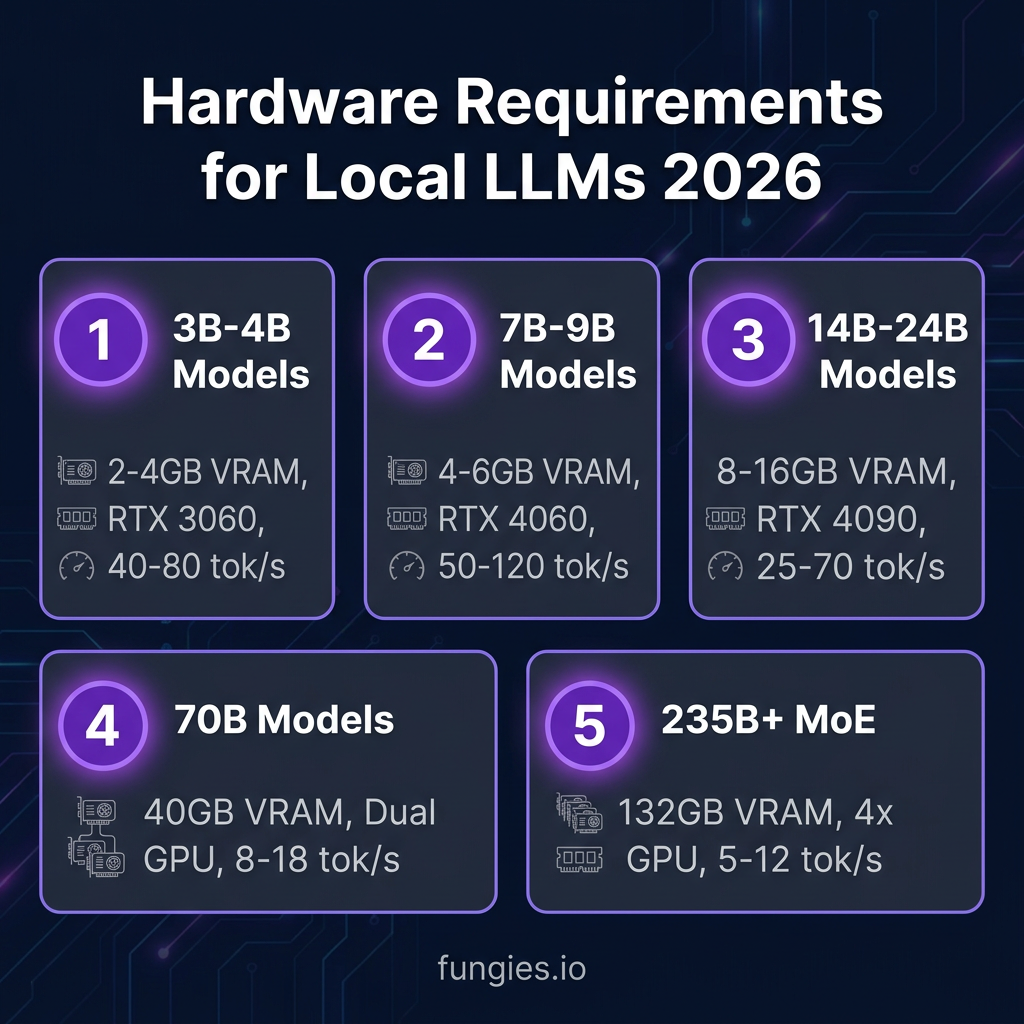
| Model Size | Q4 VRAM | FP16 VRAM | Recommended GPU | Tokens/sec* |
|---|---|---|---|---|
| 3B-4B | 2-4 GB | 6-8 GB | RTX 3060 / M4 Mini | 40-80 |
| 7B-9B | 4-6 GB | 14-18 GB | RTX 4060 / M4 Pro | 50-120 |
| 14B-24B | 8-16 GB | 28-48 GB | RTX 4090 / M4 Max | 25-70 |
| 70B | 40 GB | 140 GB | Dual RTX 4090 / M5 Max | 8-18 |
| 235B+ MoE | 132 GB | 470 GB | 4x RTX 4090 / H200 | 5-12 |
*Tokens/sec on RTX 4090 using llama.cpp with Q4_K_M quantization
Mac vs PC for Local LLMs: The 2026 Verdict
The Mac vs PC debate has shifted dramatically. Here’s the current state:
| Dimension | Mac (M4/M5) | PC (RTX 4090) |
|---|---|---|
| 7B-14B speed | 25-50 tok/s | 80-140 tok/s |
| 70B+ support | Up to 128GB unified memory | Requires multi-GPU ($7K+) |
| Power efficiency | 22× more efficient | 700W under load |
| Cost for 70B | Mac Studio M5 Max $5,999 | Dual RTX 4090 ~$7,000 |
| Ecosystem | MLX, Ollama native |
Bottom line: For 7B-14B models, NVIDIA wins on raw speed. For 70B+ models, Apple Silicon is actually cheaper and more efficient. A Mac Mini M4 at 40 watts outperformed a dual RTX 3090 rig at 700 watts on 32B model inference in multiple benchmarks.
Quantization: The Secret to Running Big Models on Small Hardware
Quantization is what makes local LLMs practical. Here’s how much VRAM you save:
| Precision | Bits per Parameter | VRAM vs FP16 | Quality Loss |
|---|---|---|---|
| FP16 | 16 bits | 100% (baseline) | None |
| Q8_0 | 8 bits | ~50% | Minimal |
| Q4_K_M | 4 bits | ~25% | Slight |
| Q3_K_M | 3 bits | ~19% | Moderate |
For most use cases, Q4_K_M offers the best balance. A 70B model drops from 140GB to ~40GB — the difference between a $15,000 server and a $2,000 dual-GPU setup.
Key Takeaways
- For absolute best performance: Qwen 3 235B or DeepSeek V4 Pro if you have the hardware
- For single-GPU setups: Llama 3.3 70B or Gemma 3 27B
- For long context: Kimi K2.6 with 2M token support
- For agents: GLM-5.1 with best-in-class tool use
- For budget builds: Phi-4 14B or Mistral Small 3.1
- For efficiency: Mac Mini M4 for 7B-14B, Mac Studio for 70B+
FAQ
What’s the best open source LLM for coding in 2026?
DeepSeek V4 Pro leads on LiveCodeBench at 93.5%, followed by Qwen 3 and GLM-5 at 89%. For local deployment, Gemma 3 27B offers the best coding performance per dollar of hardware.
Can I run a 70B model on a single RTX 4090?
Yes, with Q4 quantization. A 70B model requires ~40GB VRAM at Q4_K_M, which fits across two RTX 4090s (24GB each) using tensor parallelism. Single 4090 can run 70B at Q3 or with CPU offload.
Is Ollama or llama.cpp faster?
llama.cpp is ~70% faster for raw throughput (52 vs 30 tok/s on Qwen-3 Coder 32B). However, Ollama offers better developer experience with simple CLI commands and model management. For production, vLLM beats both with continuous batching.
What’s the cheapest setup to run local LLMs?
A used RTX 3090 (~$400) with 32GB system RAM runs 7B-13B models at 60-100 tok/s. For new hardware, the Mac Mini M4 32GB ($1,149) is the strongest all-around pick for 7B-14B models.
Are open source LLMs really as good as GPT-4?
On many benchmarks, yes. DeepSeek V4 Pro beats GPT-4 on math (96% vs ~92% GSM8K). Qwen 3 matches GPT-4 on coding. The gap has closed to the point where model choice matters less than use-case fit and cost optimization.
Conclusion
The open source LLM landscape in 2026 is genuinely competitive with proprietary alternatives. Whether you’re building AI agents, coding assistants, or just want to own your AI stack, there’s never been a better time to go local.
Start with Llama 3.3 70B or Gemma 3 27B if you’re new. Scale to Qwen 3 or DeepSeek V4 when you need frontier performance. And remember — the best model is the one that runs on your hardware and solves your problem.
Ready to build AI-powered applications? Get started with Fungies — the merchant of record platform that handles payments, tax compliance, and checkout for AI SaaS products.
References
- HuggingFace: Best Open-Source LLM Models in 2026
- BentoML: The Best Open-Source LLMs in 2026
- Fireworks AI: Best Open Source LLMs in 2026
- PromptQuorum: Best Local LLMs 2026
- TECHSY: Best Open-Source LLM 2026
- SitePoint: Local LLM Hardware Requirements Mac vs PC 2026
- SitePoint: Ollama vs vLLM Performance Benchmark 2026
- BenchLM: Best Chinese LLMs in 2026
- Codesota: LLM Benchmark Leaderboard 2026