Here’s a number worth sitting with: the top 10% of AI tools launched in 2025 crossed $10,000 MRR within 60 days of launch. Not from better models or slicker UI — from getting their monetization right. Pricing model, payment stack, and tax compliance decided the outcome before most founders finished their README.
If you’ve built an AI SaaS tool and you’re still figuring out how to actually charge for it — or you’re using Stripe directly and spending Friday nights on VAT filings — this guide is for you. We’re going to cover AI SaaS monetization in 2026: which pricing models work, how to handle global payments and tax without a finance team, and exactly which platforms to use at each stage.
Why AI SaaS Monetization Is Different From Regular SaaS
Traditional SaaS runs on flat subscription pricing. You pick a number, everyone pays it monthly, and your margin scales with user count. That model breaks for AI products in two ways.
First, your cost structure is variable. Every API call to OpenAI, Anthropic, or your own models costs you money. A flat subscription that doesn’t account for usage means power users destroy your margins — one customer consuming 50x the average on a flat fee is a silent margin killer.
Second, value delivery is variable. A customer who runs 200 AI generations gets more value than one who runs 5. Flat pricing misprice both: it’s too expensive for light users (who churn) and too cheap for heavy users (who should pay more).
The AI SaaS pricing evolution happened fast. In 2023: everyone launched flat subscriptions. In 2024: a wave of raw usage-based pricing (pay-per-token) made enterprise procurement teams nervous — they couldn’t forecast spend. By 2026, the model that’s actually working is hybrid pricing: a subscription base with an included quota plus overage.

The Four AI SaaS Monetization Models in 2026
1. Flat Subscription
How it works: Everyone pays the same monthly fee regardless of usage. Simple to understand, simple to sell.
Best for: Early stage with unclear usage patterns. If you don’t know your average user’s consumption yet, a flat fee while you gather data isn’t crazy.
The problem: As you grow, power users emerge. If they’re consuming 10x the average, you’re subsidizing them. Products like early-stage ChatGPT wrappers often started here and had to reprice — which is painful and churns users.
Typical range: $9–$49/month for prosumer, $99–$299/seat for teams.
2. Pure Usage-Based
How it works: Pay per token, per API call, per generation, per credit consumed. Revenue and cost scale together.
Best for: Developer tools and APIs where users are technical enough to understand and forecast usage.
The problem: Procurement teams hate it. Sales cycles get longer because every conversation becomes an argument about projected spend. Intercom’s original Fin AI agent initially explored this before settling on outcome-based pricing. Pure consumption works for AWS. It rarely works for indie SaaS.
3. Hybrid (Base Subscription + Quota + Overage) — The 2026 Default
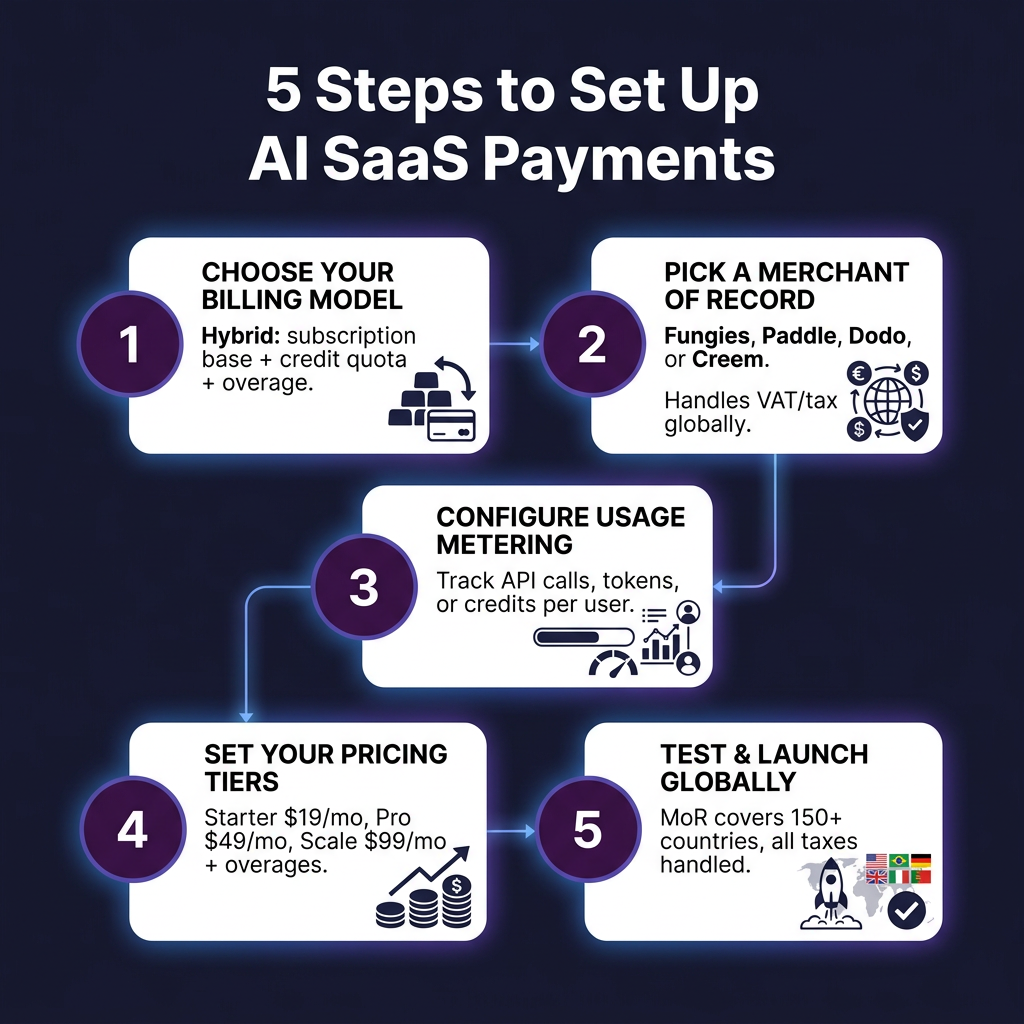
How it works: A monthly subscription includes a fixed quota of AI usage (tokens, credits, runs, messages). If you go over, you pay a per-unit overage rate. Higher tiers get bigger quotas at better per-unit rates.
Why it wins: Buyers get predictability for typical usage. Sellers capture more revenue from power users without frightening lighter users away. Gross margins are protected because overages are priced at 2–4x your actual cost.
Real example: Starter at $19/mo includes 500 AI generations. Pro at $49/mo includes 2,000 generations. Beyond the quota, $0.05/generation. Most Starter users never cross 500; most Pro users stay under 2,000. Everyone wins.
4. Outcome-Based Pricing
How it works: Charge per successful outcome — per resolved ticket, per converted lead, per successful task. Intercom’s Fin AI agent charges $0.99 per resolved support ticket and hit nine-figure ARR on this model.
Best for: Products with a clear, measurable, high-value outcome where you’re confident in your AI’s resolution rate.
The challenge: You need infrastructure to track and prove resolution. And if your AI fails often, you eat the cost.
| Model | Buyer Predictability | Seller Margin Protection | Implementation Complexity | Best Stage |
|---|---|---|---|---|
| Flat Subscription | High | Low (power user risk) | Low | Pre-PMF |
| Pure Usage-Based | Low | High | Medium | Developer APIs |
| Hybrid (Quota+Overage) | High | High | Medium | Post-PMF, scale |
| Outcome-Based | Very High | Medium | High | Clear measurable ROI |
How to Price Your AI SaaS Tiers
Before you open Stripe or Fungies and start creating products, figure out your unit economics.
Step 1 — Calculate your cost per output unit. If you’re calling OpenAI’s GPT-4o at $0.005 per 1K tokens, a typical generation of 500 tokens costs you $0.0025. Add your infrastructure overhead (10–20%) and you’re at roughly $0.003/generation.
Step 2 — Target a 70–80% gross margin. If your cost is $0.003/generation, your overage price should be around $0.01–0.015 (3–5x cost). This sounds high but is in line with what cloud infrastructure charges over their actual cost.
Step 3 — Set your included quota. Size it so 80% of users at each tier never hit the limit. This makes the product feel unlimited while protecting you from the 20% of heavy users who drive your infrastructure costs.
Step 4 — Price tiers for upgrade pressure. The quota difference between Starter and Pro should be the first thing a growing user notices. When they’re regularly hitting 80% of their Starter quota, the upgrade should feel obvious and cheap relative to the value they’re getting.
Payment Infrastructure for AI SaaS: Do You Need a Merchant of Record?
This is where most indie AI builders hit a wall. You’ve nailed your pricing model. Now you need to actually collect money — globally, with tax compliance, without spending three months integrating different payment providers.
The question is: Stripe directly, or a Merchant of Record (MoR)?
What Is a Merchant of Record?
A Merchant of Record is a company that legally stands between you and your customer as the seller. They handle payment processing, VAT/sales tax collection and remittance, chargebacks, and compliance — in every country you sell into. You get paid net of their fee. They absorb the legal and tax complexity.
For a solo developer or small team shipping an AI tool, this is often the only sane choice. The alternative — Stripe direct — requires you to:
- Register for VAT in the EU (27 countries via OSS scheme, but still requires registration)
- Collect and remit sales tax in US states where you have economic nexus
- Handle GST in Australia, GST/HST in Canada, and a dozen other regimes
- Manage chargebacks and disputes yourself
Stripe Tax helps with calculation but not remittance. That’s still on you. A MoR handles all of it.
When Stripe Direct Makes Sense
If you’re early-stage, US-only, with a simple subscription plan and under $50K MRR, Stripe directly is fine. The complexity comes when you sell globally. The moment you have a customer in Germany, you have a VAT obligation. The moment you have $100K in economic nexus in California, you have a sales tax obligation. Most AI tools go global fast — that’s kind of the point.
The Best Platforms for AI SaaS Monetization in 2026
| Platform | Transaction Fee | Merchant of Record | Usage Billing | Credit/Pack Billing | Best For |
|---|---|---|---|---|---|
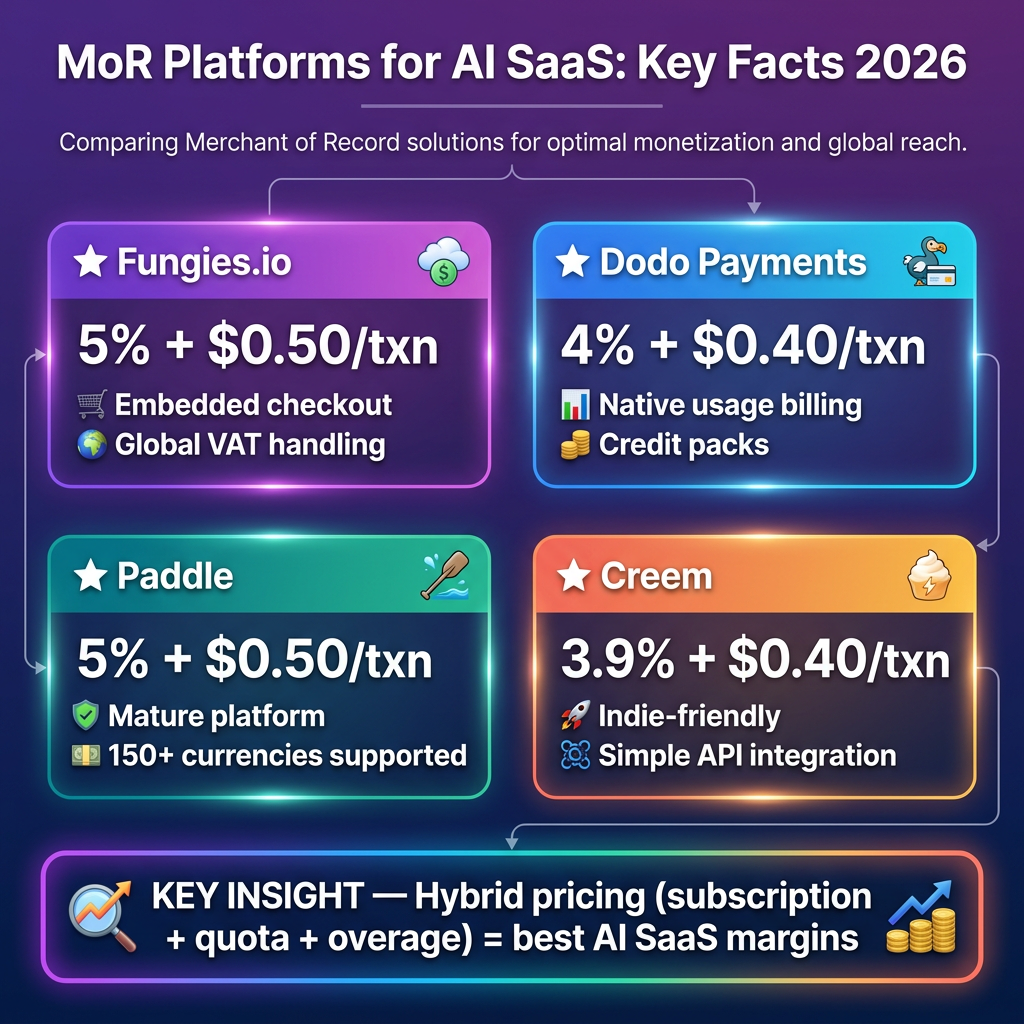
| Fungies.io | 5% + $0.50 | ✅ Yes | ✅ Yes | ✅ Yes | Indie hackers, AI startups, embedded checkout |
| Dodo Payments | 4% + $0.40 | ✅ Yes | ✅ Native | ✅ Native | AI products with complex usage metering |
| Paddle | 5% + $0.50 | ✅ Yes | 🟡 Add-ons/hybrid | 🟡 Limited | Established SaaS, mature billing needs |
| Creem | 3.9% + $0.40 | ✅ Yes | 🟡 Basic | 🟡 Limited | Lean indie teams, simple pricing |
| Lemon Squeezy | 5% + $0.50 | ✅ Yes | ❌ No | ❌ No | Digital products, courses |
| Stripe + Tax | 2.9% + $0.30 + 0.5% billing | ❌ No | ✅ Metered billing | 🟡 Custom | Teams with engineers to handle compliance |
Fungies.io for AI SaaS
Fungies.io is built specifically for developers and indie builders. It covers 150+ countries as a Merchant of Record, supports subscription, one-time, and usage-based billing, and offers an embedded checkout that integrates directly into your app — no redirect, no Stripe branding. For AI tools where you want to keep users in your product’s flow during payment, this matters.
The setup is genuinely quick — most developers have a working checkout in under two hours. API documentation is clear. And the 5% + $0.50 fee is competitive for everything you get.
Dodo Payments for Usage-Heavy AI
If your monetization is heavily usage-based — metering API calls, token consumption, or credit packs — Dodo Payments has the best native support in this space. Their platform handles prepaid credit packs, post-paid usage invoicing, and overage billing natively. For an AI product at $1M+ ARR where billing complexity is your biggest operational pain, Dodo is worth evaluating.
Their fee (4% + $0.40 for domestic US) is slightly cheaper than Fungies or Paddle. They’re a newer platform, so the ecosystem and documentation aren’t as mature, but if usage billing is your primary need, they’re purpose-built for it.
Setting Up Global Payments: The Tax Reality
Here’s what happens when you use Stripe and don’t think about tax:
- A customer in Germany buys your $49/month plan → you’re supposed to charge and remit 19% German VAT (€9.31 per month per user)
- A customer in France → 20% French TVA
- A customer in California → potentially 7.25% sales tax if SaaS is taxable there (it is in some configurations)
- Australia → 10% GST
Get this wrong and you’re liable for back taxes plus penalties. The EU VAT OSS scheme helps — one registration to remit EU VAT in a single return — but you still need to register, file quarterly, and keep records.
With a Merchant of Record like Fungies, this is entirely their problem. They collect and remit tax in every jurisdiction. Your invoice shows the right tax. Your customers get compliant receipts. You never file a VAT return.
Salesforce processes $800M+ in Agentforce ARR with this kind of compliance infrastructure. You don’t need to build it — you need to choose the right payment partner.
Credit-Based Pricing: How to Implement It
Credit packs are one of the most effective AI SaaS monetization tactics in 2026. Here’s why they work:
- No subscription anxiety — users buy when they need to, no monthly commitment pressure
- Better revenue timing — you collect upfront before usage occurs
- Natural upsell mechanic — running low on credits is a natural trigger to buy more
- Bundles work psychologically — 500 credits for $19 is easier to evaluate than $0.038/credit
A typical credit pricing structure:
| Pack | Credits | Price | Price/Credit | Includes |
|---|---|---|---|---|
| Starter Pack | 500 | $14 | $0.028 | Never expires |
| Growth Pack | 2,000 | $49 | $0.024 (14% discount) | Never expires |
| Scale Pack | 10,000 | $199 | $0.020 (29% discount) | Priority processing |
| Monthly Sub | 1,500/mo | $39/mo | $0.026/mo | Auto-refill, 10% bonus |
The subscription option at the bottom converts your credit buyers into recurring revenue. Offer 10–15% bonus credits on the subscription vs. the equivalent one-time pack to make the math obvious.
Integrating Payments Into Your AI App: Technical Approach
With Fungies.io, the integration flow looks like this:
- Create products in the Fungies dashboard — your subscription tiers, credit packs, one-time purchases
- Embed the checkout widget directly in your app using the JS snippet — no redirect, the checkout overlays or inlines in your product
- Listen for webhooks — Fungies fires a
purchase.completedevent when a payment succeeds. Your backend credits the user’s account - Track usage — in your own database or via Fungies’s usage API
- Trigger overage billing — when a user exceeds their quota, Fungies handles the automatic charge
The entire checkout flow can stay within your app’s UI. This typically improves conversion by 15–30% compared to external payment page redirects — users don’t leave your product, trust stays high, and there’s no moment where they second-guess clicking away.
Key Takeaways
- Hybrid pricing (subscription + quota + overage) is the 2026 default for AI SaaS. It protects margins, gives buyers predictability, and naturally monetizes power users.
- Calculate your per-unit cost first. Price overages at 3–5x your API/compute cost to maintain 70%+ gross margins.
- Use a Merchant of Record if you’re selling globally or plan to. The tax compliance overhead of Stripe direct is not worth it for a small team. Fungies, Dodo, Paddle, and Creem all handle this.
- Credit packs convert casual users who balk at subscriptions. Offer a subscription that refills credits monthly with a bonus to convert the best credit buyers to recurring revenue.
- Embedded checkout beats redirect checkout for AI tools — keep users in your product’s context. Fungies’s embed widget is purpose-built for this.
Frequently Asked Questions
Do I need a Merchant of Record for my AI SaaS if I’m based in the US?
If you only sell to US customers, you can start with Stripe direct. But the moment you have customers in Europe, Australia, or Canada, you need to handle VAT/GST. That’s complex to do yourself. A MoR like Fungies handles all of it — including EU VAT, Australian GST, and Canadian HST — so you can focus on your product instead of tax returns.
What’s the difference between usage-based billing and credit-based pricing?
Usage-based billing charges after consumption (postpaid) — your invoice is generated at the end of the period based on what you used. Credit-based pricing is prepaid — users buy credits upfront and spend them as they go. Credits feel more predictable to users and give you immediate cash flow. For AI tools, credits often work better for B2C; usage-based metering is more common in B2B/API products.
How much should I charge for AI SaaS in 2026?
A reasonable benchmark for a prosumer AI tool: Starter at $15–$29/month (limited quota), Pro at $49–$79/month (generous quota), Team/Scale at $99–$199/month (high quota + seats). Your overages should price at 3–5x your per-unit infrastructure cost. For context, the top quartile of bootstrapped AI SaaS tools in 2026 charges between $29–$99/month as their primary paid tier.
Can I switch from Stripe to a Merchant of Record later?
Yes, but it requires migrating existing subscribers (re-collecting payment details or using Stripe’s migration APIs if moving to a Stripe-based MoR) and updating your payment integration. It’s doable — many founders do it at the $50K–$200K ARR mark when tax compliance becomes a real operational burden. Starting with a MoR from day one is simpler if you expect to go global quickly.
Conclusion
Getting your AI SaaS monetization right in 2026 is less about having the perfect pricing page and more about having the right infrastructure beneath it. Hybrid pricing (subscription + quota + overage) gives you the model. A Merchant of Record gives you the compliance and global reach. Embedded checkout gives you the conversion advantage.
If you’re building an AI tool and want to set up payments that handle global tax, support usage-based billing, and embed directly into your product — Fungies.io is built exactly for this. Sign up, create your products, and have a working checkout in under two hours.
References:
- SaaS Mag — How SaaS Companies Are Monetizing AI Agents in 2026
- Dodo Payments — AI SaaS Monetization in 2026: What Actually Works
- Dodo Payments — Best Payment Platform for AI Startups in 2026
- Valueships — AI Pricing in 2026
- Stripe — AI SaaS Pricing Models Guide
- FastSpring — AI Monetization: Pricing, Global Expansion, and Compliance
- Creem — Best Merchant of Record for SaaS in 2026