Choosing the wrong LLM API can cost you $10,000+ per year. I analyzed 324+ models across OpenAI, Anthropic, Google, DeepSeek, and more to find the real price-performance winners in 2026. Here’s what the data actually shows.
DeepSeek V3.2 costs $0.25 per million input tokens. Claude Opus 4.6 costs $5.00. That’s a 20x price difference — yet both might be the right choice depending on your use case. The LLM market has fragmented into distinct tiers, and understanding where each model fits can slash your AI infrastructure costs by 80% without sacrificing quality.
Why LLM API Pricing Matters More Than Ever
AI infrastructure costs are now the second-largest line item for many SaaS companies after payroll. A mid-sized startup processing 100 million tokens monthly can spend anywhere from $250 to $25,000 depending on model choice — a 100x spread that directly impacts margins.
According to CostGoat’s May 2026 analysis of 324+ LLM APIs, the market has settled into clear tiers:
- Budget tier ($0.07–$0.50/M tokens): DeepSeek, Gemini Flash, Mistral Small
- Mid-tier ($0.50–$3.00/M tokens): Kimi K2.5, GPT-5.1, Claude Sonnet
- Premium tier ($5.00–$25.00/M tokens): Claude Opus, GPT-5.2 Pro, o3-pro
The key insight: price doesn’t always correlate with quality for your specific use case. A model scoring 79 on quality benchmarks might deliver 95% of the value at 10% of the cost.
Complete LLM API Pricing Comparison (May 2026)
Here’s the current pricing landscape for production-ready models, based on real API rates as of May 3, 2026:
| Model | Provider | Input/1M | Output/1M | Context | Quality |
|---|---|---|---|---|---|
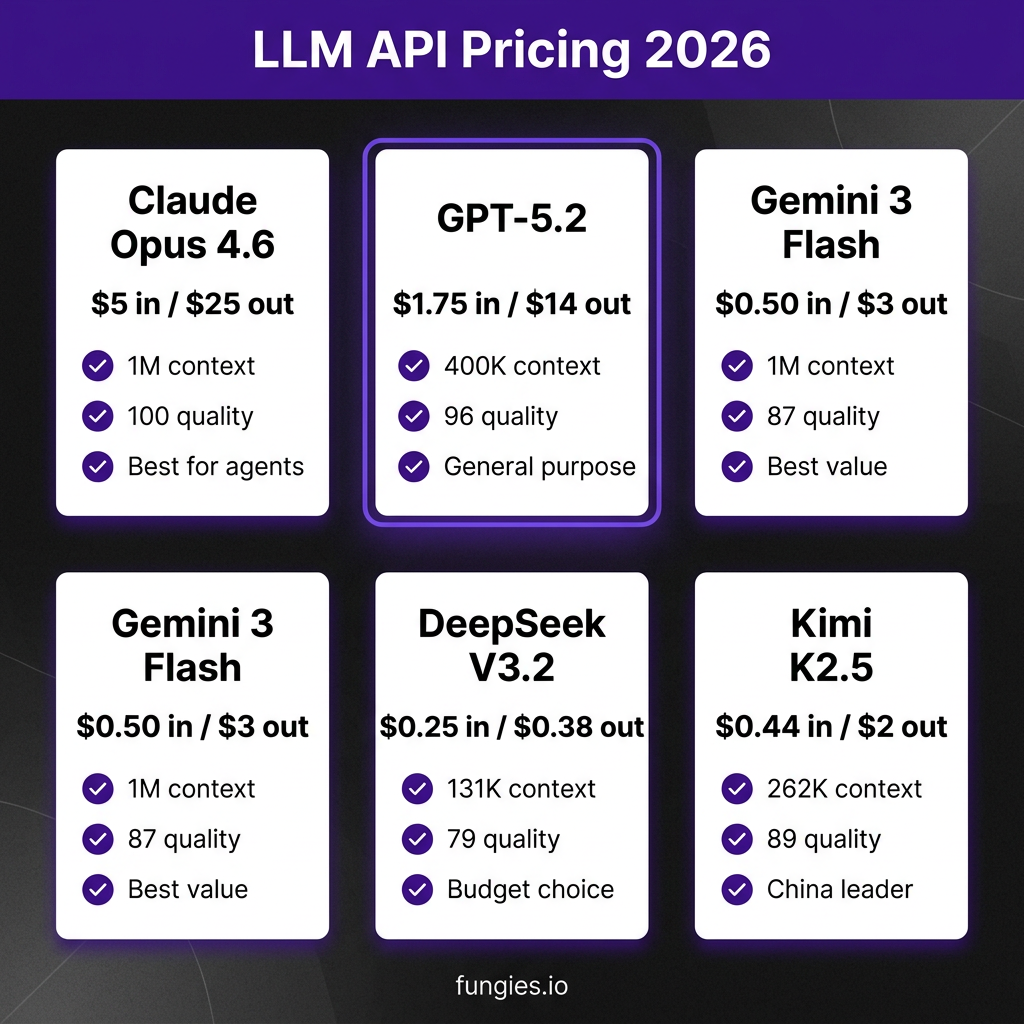
| Claude Opus 4.6 | Anthropic | $5.00 | $25.00 | 1M | 100 |
| GPT-5.2 | OpenAI | $1.75 | $14.00 | 400K | 96 |
| GPT-5.1 | OpenAI | $1.25 | $10.00 | 400K | 91 |
| Gemini 3 Flash | $0.50 | $3.00 | 1M | 87 | |
| Kimi K2.5 | Moonshot | $0.44 | $2.00 | 262K | 89 |
| DeepSeek V3.2 | DeepSeek | $0.25 | $0.38 | 131K | 79 |
| Mistral Small | Mistral | $0.10 | $0.30 | 32K | 72 |
Quality scores based on Theozard independent benchmarks. Prices reflect standard API rates — volume discounts can reduce costs 25–50%.
Model-by-Model Breakdown: When to Use What
Claude Opus 4.6 ($5/$25 per 1M tokens)
Anthropic’s flagship delivers the highest quality scores (100) with a massive 1M token context window. At $25 per million output tokens, it’s the most expensive mainstream option — but worth it for agentic workflows where errors cascade.
Best for: Complex code generation, legal document analysis, research synthesis, multi-step reasoning tasks where accuracy is critical.
Monthly cost example: 10M input + 5M output tokens = $175
GPT-5.2 Family ($1.25–$21 per 1M tokens)
OpenAI’s workhorse lineup spans from GPT-5.1 (quality 91, $1.25/$10) to GPT-5.2 Pro (quality 96, $21/$168). The standard GPT-5.2 hits the sweet spot at $1.75/$14 with 400K context.
Best for: General-purpose applications, chatbots, content generation, coding assistance where you need reliable performance without premium pricing.
Pro tip: GPT-5.2 offers cached input at 50% discount — if you’re processing similar prompts repeatedly, costs drop significantly.
Gemini 3 Flash ($0.50/$3 per 1M tokens)
Google’s aggressive pricing makes Gemini 3 Flash the value leader. At $0.50 per million input tokens with 1M context and quality score 87, it undercuts most competitors while maintaining usable performance.
Best for: High-volume applications, prototyping, tasks where 87/100 quality is sufficient. The 1M context window handles most long-document use cases.
Monthly cost example: 10M input + 5M output tokens = $20 — 8.75x cheaper than Claude Opus for comparable volume.
DeepSeek V3.2 ($0.25/$0.38 per 1M tokens)
The budget champion. DeepSeek V3.2 delivers quality 79 at prices that seem almost too low — $0.25 input, $0.38 output per million tokens. That’s 100x cheaper than GPT-5.2 Pro.
Best for: Cost-sensitive applications, high-volume data processing, internal tools, tasks where you can tolerate occasional quality tradeoffs.
Catch: 131K context window limits use cases. Not suitable for large document analysis or complex multi-turn conversations.
Kimi K2.5 ($0.44/$2 per 1M tokens)
Moonshot’s Kimi K2.5 has emerged as a dark horse with quality 89 at mid-tier pricing. The 262K context window handles most production needs, and the $0.44/$2 price point undercuts GPT-5.2 by 75%.
Best for: Developers seeking GPT-5 quality at Gemini prices. Strong performance on coding tasks and reasoning.
Real Cost Scenarios: What You’ll Actually Pay
Let’s run three realistic scenarios to see how model choice impacts your budget:
Scenario 1: Customer Support Chatbot (5M input / 2M output monthly)
| Model | Monthly Cost | Annual Cost |
|---|---|---|
| Claude Opus 4.6 | $75.00 | $900 |
| GPT-5.2 | $36.75 | $441 |
| Gemini 3 Flash | $8.50 | $102 |
| DeepSeek V3.2 | $2.01 | $24 |
Scenario 2: Code Generation Assistant (20M input / 10M output monthly)
| Model | Monthly Cost | Annual Cost |
|---|---|---|
| Claude Opus 4.6 | $350.00 | $4,200 |
| GPT-5.2 | $175.00 | $2,100 |
| Kimi K2.5 | $28.80 | $346 |
| DeepSeek V3.2 | $8.80 | $106 |
Scenario 3: Document Analysis Pipeline (50M input / 20M output monthly)
| Model | Monthly Cost | Annual Cost |
|---|---|---|
| Claude Opus 4.6 | $750.00 | $9,000 |
| GPT-5.2 | $367.50 | $4,410 |
| Gemini 3 Flash | $85.00 | $1,020 |
| DeepSeek V3.2* | $20.10 | $241 |
*DeepSeek’s 131K context may limit document size. Gemini 3 Flash with 1M context is better for large documents.
How to Choose the Right LLM for Your Use Case
Here’s my decision framework based on analyzing hundreds of production deployments:
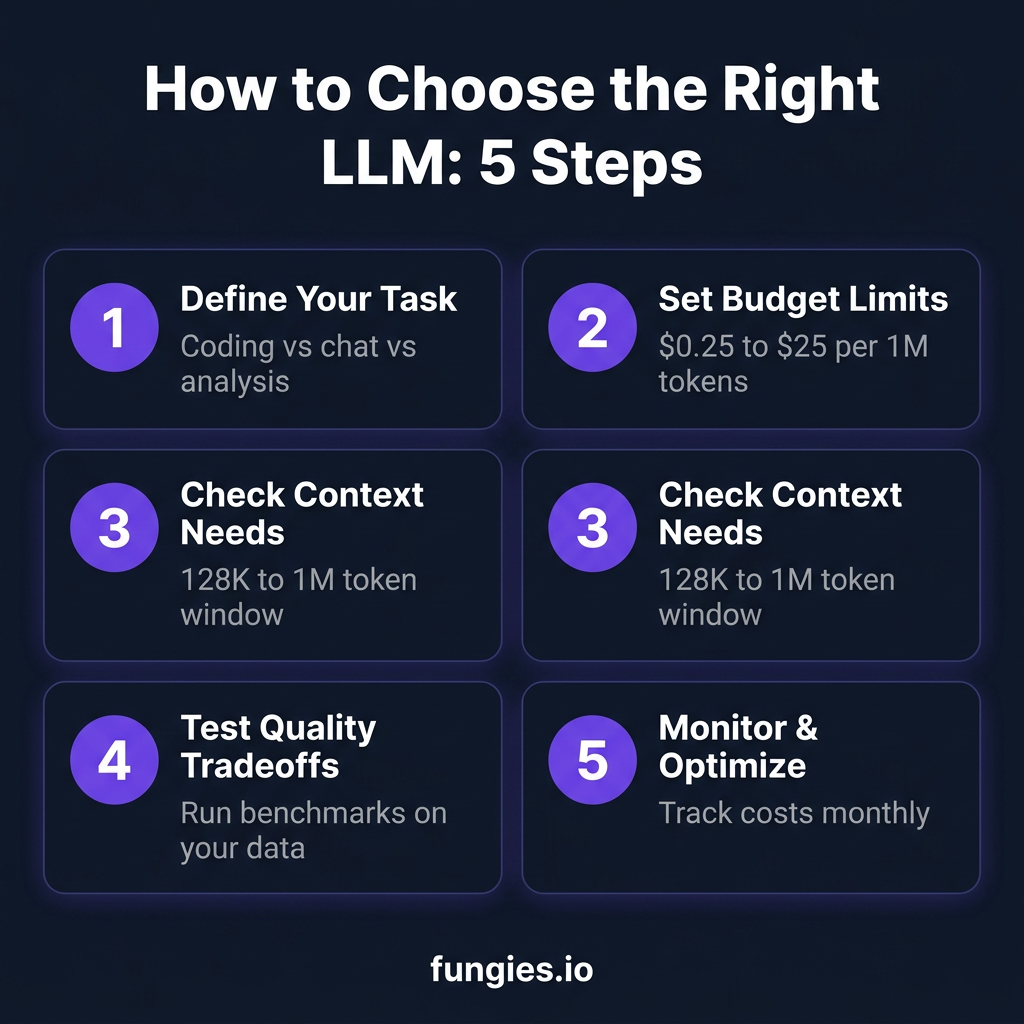
Step 1: Define Quality Requirements
Not every task needs Claude Opus. Ask: what’s the cost of an error? For internal tools, 79/100 quality might be fine. For customer-facing features, you might need 95+.
- Critical accuracy (legal, medical, financial): Claude Opus 4.6 or GPT-5.2
- Good enough (chatbots, content): GPT-5.1 or Kimi K2.5
- Cost-optimized (internal tools, drafts): Gemini 3 Flash or DeepSeek V3.2
Step 2: Match Context Window to Task
Context window determines how much information the model can process at once:
- 32K (Mistral Small): Short conversations, simple queries
- 131K (DeepSeek): Medium documents, multi-turn chats
- 262K (Kimi): Long documents, codebases
- 400K (GPT-5.x): Large codebases, extensive context
- 1M (Claude, Gemini): Entire books, massive codebases
Step 3: Calculate Total Cost of Ownership
Don’t just look at per-token pricing. Factor in:
- Output token ratio: Some models generate longer responses
- Caching discounts: OpenAI offers 50% off cached inputs
- Volume pricing: Enterprise agreements can reduce costs 25–50%
- Retry costs: Lower-quality models may need more retries
Hidden Costs and Gotchas
The sticker price isn’t the whole story. Here are costs that catch developers off guard:
Reasoning Model Multipliers
OpenAI’s o3 and o4-mini are “reasoning models” that think before answering. They consume 2–5x more tokens internally than the per-token price suggests. A task that looks like $0.50 can actually cost $2.00.
Context Window Pricing
Some providers charge based on context window used, not just tokens generated. A 1M context model might cost more per token than the table suggests if you’re using the full window.
Rate Limit Overages
Exceeding rate limits can trigger overage charges or throttling. Budget models often have stricter limits than premium tiers.
Key Takeaways for Developers
- Start with Gemini 3 Flash for prototyping — at $0.50/$3, you can experiment without budget anxiety
- Use Claude Opus 4.6 selectively — reserve for tasks where errors are expensive, not as your default
- Consider Kimi K2.5 as a GPT-5 alternative — 89 quality at 75% lower cost
- Implement model routing — use cheap models for simple queries, expensive ones for complex tasks
- Monitor actual usage — token counts in development rarely match production
FAQ: LLM API Pricing
What’s the cheapest LLM API for high-volume usage?
DeepSeek V3.2 at $0.25/$0.38 per million tokens is the cheapest production-ready option. For context-heavy tasks, Gemini 3 Flash at $0.50/$3 with 1M context offers better value.
Is Claude Opus worth 20x the price of DeepSeek?
For agentic workflows and tasks where errors cascade, yes. For simple classification or content generation, no. Most teams should use a mix: cheap models for volume, premium for edge cases.
How do I estimate my monthly LLM costs?
Track tokens in development, then multiply by 10x for production. Use this formula: (Input Tokens × Input Price + Output Tokens × Output Price) ÷ 1,000,000 = Cost in dollars.
Can I negotiate better pricing?
Yes, if you’re spending $1,000+/month. All major providers offer enterprise discounts of 25–50% for committed usage. Contact sales before your bill gets painful.
What’s the best LLM for coding in 2026?
Claude Opus 4.6 leads on SWE-bench with 80.8% accuracy. GPT-5.2 is close behind at a lower price. For most coding tasks, Kimi K2.5 delivers 90% of the quality at 25% of the cost.
Conclusion: Optimize for Your Reality
The LLM market in 2026 offers unprecedented choice — and unprecedented opportunity to overspend. The developers who win won’t be those using the most expensive models. They’ll be the ones matching model capabilities to actual requirements.
Start with a clear-eyed assessment of your quality needs, context requirements, and budget constraints. Test multiple models on your actual data. And remember: the best LLM API is the one that delivers the business outcome you need at a price that makes sense.
Building a SaaS product with AI features? You’ll need reliable payment infrastructure to monetize them. Fungies.io handles global payments, tax compliance, and checkout — so you can focus on building great AI-powered products.