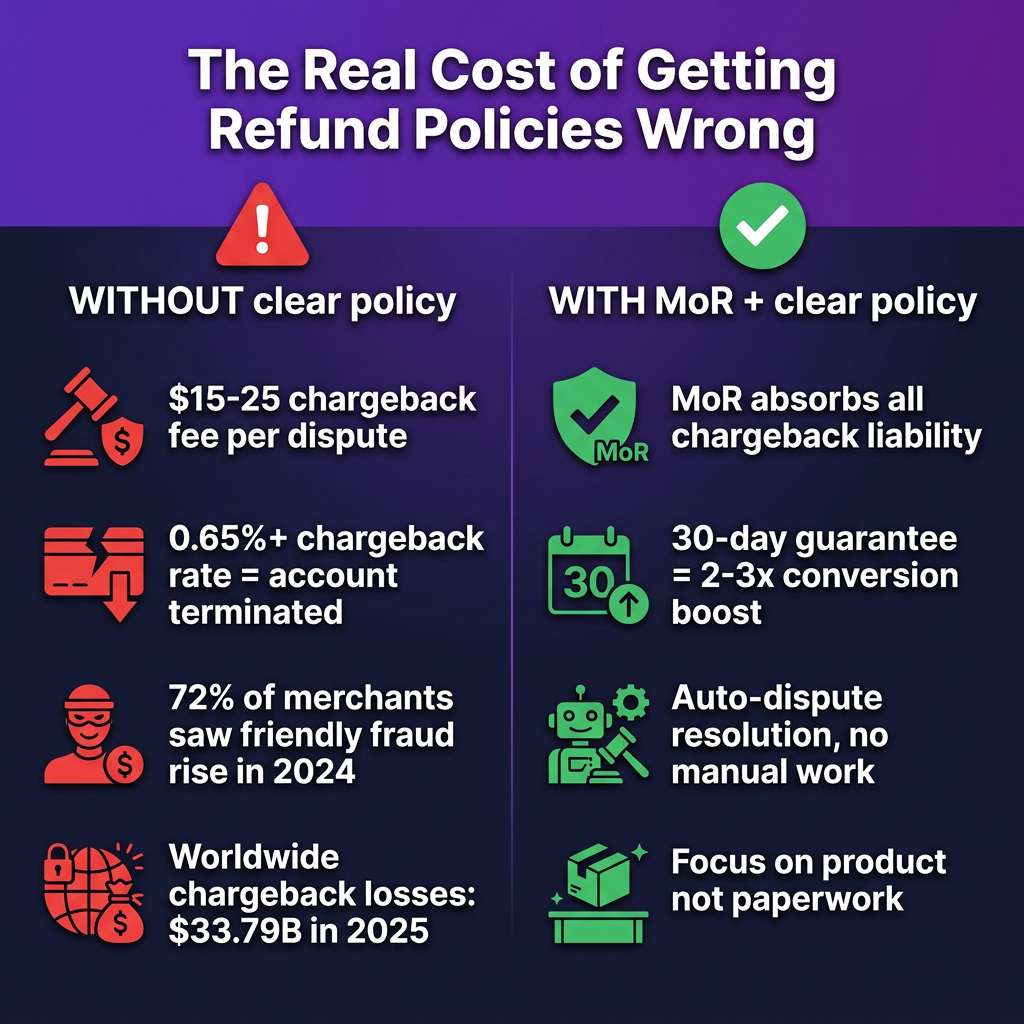
72% of merchants reported an increase in friendly fraud chargebacks in 2024. Worldwide chargeback losses hit $33.79 billion in 2025 — and every single dispute costs you $15–25 in fees on top of the lost revenue. For digital product sellers, your refund policy is either your first line of defense or the gap that friendly fraudsters walk straight through.
Here’s the thing most guides won’t tell you: a well-written refund policy for digital products doesn’t just protect you legally. It increases your conversion rate, reduces chargebacks before they happen, and builds the kind of customer trust that drives repeat purchases. Getting it wrong costs you on both ends.
This guide covers what a digital product refund policy actually needs (it’s different from physical goods), how major platforms handle it, the EU compliance angle many sellers miss, and how to write copy that converts better while covering your back.
Why Digital Product Refund Policies Are Different
You can’t ship a download back. Once someone accesses a file, watches a course module, or activates a software license — the delivery is done. This fundamentally changes the refund conversation compared to physical goods.
Digital products fall into four main categories, and each one needs a slightly different policy:
- Downloadable files (PDFs, templates, eBooks, asset packs, software installers) — once downloaded, access is irreversible. Policy needs to define whether “downloaded = accessed.”
- Access-based products (online courses, membership communities, gated content) — refund window is more defensible here since you can revoke access cleanly.
- SaaS subscriptions (recurring billing software) — most common source of chargebacks. Pro-rated refunds or “cancel and keep access until period end” are industry norms.
- Digital licenses (activation keys, account-based entitlements) — once a key is used, you have almost no chargeback protection without a strong policy and delivery evidence.
The key insight: you’re not saying whether to refund money. You’re defining what “refund” means for your specific product type — and making that crystal clear before the customer clicks buy.
How the Top Platforms Handle Refunds (And Who Takes the Risk)
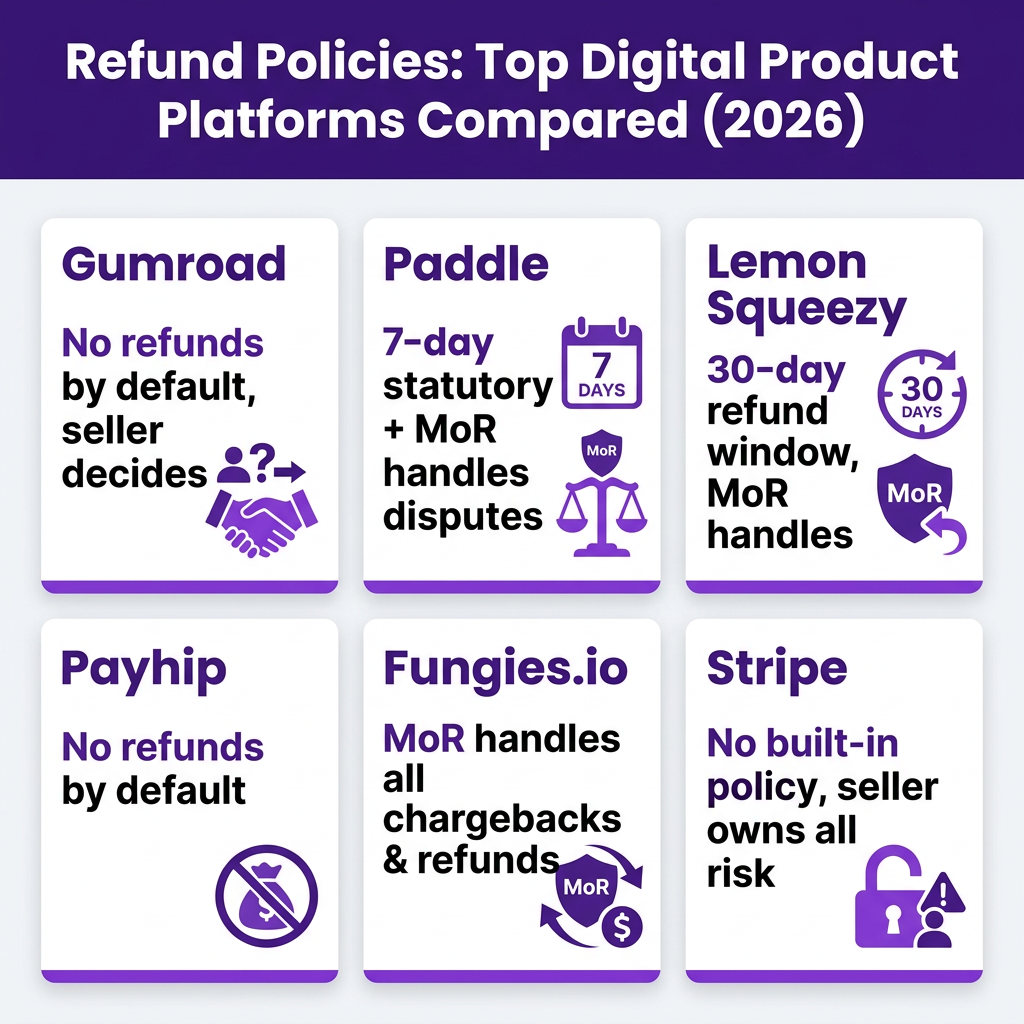
Where you sell matters as much as what your policy says. Different platforms allocate refund and chargeback liability very differently.
| Platform | Default Refund Policy | Chargeback Liability | Seller Control | MoR? |
|---|---|---|---|---|
| Gumroad | No refunds by default; seller decides | Seller absorbs all chargebacks | Full control | Yes (since 2024) |
| Paddle | 7-day statutory window; MoR manages | Paddle absorbs | Moderate | Yes |
| Lemon Squeezy | 30-day refund window, MoR handles | Lemon Squeezy absorbs | Low (standard policy) | Yes (now Stripe) |
| Payhip | No refunds by default | Seller absorbs all chargebacks | Full control | No |
| Fungies.io | MoR handles refunds and disputes | Fungies.io absorbs all liability | Full customization | Yes |
| Stripe (direct) | No built-in policy — you own it | Seller absorbs everything | Full control, full risk | No |
| FastSpring | 30-day standard window | FastSpring absorbs | Moderate | Yes |
The big dividing line here is Merchant of Record (MoR). When you sell through an MoR platform, the platform is legally the seller on record — they own the refund and chargeback liability. When you sell direct via Stripe or Payhip, you own all of it.
This matters because chargeback fees ($15–25 each) compound fast. And if your chargeback rate exceeds 0.65% of transactions, Visa and Mastercard can terminate your processing — a catastrophic outcome for any digital business.
The EU Right of Withdrawal: The Rule Most Sellers Miss
If you sell to customers in the European Union, the 14-day right of withdrawal applies automatically under the Consumer Rights Directive. Customers can cancel any online purchase within 14 days, no questions asked.
For digital products, there’s an important exception — but it requires active consent. You can waive the 14-day withdrawal right if:
- The customer explicitly acknowledges they want immediate digital delivery
- They confirm they understand they’re waiving their withdrawal right by requesting this
- You document this consent at checkout
Without this checkbox and consent flow, every EU customer technically has 14 days to demand a refund regardless of your policy. Most platforms (Paddle, Lemon Squeezy, Fungies.io) handle this automatically as part of their MoR checkout. If you’re selling direct through Stripe, you need to build this consent flow yourself.
The EU is also introducing a mandatory “withdrawal button” requirement in 2026 — businesses will need a clearly visible cancel/withdraw mechanism on their customer-facing interfaces. MoR platforms will handle this automatically; direct sellers will need to implement it manually.
| Jurisdiction | Legal Requirement | Digital Product Exception | Who Manages Compliance |
|---|---|---|---|
| EU (27 countries) | 14-day right of withdrawal | Yes, with explicit consent at checkout | MoR or seller (direct) |
| UK | 14-day cooling-off period | Yes, with acknowledgment | MoR or seller (direct) |
| US | No federal mandate; state-level varies | Seller defines own policy | Seller |
| Australia | Consumer Law guarantees apply | Must be “fit for purpose” | MoR or seller (direct) |
| Canada | Province-level varies (ON, QC strictest) | Seller defines; must not mislead | Seller |
How to Write a Refund Policy That Actually Converts
Here’s what most policy guides get wrong: they write for legal protection only, not for customer psychology. Your refund policy is sales copy as much as it is legal text.
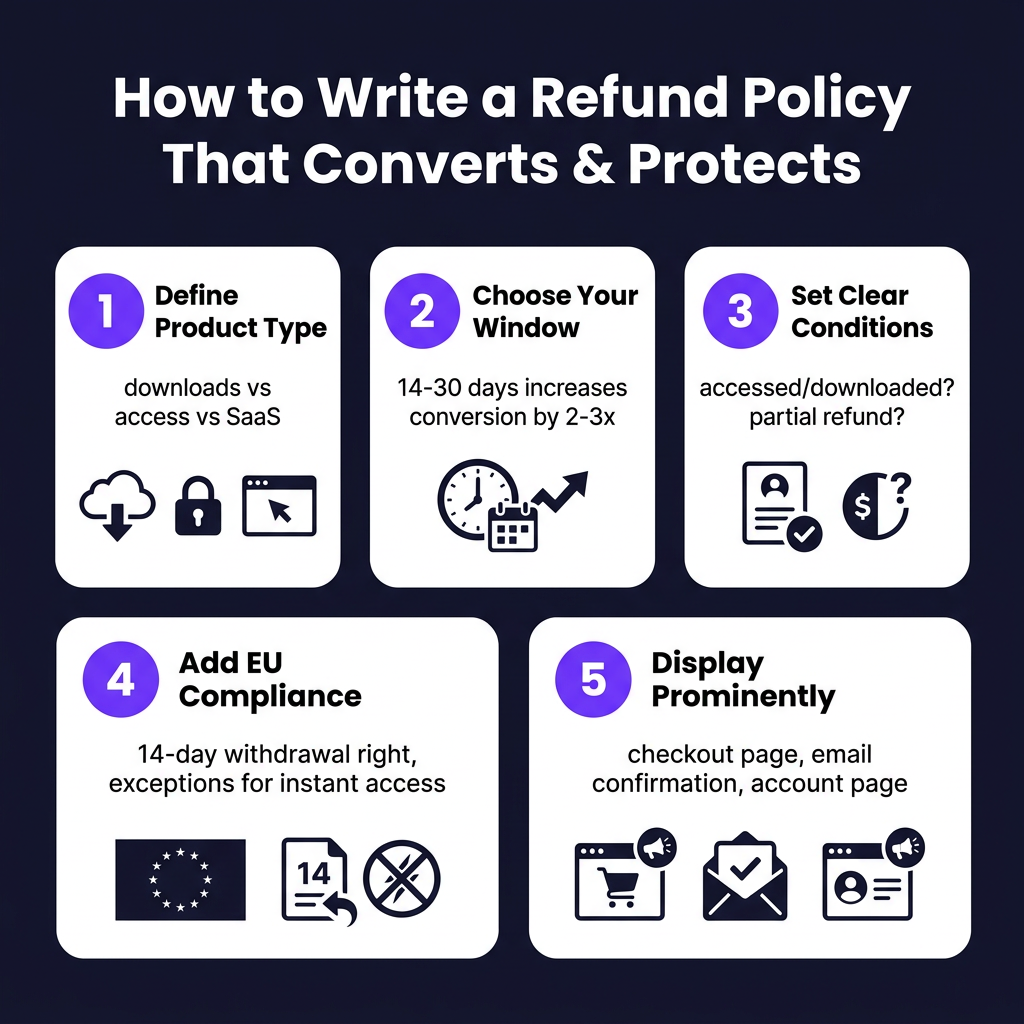
The conversion data is clear: offering a 30-day money-back guarantee can double or triple conversion rates on digital products. The reason? Buyers are risk-averse. When they can’t physically inspect what they’re buying, perceived risk is the #1 objection. A clear, fair refund policy removes that friction.
But “30 days, no questions asked” isn’t the right policy for every product. Here’s a framework based on product type:
For Downloadable Files (Templates, PDFs, Ebooks)
This is the trickiest category because the file can be copied before a refund request. The most defensible approach:
- Offer a 7-day window for “product significantly different from description” claims
- Clearly define “downloaded = accessed” in your terms
- Consider offering a free sample, preview, or demo to reduce buyer uncertainty upfront (better than generous refunds)
- Require a reason for refund requests (reduces casual refund abuse without blocking legitimate claims)
For Online Courses and Memberships
You can afford to be generous here because you can revoke access. Industry standard:
- 14-30 day window with access revocation on refund
- “Completed less than X% of content” condition if you want to limit abuse
- No partial refunds on memberships (pro-rate on subscription cancellation instead)
For SaaS Subscriptions
Most SaaS companies offer a free trial rather than a refund policy — and that’s the right move. If you do offer refunds:
- Pro-rated refund for unused subscription period (or none — both are defensible)
- “Cancel and retain access until period end” is the industry norm
- Auto-renewal chargebacks are the highest-risk area: proactive renewal reminders cut these dramatically
For Software Licenses and Activation Keys
Once a key is used, you have minimal chargeback protection without ironclad evidence. Best practices:
- Log activation timestamps and IP with the key delivery
- No refunds after key activation — state this clearly at checkout
- Offer a trial/demo version to reduce pre-purchase uncertainty
- Support-first approach: often the “refund” request is actually a bug report
The Chargeback Problem: Why Your Refund Policy Is Your First Defense
In 2025, every dollar lost to fraud cost US merchants $4.61 when you factor in fees, overhead, and lost product. Friendly fraud — where a customer gets the product and then disputes the charge with their bank — accounts for roughly 45% of chargebacks.
Your refund policy directly affects your chargeback rate:
- Clear, prominent policies reduce “I didn’t know about this” disputes
- Easy refund processes give frustrated customers an alternative to chargebacks
- Documented delivery evidence lets you win disputes when they happen
- MoR platforms take over the entire dispute process — you don’t fight individual chargebacks, they do
Here’s the math that matters: if you’re doing $50,000/month in digital product sales and your chargeback rate hits 0.65%, you’re looking at ~$325/month in dispute fees alone, plus potential merchant account termination. A well-designed refund policy that processes legitimate complaints before they become chargebacks is the cheapest insurance you can buy.
| Scenario | Without Clear Policy | With Clear Policy + MoR |
|---|---|---|
| Angry customer (wrong expectations) | Files chargeback ($15-25 fee + lost revenue) | Contacts support, gets refund, case closed |
| EU customer, 14-day window | Legally entitled to refund, you’re liable | MoR handles compliance automatically |
| Friendly fraud (downloaded + disputed) | No evidence to fight it, you lose | Delivery logs + MoR dispute team fight it |
| High chargeback rate (0.65%+) | Account termination risk | MoR absorbs liability, your business safe |
| Auto-renewal dispute | Almost always loses without email proof | MoR sends reminders, manages disputes |
Where to Display Your Refund Policy (And Why It Matters)
A refund policy buried in your footer doesn’t prevent chargebacks. Visibility is everything.
The four places your refund policy needs to appear:
- Checkout page — a brief summary (1-2 sentences) near the buy button. “30-day money-back guarantee. No questions asked.” increases conversions and establishes the expectation before payment.
- Order confirmation email — remind the customer of the policy immediately after purchase. “If you have any issues in the first 30 days, just reply to this email.” This is your chargeback prevention layer.
- Product access page / dashboard — especially important for SaaS. Customers who can’t find support often jump straight to their bank.
- Full policy page (linked from footer) — the detailed legal version, covering all edge cases, jurisdiction-specific rights, and contact information for refund requests.
If you’re using an MoR platform like Fungies.io, the checkout-level policy display is handled automatically as part of the purchase flow. For direct Stripe integrations, this is manual work you need to implement and maintain.
Refund Policy Template for Digital Products
Here’s a battle-tested template you can adapt. Replace the brackets with your specifics:
[Product Name] Refund Policy
We want you to be completely satisfied with your purchase. If you’re not happy within [X] days of purchase, we’ll refund your payment in full — no questions asked.
How to request a refund: Email [[email protected]] with your order number. Refunds are processed within 5–7 business days.
Conditions: [If applicable: Refunds are available for accounts that have accessed less than [X]% of the course content / have not activated their license key.] After [X] days, refunds are at our discretion.
EU customers: In addition to our standard policy, EU consumers have the right to withdraw from this purchase within 14 days. If you request immediate digital access at checkout, you acknowledge that your right of withdrawal ends upon delivery.
Exceptions: We cannot offer refunds on
Questions? Email [[email protected]].
Keep it short, plain-language, and prominent. The goal is clarity, not comprehensiveness.
Key Takeaways
- Your refund policy is conversion copy, not just legal text. A 30-day money-back guarantee can 2-3x conversions on digital products by removing buyer risk. Don’t treat it as a footnote.
- Different product types need different policies. Downloadable files, courses, SaaS subscriptions, and license keys each have different delivery characteristics — tailor your policy to the product.
- EU compliance is non-negotiable if you have EU customers. The 14-day withdrawal right applies unless you get explicit consent at checkout for immediate digital delivery. MoR platforms handle this automatically.
- A clear refund process is cheaper than chargebacks. Every chargeback costs $15–25 in fees plus the lost revenue. Easy refund requests divert frustrated customers away from their bank.
- MoR platforms absorb chargeback liability. If you’re selling direct via Stripe and managing chargebacks manually, you’re taking on risk that MoR platforms like Fungies.io carry for you — at the same or lower transaction cost.
FAQ
Can I legally have a “no refunds” policy for digital products?
In most jurisdictions, yes — but with important exceptions. In the EU and UK, customers have a 14-day withdrawal right unless they explicitly waive it for immediate digital access. In the US, you can legally decline refunds for digital products, but you need to clearly disclose this policy before purchase. Having a “no refunds” policy doesn’t protect you from chargebacks — customers can still dispute with their bank and often win, especially if your policy wasn’t prominently displayed.
What’s the best refund policy to minimize chargebacks?
Counter-intuitively, a more generous refund policy usually reduces chargebacks. When customers know they can easily get a refund by contacting you, they’re less likely to escalate to a bank dispute. The highest chargeback risk comes from products with hard “no refund” policies where frustrated customers have no alternative. A 14–30 day money-back guarantee with a simple email-based process is the sweet spot for most digital product sellers.
How does a Merchant of Record handle refunds differently from direct Stripe?
With a Merchant of Record (like Fungies.io, Paddle, or Lemon Squeezy), the MoR is the legal seller on record. They handle all refund requests, manage chargeback disputes, maintain relationships with card networks, and absorb the liability. You get a unified dashboard to approve or decline refunds, but the legal and financial exposure sits with the MoR. With direct Stripe, you own everything — every dispute, every fee, every compliance obligation. For sellers with scale or international customers, MoR typically offers better risk management.
Do I need a refund policy for free products or free trials?
Not technically, but it’s still good practice. If you offer a free trial that converts to a paid subscription, clearly state what happens at the end of the trial period. Auto-renewal disputes are one of the most common chargeback categories for SaaS products. A proactive renewal reminder email (sent 3-7 days before billing) is the single highest-impact action you can take to reduce subscription chargebacks.
Conclusion
A digital product refund policy isn’t something you write once and forget. It’s a living part of your sales funnel that affects conversion rates, chargeback rates, customer trust, and legal compliance simultaneously.
The practical truth: if you’re selling directly via Stripe or similar, you’re managing all of this yourself. If you’re using an MoR platform, the refund policy compliance, EU right of withdrawal handling, and chargeback liability are handled for you — letting you focus on building and selling instead of dispute management.
If you’re ready to stop managing chargebacks manually and let a Merchant of Record handle the legal and compliance layer for you, Fungies.io takes 5 minutes to set up — and you keep more control over your product and pricing than most alternatives offer.
References
- Chargebacks911 — Chargeback Statistics 2026
- Sift Q4 2025 Digital Trust Index — Dispute & Chargeback Data
- Automateed — Digital Product Refund Policy Examples & Best Practices
- Dodo Payments — SaaS Refund Management: Policies, Automation, and Best Practices
- AMSTlegal — EU Right of Withdrawal Explained
- Taylor Wessing — The Withdrawal Button: New EU Compliance Risk 2026
- PolicyOwn — Refund Policy Best Practices 2026