Payhip Review 2026: Is It Still Worth Using for Digital Creators?
Payhip has been around since 2013. Most “reviews” you’ll find are either affiliates chasing a commission or shallow listicles that copy Payhip’s own marketing copy. This one isn’t. I’ve dug into the actual pricing math, tested the limitations, and compared it against what you can get elsewhere in 2026. Short verdict: Payhip is genuinely good
Payhip has been around since 2013. Most “reviews” you’ll find are either affiliates chasing a commission or shallow listicles that copy Payhip’s own marketing copy. This one isn’t. I’ve dug into the actual pricing math, tested the limitations, and compared it against what you can get elsewhere in 2026.
Short verdict: Payhip is genuinely good for creators at the beginning of their journey. But there are real ceilings — and if you’re selling globally, there’s a compliance gap that’ll bite you sooner or later.
What Is Payhip?
Payhip is a UK-based e-commerce platform for digital product sellers. You can sell digital downloads, online courses, coaching sessions, memberships, and physical products — all from one dashboard. It connects to your Stripe or PayPal account for payments.
Unlike a Merchant of Record (MoR) like Paddle, Fungies.io, or FastSpring, Payhip is a platform layer. You’re still the merchant. Stripe or PayPal is still your payment processor. Payhip sits in the middle, handling the product delivery, checkout UI, and — for EU and UK sales — VAT collection and remittance.
That distinction matters a lot. More on that in a moment.
Payhip Pricing: The Only Thing That Changes Between Plans
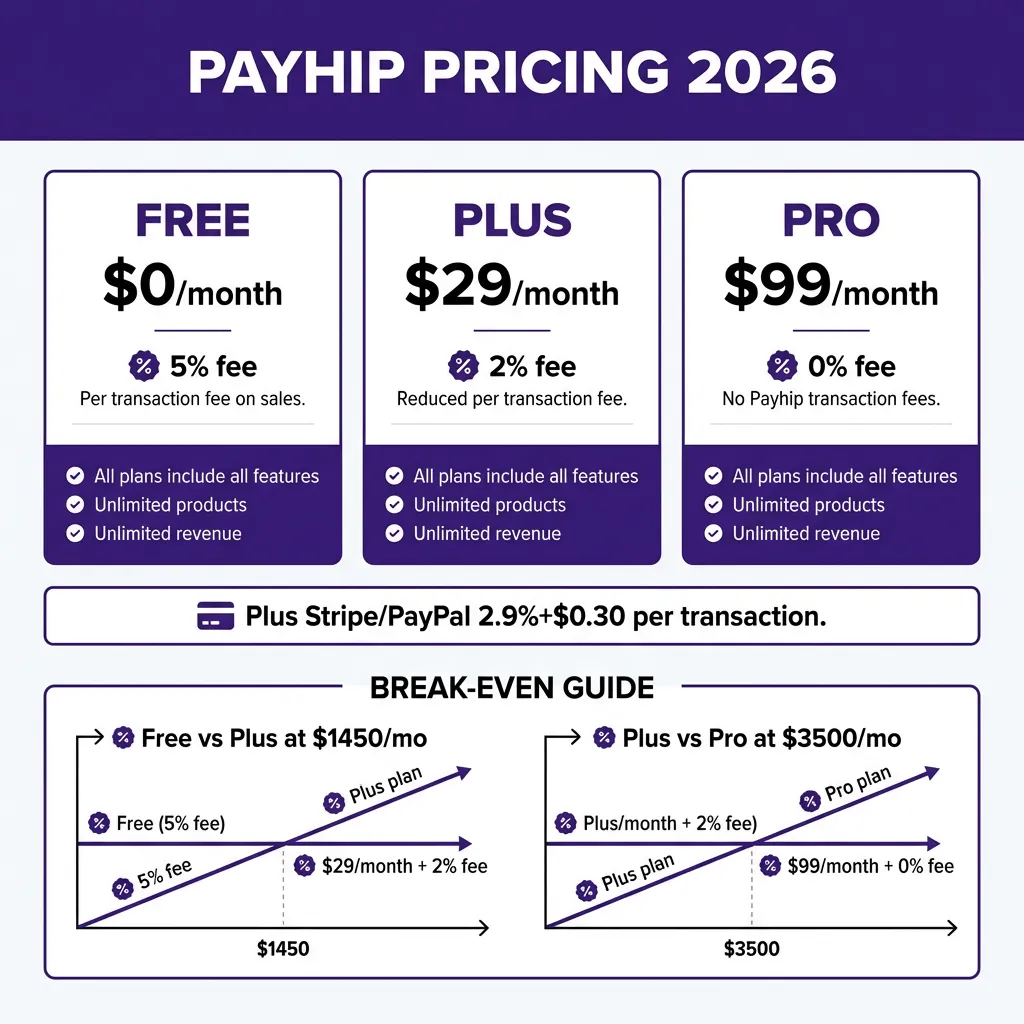
Payhip’s pricing is refreshingly simple. Every plan gets every feature. The only thing you’re paying for is a lower transaction fee.
| Plan | Monthly Cost | Payhip Fee | Stripe/PayPal Fee | Total at $1,000/mo Revenue |
|---|---|---|---|---|
| Free Forever | $0 | 5% | ~2.9% + $0.30/txn | ~$79 in fees |
| Plus | $29 | 2% | ~2.9% + $0.30/txn | ~$78 in fees |
| Pro | $99 | 0% | ~2.9% + $0.30/txn | ~$128 in fees |
At low revenue, the Free plan wins. At $1,000/month the Plus plan barely breaks even compared to Free (you’re saving $30 in Payhip fees but paying $29 for the plan). The real break-even points are:
Free → Plus: Makes sense once you’re past ~$1,450/month revenue
Plus → Pro: Makes sense past ~$3,500/month revenue
Remember: Stripe and PayPal fees (roughly 2.9% + $0.30 per transaction) apply on all plans, on top of Payhip’s cut. They’re non-negotiable and Payhip doesn’t absorb them.
What Payhip Can Do: Feature Rundown
Despite its simple pricing, Payhip’s feature set has grown significantly since 2020. Here’s what you get on every plan:
Digital Downloads
The core use case. Upload any file (PDFs, ZIPs, videos, software), set a price, get a checkout link. Payhip handles delivery and download limits. Works well for ebooks, templates, presets, music, code snippets.
Online Courses
Payhip has a full course builder — drip content, video hosting, quizzes, completion certificates. It’s not as powerful as Teachable or Thinkific, but it’s solid for simple course setups and you don’t pay extra for it.
Coaching
Sell 1:1 or group coaching sessions with calendar booking integration. Good enough for most coaches who want to keep things simple.
Memberships
Recurring subscriptions with member-only content. You can create tiered membership levels. Not as flexible as dedicated membership platforms, but functional.
Affiliate Marketing
Built-in affiliate program. You set the commission rate, affiliates get a unique link, Payhip tracks sales. This is actually a strong feature that many platforms charge extra for.
EU VAT and UK VAT
Payhip collects and remits EU VAT and UK VAT on your behalf automatically. This is important — it means for European digital product sales, you’re not chasing VAT compliance yourself. However, this only covers EU and UK. For US sales tax, Australian GST, Canadian GST/HST, and other jurisdictions, you’re on your own.
Marketing Tools
Coupons, discount codes, upsells, order bumps, and email marketing with list building. Basic but covers the essentials.
Store Builder
Custom domain support, branded storefront, multiple themes. You can build a decent looking shop. SEO options are limited — you can’t set custom meta descriptions or URLs on some pages, which is a real weakness if organic traffic matters to you.
The Big Limitation: Payhip Isn’t a Merchant of Record
This is the single most important thing to understand about Payhip before you sign up.
When you sell through Payhip, you are the seller of record. Payhip is a platform that connects to your Stripe/PayPal account. That means:
You’re legally responsible for tax compliance in every country you sell to (except EU/UK VAT which Payhip handles)
Stripe/PayPal appear on your customer’s credit card statement as the processor — but the liability is yours
If a US state sends you a sales tax notice, that’s your problem to deal with
If Australia’s ATO asks about your GST, that’s your problem too
Chargebacks and fraud disputes go through your Stripe/PayPal account
Contrast this with a full Merchant of Record platform like Paddle, Fungies.io, or FastSpring — where the MoR is the legal seller in every transaction. They handle all global tax compliance, file returns in every jurisdiction, and take on the chargeback and fraud liability. You just get paid.
For many creators selling simple products to a mostly EU/US audience, Payhip’s partial coverage is fine. But if you’re scaling globally or building a SaaS product, the MoR gap is a real risk.
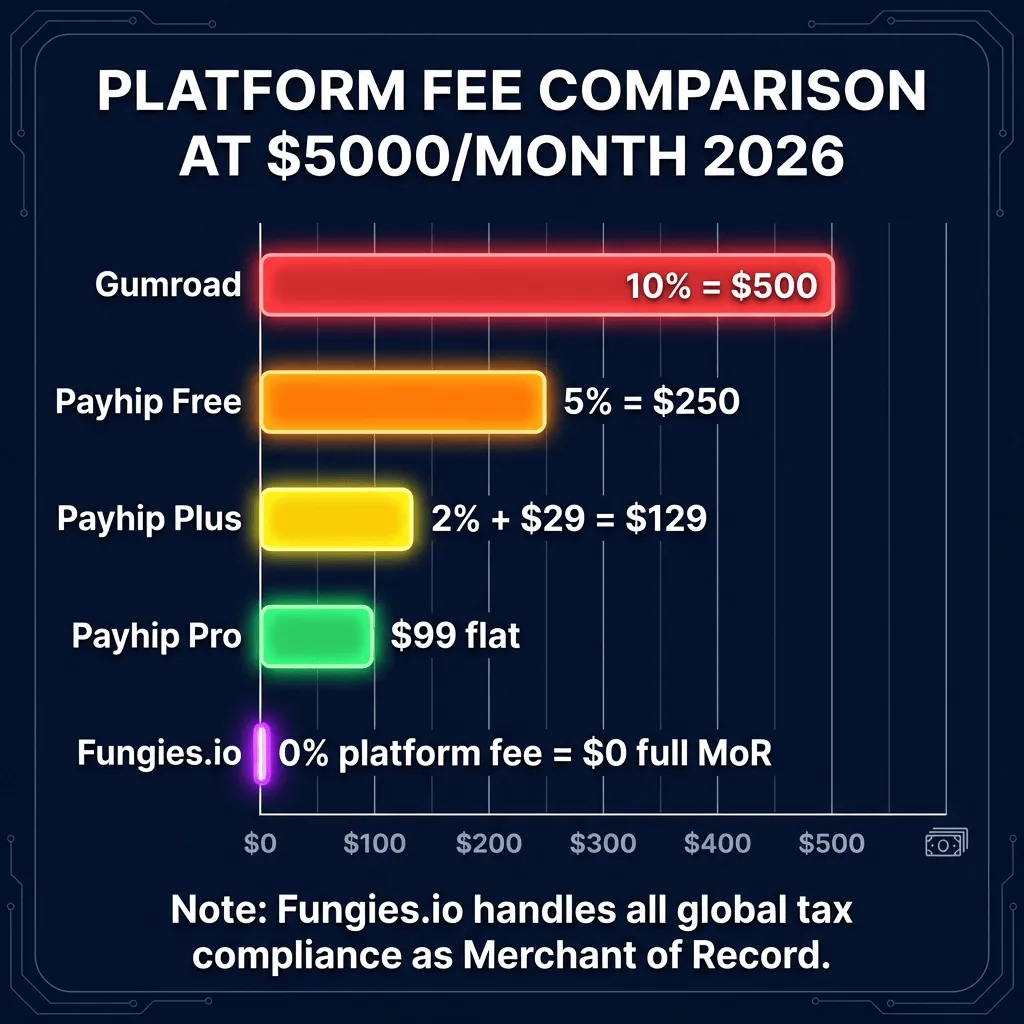
Payhip vs Competitors: Fee Comparison at $5,000/Month Revenue
| Platform | Monthly Cost | Platform Fee | MoR Status | Total Platform Cost at $5K/mo |
|---|---|---|---|---|
| Gumroad | $0 | 10% | Full MoR (since 2025) | $500 |
| Payhip Free | $0 | 5% | Partial (EU/UK VAT only) | $250 |
| Payhip Plus | $29 | 2% | Partial (EU/UK VAT only) | $129 |
| Payhip Pro | $99 | 0% | Partial (EU/UK VAT only) | $99 |
| Lemon Squeezy | $0 | 5% + $0.50/txn | Full MoR | ~$250+ |
| Fungies.io | $0 | % per sale | Full MoR (global) | Competitive |
| Paddle | $0 | 5% + $0.50/txn | Full MoR | ~$250+ |
Pure fee comparison favors Payhip Pro at scale — $99 flat versus percentage-based MoR fees. But this ignores the compliance costs you’ll absorb if you’re not using a full MoR. Tax accountant fees, potential penalties, and the time spent managing multi-jurisdiction compliance can easily exceed the savings.
Who Should Use Payhip in 2026?
Payhip is a great fit if you:
Are just starting out and want zero upfront costs
Sell primarily in EU/UK where Payhip handles VAT for you
Sell simple digital downloads, courses, or memberships
Don’t need complex subscription billing or SaaS-style recurring revenue
Want an all-in-one platform that includes affiliate marketing
Are earning under ~$3,500/month (Free or Plus tier is cost-effective)
Payhip is a poor fit if you:
Are selling globally and need full MoR tax compliance handled for you
Build SaaS products with complex subscription tiers and usage billing
Need embeddable checkout inside your own app or website
Have high revenue where 2-5% fees start to compound painfully
Need strong SEO control over your storefront
Want detailed analytics and revenue dashboards
Payhip vs. Fungies.io: When to Make the Switch
Fungies.io is a Merchant of Record built specifically for SaaS founders and digital product creators who need to sell globally without the tax compliance headache. Here’s how the two compare on the dimensions that matter most:
| Feature | Payhip | Fungies.io |
|---|---|---|
| Merchant of Record | ❌ Partial (EU/UK VAT only) | ✅ Full global MoR |
| Global Tax Compliance | EU + UK only | All jurisdictions handled |
| SaaS Subscriptions | Basic memberships | Full SaaS billing |
| Embeddable Checkout | ❌ | ✅ |
| Monthly Platform Fee | $0–$99/mo | $0 (commission-based) |
| Affiliate Marketing | ✅ Built-in | ✅ |
| Course Builder | ✅ | Digital products focus |
| Fraud/Chargeback Liability | Your Stripe/PayPal account | Handled by Fungies.io |
| Setup Time | Minutes | Minutes |
The decision point is usually this: if you’re a creator selling ebooks and courses primarily to US and EU audiences, Payhip is fine and cost-effective. If you’re building a SaaS product, selling software licenses, or want zero tax liability exposure globally, a full MoR like Fungies.io makes more sense — and the commission-based pricing means you don’t pay anything upfront.
Real User Complaints About Payhip
Cross-referencing reviews from Capterra, G2, and Reddit, here’s what creators consistently complain about:
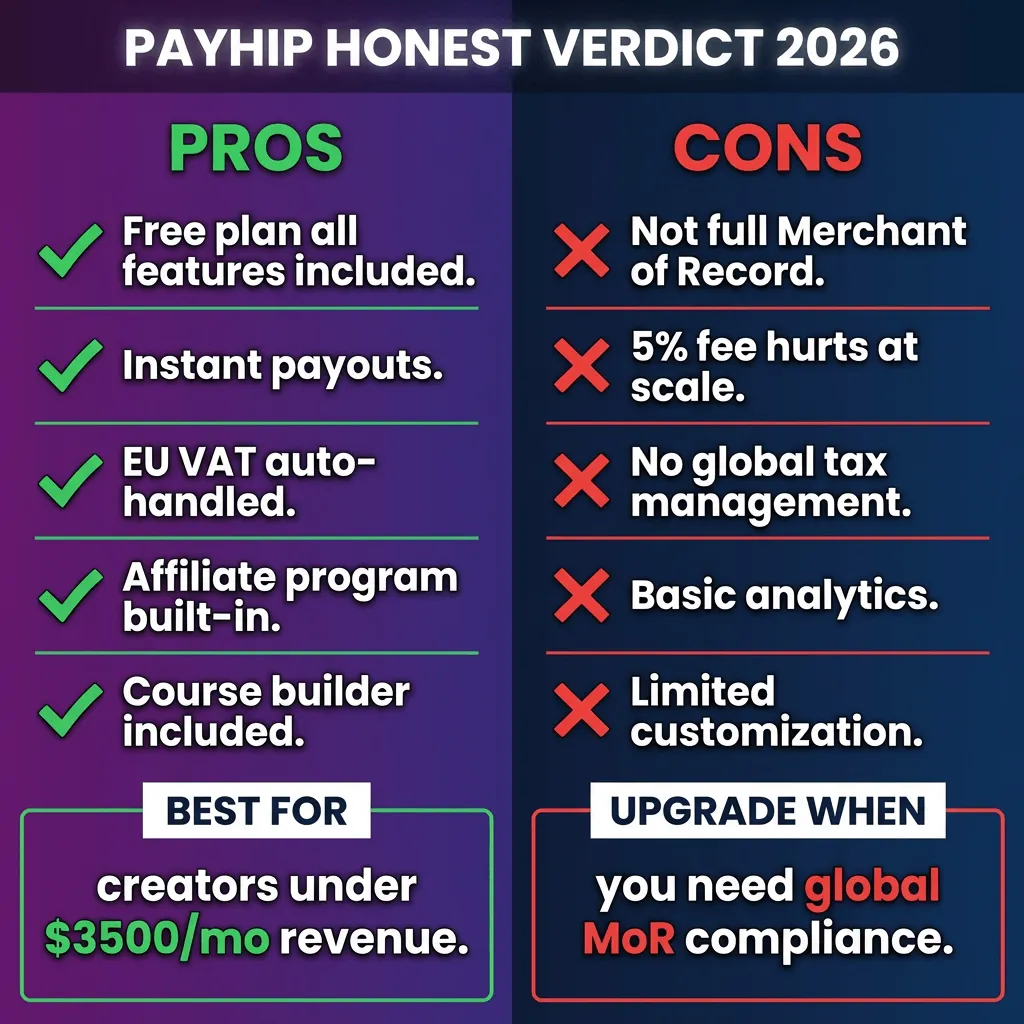
Page load speed — Payhip storefronts are not the fastest. Multiple users cite slow page loads affecting conversion rates.
Limited SEO control — Can’t set custom meta descriptions or URLs on all pages. A real problem if you’re trying to rank organically.
Basic analytics — Revenue overview and product sales are there, but you won’t get funnel analysis, cohort data, or detailed customer lifetime value metrics.
No app marketplace — Limited third-party integrations compared to Shopify or even Gumroad. Zapier fills some gaps.
Checkout customization is minimal — You can add your logo and change colors, but the checkout UX is pretty locked down.
Key Takeaways
Payhip’s Free plan is one of the best entry points in the space — all features, $0/month, just 5% per sale
The break-even math: upgrade to Plus at $1,450/mo revenue, Pro at $3,500/mo
Payhip handles EU and UK VAT automatically — but you own tax liability in the US, Australia, Canada, and everywhere else
It’s not a Merchant of Record — if global compliance is a concern, look at Paddle, Fungies.io, or FastSpring
Best for: creators and course sellers who want simple setup, instant payouts, and low fees at early revenue stages
Frequently Asked Questions
Is Payhip free to use?
Yes, Payhip has a Free Forever plan with $0/month and all features included. You pay a 5% transaction fee per sale, plus your Stripe or PayPal processing fees (typically 2.9% + $0.30 per transaction). There’s no trial — it’s genuinely free to start.
Does Payhip handle VAT?
Payhip automatically collects and remits EU VAT and UK VAT on digital product sales. This means for European customers, Payhip handles the compliance. However, Payhip does not handle US sales tax, Australian GST, or other global jurisdictions — you remain liable for those as the merchant of record in your own Stripe/PayPal account.
What’s the difference between Payhip and a Merchant of Record?
A Merchant of Record (MoR) like Paddle or Fungies.io is the legal seller in every transaction. They own the tax compliance obligation globally, handle fraud and chargebacks, and you simply collect revenue. Payhip is a platform layer — it connects to your own payment accounts, so you remain the legal seller and are responsible for most tax compliance yourself (except EU/UK VAT).
What are the best Payhip alternatives for SaaS founders?
For SaaS founders specifically, the best alternatives to Payhip are Fungies.io (full MoR, built for SaaS subscriptions, commission-based), Lemon Squeezy (full MoR, developer-friendly, 5% + $0.50/txn), and Paddle (full MoR, strong for B2B SaaS, 5% + $0.50/txn). All three handle global tax compliance, which Payhip doesn’t fully cover.
Conclusion
Payhip is a genuinely useful platform. The free plan with all features is hard to beat for creators just starting out. The pricing math rewards growth with Plus and Pro tiers. Instant payouts, a built-in affiliate program, and course hosting make it a legitimate all-in-one for digital product sellers in the $0–$5,000/month range.
The ceiling is clear though: no embeddable checkout, partial tax coverage, limited SEO, basic analytics. When you outgrow it, you outgrow it fast.
If you’re selling SaaS subscriptions or need global Merchant of Record coverage from day one, skip Payhip and go straight to a platform built for that. Fungies.io is free to start, commission-based, and a full MoR — meaning zero upfront cost and zero global tax headaches from your first sale.