Choosing the right SaaS payment processing solution is one of the most critical decisions for any software company. With the global SaaS market projected to reach $819 billion by 2030, having a robust payment infrastructure isn’t just nice to have—it’s essential for survival. Whether you’re launching a new subscription service or scaling an existing platform, the payment processor you choose directly impacts your revenue, customer experience, and global expansion capabilities.
In this comprehensive guide, we’ll explore the best SaaS payment processing solutions available in 2026, compare their features, pricing, and tax compliance capabilities, and help you make an informed decision for your business.
What Is SaaS Payment Processing?
SaaS payment processing refers to the systems and services that enable software-as-a-service companies to accept payments from customers worldwide. Unlike traditional e-commerce payment processing, SaaS payments involve unique challenges:
- Recurring billing: Managing subscriptions, upgrades, downgrades, and cancellations
- Global tax compliance: Handling VAT, GST, and sales tax across 100+ countries
- Multi-currency support: Accepting payments in local currencies to reduce friction
- Usage-based pricing: Metered billing for API calls, storage, or feature usage
- Dunning management: Recovering failed payments and reducing churn
The right payment solution should handle all these complexities while providing a seamless checkout experience that converts visitors into paying customers.
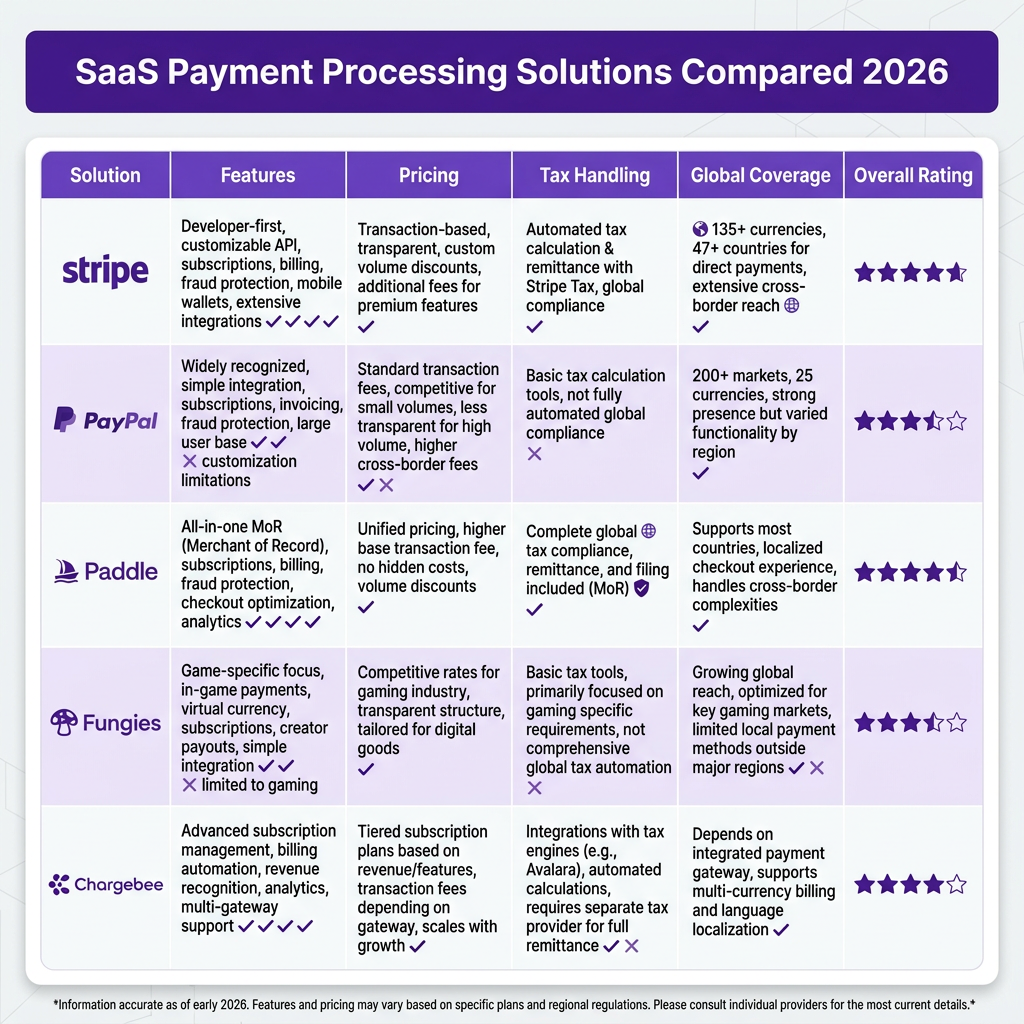
Top 5 SaaS Payment Processing Solutions in 2026
1. Stripe
Stripe remains the dominant force in SaaS payment processing, powering millions of businesses worldwide. Their developer-first approach and comprehensive API make them a favorite among technical teams.
Key Features:
- 135+ currencies and 45+ countries supported
- Stripe Billing for subscription management
- Stripe Tax for automated tax calculation (additional cost)
- Advanced fraud prevention with Radar
- Extensive developer documentation and SDKs
Pricing: 2.9% + 30¢ per transaction. Stripe Billing starts at 0.5% on recurring payments. Stripe Tax is 0.5% per transaction where tax is calculated.
Best For: Tech-savvy teams who want maximum customization and don’t mind managing tax compliance separately.
2. PayPal
PayPal’s brand recognition and consumer trust make it a solid choice for SaaS companies targeting mainstream audiences. Their recent improvements to subscription management have made them more competitive.
Key Features:
- Massive user base (400+ million active accounts)
- One Touch checkout for reduced friction
- Built-in subscription management
- Buyer and seller protection programs
- Express Checkout integration
Pricing: 2.9% + fixed fee per transaction. International payments add 1.5% fee. Currency conversion is 3-4%.
Best For: Companies targeting consumers who prefer PayPal, or those wanting the trust factor of a recognized brand.
3. Paddle
Paddle has positioned itself as the complete payment infrastructure for SaaS, combining payment processing with tax compliance and subscription management in one unified platform.
Key Features:
- Merchant of Record model (handles all tax compliance)
- Complete subscription lifecycle management
- Localized checkout experiences
- Revenue recovery and dunning management
- Built-in analytics and reporting
Pricing: 5% + 50¢ per transaction. No monthly fees or additional costs for tax handling.
Best For: SaaS companies wanting a hands-off approach to global tax compliance and subscription management.
4. Fungies.io
Fungies.io offers a modern Merchant of Record solution specifically designed for SaaS companies and digital product creators. With competitive pricing and comprehensive features, it’s becoming a popular alternative to established players.
Key Features:
- Full Merchant of Record with global tax compliance
- 50+ payment methods including local options
- No-code checkout with customization options
- Developer-friendly API and webhooks
- Real-time analytics dashboard
- Automatic invoice generation
Pricing: Competitive rates with transparent pricing. Contact for custom enterprise pricing.
Best For: SaaS startups and scale-ups looking for a modern, developer-friendly MoR solution with competitive pricing.
5. Chargebee
Chargebee focuses exclusively on subscription management and billing, integrating with various payment gateways rather than processing payments directly.
Key Features:
- Advanced subscription management
- Multiple payment gateway support
- Revenue recognition and reporting
- Subscription analytics and insights
- Customizable billing workflows
Pricing: Starts at $249/month for up to $600K annual revenue. Higher tiers for larger businesses.
Best For: Established SaaS companies with complex billing needs who already have payment processing handled.
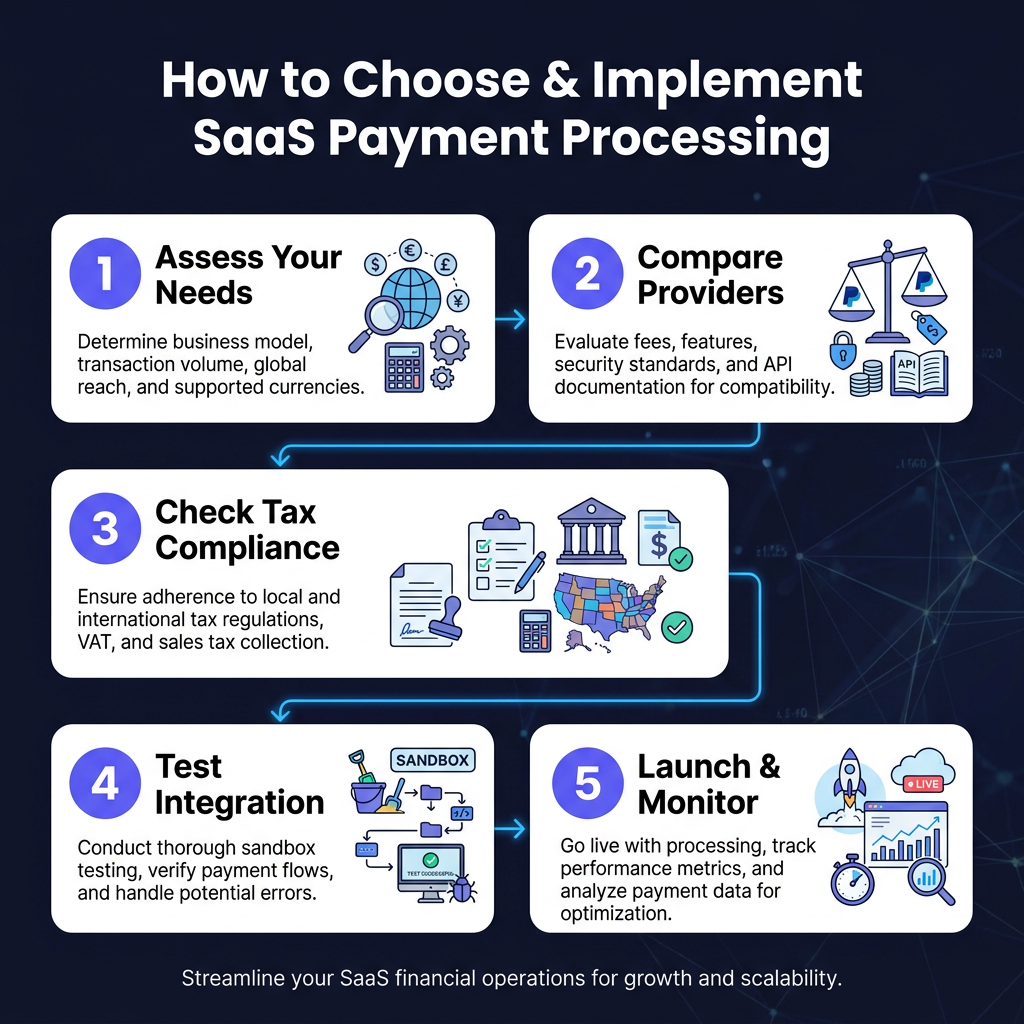
Key Factors to Consider When Choosing a Solution
Global Tax Compliance
Tax compliance is one of the most complex aspects of SaaS payments. With different VAT rates across EU countries, US sales tax nexus requirements, and evolving digital tax laws, handling taxes manually is nearly impossible at scale.
Merchant of Record (MoR) solutions like Paddle and Fungies handle all tax compliance for you, collecting, remitting, and filing taxes in every jurisdiction. This significantly reduces legal risk and administrative burden.
Pricing Structure
Look beyond the headline transaction rate. Consider:
- Monthly platform fees
- Additional costs for tax handling
- Currency conversion fees
- International transaction fees
- Chargeback fees
A solution with a higher transaction rate but included tax handling may actually cost less overall.
Integration Complexity
Consider your team’s technical capabilities. Some solutions offer no-code options that can be set up in hours, while others require significant development work. Also evaluate the quality of documentation, SDKs, and developer support.
Payment Methods and Global Coverage
Your customers’ preferred payment methods vary by region. While credit cards dominate in the US, many European customers prefer SEPA direct debit, and Asian markets often favor local payment methods like Alipay or GrabPay. Ensure your solution supports the methods your target customers use.
Implementation Best Practices
Once you’ve selected your payment solution, follow these best practices for a smooth implementation:
- Test thoroughly: Use sandbox environments to test all payment flows, including failures and edge cases
- Plan for dunning: Set up automated failed payment recovery from day one
- Monitor metrics: Track conversion rates, churn, and revenue recovery to optimize over time
- Localize checkout: Display prices in local currencies and offer local payment methods
- Document everything: Maintain clear documentation of your payment flows for your team
FAQ
What is the difference between a payment processor and a Merchant of Record?
A payment processor (like Stripe) handles the technical aspect of charging cards and moving money. A Merchant of Record (like Paddle or Fungies) acts as the legal seller of your product, handling all tax compliance, invoicing, and regulatory requirements on your behalf.
How much should SaaS companies expect to pay for payment processing?
Expect to pay between 2.9% + 30¢ (basic processors) to 5% + 50¢ (full MoR solutions) per transaction. Additional costs for tax handling, subscription management, and international payments can add 1-3%.
Do I need separate tools for subscription management and payment processing?
Not necessarily. Many modern solutions like Paddle, Fungies, and Stripe Billing combine payment processing with subscription management. However, some companies prefer specialized tools like Chargebee for complex billing scenarios.
How important is global tax compliance for SaaS companies?
Critical. Selling software globally triggers tax obligations in multiple jurisdictions. Non-compliance can result in penalties, legal issues, and blocked market access. Using an MoR solution eliminates this risk entirely.
Conclusion
Choosing the right SaaS payment processing solution depends on your specific needs, technical resources, and growth stage. For early-stage startups, a simple Stripe integration might suffice. For companies prioritizing global expansion without tax headaches, a Merchant of Record solution like Fungies or Paddle offers significant advantages.
The key is to evaluate your current requirements while planning for future growth. The right solution should scale with your business, support your target markets, and free you to focus on building great software rather than managing payment infrastructure.
Ready to Simplify Your SaaS Payments?
Join hundreds of SaaS companies using Fungies.io — automated tax compliance, 50+ payment methods, global Merchant of Record.
No credit card required