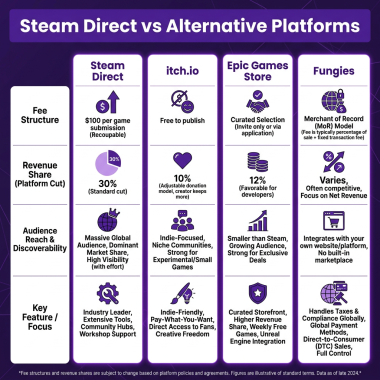
So you want to make an indie game? You’re not alone. The global indie game market hit $85 billion in 2026, and platforms like Steam, itch.io, and the Epic Games Store have made it easier than ever for solo developers and small teams to reach millions of players.
But here’s the reality check: the median lifetime earnings for a Steam indie game is just $4,000. The top 1% of games capture 90% of all revenue. Making a game is hard. Making a successful indie game requires strategy, discipline, and a clear understanding of what you’re getting into.
This guide walks you through the complete process — from your first line of code to your Steam release — based on what actually works in 2026.
Step 1: Choose Your Game Engine (This Decision Matters)
Your game engine is the foundation of everything. Choose wrong, and you’ll fight your tools for months. Choose right, and development becomes significantly smoother.
Unity: The Safe Default (With Caveats)
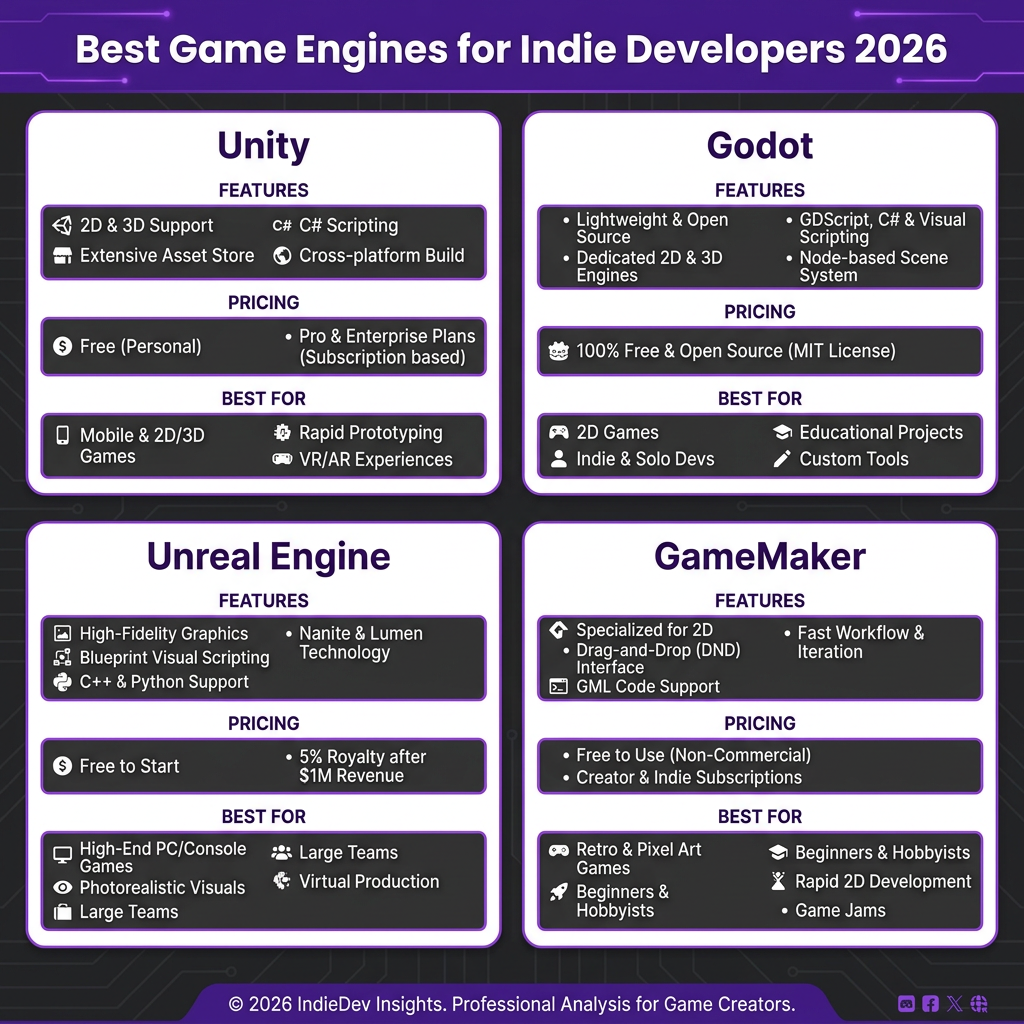
Unity remains the most popular engine for indie developers, and for good reason. It supports both 2D and 3D, has the largest asset store, and offers extensive documentation. But Unity’s 2023 runtime fee announcement changed the calculus. While they walked back the most controversial aspects, trust was damaged.
Best for: Developers who need extensive platform support, asset store resources, or plan to work in 3D.
Pricing: Free until $200K revenue, then subscription-based.
Godot: The Rising Star
Godot 4.4 has become a genuine contender. It’s lightweight (120MB download), completely free with no royalties, and has a dedicated 2D engine that doesn’t feel like an afterthought. The GDScript language is Python-like and easy to learn.
Best for: Solo developers, 2D games, and anyone who wants zero licensing risk.
Pricing: Completely free, open-source.
Unreal Engine: For Visual Power
Unreal Engine 5 delivers stunning visuals out of the box, but it’s overkill for most indie projects. The learning curve is steep, and the engine is resource-heavy. Unless you’re making a visually ambitious 3D game, you probably don’t need it.
Best for: 3D games with high visual fidelity, teams with C++ experience.
Pricing: 5% royalty after $1M revenue.
GameMaker: The 2D Specialist
GameMaker has powered indie hits like Undertale, Hyper Light Drifter, and Katana Zero. It’s specifically built for 2D games and uses its own scripting language (GML) that’s beginner-friendly.
Best for: 2D games, beginners who want a gentle learning curve.
Pricing: Free trial, then subscription or one-time purchase.
Step 2: Define Your Scope (The #1 Killer of Indie Games)
Here’s a hard truth: most indie games fail because they’re too ambitious. The developers run out of steam (and money) before finishing. Your first game should be small. Like, embarrassingly small.
Start with a core gameplay loop you can prototype in 2-4 weeks. If you can’t explain your game in one sentence, it’s too complex. Some of the most successful indie games were made by teams of 1-3 people in under a year:
- Stardew Valley: One developer, 4.5 years
- Celeste: Core team of 4, but started as a game jam prototype
- Vampire Survivors: One developer, ~1 year to hit it big
Step 3: Build a Vertical Slice
A vertical slice is a playable segment of your game that demonstrates the final quality. It’s not a prototype — it’s a polished section that looks, sounds, and plays like the finished product.
This serves multiple purposes:
- It proves your concept works
- It gives you something to show publishers, press, and players
- It helps you estimate how long the full game will take
- It forces you to solve technical problems early
Aim for 15-30 minutes of gameplay that represents your game’s best moments.
Step 4: The 7-Step Development Process
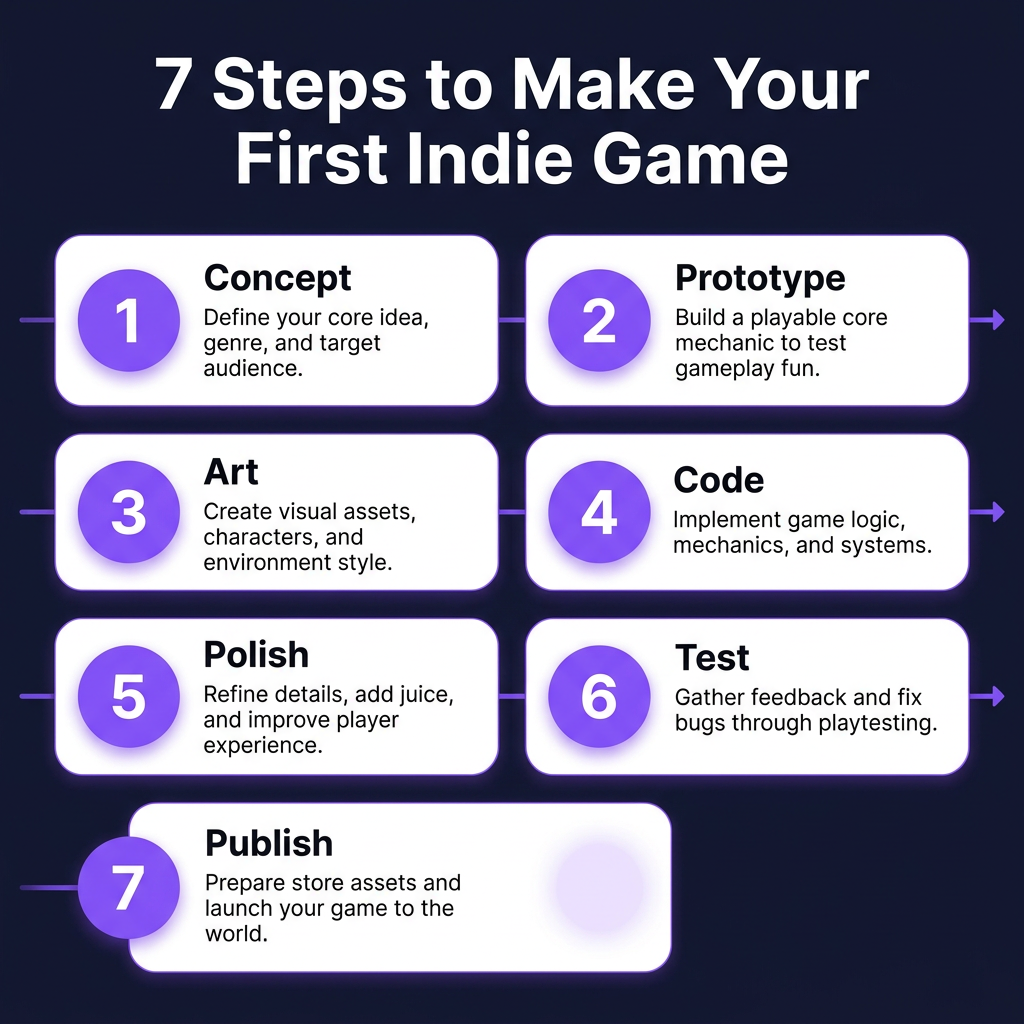
1. Concept & Design Document
Write a one-page design document. Define your core gameplay loop, target audience, and unique selling proposition. What makes your game different from everything else on Steam?
2. Prototype
Build the absolute minimum to test your core mechanic. Use placeholder art. Focus on gameplay feel. If it’s not fun with gray boxes, it won’t be fun with beautiful art.
3. Production
This is the long middle phase where you build all the content. Level design, art assets, sound, music, UI. Break it into milestones and celebrate small wins.
4. Polish
Polish is what separates amateur games from professional ones. Particle effects, screen shake, juicing, transitions, sound design. These details matter enormously.
5. Testing
Get feedback early and often. Show your game to friends, post GIFs on Twitter, join Discord communities. Watch people play without explaining anything. Their confusion is valuable data.
6. Marketing (Start This Early)
Marketing isn’t something you do after the game is done. Start building an audience from day one. Post devlogs, share work-in-progress screenshots, build a mailing list. Your game’s success depends more on marketing than on quality — harsh but true.
7. Publishing & Post-Launch
Steam is the default platform for PC games, but consider itch.io for early builds and Epic Games Store if you can get in. Plan your launch date carefully — avoid major sales events and big AAA releases.
Step 5: Handle the Business Side
Making the game is only half the battle. You also need to handle:
- Business entity: LLC, sole proprietorship, or equivalent
- Tax compliance: Sales tax, VAT, GST depending on where you sell
- Payment processing: How you’ll collect money from players
- IP protection: Trademarks, copyrights
This is where many indie developers get overwhelmed. Selling globally means dealing with tax compliance in dozens of jurisdictions. A Merchant of Record (MoR) platform like Fungies handles this for you — tax collection, remittance, and compliance — so you can focus on making games.
Common Mistakes to Avoid
- Scope creep: Adding features because you saw them in another game. Stay focused.
- Perfectionism: Your first game won’t be perfect. Ship it, learn, make the next one better.
- No marketing: “Build it and they will come” is a lie. You need to actively promote your game.
- Ignoring feedback: If multiple playtesters are confused by the same thing, it’s your fault, not theirs.
- Working in isolation: Join game dev communities. The support and accountability matter.
FAQ
How long does it take to make an indie game?
It depends on scope, but plan for 6 months to 2 years for a commercial-quality game. Your first game will likely take longer than you expect. Start small — a 3-6 month project is ideal for learning the full pipeline.
How much does it cost to make an indie game?
Costs range from $0 (if you do everything yourself) to $50,000+ (if you hire artists, musicians, and marketers). Most solo developers spend $1,000-$5,000 on software, assets, and marketing.
Do I need to know how to code?
For most engines, yes. Godot uses GDScript (Python-like), Unity uses C#, Unreal uses C++ or Blueprints (visual scripting). GameMaker uses GML. Visual scripting options exist but learning to code gives you more control.
Can I make an indie game alone?
Absolutely. Many successful indie games were made by solo developers. You’ll need to wear many hats — designer, programmer, artist, marketer — but it’s entirely doable.
What’s the best way to learn game development?
Start with tutorials for your chosen engine, then immediately apply what you learn by making small projects. Game jams (like Ludum Dare) are excellent for forced learning. Finish small games before attempting larger ones.
Conclusion
Making an indie game is one of the most challenging and rewarding creative endeavors you can undertake. The market is competitive, the work is hard, and success is never guaranteed. But with the right approach — scoped appropriately, built with the right tools, and marketed consistently — you can create something players love.
Remember: every successful indie developer started exactly where you are now. The difference between those who make it and those who don’t isn’t talent — it’s persistence. Start small, finish what you start, and keep making games.
Ready to Monetize Your Indie Game?
Fungies.io handles global tax compliance, payments, and checkout for game developers — so you can focus on making great games.
No credit card required