Steam remains the dominant platform for PC game distribution, with over 120 million monthly active users and billions in annual revenue for developers. If you’ve built a game and want to reach the largest audience of PC gamers, learning how to sell a game on Steam is essential. This comprehensive guide walks you through the entire process — from initial setup to your first sale — with real data and actionable steps.
Why Sell Your Game on Steam?
Before diving into the how-to, let’s look at why Steam dominates the PC gaming market:
- Massive reach: 120+ million monthly active users
- Revenue potential: Top indie games earn millions; even niche titles can generate sustainable income
- Built-in discovery: Steam’s algorithm can surface your game to interested players
- Global payments: Supports 40+ currencies and multiple payment methods
- Community features: Reviews, forums, and wishlists help build your player base
However, Steam isn’t your only option. Depending on your game’s genre, target audience, and business model, alternative platforms might offer better terms or reach.
Steam Direct: The $100 Gateway
Valve’s Steam Direct program replaced Steam Greenlight in 2017, making it easier than ever to publish games. Here’s what you need to know:
The $100 Recoupable Fee
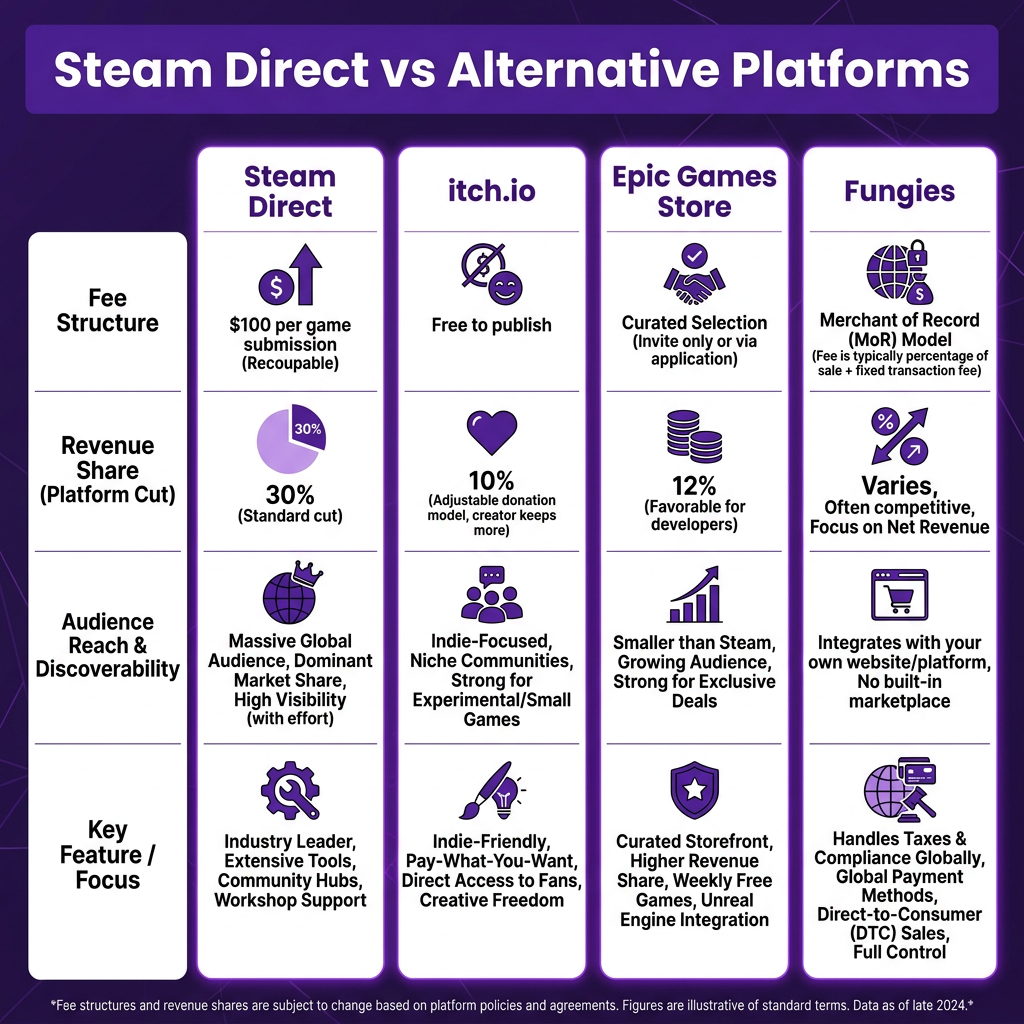
Steam charges a $100 per-game fee to publish on the platform. This isn’t a loss — it’s recoupable. Once your game generates $1,000 in revenue, Valve refunds the $100 fee. This system helps filter out low-effort submissions while remaining accessible to serious indie developers.
Revenue Share
Steam’s standard revenue split is 70/30 — you keep 70% of gross revenue, Valve takes 30%. However, this improves as you sell more:
- $0–$10M: 70/30 split
- $10M–$50M: 75/25 split
- Over $50M: 80/20 split
For most indie developers, the 70/30 split applies. Compare this to Epic Games Store’s 88/12 or itch.io’s flexible 90/10 (or lower if you choose).
Step-by-Step: How to Sell a Game on Steam
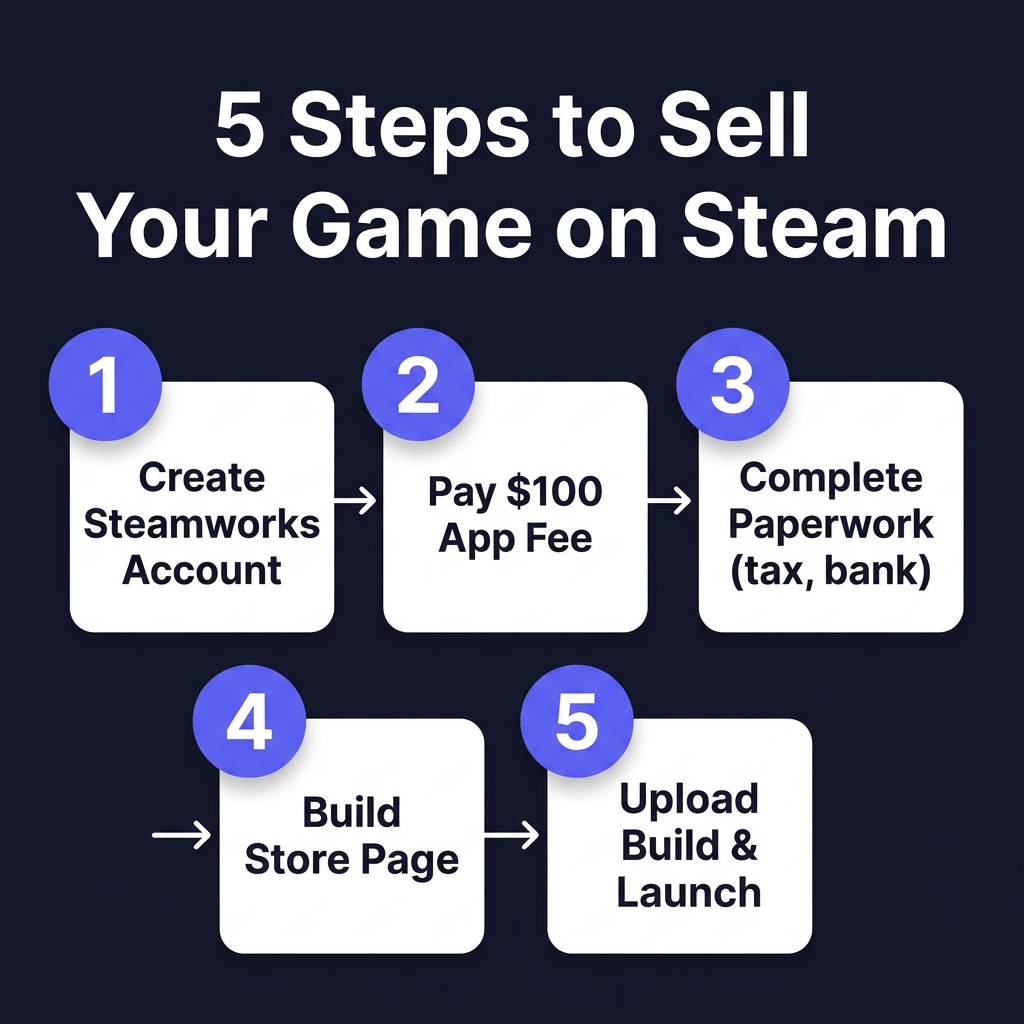
Step 1: Create a Steamworks Account
Visit partner.steamgames.com and sign up for a Steamworks account. You’ll need:
- A valid Steam account (not your personal gaming account — create a business one)
- Legal business information (or personal details if operating as an individual)
- A verified email address and phone number
Step 2: Pay the $100 App Fee
Once your account is set up, you’ll need to pay the $100 fee for each game you want to publish. This is done through Steam’s payment system and is refundable after $1,000 in sales.
Step 3: Complete Tax and Banking Paperwork
This is where many developers get stuck. Steam requires:
- Tax forms: W-9 (US) or W-8BEN (international) for IRS compliance
- Bank account: For receiving payouts (direct deposit)
- Identity verification: May require government ID
Important: Steam does NOT handle VAT, sales tax, or other international tax obligations. You’re responsible for collecting and remitting taxes in every jurisdiction where you have customers. This is where a Merchant of Record like Fungies becomes valuable — we handle global tax compliance so you don’t have to.
Step 4: Build Your Store Page
Your store page is your sales pitch. Essential elements include:
- Trailer: 60–90 seconds showing gameplay
- Screenshots: 5–10 high-quality images
- Description: Clear, compelling copy highlighting unique features
- System requirements: Minimum and recommended specs
- Tags: Accurate genre and feature tags for discovery
- Release date: Set a realistic date (you can change it)
Steam provides a “Coming Soon” page option that lets you build a wishlist audience before launch. This is highly recommended — games with strong pre-launch wishlists tend to perform better.
Step 5: Upload Your Build and Launch
Using Steam’s SDK and SteamPipe, upload your game build. You’ll need to:
- Configure depots (game files, DLC, etc.)
- Set up build branches (default, beta, etc.)
- Configure pricing and regional pricing
- Complete Steam’s review checklist
- Submit for review (usually takes 3–5 business days)
Once approved, you can release immediately or set a specific launch date.
Ready to Sell Your Game Without the Tax Headaches?
Fungies.io handles global tax compliance, VAT, and payments — so you can focus on making great games.
No credit card required
Common Mistakes to Avoid
- Ignoring regional pricing: Steam recommends pricing based on purchasing power parity. A $20 game in the US might sell better at ₽400 in Russia.
- Weak store page: Poor trailers and screenshots kill conversions. Invest in professional assets.
- No marketing: Steam’s discovery algorithm helps, but you still need to drive external traffic.
- Tax non-compliance: Failing to handle VAT/sales tax can result in penalties. Consider using a Merchant of Record.
- Rushing launch: A buggy launch generates negative reviews that are hard to recover from.
Alternatives to Steam Direct
While Steam offers the largest audience, it’s not always the best fit:
itch.io — Indie-Friendly
Free to publish, with a default 10% revenue share (you can adjust this). Great for early access, prototypes, and niche games. Less discoverability than Steam but a supportive community.
Epic Games Store — Curated
88/12 revenue split and no upfront fee, but acceptance is curated. Epic actively seeks exclusive deals with developers.
Fungies — Merchant of Record Solution
If you want to sell directly from your own website while keeping more revenue, Fungies acts as your Merchant of Record. We handle:
- Global tax compliance (VAT, sales tax, GST)
- 50+ payment methods worldwide
- Fraud prevention and chargeback management
- Automatic digital delivery
This lets you build a direct relationship with players while we handle the compliance complexity.
FAQ
How much does it cost to sell a game on Steam?
The upfront cost is $100 per game (recoupable after $1,000 in sales). Steam takes 30% of revenue (reducing to 25% and 20% at higher sales tiers).
Do I need a company to sell on Steam?
No — individuals can sell on Steam using their personal tax information. However, operating as a business entity (LLC, corporation) offers liability protection.
How long does Steam approval take?
Typically 3–5 business days after submission. Build review and store page review happen separately.
Can I sell the same game on multiple platforms?
Yes — non-exclusivity is standard. Most developers sell on Steam, itch.io, and their own website simultaneously.
What about taxes when selling games internationally?
Steam does not handle VAT, GST, or sales tax for you. You’re responsible for compliance in every jurisdiction where you sell. This is complex — consider using a Merchant of Record like Fungies to handle tax compliance automatically.
Conclusion
Learning how to sell a game on Steam opens access to the largest PC gaming marketplace in the world. The process is straightforward: create a Steamworks account, pay the $100 fee, complete your paperwork, build an attractive store page, and upload your build. With 120+ million potential customers, even niche games can find their audience.
However, remember that Steam is just one channel. Smart developers multi-platform — selling on Steam, itch.io, Epic Games Store, and their own website to maximize reach and revenue. And if the complexity of global tax compliance concerns you, consider a Merchant of Record solution that handles VAT, sales tax, and payments so you can focus on what you do best: making great games.
Ready to Sell Your Game Without the Tax Headaches?
Fungies.io handles global tax compliance, VAT, and payments — so you can focus on making great games.
No credit card required