Here’s a sobering statistic: customer acquisition costs have risen 60% over the past five years. If you’re running a SaaS business in 2026, you’re probably feeling this pinch. The average B2B SaaS company now spends between $536 and $702 to acquire a single customer. For some verticals like fintech, that number climbs into the thousands.
But here’s what most founders miss: rising CAC isn’t a death sentence. It’s a signal that your acquisition strategy needs evolution. The companies winning in 2026 aren’t outspending competitors—they’re outthinking them. They’re building compound growth engines that get cheaper over time, not more expensive.
What Is SaaS Customer Acquisition Cost (CAC)?
Customer Acquisition Cost (CAC) is the total amount your business spends on sales and marketing to acquire one new paying customer. The formula is straightforward:
CAC = (Total Sales + Marketing Costs) ÷ Number of New Customers Acquired
So if you spend $50,000 on sales and marketing in a quarter and acquire 100 new customers, your CAC is $500. Simple enough. But the devil is in the details—what counts as “sales and marketing costs” varies by company, and comparing your CAC to benchmarks without context is dangerous.
What matters more than absolute CAC is your LTV:CAC ratio—the relationship between what a customer is worth and what you paid to get them. A healthy SaaS business needs at least a 3:1 ratio (meaning you earn $3 for every $1 spent on acquisition). Elite performers target 4:1 or higher.
Why CAC Is Rising (And Why It Won’t Stop)
Several forces are driving CAC inflation across the SaaS industry:
- Privacy changes — iOS updates and cookie deprecation have made ad targeting less precise, forcing higher spend for the same results.
- Platform saturation — More SaaS companies competing for the same keywords and audiences drives up auction prices.
- Buyer behavior shifts — 81% of B2B buyers now make vendor decisions before ever talking to sales, lengthening the consideration phase.
- AI content flood — The barrier to creating content has dropped, increasing noise and making standout marketing harder.
The companies that survive this environment won’t be the ones with the biggest budgets. They’ll be the ones who diversified their acquisition channels before it became an emergency.
CAC Benchmarks by Channel: Where to Invest in 2026
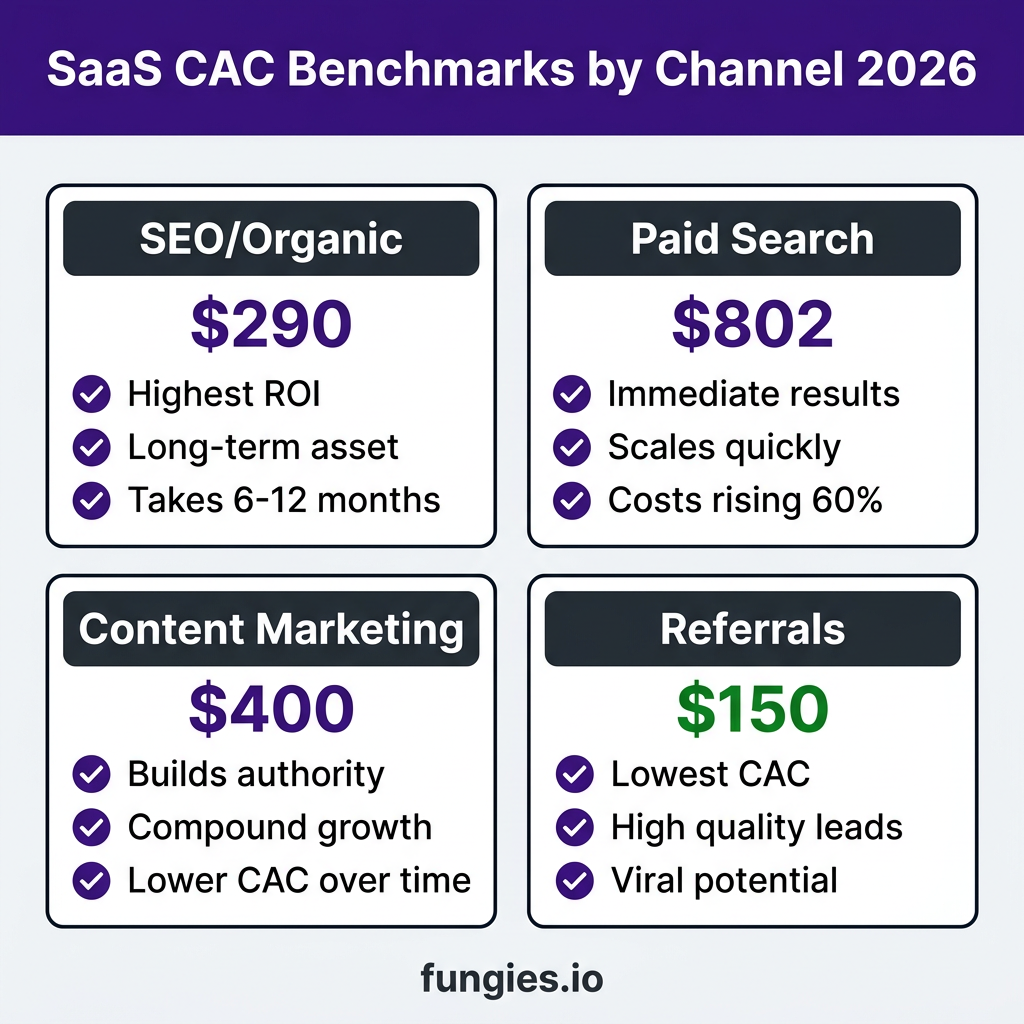
Not all channels are created equal. Here’s how CAC breaks down across major acquisition channels for B2B SaaS:
| Channel | Average CAC | Time to ROI | Best For |
|---|---|---|---|
| SEO/Organic Search | $290 | 6-12 months | Long-term compound growth |
| Referrals/Word of Mouth | $150 | Immediate | Lowest CAC, highest quality |
| Content Marketing | $400 | 3-6 months | Authority building |
| Paid Social | $550 | Immediate | Brand awareness + retargeting |
| Paid Search (Google Ads) | $802 | Immediate | High-intent capture |
| Outbound Sales | $900+ | 1-3 months | Enterprise deals |
The pattern is clear: organic channels deliver lower CAC but require patience. Paid channels provide immediate results but at a premium—and that premium is rising. The smartest SaaS companies in 2026 are building hybrid acquisition models that blend fast-paid wins with slow-burning organic assets.
The LTV:CAC Ratio: Your True North Metric
CAC in isolation is meaningless. A $1,000 CAC is terrible if your customers only stay for 3 months. It’s excellent if they stay for 5 years. That’s why the LTV:CAC ratio is the metric that matters.
Here’s how to think about your ratio:
- Below 3:1 — Unsustainable. You’re spending too much to acquire customers relative to their value.
- 3:1 to 4:1 — Healthy. This is the baseline for sustainable SaaS growth.
- 4:1 to 5:1 — Strong. You have room to invest more aggressively in acquisition.
- Above 5:1 — Elite. You’re either under-investing in growth or have exceptional unit economics.
Here’s a counterintuitive insight: reducing churn often improves your LTV:CAC ratio more than cutting acquisition costs. Dropping churn from 5% to 3% can improve your ratio from 2.5:1 to 4:1—without spending a dollar less on marketing. Retention is your hidden profit center.
5 Proven Strategies to Reduce Your SaaS CAC
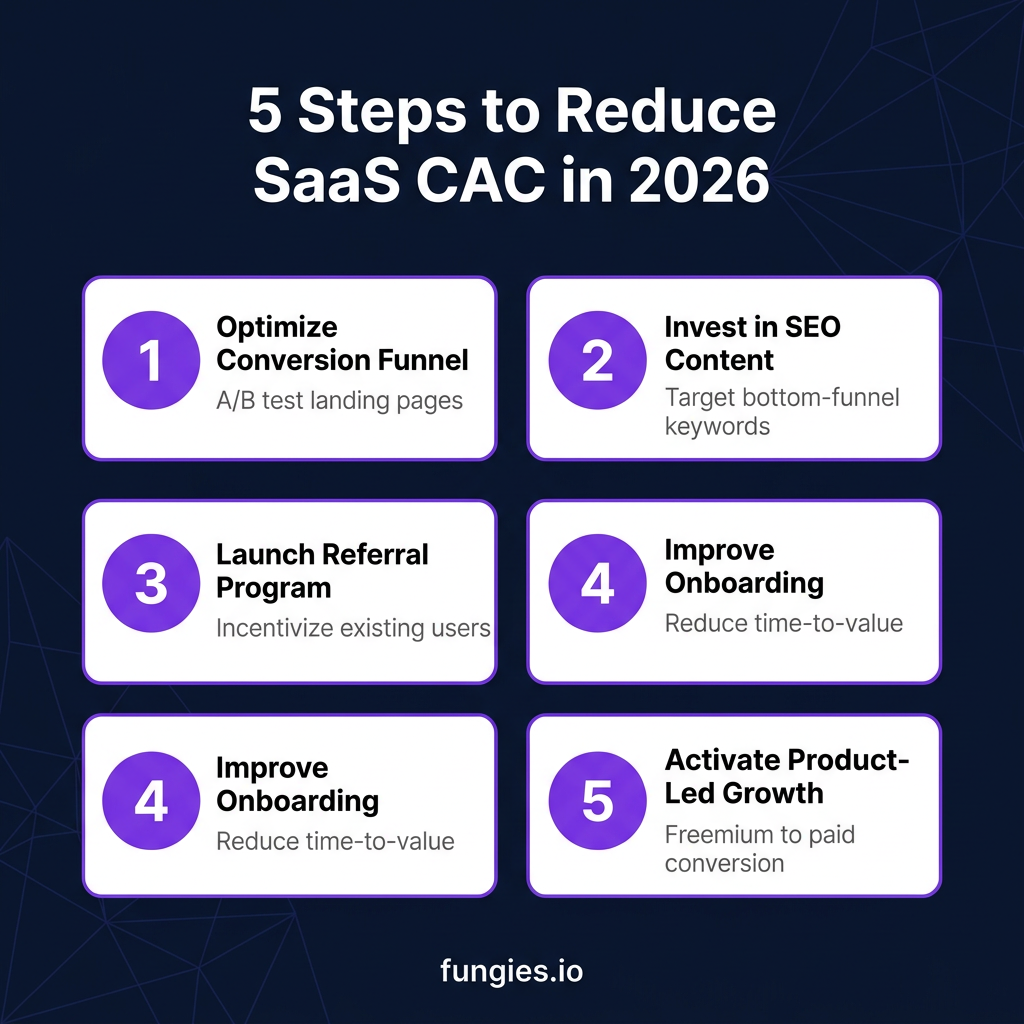
1. Double Down on SEO and Content Marketing
SEO has the highest ROI of any digital marketing channel. With an average CAC of $290 compared to $802 for paid search, organic search is 2.7x more efficient. The catch? It takes 6-12 months to see results.
Here’s the strategy that works in 2026: target bottom-funnel keywords with high purchase intent. Instead of “what is CRM software,” write “best CRM software for real estate agents.” These keywords have lower volume but much higher conversion rates. One article ranking for a bottom-funnel term can generate more revenue than ten ranking for top-funnel terms.
Also, update existing content. Refreshing an old post that already has backlinks is 3x faster than writing a new one from scratch. Google rewards freshness—use it.
2. Launch a Referral Program
Referrals have the lowest CAC of any channel—often under $150 per customer. Why? Because your existing customers do the trust-building for you. A referral from a happy customer converts at 3-5x the rate of a cold lead.
The key is making your referral program impossible to ignore. Dropbox’s famous “give storage, get storage” model worked because the reward was immediate and valuable. Your referral incentive should be something users actually want—not a generic $50 credit.
Also, time your asks. The best moment to request a referral is right after a customer experiences a “win” with your product—when they’ve just completed a successful project or hit a milestone. Strike while the dopamine is high.
3. Optimize Your Conversion Funnel
Small improvements in conversion rate have outsized impacts on CAC. If your landing page converts at 2% and you improve it to 3%, you’ve effectively reduced your CAC by 33%—without changing your ad spend.
Here’s where to focus:
- Remove friction — Every form field you add drops conversion by ~10%. Ask for email only on first touch.
- Speed matters — A 1-second delay in page load reduces conversions by 7%. Use a CDN and compress images.
- Social proof — Testimonials above the fold increase conversion by 34%. Use real faces and specific results.
- Clear CTAs — “Start Free Trial” beats “Submit” every time. Your CTA should describe the value, not the action.
A/B test relentlessly. Most SaaS companies run too few tests. Aim for one meaningful experiment per week. Over a year, that’s 50 opportunities to find winners.
4. Implement Product-Led Growth (PLG)
Product-Led Growth is the most significant shift in SaaS acquisition strategy of the past decade. Instead of sales demos and white-glove onboarding, PLG companies let users experience value before paying.
The numbers are compelling: PLG companies achieve median free-to-paid conversion rates of 9%, with freemium products converting at 12% and opt-out free trials (requiring credit card) converting at nearly 49%. The fastest-growing SaaS company in history—Cursor—crossed $2 billion ARR in under two years using a PLG model.
To make PLG work, your product needs to deliver value fast. Time-to-value should be under 60 seconds. If users can’t experience an “aha” moment immediately, they’ll churn before converting. Design your onboarding like a game tutorial—progressive disclosure, quick wins, and clear next steps.
5. Improve Activation and Onboarding
Companies with strong onboarding (time-to-first-value under 7 days) see 50% lower churn rates. Lower churn means higher LTV, which means better LTV:CAC ratio—all without changing your acquisition spend.
Effective onboarding in 2026 looks different than it used to. Users don’t want product tours they can’t skip. They want contextual guidance that appears when they need it. Think Slack’s interactive tutorial or Notion’s template gallery—users learn by doing, not watching.
Track activation rate religiously. What percentage of new users reach your “aha” moment within the first session? If it’s under 40%, you have a product problem, not a marketing problem.
CAC Payback Period: The Cash Flow Killer
There’s one more metric that matters as much as LTV:CAC: CAC payback period. This is how long it takes to recover your acquisition costs from a new customer’s revenue.
Healthy B2B SaaS companies achieve payback within 6 to 12 months. Elite performers hit 80 to 90 days. If your payback period exceeds 18 months, you’re financing your customers’ acquisition with investor capital—and that’s a dangerous game.
The fastest way to improve payback period? Annual upfront billing. Offering a discount for annual plans (typically 15-20%) improves your cash position immediately. You get 12 months of revenue on day one instead of waiting month by month.
Building Your 2026 Customer Acquisition Strategy
Here’s the framework I recommend for SaaS founders planning their 2026 acquisition strategy:
- Month 1-2: Audit your current CAC by channel. Cut the bottom 20% of performers immediately.
- Month 3-4: Launch or optimize your SEO content engine. Target 5 bottom-funnel keywords.
- Month 5-6: Implement a referral program with compelling incentives.
- Month 7-8: A/B test your highest-traffic landing pages. Aim for 20% conversion improvement.
- Month 9-10: Introduce PLG elements—freemium tier or free trial with optimized onboarding.
- Month 11-12: Double down on what’s working. Scale winners, kill losers.
The goal isn’t to eliminate paid acquisition—it’s to make paid a smaller percentage of your mix over time. Organic channels compound. Paid channels don’t.
Common CAC Mistakes to Avoid
I’ve audited hundreds of SaaS acquisition strategies. Here are the mistakes I see most often:
- Over-reliance on one channel — If 80% of your customers come from Google Ads, you’re one algorithm update away from disaster.
- Ignoring organic until it’s urgent — SEO takes 6-12 months. Start before you need it.
- Comparing CAC without context — A $500 CAC is great for enterprise SaaS, terrible for a $10/month product.
- Neglecting retention — You can cut CAC by 20% or improve retention by 20%. Retention usually wins.
- Not accounting for sales cycles — Enterprise CAC looks terrible in month one. Measure cohorts, not snapshots.
FAQ: SaaS Customer Acquisition
What is a good CAC for B2B SaaS?
The average B2B SaaS CAC ranges from $536 to $702, but “good” depends on your customer lifetime value. Focus on achieving at least a 3:1 LTV:CAC ratio rather than targeting a specific CAC number.
How can I reduce my SaaS CAC quickly?
The fastest wins come from conversion rate optimization. A/B test your landing pages, remove form fields, and add social proof. These changes can reduce effective CAC by 20-30% within weeks.
Is product-led growth better than sales-led?
For most SaaS companies under $10M ARR, yes. PLG typically delivers lower CAC and faster scaling. However, enterprise deals above $50K ACV often still require sales assistance. The winning model in 2026 is hybrid: PLG for entry, sales for expansion.
Why is my CAC increasing even though I’m not changing tactics?
Platform costs rise over time due to increased competition. What worked last year likely costs more today. Combat this by diversifying channels and building organic assets that don’t have auction-based pricing.
How do I calculate LTV for my SaaS business?
The simple formula is: Average Revenue Per User (ARPU) × Gross Margin ÷ Monthly Churn Rate. For example, if customers pay $100/month, you have 80% margins, and 5% monthly churn: $100 × 0.8 ÷ 0.05 = $1,600 LTV.
Conclusion: Play the Long Game
Customer acquisition in 2026 is harder than it was five years ago. That’s not changing. But the fundamentals remain: build a great product, deliver value fast, and create compound growth engines that get cheaper over time.
The SaaS companies that thrive won’t be the ones with the biggest ad budgets. They’ll be the ones who invested in SEO when it felt slow, who optimized onboarding when it felt tedious, and who built referral programs when they had “more important” things to do.
Your CAC is a symptom of your strategy. Fix the strategy, and the numbers follow.
Ready to reduce friction in your customer journey? Create your free Fungies account and start accepting payments with our developer-friendly, no-code checkout solution.