The digital marketing landscape has reached an unprecedented inflection point in 2026. With global digital ad spending surpassing $1.25 trillion for the first time in history, the industry now commands 68.7% of total global advertising investment. This isn’t just growth—it’s a fundamental restructuring of how businesses connect with consumers, driven by artificial intelligence, privacy-first strategies, and the continued shift from traditional to digital channels.
Consider this: Meta is projected to overtake Google in global advertising revenue for the first time ever in 2026, with forecasted net ad revenue of $243.46 billion compared to Google’s $239.54 billion. Meanwhile, connected TV advertising is growing at 14% annually and will surpass traditional TV spending by 2028. These aren’t isolated trends—they signal a permanent transformation in the marketing ecosystem.

Market Overview: The $1.25 Trillion Digital Advertising Ecosystem
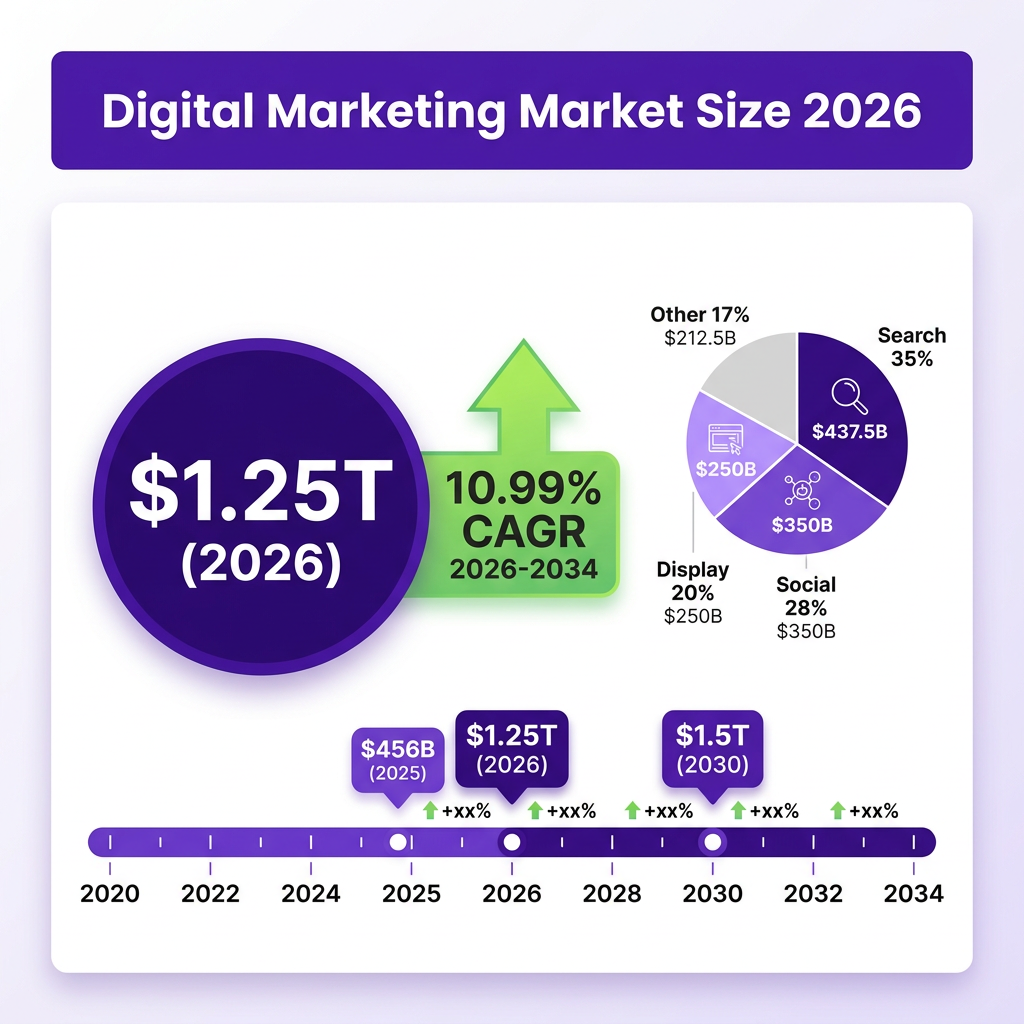
The global digital marketing market has evolved from a $456.7 billion industry in 2025 to a projected $1.25 trillion behemoth by 2026, representing a compound annual growth rate (CAGR) of 10.99% through 2034. This explosive growth is fueled by several converging factors: the proliferation of internet connectivity reaching 5.35 billion users (66.2% of the global population), the maturation of AI-powered marketing technologies, and the continued migration of consumer attention from traditional media to digital platforms.
North America continues to dominate the digital marketing landscape, accounting for approximately 35% of global digital ad spend, followed by Asia-Pacific at 32% and Europe at 24%. However, the most significant growth is occurring in emerging markets, where mobile-first internet adoption is accelerating digital marketing investment at rates exceeding 15% annually in regions like Southeast Asia, Latin America, and Africa.
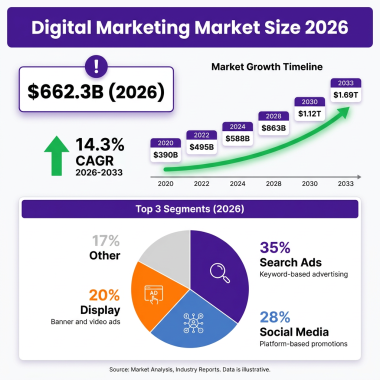
The composition of digital marketing spend has shifted dramatically. Search advertising, while still the largest single category at approximately 35% of total digital spend, is facing increased competition from social media advertising (28%), display and programmatic (20%), and the rapidly emerging connected TV segment (8%). Video advertising across all platforms now represents $78 billion in annual revenue, having grown 25.4% year-over-year.
Perhaps most telling is the rise of commerce media—retail media networks operated by e-commerce platforms—which grew 18% year-over-year to reach $63.4 billion in 2025. This category is projected to exceed $100 billion by 2028 as retailers recognize the value of their first-party data in a cookieless world. Amazon’s advertising business alone is expected to reach $82 billion in 2026, up from $68.6 billion in 2025.
The three tech giants—Google, Meta, and Amazon—collectively account for 62.3% of global digital ad spending in 2026, according to eMarketer data. However, this dominance is being challenged by the rise of retail media networks, the growth of TikTok and other emerging platforms, and the increasing sophistication of programmatic advertising that allows advertisers to access inventory outside the walled gardens.
Key Statistics and Data: The Numbers Defining Digital Marketing in 2026
The digital marketing industry in 2026 is defined by a series of remarkable statistics that illustrate both the scale of the market and the pace of transformation. Understanding these numbers is essential for marketers, business owners, and investors seeking to navigate this dynamic landscape.
Global Market Size and Growth: The worldwide digital advertising market reached $1.25 trillion in 2026, marking the first time the industry has crossed the trillion-dollar threshold. Digital now accounts for 68.7% of total global ad investment, up from 65% in 2024. The industry is growing at 6.7% annually for digital channels specifically, compared to 5.1% for overall advertising.
Platform-Specific Metrics: Facebook remains the largest social media platform with over 3.07 billion monthly active users. Instagram surpassed 3 billion monthly active users in 2025, while TikTok’s engagement rate reached 3.70%—up 49% year-over-year and significantly outperforming Instagram’s 0.48% and Facebook’s 0.15%. YouTube maintains over 2.5 billion monthly active users and continues to be the dominant platform for video advertising.
Social Media Advertising: Social media ad revenues reached $117.7 billion in 2025, showing 32.6% year-over-year growth—an increase of $29 billion. This makes social media the fastest-growing major advertising category. LinkedIn now has over 1 billion users worldwide, with 65% of global B2B marketers using the platform for advertising.
Connected TV (CTV) Growth: U.S. CTV advertising is projected to reach approximately $38 billion in 2026, growing from $33.35 billion in 2025—representing roughly 14% year-over-year growth. By 2028, CTV is projected to reach $46.89 billion and surpass traditional TV advertising for the first time in history. Marketers on average reallocated 36% of linear TV ad spend to CTV in 2025.
Email Marketing Performance: Email marketing continues to deliver exceptional ROI, generating an average return of $36 to $42 for every dollar spent—a 3,600% to 4,200% return on investment. Good open rates range between 17% and 28%, while the average click-through rate across all industries is 1.40%. Welcome emails achieve a remarkable 69%-80% open rate.
AI Adoption in Marketing: According to Gartner’s 2026 CMO Survey, 78% of marketing teams now use generative AI in at least one stage of ad production, up from 41% in 2024. eMarketer projects global AI ad spend to surpass $190 billion in 2026. Additionally, 46% of marketers now use AI to scale creative production.
Programmatic Advertising: Over 84% of CTV ad transactions are now conducted programmatically. The programmatic advertising ecosystem continues to expand, with real-time bidding systems processing millions of ad impressions per second across display, video, audio, and connected TV inventory.
Privacy and Cookie Deprecation: With 20 states now enforcing comprehensive privacy laws and 34.9% of US browsers already blocking third-party cookies by default, the industry has fully entered the cookieless era. Google’s completion of Chrome’s third-party cookie deprecation in early 2024 joined Safari and Firefox in eliminating cross-site tracking.
Global Internet and Social Media Usage: As of October 2025, 68.7% of the world’s population are social media users—approximately 5.17 billion people. Users visit an average of 6 to 7 social media platforms per month, indicating the continued fragmentation of attention across multiple channels.
Ad Spend Waste: According to Smartly’s 2026 Digital Advertising Trends Report, up to 30% of marketing budgets are wasted due to inefficiencies in targeting, creative performance, and measurement. This represents both a challenge and an opportunity for optimization-focused marketers.
Major Trends Shaping Digital Marketing in 2026
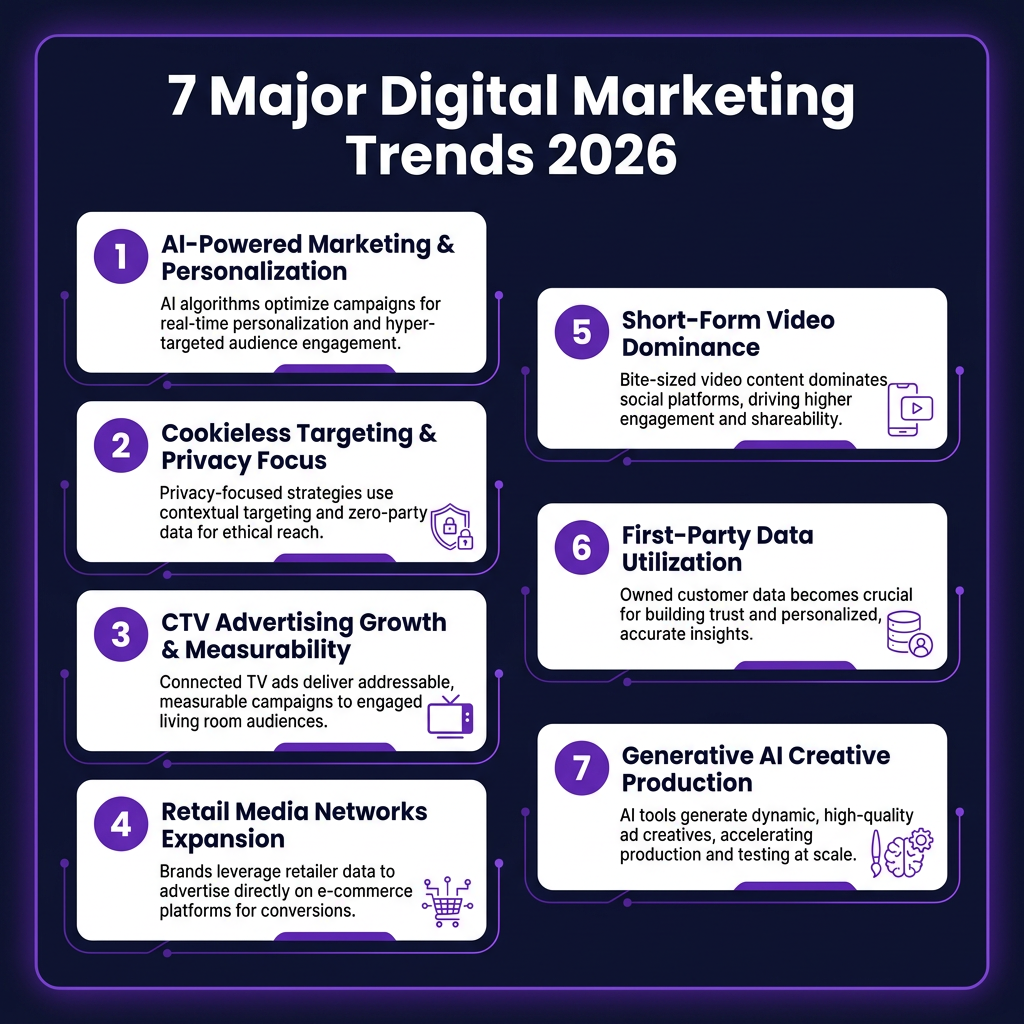
The digital marketing landscape of 2026 is being reshaped by seven transformative trends that are fundamentally altering how brands connect with consumers. These trends represent both opportunities for growth and challenges that require strategic adaptation.
1. AI-Powered Marketing Automation and Generative Creative
Artificial intelligence has moved from experimental to essential in 2026. The convergence of generative AI, predictive analytics, and privacy-first technologies creates unprecedented opportunities for marketing teams. Modern AI-powered marketing automation enables hyper-personalized customer journeys at scale, real-time content generation, and predictive insights that anticipate customer behavior before it happens.
Native video models like Sora 2, Veo 3, and Runway Gen-4 are now embedded directly inside ad tools, allowing marketers to generate video creative at scale. “Agentic” workflows—where AI plans, generates, ships, and iterates on campaigns autonomously—have become the new baseline for sophisticated marketing operations. Predictive analytics powered by AI analyzes past consumer data patterns to predict future purchasing behaviors, allowing marketers to anticipate customer needs at various touchpoints.
2. The Cookieless Revolution and First-Party Data Strategy
Third-party cookies are now deprecated across all major browsers, fundamentally changing how marketers target and measure campaigns. This isn’t a future problem to prepare for—it’s the present reality. First-party data, collected directly from customers with explicit permission, is more accurate, more compliant, and more stable than third-party behavioral data ever was.
Leading marketers have rebuilt measurement from the server layer up, constructed first-party data programs that create genuine consumer value in exchange for data consent, and shifted their media mix toward channels that don’t depend on third-party tracking. Contextual targeting, which matches ads to content context rather than user profiles, has experienced a renaissance with AI-powered semantic analysis.
3. Connected TV (CTV) as a Performance Channel
Connected TV has crossed the performance threshold. For years, CTV advertising felt like the exclusive domain of Fortune 500 brands with broadcast-level budgets. In 2026, CTV is now a performance channel accessible to mid-size brands with $10M–$500M in revenue. The 2026 IAB NewFronts sent a consistent message: CTV is now a performance channel, not just an awareness play.
The shift toward programmatic CTV buying continues, with nearly half (47%) of advertisers expecting CTV inventory to be biddable. Comcast Advertising’s partnership with Amazon Ads allows local and SMB advertisers to access Prime Video inventory through Amazon DSP, with geographic targeting granular enough to reach audiences in specific ZIP codes.
4. Retail Media Networks and Commerce Advertising
Retail media has emerged as the fastest-expanding line item on marketing budgets globally. Commerce media networks operated by retailers like Amazon, Walmart, Target, and Instacart leverage first-party purchase data to deliver highly targeted advertising both on and off their platforms. This category grew 18% year-over-year to $63.4 billion and is projected to exceed $100 billion by 2028.
The power of retail media lies in its proximity to purchase intent. Unlike traditional digital advertising that targets based on demographics or interests, retail media targets based on actual shopping behavior, search queries, and purchase history. This bottom-funnel positioning delivers superior ROAS compared to upper-funnel channels.
5. Short-Form Video Dominance
Short-form video has become the dominant content format across all major platforms. TikTok, Instagram Reels, and YouTube Shorts now command the majority of user attention and engagement. Video advertising across all platforms reached $78 billion in revenue, growing 25.4% year-over-year.
TikTok shares per post increased by 45% year-over-year, while view growth on Instagram reached 29%. The algorithmic nature of short-form video platforms means that content quality and engagement matter more than follower count, democratizing reach for smaller creators and brands willing to invest in authentic, engaging content.
6. The Rise of AI Search and Answer Engines
AI-powered search is reshaping how consumers discover brands. Traditional search engine optimization is being supplemented by “generative engine optimization”—optimizing content to appear in AI-generated answers and summaries. Users now ask full questions instead of typing short keywords, and AI assistants provide synthesized answers rather than lists of links.
This shift demands new content strategies focused on comprehensive, authoritative coverage of topics rather than keyword-optimized pages. Structured data, entity optimization, and semantic relevance have become critical for visibility in AI-powered search environments.
7. Privacy-First Personalization
Personalization now depends on consent, context, and control using first- and zero-party data. Advanced AI models deliver personalization without compromising customer privacy using federated learning and differential privacy while maintaining compliance with GDPR, CCPA, and emerging regulations. The most successful marketers in 2026 have built transparent data relationships with their customers, offering clear value exchange for data sharing.
Key Players and Competitive Landscape
The digital marketing ecosystem of 2026 is dominated by a handful of technology giants, but the competitive landscape is more dynamic than ever. Understanding the positions and strategies of key players is essential for marketers allocating budgets and planning campaigns.
Meta: The New Digital Advertising Leader
For the first time in history, Meta is projected to surpass Google in global advertising revenue in 2026. With forecasted net ad revenue of $243.46 billion, Meta will capture approximately 26.8% of the global digital ad market. This milestone represents the culmination of Meta’s investments in AI-powered ad targeting, Reels monetization, and Advantage+ automated campaigns.
Meta’s growth is driven by several factors: the recovery of digital ad spend post-pandemic, the success of Reels in competing with TikTok, and the sophistication of its AI-driven targeting systems. The company’s ability to deliver performance results even amid privacy changes has solidified its position as the go-to platform for direct-response advertisers.
Google: Search, YouTube, and the AI Transition
Google holds approximately 26.4% of the global digital ad market with projected 2026 ad revenue of $239.54 billion. While losing the top spot to Meta, Google remains dominant in search advertising and continues to grow YouTube’s advertising business. The company’s advertising revenue hit $294.7 billion in 2025, with eMarketer projecting steady growth at 11.9%.
Google’s challenge in 2026 is managing the transition to AI-powered search while maintaining its advertising business model. The introduction of AI Overviews and the Search Generative Experience represents both an opportunity for new ad formats and a risk to traditional search ad clicks. The company’s success in integrating ads into AI-generated answers will determine its trajectory over the next five years.
Amazon: The Retail Media Powerhouse
Amazon’s advertising business is expected to reach just over $82 billion in 2026, up from $68.6 billion in 2025. While smaller than Meta and Google, Amazon’s advertising growth rate exceeds both, driven by the expansion of retail media and the unique value of purchase-intent data. Amazon DSP has become a essential tool for brands seeking to reach shoppers both on and off Amazon properties.
The company’s partnership with Comcast Advertising to provide local and SMB access to Prime Video inventory represents a significant expansion of its advertising ecosystem beyond e-commerce into streaming video.
TikTok: The Engagement Leader
TikTok continues to lead in engagement metrics with a 3.70% average engagement rate—up 49% year-over-year. The platform has successfully monetized its highly engaged user base, becoming a significant player in digital advertising despite regulatory challenges in some markets. TikTok’s algorithm-driven content discovery has made it particularly effective for brand awareness and viral marketing campaigns.
Microsoft, LinkedIn, and B2B Advertising
Microsoft’s advertising business, including LinkedIn, continues to grow, particularly in B2B markets. LinkedIn has over 1 billion users worldwide, with 65% of global B2B marketers using the platform for advertising. Microsoft’s integration of AI into its advertising products, including Copilot for advertising, positions it well for the AI-driven future of marketing.
Programmatic Platforms and Ad Tech
The Trade Desk, StackAdapt, and other demand-side platforms (DSPs) continue to grow as programmatic advertising expands beyond display into CTV, audio, and digital out-of-home. These platforms provide the infrastructure that enables advertisers to access inventory across publishers while maintaining control over targeting, frequency, and measurement.

Challenges and Pain Points in Digital Marketing
Despite the growth and opportunity in digital marketing, the industry faces significant challenges that require strategic attention and investment. Understanding these pain points is essential for developing resilient marketing strategies.
1. Signal Loss and Attribution Challenges
The deprecation of third-party cookies, combined with Apple’s App Tracking Transparency (ATT) framework and other privacy measures, has created a measurement crisis in digital marketing. Marketers are struggling to attribute conversions accurately, measure cross-channel performance, and optimize campaigns based on reliable data.
The mix of identifiers across display, retail media, digital out-of-home (DOOH), and audio channels demands sophisticated identity solutions for coherent cross-channel campaigns. Many marketers are investing in marketing mix modeling (MMM), incrementality testing, and server-side tracking to rebuild measurement capabilities in a privacy-first world.
2. Ad Fraud and Brand Safety
Digital ad fraud remains a persistent challenge, with estimates suggesting that billions of dollars are wasted annually on fraudulent traffic, click farms, and domain spoofing. Brand safety concerns have intensified as advertisers seek to avoid association with harmful content, misinformation, and controversial platforms.
The complexity of the programmatic supply chain makes fraud detection and prevention challenging. Advertisers are demanding greater transparency from their ad tech partners and investing in verification tools to ensure their ads appear in brand-safe environments.
3. Creative Fatigue and Content Demands
The shift to short-form video and the increasing personalization of advertising has created an insatiable demand for creative content. Marketers are struggling to produce enough high-quality creative variants to feed algorithmic platforms that optimize toward engagement.
According to Smartly’s research, 46% of marketers now use AI to scale creative production, but many still struggle with the volume and variety of content required for effective personalization. Creative fatigue—where audiences become desensitized to ad formats—requires constant innovation in creative approach.
Opportunities and Growth Strategies
Amidst the challenges, significant opportunities exist for marketers willing to adapt their strategies and invest in emerging capabilities. These growth strategies represent the most promising avenues for competitive advantage in 2026.
1. AI-Native Marketing Operations
Organizations that build their marketing operations around AI capabilities are achieving significant competitive advantages. This includes AI-powered creative generation, predictive audience targeting, automated campaign optimization, and natural language interfaces for marketing analytics.
The key is moving beyond using AI as a point solution to integrating it into the entire marketing workflow—from strategy and planning to execution and measurement. Companies that successfully make this transition are seeing improvements in efficiency, effectiveness, and agility.
2. First-Party Data Monetization
Brands with strong first-party data assets are discovering new revenue streams through retail media networks and data partnerships. Companies like Walmart, Target, and Instacart have built significant advertising businesses by monetizing their customer data. This model is now being adopted by brands in other categories, including travel, financial services, and telecommunications.
The opportunity extends beyond selling advertising to using first-party data to improve customer experiences, personalize communications, and build lasting customer relationships that drive lifetime value.
3. CTV and Streaming Video Investment
The migration of viewership from linear TV to streaming represents a massive opportunity for digital marketers. CTV offers the targeting and measurement capabilities of digital advertising combined with the premium brand environment of television. As CTV surpasses traditional TV in ad spend by 2028, early movers are establishing competitive advantages in this channel.
The key to success in CTV is treating it as a performance channel rather than just an awareness play. This requires investment in creative optimized for TV viewing, attribution models that connect CTV exposure to outcomes, and programmatic buying capabilities.
Case Studies and Success Stories
Real-world examples illustrate the strategies and tactics driving success in digital marketing in 2026. These case studies demonstrate how leading brands are navigating the trends and challenges outlined in this analysis.
Case Study 1: AI-Powered Creative at Scale
A leading DTC apparel brand faced the challenge of producing enough creative content to feed Meta’s Advantage+ campaigns across multiple markets and product lines. By implementing AI-powered creative tools, the brand was able to generate thousands of creative variants from a single product photoshoot, testing different backgrounds, models, and messaging automatically.
The result was a 40% improvement in cost per acquisition (CPA) and a 3x increase in creative testing velocity. The brand’s marketing team shifted focus from creative production to creative strategy, using AI-generated insights to understand which visual and messaging elements drove the best performance.
Case Study 2: First-Party Data Transformation
A mid-market beauty brand recognized early that third-party cookie deprecation would severely impact its digital marketing performance. The company invested in building a comprehensive first-party data strategy, including a loyalty program, personalized content experiences, and transparent value exchanges for customer data.
Within 18 months, the brand had built a database of over 2 million opted-in customer profiles, enabling personalized email campaigns with 35% open rates and retargeting campaigns that achieved 4x the ROAS of previous third-party cookie-based efforts. The first-party data asset has become a significant competitive advantage and is now being explored as a potential retail media network.
Case Study 3: CTV Performance Campaign
A B2B SaaS company challenged the conventional wisdom that CTV was only for consumer brands by launching a performance-focused CTV campaign targeting IT decision-makers. Using programmatic buying and audience data from partners like LiveRamp, the company reached its target audience on streaming platforms during relevant content.
By implementing cross-device attribution and measuring incremental lift, the company demonstrated that CTV drove a 15% increase in branded search volume and a 12% lift in demo requests among exposed audiences. The campaign achieved a cost per qualified lead comparable to LinkedIn advertising while delivering the brand impact of television.
Future Outlook and Predictions (2027-2030)
The digital marketing landscape will continue to evolve rapidly through the remainder of the decade. Based on current trends and emerging technologies, several key developments are expected to shape the industry from 2027 to 2030.
Market Size Projections
The global digital marketing market is projected to reach $1.5 trillion by 2030, with digital capturing nearly 75% of total global ad spend. The CAGR of 10.99% through 2034 suggests sustained growth driven by emerging markets, new ad formats, and the continued shift of consumer attention to digital channels.
By 2027, there will be close to 6 billion internet users globally, representing over 70% of the world’s population. This expansion of the addressable market, combined with increasing time spent online, will drive continued investment in digital marketing.
AI and Automation Maturation
By 2030, AI will handle the majority of tactical marketing execution, from media buying to creative optimization. Human marketers will focus on strategy, brand positioning, and creative direction while AI agents manage campaign execution, testing, and optimization in real-time.
Predictive forecasting, automated channel mix decisions, and real-time creative adaptation will empower teams to scale smarter and faster. The distinction between “digital” and “traditional” marketing will dissolve as AI enables seamless orchestration across all channels.
CTV Surpasses Linear TV
The milestone projected for 2028—CTV ad spending surpassing traditional TV—will fundamentally reshape the advertising industry. This shift will accelerate the decline of linear television and force traditional media companies to accelerate their digital transformation.
The implications extend beyond ad spend to content creation, as the targeting and measurement capabilities of CTV enable new content monetization models that could disrupt traditional entertainment industry economics.
Privacy-First Marketing as Default
By 2030, privacy-first marketing will be the default rather than the exception. The regulatory landscape will continue to expand, with comprehensive privacy laws in effect across most major markets. Brands that have built transparent, value-based relationships with customers will have significant advantages over those that relied on surveillance-based targeting.
The technologies enabling privacy-preserving measurement and targeting—federated learning, differential privacy, and secure multi-party computation—will mature and become standard components of the marketing technology stack.
Regional Market Analysis: Digital Marketing by Geography
The global digital marketing landscape varies significantly by region, with distinct characteristics, growth rates, and opportunities in each major market. Understanding these regional differences is crucial for businesses planning international expansion or global marketing campaigns.
North America: The Mature Market Leader
North America remains the largest digital advertising market, accounting for approximately 35% of global spend. The United States alone represents over $300 billion in annual digital ad investment. This mature market is characterized by high adoption of advanced technologies, sophisticated programmatic infrastructure, and significant investment in AI-powered marketing solutions.
Key trends in North America include the rapid adoption of CTV advertising, with U.S. CTV ad spend projected at $38 billion in 2026. Retail media networks are particularly advanced, with Amazon, Walmart, and Target leading innovation in commerce advertising. Privacy regulations vary by state, with California’s CCPA and emerging laws in 20 states creating a complex compliance landscape.
Asia-Pacific: The Growth Engine
Asia-Pacific accounts for 32% of global digital ad spend and represents the fastest-growing major region, with annual growth rates exceeding 12%. China dominates the regional market with platforms like Alibaba, Tencent, and ByteDance (TikTok’s parent company) operating sophisticated advertising ecosystems that rival Western platforms in scale and sophistication.
Southeast Asian markets including Indonesia, Vietnam, and the Philippines are experiencing explosive growth as mobile-first internet adoption accelerates. India represents a particularly significant opportunity, with over 800 million internet users and rapidly growing digital commerce driving advertising investment. The region’s diverse languages, cultures, and regulatory environments present both challenges and opportunities for marketers.
Europe: Privacy-First Innovation
Europe represents 24% of global digital ad spend and leads the world in privacy regulation with GDPR serving as the global standard for data protection. This regulatory environment has accelerated innovation in privacy-preserving advertising technologies, with European companies pioneering solutions in contextual targeting, first-party data management, and consent-based personalization.
The European market is characterized by strong e-commerce adoption, sophisticated retail media networks (particularly in the UK and Germany), and growing investment in sustainability-focused marketing. The Digital Markets Act (DMA) and Digital Services Act (DSA) are reshaping the competitive landscape, with significant implications for major platforms operating in the region.
Latin America and Emerging Markets
Latin America, the Middle East, and Africa represent smaller but rapidly growing shares of global digital ad spend. Brazil and Mexico lead Latin America, with mobile advertising dominating due to high smartphone penetration. These markets are leapfrogging traditional advertising infrastructure, moving directly to mobile-first, programmatic, and social media-driven marketing models.
The growth potential in these regions is substantial, with internet penetration still expanding and digital commerce adoption accelerating. However, infrastructure challenges, payment system limitations, and regulatory uncertainty create complexities for international marketers entering these markets.
Technology Stack Evolution: The Modern Marketing Infrastructure
The technology infrastructure supporting digital marketing has evolved dramatically, with new categories emerging and existing platforms consolidating. Understanding this stack is essential for marketers building their technology capabilities.
Customer Data Platforms (CDPs)
Customer Data Platforms have become foundational infrastructure for modern marketing organizations. CDPs unify first-party data from multiple sources—websites, mobile apps, CRM systems, point-of-sale systems, and more—to create comprehensive customer profiles. In the cookieless era, CDPs are essential for identity resolution, audience segmentation, and personalization at scale.
Leading CDP vendors include Segment, mParticle, Tealium, and Adobe Real-Time CDP. The market has seen significant consolidation, with major cloud providers (AWS, Google Cloud, Microsoft Azure) launching their own CDP solutions. The integration of AI into CDPs is enabling predictive audience modeling, next-best-action recommendations, and automated personalization.
Marketing Automation and CRM
Marketing automation platforms have evolved from email-centric systems to omnichannel orchestration engines. Modern platforms like HubSpot, Marketo, Salesforce Marketing Cloud, and Braze enable sophisticated customer journey mapping, trigger-based messaging, and cross-channel campaign coordination.
The integration of AI into marketing automation is enabling predictive lead scoring, content recommendations, and send-time optimization. The line between marketing automation and CRM is blurring, with platforms offering unified views of customer interactions across marketing, sales, and service touchpoints.
Ad Tech and Programmatic Infrastructure
The programmatic advertising ecosystem continues to mature, with demand-side platforms (DSPs), supply-side platforms (SSPs), and ad exchanges forming the infrastructure for automated media buying. The Trade Desk, DV360, Amazon DSP, and StackAdapt lead the DSP market, while PubMatic, Magnite, and OpenX dominate the supply side.
Retail media networks are building their own ad tech infrastructure, creating walled gardens that offer unique data and inventory but require separate buying workflows. The complexity of this landscape is driving demand for unified buying platforms and cross-channel measurement solutions.
Measurement and Attribution in the Privacy Era
The deprecation of third-party cookies and mobile device identifiers has created a measurement crisis in digital marketing. Marketers are rebuilding their measurement frameworks using a combination of old and new approaches.
Marketing Mix Modeling (MMM) Renaissance
Marketing Mix Modeling, once considered a legacy approach, has experienced a renaissance in the privacy era. Modern MMM leverages Bayesian statistical methods, machine learning, and high-frequency data to provide timely insights into marketing effectiveness. Companies like Meta (Robyn), Google (Lightweight MMM), and independent vendors like Northbeam and Recast are making MMM more accessible to mid-market advertisers.
The key advantage of MMM is that it doesn’t rely on user-level tracking, making it privacy-compliant by design. However, MMM requires significant historical data and statistical expertise to implement effectively, creating barriers for smaller advertisers.
Incrementality Testing
Incrementality testing—measuring the true causal impact of marketing by comparing exposed and control groups—has become the gold standard for measurement. Geo-lift tests, conversion lift studies, and holdout experiments provide reliable evidence of marketing effectiveness without relying on cookies or device identifiers.
Platforms like Meta, Google, and TikTok offer built-in incrementality testing tools, while third-party vendors provide more sophisticated experimental design and analysis. The challenge is that incrementality testing requires careful experimental design and sufficient sample sizes, making it resource-intensive for smaller campaigns.
Server-Side Tracking and First-Party Analytics
Server-side tracking solutions like Meta’s Conversions API, Google’s Enhanced Conversions, and independent solutions like Segment’s server-side destinations are becoming essential for reliable measurement. These solutions bypass browser restrictions by sending conversion data directly from servers rather than relying on browser pixels.
First-party analytics platforms that use first-party cookies and server-side tracking are replacing traditional web analytics for many organizations. These solutions provide more reliable data while maintaining privacy compliance.
The Evolving Role of the Modern Marketer
The transformation of digital marketing is fundamentally changing the skills and capabilities required of marketing professionals. The marketer of 2026 must be part data scientist, part creative director, part technologist, and part privacy compliance expert. This evolution demands continuous learning and adaptation.
Technical skills have become essential across all marketing roles. Understanding data architecture, API integrations, and marketing technology infrastructure is no longer the exclusive domain of marketing operations specialists. Creative teams must understand how to produce content that performs across algorithmic platforms, while media buyers need sophisticated analytical capabilities to navigate complex programmatic ecosystems.
The rise of AI in marketing is creating new specializations while automating traditional tasks. AI prompt engineering, model fine-tuning, and AI ethics are emerging as critical skill areas. At the same time, routine tasks like reporting, basic creative production, and campaign optimization are increasingly automated, allowing marketers to focus on strategy, innovation, and customer experience.
Perhaps most importantly, modern marketers must develop deep expertise in privacy and data ethics. As regulations expand and consumer awareness grows, the ability to build transparent, trust-based relationships with customers has become a competitive advantage. Marketers who can balance personalization with privacy, automation with authenticity, and scale with relevance will thrive in this new environment.
Key Takeaways
- The global digital marketing market has crossed $1.25 trillion in 2026, with digital now accounting for 68.7% of total advertising investment.
- Meta is projected to surpass Google in global ad revenue for the first time, capturing 26.8% of the market with $243.46 billion in forecasted revenue.
- Seven transformative trends are reshaping the industry: AI-powered marketing automation, cookieless targeting, CTV advertising, retail media networks, short-form video dominance, AI search optimization, and privacy-first personalization.
- Connected TV advertising is growing at 14% annually and will surpass traditional TV ad spend by 2028, representing a fundamental shift in video advertising.
- Email marketing continues to deliver exceptional ROI of $36-$42 for every dollar spent, even as new channels emerge.
- 78% of marketing teams now use generative AI in at least one stage of ad production, up from 41% in 2024.
- The cookieless era is fully here, with first-party data strategies becoming essential for targeting, personalization, and measurement.
- AI-native marketing operations, first-party data monetization, and CTV investment represent the most significant growth opportunities for the remainder of the decade.
Sources and Citations
- IMARC Group – Global Digital Marketing Market Report 2026: https://www.imarcgroup.com/digital-marketing-market-statistics
- IAB Internet Advertising Revenue Report 2025: https://www.iab.com/news/digital-ad-revenue-climbs-to-nearly-300b
- eMarketer Digital Advertising Forecast 2026: https://www.reuters.com/business/media-telecom/meta-poised-surpass
-google-digital-ad-revenue-first-time-report-says-2026-04-13 - Smartly 2026 Digital Advertising Trends Report: https://www.smartly.io/digital-advertising-trends/2026
- Gartner 2026 CMO Survey – AI in Marketing: https://www.gartner.com/en/marketing
- Hootsuite Social Media Statistics 2026: https://blog.hootsuite.com/social-media-statistics
- StackAdapt Connected TV Statistics: https://www.stackadapt.com/resources/blog/connected-tv-stats
- Digital Applied – Email Marketing Statistics 2026: https://www.digitalapplied.com/blog/email-marketing-statistics-2026-data-points
- 99 Coupons Journal – Digital Marketing Statistics 2026: https://blog.99coupons.ai/digital-marketing-statistics
- LSEO – Top 10 Digital Marketing Trends for 2026: https://lseo.com/blog/generative-engine-optimization/top-10-digital-marketing-trends-for-2026
- Dotdigital 2026 Marketing Predictions: https://dotdigital.com/blog/2026-marketing-predictions
- Digital Applied – Data Privacy Marketing 2026: https://www.digitalapplied.com/blog/data-privacy-marketing-2026-cookieless-strategy