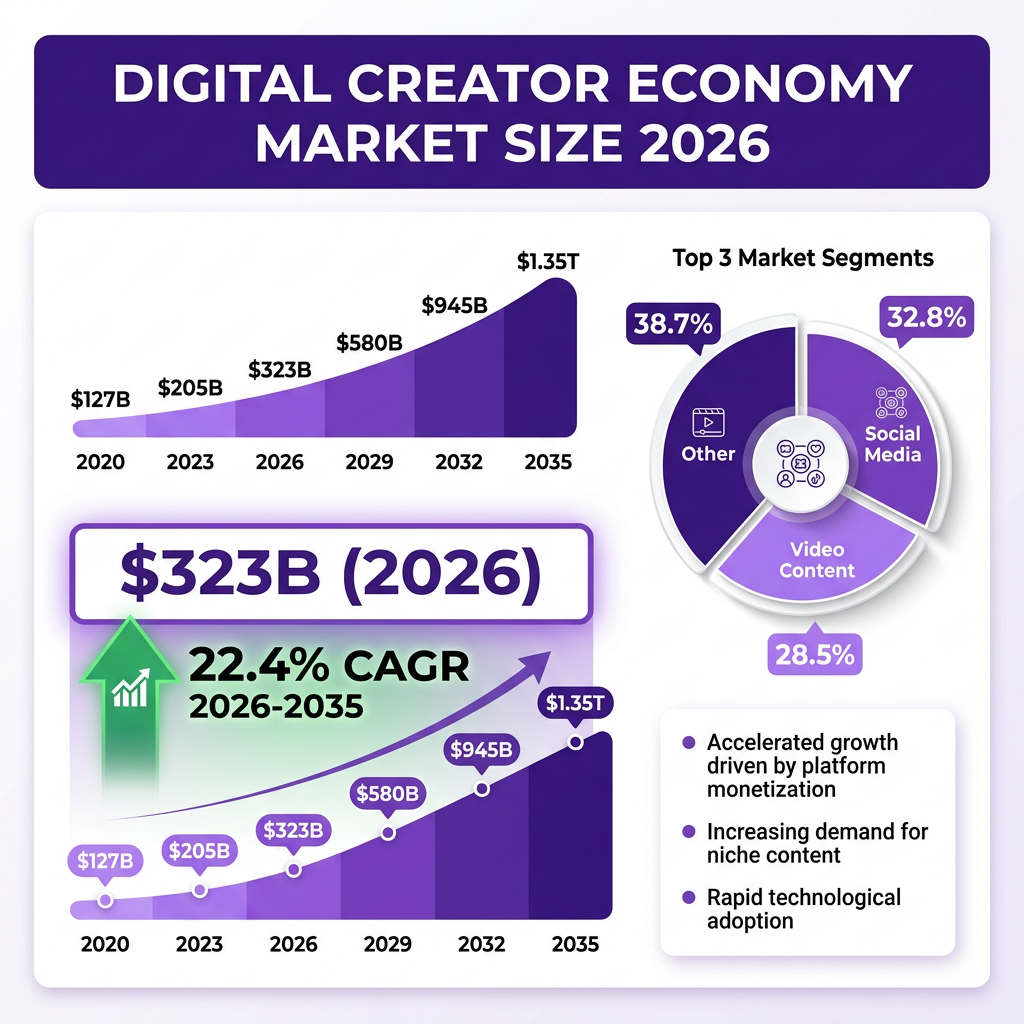
The creator economy has evolved from a digital side hustle into a $323 billion global industry that is fundamentally reshaping how content is produced, consumed, and monetized. What started as a niche phenomenon of bloggers and early YouTubers has transformed into a sophisticated ecosystem where over 200 million people worldwide now identify as creators—building audiences, generating income, and operating full-fledged media businesses across multiple platforms.
In 2026, the creator economy stands at an inflection point. With Goldman Sachs projecting the market to approach $480 billion by 2027 and potentially exceed $1.35 trillion by 2035, the sector is growing at a compound annual growth rate of 22.4%—outpacing traditional media and entertainment industries by a significant margin. This is not just about viral videos anymore; it is about sustainable business models, diversified revenue streams, and the professionalization of content creation as a legitimate career path.
The democratization of content creation tools, combined with the global proliferation of smartphones and high-speed internet, has lowered the barriers to entry for aspiring creators. Anyone with a smartphone and an internet connection can now reach a global audience, build a community, and generate income from their creativity, expertise, or personality. This fundamental shift has disrupted traditional media gatekeepers and created new pathways for talent to emerge from anywhere in the world.
The implications of this shift extend beyond individual creators. Traditional media companies, advertising agencies, and entertainment conglomerates are all grappling with how to adapt to a world where individual creators can command audiences that rival established media outlets. The power dynamic has fundamentally shifted from institutions to individuals.
What makes the creator economy particularly fascinating is its dual nature as both an individual pursuit and a massive industrial complex. On one hand, it represents the ultimate expression of individual entrepreneurship—solo creators building global businesses from their bedrooms. On the other hand, it has attracted billions in venture capital, spawned entire categories of supporting technology, and fundamentally altered how brands approach marketing and customer acquisition.

Market Overview: The $323 Billion Creator Economy Ecosystem
The global creator economy market size reached $205.25 billion in 2024, according to Grand View Research, and current 2026 data from Research and Markets places the market value at $323.48 billion—representing year-over-year growth of 26.5%. This explosive expansion is driven by several converging factors: the widespread penetration of smartphones and high-speed internet, the emergence of new monetization tools, and a fundamental shift in consumer behavior toward authentic, creator-driven content.
The creator economy growth trajectory is particularly impressive when compared to traditional industries. While legacy media has struggled with cord-cutting and declining advertising revenues, the creator economy has attracted significant investment from venture capital firms, major brands, and traditional entertainment companies looking to tap into younger demographics. The sector growth rate of 22.5% CAGR through 2030 far exceeds that of traditional advertising, which hovers around 4-6% annually.
North America continues to dominate the creator economy landscape, accounting for 34.2% of global revenue in 2024 and projected to maintain a 38.9% share through 2030. The region market size was valued at $46.10 billion in 2026 and is expected to reach $378.66 billion by 2033, exhibiting a compound annual growth rate of 35.1%. This dominance stems from high internet penetration rates, the presence of major social media platforms headquartered in the region, and a mature advertising ecosystem that supports creator monetization.
The Asia-Pacific region represents the fastest-growing market, driven by massive user bases in India, China, and Southeast Asian countries where mobile-first content consumption has become the norm. Countries like India have seen explosive growth in creator adoption, with local language content creators building massive audiences that rival their Western counterparts. The region’s young demographic, increasing smartphone penetration, and growing middle class create perfect conditions for creator economy expansion.
Europe follows as the third-largest market, with the UK influencer marketing industry alone projected to reach £2.9 billion in 2026. The European market benefits from high disposable incomes, strong regulatory frameworks that protect both creators and consumers, and a sophisticated brand ecosystem that recognizes the value of creator partnerships.
Latin America and Africa, while currently smaller markets, show tremendous potential for growth as internet infrastructure improves and local creator ecosystems develop. These regions represent the next frontier for the creator economy, with young, digitally-native populations eager to consume and create content. The expansion of affordable smartphones and mobile data plans is expected to drive significant creator economy growth in these regions over the next decade.
Key Statistics and Data: Understanding the Creator Landscape
The creator economy scale becomes even more impressive when examining the granular data behind the macro trends. Here are the critical statistics that define the industry in 2026:
Creator Demographics and Participation
There are over 50 million content creators worldwide who consider themselves professional or semi-professional. This represents approximately 1 in 40 people globally. Of these creators, 55% now operate as full-time business owners, a significant increase from just a few years ago when the majority treated content creation as a side hustle. The average content creator income in 2026 is $61,980 per year, though this figure varies dramatically based on niche, platform, and audience size.
The creator demographic skews young, with the majority of full-time creators falling between 18-34 years old. However, the industry is seeing increasing participation from older demographics who bring professional expertise and established networks to their creator businesses. This diversity of age and experience is enriching the creator economy with content that spans generations and interests.
Platform-Specific Performance Data
Social media platforms account for 32.8% of the creator economy market, making them the largest segment by platform type. Video streaming platforms represent the fastest-growing category, with video content alone capturing 28.5% of market share. YouTube remains the dominant platform for creator earnings, with finance and business content creators earning $15-50 per 1,000 views through AdSense. Gaming content on YouTube typically earns $3-8 per 1,000 views, while entertainment content averages $2-5 per 1,000 views.
TikTok pays creators $0.40-$1.00 per 1,000 qualified views through its Creator Rewards Program, while Instagram pays almost nothing per view directly, pushing creators toward brand partnerships. X (formerly Twitter) pays roughly $8-$12 per 1 million verified views. These platform differences significantly impact creator strategy, with many creators using TikTok and Instagram for discovery while relying on YouTube for monetization.
Revenue and Monetization Statistics
Approximately 68.8% of creators rely on brand deals as their primary revenue source. Advertising revenue accounts for the largest share of monetization methods, followed by brand collaborations, subscriptions, affiliate marketing, and merchandise sales. Only 34% of creators earn their primary income from platform ads, highlighting the importance of diversified revenue streams. The richest creators across Instagram, TikTok, and YouTube earned an estimated $853 million in a single year.
Subscription-based revenue is growing rapidly, with platforms like Patreon processing hundreds of millions in creator earnings annually. The average Patreon creator earns around $300 per month, but top creators generate six or seven figures monthly through dedicated fan support. This model demonstrates that audiences are willing to pay directly for content they value, bypassing traditional advertising models.
OnlyFans, despite its controversial reputation, has paid out over $10 billion to creators since its inception, demonstrating the massive potential of direct fan monetization. Substack has enabled writers to build six and seven-figure newsletter businesses, proving that text-based content can thrive in an increasingly video-dominated landscape.
Influencer Marketing Investment Data
The global influencer marketing industry reached $32.55 billion in 2025 and is projected to hit $40.51 billion in 2026—a single-year jump of over 30%. Brands earn an average of $5.78 for every $1 invested in influencer marketing, making it one of the highest-ROI marketing channels available. Creator economy ad spend in 2025 grew 26% year-over-year, expanding 4x faster than the total media industry.
Audience Engagement Metrics
Nano-influencers (1,000-10,000 followers) now represent 75.9% of Instagram influencer base and achieve 2.71% engagement rates—50% higher than micro-influencers. Gifted partnerships deliver 2.19% engagement rates, 12.9% higher than paid collaborations at 1.94%.
Major Trends Shaping the Digital Creator Economy in 2026
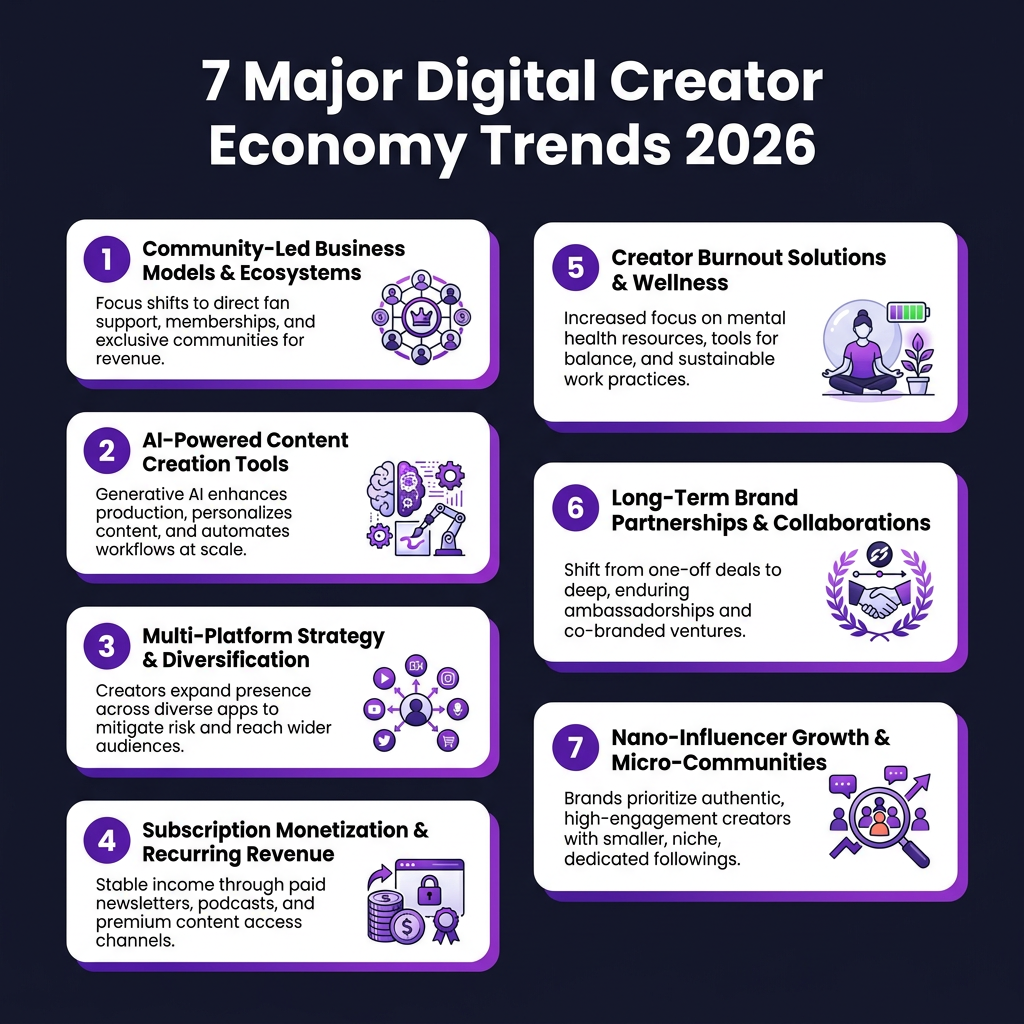
The creator economy is undergoing a fundamental transformation as it matures from an emerging sector into a sophisticated industry. Here are the seven major trends defining the landscape in 2026:
1. Community-Led Business Models
Perhaps the most significant shift in the creator economy is the move from audience-building to community-building. 56% of creators launched their community in 2024-2025, indicating that community-building has become a near-default move for newer creator businesses rather than a late-stage optimization. Platforms like Circle, Discord, Mighty Networks, and Geneva are enabling creators to build owned communities where they control the relationship with their audience, independent of algorithm changes on social platforms.
This trend reflects a growing awareness among creators that social media followers do not equate to business stability. A creator with 100,000 Instagram followers has no guarantee of reaching even 1% of that audience with any given post due to algorithm changes. By building communities on owned platforms, creators can establish recurring revenue through memberships, create deeper engagement with their most dedicated fans, and insulate themselves from the volatility of platform algorithms.
Community-led businesses also benefit from network effects—members bring other members, creating organic growth that does not depend on platform algorithms. The most successful creator communities offer exclusive value that cannot be found on public platforms: direct access to the creator, peer connections with like-minded members, exclusive content, and early access to products or services.
2. AI-Powered Content Creation and Optimization
Artificial intelligence has become the silent co-founder for many creators in 2026. AI tools are now assisting with everything from script writing and video editing to thumbnail generation, content optimization, and audience analysis. By the end of 2026, AI agents and workflows could support nearly 40% of creator workflows, not by replacing creators but by freeing them to focus on strategy, creativity, and authentic connection with their audiences.
Creators are using AI to automate repetitive tasks, analyze audience data for content optimization, generate initial drafts that they then refine with their unique voice, and even create personalized content experiences for different audience segments. This has lowered the barrier to entry for content creation while simultaneously raising the bar for quality and consistency.
However, the integration of AI also raises important questions about authenticity and originality. Audiences value genuine human connection, and creators must balance the efficiency gains of AI with the need to maintain their unique voice and perspective. The most successful creators in 2026 are those who use AI as a tool to amplify their creativity rather than replace it.
3. Multi-Platform Diversification Strategy
The era of platform loyalty is over. With TikTok facing regulatory uncertainty in the United States and experiencing a 17.2% drop in investment intentions from brands, creators are aggressively diversifying across platforms. The most successful creators in 2026 maintain a presence on YouTube (37% preference), Instagram (57% preference), TikTok (52% brand usage), and emerging platforms.
This diversification strategy is not just about risk mitigation—it is about meeting audiences where they are and optimizing content for each platform unique strengths. A creator might use TikTok for discovery and viral growth, YouTube for long-form content and ad revenue, Instagram for community engagement and brand partnerships, and an owned platform for monetization and direct fan relationships.
Cross-platform content strategies require understanding the unique culture, audience expectations, and algorithm preferences of each platform. What works on TikTok may not work on YouTube, and successful creators develop platform-specific expertise while maintaining a consistent brand identity across channels.
4. Subscription and Membership Monetization
Direct-to-fan monetization through subscriptions has emerged as the most sustainable revenue model for creators. Platforms like Patreon, OnlyFans, Substack, Fourthwall, and Buy Me a Coffee are enabling creators to generate predictable, recurring revenue by offering exclusive content, early access, direct interaction with fans, and community membership.
The subscription model aligns creator incentives with audience value—creators are motivated to consistently deliver high-quality content that justifies the ongoing subscription, rather than chasing viral moments. This has led to the rise of the “creator middle class”—creators with smaller but highly engaged audiences who can generate substantial income through subscriptions.
Subscription tiers allow creators to monetize different levels of fan commitment, from casual supporters at $5 per month to super fans willing to pay $50 or more for premium access. This tiered approach maximizes revenue while making support accessible to fans at different financial levels, creating a more inclusive monetization model than traditional advertising.
5. Addressing Creator Burnout and Mental Health
The dark side of the creator economy has become impossible to ignore. 62% of creators experience burnout, and 89% lack access to specialized mental health resources. The pressure to constantly produce content, maintain engagement, navigate algorithm changes, and manage public scrutiny has taken a significant toll on creator wellbeing.
In response, 2026 has seen the emergence of creator wellness initiatives, mental health resources specifically tailored to the unique challenges of content creation, and a broader conversation about sustainable work practices. Successful creators are increasingly treating their work as a business with systems, boundaries, and sustainable schedules rather than a constant hustle.
Platforms are beginning to recognize their role in creator burnout, with some implementing features designed to help creators manage their workload and mental health. However, fundamental tensions remain—platform algorithms typically reward frequent posting, creating incentives that conflict with sustainable work practices. The industry is grappling with how to maintain growth while protecting the mental health of its workforce.
6. Long-Term Brand Partnerships and Creator Programs
The transactional nature of early influencer marketing is giving way to long-term partnerships between creators and brands. 74% of brands are moving budget into creator programs in 2026, with an emphasis on ongoing relationships rather than one-off sponsored posts. This shift benefits both parties—brands get authentic advocacy and deeper integration, while creators gain income stability and creative freedom.
Hybrid compensation models that combine guaranteed fees with performance-based payouts are becoming standard, aligning creator and brand incentives around actual business results rather than vanity metrics like impressions and likes. These models reward creators who can drive real outcomes while providing baseline income security.
Creator programs are also becoming more sophisticated, with brands providing creators with resources, creative freedom, and long-term collaboration opportunities that go beyond simple product promotion. The most successful brand-creator relationships in 2026 resemble true partnerships rather than transactional advertising arrangements, with creators involved in product development, feedback loops, and strategic planning.
7. The Rise of Nano and Micro-Influencers
While celebrity influencers with millions of followers still command attention, the real growth in the creator economy is happening at the nano and micro levels. These smaller creators offer higher engagement rates, more authentic connections with their audiences, and better ROI for brands. The data shows that nano-influencers achieve 2.71% engagement rates compared to 1.5% or lower for macro-influencers, making them increasingly attractive to performance-focused marketers.
Brands are increasingly recognizing that reach does not equal results. A creator with 10,000 highly engaged followers in a specific niche can drive more conversions than a creator with 1 million general-interest followers. This shift is democratizing the creator economy, enabling creators with smaller but dedicated audiences to build sustainable businesses through higher conversion rates and more authentic brand partnerships.
The rise of nano and micro-influencers also reflects a broader consumer preference for authenticity over polish. Audiences increasingly value creators who feel relatable and genuine, even if that means lower production values than major media outlets. This trend is particularly pronounced among younger demographics who have grown up with social media and can quickly identify inauthentic content.

Key Players and Competitive Landscape
The creator economy ecosystem comprises multiple layers of platforms, tools, and services that enable creators to produce, distribute, and monetize content. Understanding this landscape is crucial for both creators building their businesses and brands looking to engage with the creator economy.
Platform Giants and Their Strategies
YouTube remains the most established platform for creator monetization, with its Partner Program distributing billions in ad revenue annually. The platform long-form content model, combined with the YouTube Shorts feature, provides creators with multiple content formats and revenue streams. YouTube’s algorithm favors watch time and engagement, rewarding creators who can capture and maintain audience attention over extended periods.
YouTube’s strength lies in its mature monetization infrastructure. Creators can earn through AdSense, channel memberships, Super Chat during livestreams, and YouTube Premium revenue. The platform’s search functionality also provides long-tail discoverability that short-form platforms cannot match—content can continue generating views and revenue for years after publication.
TikTok has revolutionized content discovery with its algorithmic feed, enabling creators to achieve viral growth regardless of follower count. However, the platform monetization tools lag behind its discovery capabilities, pushing creators toward brand partnerships and off-platform monetization. The regulatory uncertainty surrounding TikTok in the US has accelerated the platform’s efforts to demonstrate economic value to creators through programs like the Creator Fund and Creator Rewards Program.
TikTok’s impact on the creator economy extends beyond its own platform. The short-form video format pioneered by TikTok has been adopted by competitors, changing how all social platforms approach content. TikTok has also democratized virality—unknown creators can reach millions of views overnight, something that was nearly impossible on follower-based platforms.
Instagram continues to evolve its creator tools, with Meta investing heavily to retain creators. The platform paid nearly $3 billion to creators in 2025, up 35% from the previous year. Meta Creator Fast Track program offers guaranteed monthly payments of $1,000 to creators with 100,000+ followers and $3,000 to those with 1 million+ followers to post on Facebook.
Instagram’s creator ecosystem spans feed posts, Stories, Reels, and live content, providing multiple formats for creator expression. The platform’s shopping features also enable direct commerce, allowing creators to sell products without sending audiences off-platform. This integration of content and commerce represents a significant evolution in how creators monetize their influence.
Twitch dominates the live streaming segment, particularly for gaming content. The platform subscription model, combined with donations and sponsorships, has enabled top streamers to build multi-million dollar businesses. The average Twitch viewer watches for over 95 minutes per session, demonstrating the platform’s powerful engagement capabilities.
However, Twitch faces increasing competition from YouTube Live and emerging platforms like Kick, which are offering more favorable revenue splits to attract top creators. This competition is forcing Twitch to innovate and improve its creator offerings to maintain its market position.
Monetization Infrastructure Providers
Beyond the social platforms, a robust ecosystem of monetization tools has emerged. Patreon has proven that direct fan support can generate billions in revenue for creators across all categories. OnlyFans, while controversial, has demonstrated the viability of subscription models for individual creators. Substack has shown that newsletter-based creator businesses can generate substantial income for writers and journalists.
Gumroad, Stan Store, Fourthwall, and Beacons enable creators to sell digital products, merchandise, and services directly to their audiences. These platforms provide creators with ownership of their customer relationships, higher margins on sales (typically 80-95% of revenue versus 50-55% on most social platforms), and protection from algorithm changes.
These infrastructure providers are increasingly important as creators seek to diversify revenue beyond platform ad shares. They represent a shift toward creator independence—tools that empower creators to build businesses they own rather than relying entirely on platforms they don’t control. This independence is becoming a key priority for creators who have experienced algorithm changes or policy shifts that impacted their income.
Challenges and Pain Points in the Creator Economy
Despite its impressive growth and opportunities, the creator economy faces significant challenges that threaten its sustainability and accessibility. Understanding these pain points is essential for creators, platforms, and brands operating in this space.
1. Platform Dependency and Algorithm Volatility
The most significant risk facing creators is their dependence on platforms they do not control. Algorithm changes can decimate a creator reach overnight, and platform policy shifts can eliminate entire categories of content. The TikTok ban concerns in the United States highlighted this vulnerability, with creators who had built their entire businesses on the platform facing potential catastrophic loss.
Creators are increasingly aware of this risk, which is driving the push toward owned platforms and diversified presence. However, the discovery power of major platforms remains unmatched, creating a difficult balance between reach and control. Even creators with successful owned businesses typically rely on social platforms for new audience acquisition.
Platform dependency also extends to monetization. When platforms change their revenue share models or eligibility requirements, creators can see immediate impacts on their income. This volatility makes financial planning difficult and creates stress for creators who depend on platform revenue.
2. Income Inequality and the Winner-Takes-All Dynamic
While the average creator income of $61,980 sounds promising, the reality is starkly unequal. A small percentage of top creators capture the majority of revenue, while the vast majority struggle to generate meaningful income. This inequality is exacerbated by algorithmic distribution that favors already-successful creators, creating a feedback loop that makes it increasingly difficult for new creators to break through.
The creator economy has been criticized for promoting a false narrative of accessibility—while anyone can technically become a creator, the barriers to sustainable income remain high. The vast majority of creators earn less than $1,000 annually from their content, while a tiny fraction earn millions.
This inequality has led to calls for more equitable revenue distribution models and better support for emerging creators. Some platforms have attempted to address this through creator funds and guaranteed payment programs, but the fundamental dynamics of attention economics favor those who have already succeeded. The challenge for the industry is creating pathways for new creators to build sustainable businesses without relying on viral luck.
3. Mental Health and Burnout Crisis
The creator economy runs on constant content production. The pressure to maintain posting schedules, respond to comments, and stay relevant creates an unsustainable work environment for many creators. 62% of creators experience burnout, and 89% lack access to specialized mental health resources.
The lack of boundaries between personal and professional life, combined with the public nature of creator work, creates unique mental health challenges. Creators face constant public scrutiny, with every post subject to comments, criticism, and potential viral backlash. The algorithmic nature of content distribution means that creators often don’t know which content will succeed, creating anxiety around every post. The fear of losing relevance drives many creators to overwork, sacrificing their mental and physical health.
Platforms and creator economy companies are beginning to address this issue with wellness resources, but systemic solutions—such as algorithm changes that don’t reward constant posting—remain elusive. The fundamental business model of social platforms depends on engagement, creating incentives that may conflict with creator wellbeing.
4. Discovery and Competition Challenges
As the creator economy has grown, so has competition for audience attention. With over 50 million creators worldwide, standing out has become increasingly difficult. New creators face the challenge of building an audience in saturated niches where established creators already dominate.
Platform algorithms, while designed to surface relevant content, often favor creators who already have engagement, making it difficult for new voices to break through. This creates a “rich get richer” dynamic where established creators continue to grow while new creators struggle to gain visibility.
The cost of content production has also risen as audience expectations increase. What constituted high-quality content five years ago may not compete today, requiring creators to invest in better equipment, editing, and production values. This creates a barrier to entry for creators without significant upfront capital.
Opportunities and Growth Strategies
Despite the challenges, the creator economy offers unprecedented opportunities for those who approach it strategically. Here are the key growth strategies for creators and businesses in 2026:
1. Building Owned Audiences and Communities
The most successful creators in 2026 are those who have built audiences they own—email lists, community memberships, and direct relationships with fans. While social media remains crucial for discovery, owned audiences provide stability and higher monetization potential. Creators should prioritize converting social media followers into owned audience members through lead magnets, exclusive content, and community building.
Email lists remain one of the most valuable assets a creator can build. Unlike social media followers, email subscribers can be reached reliably without algorithm interference. Communities provide additional value through peer connections and exclusive access, creating stickiness that goes beyond any individual piece of content.
2. Diversifying Revenue Streams
Relying on a single revenue source is increasingly risky in the creator economy. The most resilient creators combine multiple income streams: platform ad revenue, brand partnerships, affiliate marketing, digital products, subscriptions, merchandise, coaching or consulting services, and speaking engagements. This diversification not only increases total revenue but also provides protection against changes in any single source.
Digital products—courses, templates, ebooks, presets—have emerged as particularly attractive revenue streams because they can be created once and sold repeatedly with minimal marginal cost. A creator with expertise in a specific area can package that knowledge into products that generate passive income.
3. Niche Specialization and Expertise
As the creator economy matures, generalist content faces increasing competition. Creators who specialize in specific niches—whether that is finance education, fitness coaching, software development, or gaming commentary—can build more engaged audiences and command higher rates from brands targeting those niches.
The data shows that specialized creators in high-value niches like finance and business earn significantly more than general entertainment creators. Expertise creates value that audiences are willing to pay for, whether through subscriptions, courses, or consulting.
4. Leveraging AI and Automation
Creators who effectively leverage AI and automation tools can produce more content with less effort, analyze audience data more effectively, and optimize their workflows for maximum efficiency. This does not mean replacing human creativity—it means using technology to handle repetitive tasks so creators can focus on what they do best.
AI tools can help with content ideation, script writing, video editing, thumbnail creation, and audience analysis. Automation can handle scheduling, cross-posting, and routine community management. Creators who master these tools gain a significant competitive advantage.
The key is finding the right balance—using technology to handle repetitive tasks while preserving the human creativity and authenticity that audiences value. Creators who become overly dependent on AI risk losing the unique voice that attracted their audience in the first place.
Case Studies and Success Stories
The creator economy is filled with examples of creators who have built substantial businesses. While individual results vary widely, these case studies illustrate the potential of the creator economy when approached strategically:
Case Study 1: Educational Content Creators
Finance and business content creators have emerged as some of the highest earners in the creator economy, with CPMs (cost per thousand views) of $15-50 compared to $2-5 for general entertainment content. These creators have built businesses combining YouTube ad revenue, course sales, consulting services, and brand partnerships with financial services companies.
Their success demonstrates the value of educational content in the creator economy. By providing genuine value and expertise, these creators have built loyal audiences willing to pay premium prices for courses, coaching, and other educational products. The trust built through free educational content translates directly into willingness to purchase paid offerings.
Case Study 2: Community-First Creators
Creators who have prioritized community building over audience growth have shown remarkable resilience and monetization potential. By creating exclusive communities on platforms like Circle or Discord, these creators generate recurring revenue through memberships while building deeper relationships with their most dedicated fans.
This model has proven particularly effective for creators in niches like professional development, fitness, and creative skills. The community itself becomes the product, with members paying for access to peer networks, exclusive content, and direct interaction with the creator.
Case Study 3: Multi-Platform Operators
Creators who have successfully diversified across platforms have built more stable businesses than those dependent on a single platform. These creators use each platform for its strengths—TikTok for discovery, YouTube for long-form content and ad revenue, Instagram for community engagement, and owned platforms for monetization.
This approach requires more effort but provides significant protection against platform-specific risks. When one platform changes its algorithm or policies, these creators have other channels to maintain their income and audience relationships. The most successful multi-platform creators develop systems for repurposing content across platforms, maximizing the value of each piece of content they create.
These case studies illustrate a key principle of the creator economy in 2026: success comes from building sustainable business models rather than chasing viral moments. The creators who thrive are those who treat their work as a business, invest in systems and processes, and build genuine relationships with their audiences.
Future Outlook and Predictions (2026-2030)
The creator economy is projected to continue its rapid growth, with multiple forecasts converging on a market size exceeding $500 billion by 2030. However, the nature of this growth will likely differ from the explosive expansion of the past decade.
Professionalization and Maturation: The creator economy will increasingly resemble traditional media and entertainment industries, with established career paths, professional standards, and industry organizations. This maturation will bring both benefits (greater legitimacy, better business practices) and challenges (higher barriers to entry, more competition).
AI Integration: Artificial intelligence will become deeply integrated into creator workflows, from content generation to audience analysis. While this will increase efficiency, it may also raise questions about authenticity and the value of human-created content.
Regulatory Evolution: As the creator economy grows, it will face increased regulatory scrutiny around issues like advertising disclosure, data privacy, and platform monopolies. Creators and platforms will need to navigate an increasingly complex regulatory landscape.
Global Expansion: While North America currently dominates, the creator economy will see significant growth in Asia, Africa, and Latin America as internet penetration increases and local platforms emerge. This globalization will bring new creators, new content formats, and new monetization models.
Web3 and Creator Ownership: Blockchain-based technologies may enable new forms of creator ownership and monetization, from NFTs representing exclusive content to decentralized platforms that give creators more control over their work and revenue. While the initial NFT hype has cooled, the underlying technology continues to evolve with more practical applications for creator monetization.
The creator economy of 2030 will likely look very different from today, with more sophisticated tools, established professional standards, and greater global participation. Creators who build sustainable businesses now will be well-positioned to capitalize on these developments as they emerge.
Key Takeaways
- The creator economy has grown into a $323 billion industry in 2026, projected to reach $480 billion by 2027 and potentially $1.35 trillion by 2035
- Over 200 million people worldwide now identify as creators, with 55% operating as full-time business owners
- The average creator income is $61,980 annually, though top creators earn millions through diversified revenue streams
- Community-led business models and owned memberships are emerging as the most sustainable foundation for creator income
- AI-powered tools are transforming creator workflows, with AI agents supporting up to 40% of creator tasks by end of 2026
- Nano and micro-influencers are delivering better engagement rates than macro-influencers, driving a shift toward smaller, more authentic creator partnerships
- Platform diversification is essential as creators seek to reduce dependency on any single platform
- Creator burnout affects 62% of creators, highlighting the need for sustainable work practices and mental health support
- Brands earn an average of $5.78 for every $1 invested in influencer marketing, making it one of the highest-ROI marketing channels
- The creator economy is maturing from a side hustle phenomenon into a legitimate, professional industry with established career paths and business practices
Sources and Citations
- Research Nester – Creator Economy Market Size & Share Forecast Report 2026-2035: https://www.researchnester.com/reports/creator-economy-market/5691
- SNS Insider – Creator Economy Market Size, Share & Growth Report 2035: https://www.snsinsider.com/reports/creator-economy-market-8072
- ShortsIntel – Creator Economy Statistics 2026: https://www.shortsintel.com/statistics/creator-economy
- Fungies.io – Creator Economy Statistics 2026: https://fungies.io/creator-economy-statistics-2026-2
- Coherent Market Insights – North America Creator Economy Market: https://www.coherentmarketinsights.com/industry-reports/north-america-creator-economy-market
- ThriveCart – State of the Global Creator Economy 2025-26: https://thrivecart.com/resources/state-of-the-global-creator-economy-2025-26
- Circle – Creator Economy Statistics for 2026: https://circle.so/blog/creator-economy-statistics
- InfluenceFlow – Creator Earnings Reports Guide 2026: https://influenceflow.io/resources/creator-earnings-reports-complete-guide-to-how-creators-make-money-in-2026
- Uscreen – Content Creator Income in 2026: https://www.uscreen.tv/blog/content-creator-income
- CNBC – Meta Creator Pay Program 2026: https://www.cnbc.com/2026/03/18/meta-creator-pay-instagram-tiktok-youtube-facebook.html
- Forbes – Most Profitable Platforms for Creators 2026: https://www.forbes.com/sites/meggenharris/2026/03/25/7-of-the-most-profitable-platforms-for-creators-in-2026
- Passes – Best Creator Monetization Platforms 2026: https://www.passes.com/blog/posts/best-creator-monetization-platforms
- Stan Store – State of the Creator Economy 2026: https://stan.store/blog/state-of-the-creator-economy
- Gitnux – Creator Economy Statistics 2026: https://gitnux.org/creator-economy-statistics
- inBeat Agency – Creator Economy Statistics 2026: https://inbeat.agency/blog/creator-economy-statistics
- Exploding Topics – Creator Economy Market Size 2025-2030: https://explodingtopics.com/blog/creator-economy-market-size
- Technavio – Creator Economy Market Growth Analysis: https://www.technavio.com/report/creator-economy-market-industry-analysis
- Archive.com – Influencer Marketing Growth Statistics 2026: https://archive.com/blog/influencer-marketing-growth-statistics
- Ringly.io – Influencer Marketing Statistics 2026: https://www.ringly.io/blog/influencer-marketing-statistics-2026
- Charle Agency – Influencer Marketing Statistics USA 2026: https://www.charleagency.com/articles/influencer-marketing-statistics {“@context”: “https://schema.org”, “@type”: “BlogPosting”, “headline”: “Digital Creator Economy 2026: The Complete Market Analysis with Data, Trends and Forecasts”, “description”: “The creator economy has evolved into a $323 billion global industry in 2026. Discover key statistics, trends, and predictions for digital creators, platforms, and monetization strategies.”, “url”: “https://fungies.io/digital-creator-economy-market-analysis-2026-9/”, “datePublished”: “2026-06-06T09:37:22”, “dateModified”: “2026-06-06T09:37:22”, “author”: {“@type”: “Person”, “name”: “Duke Vu”}, “publisher”: {“@type”: “Organization”, “name”: “Fungies.io”, “url”: “https://fungies.io”, “logo”: {“@type”: “ImageObject”, “url”: “https://fungies.io/wp-content/uploads/2023/01/fungies-logo.png”}}, “mainEntityOfPage”: {“@type”: “WebPage”, “@id”: “https://fungies.io/digital-creator-economy-market-analysis-2026-9/”}}