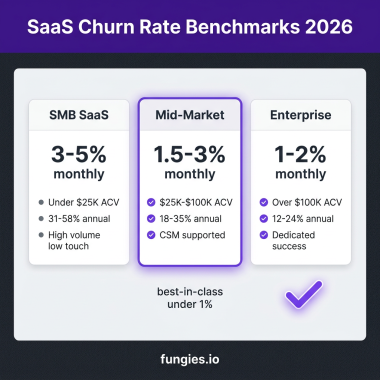
Here’s a sobering statistic: the median B2B SaaS company loses 3.5% of its customers every month to churn. For a $1M ARR business, that’s $35,000 walking out the door monthly. Annualized, you’re looking at nearly half a million in lost revenue — and that’s before you factor in the CAC you’ve already spent to acquire those customers.
I’ve seen too many SaaS founders obsess over new acquisition while their existing customers quietly cancel. The truth? Reducing churn by just 5% can increase profitability by 25-95% depending on your business model. Customer success isn’t a nice-to-have anymore — it’s the difference between scaling and stalling.
What Is Customer Success Software?
Customer success platforms are specialized tools that help SaaS companies proactively manage customer relationships, reduce churn, and drive expansion revenue. Unlike traditional CRMs that focus on sales pipelines, CS tools monitor product usage, health scores, and engagement patterns to flag at-risk accounts before they churn.
The best platforms combine several capabilities: customer health scoring based on product usage and engagement, automated playbooks for onboarding and renewals, in-app guidance and walkthroughs, NPS and satisfaction surveys, and revenue forecasting based on renewal likelihood. They essentially give your CS team superpowers — letting one CSM manage 50-100 accounts instead of 20-30.
Why Customer Success Tools Matter More Than Ever
The SaaS landscape has shifted dramatically. In 2021, growth at all costs was the mantra. In 2026, efficient growth rules. Investors want to see net revenue retention (NRR) above 110%, and public SaaS companies with NRR over 120% trade at 2-3x the valuation multiples of those below 100%.
Here’s what the data shows: companies with dedicated customer success teams see 24% higher net revenue retention on average. Automated onboarding reduces time-to-value by 40%. And proactive health scoring can predict churn 30-60 days before it happens — giving you time to intervene.
Honestly, if you’re running a SaaS business without a CS platform in 2026, you’re flying blind. Spreadsheets and gut feelings don’t scale.
10 Best Customer Success Tools Compared
I’ve evaluated dozens of platforms across implementation complexity, feature depth, pricing transparency, and real user feedback. Here are the 10 best customer success tools for SaaS companies in 2026, organized by use case and company size.
1. Gainsight — Best for Enterprise SaaS
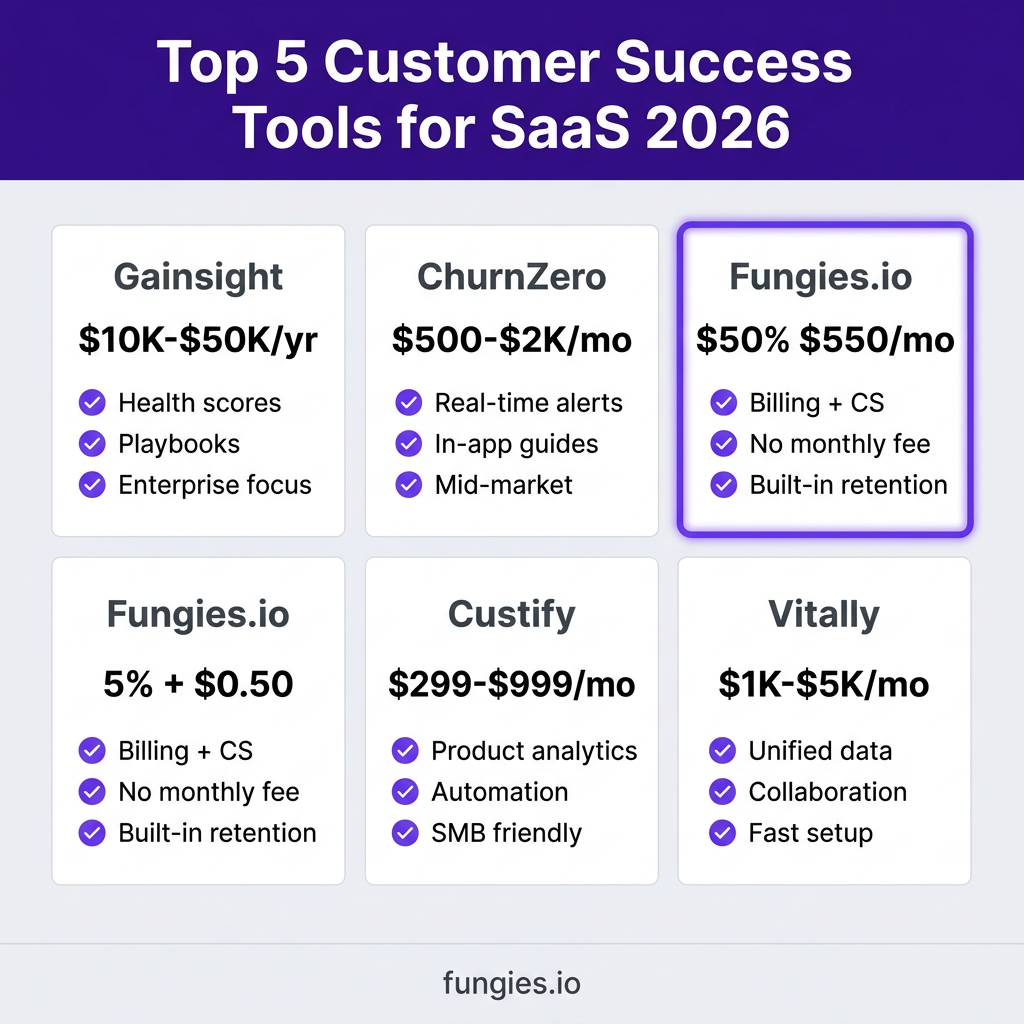
Gainsight is the 800-pound gorilla of customer success. Used by companies like Adobe, VMware, and Workday, it’s built for complex enterprise environments with thousands of accounts and sophisticated segmentation needs.
- Key features: Advanced health scoring with custom formulas, Journey Orchestrator for automated playbooks, Revenue Optimizer for expansion forecasting, Sally AI for predictive insights
- Pricing: $10,000-$50,000+ annually (custom pricing, requires sales call)
- Best for: Enterprise SaaS with $50M+ ARR, complex multi-product portfolios
The downside? Implementation typically takes 3-6 months and requires dedicated admin resources. This isn’t a tool you set up over a weekend. But if you’re at scale and need the most comprehensive CS platform available, Gainsight delivers.
2. ChurnZero — Best for Mid-Market SaaS
ChurnZero strikes an excellent balance between capability and usability. It’s designed specifically for SaaS companies and offers real-time alerts that actually matter — not noise that desensitizes your team.
- Key features: Real-time churn alerts, in-app walkthroughs and guides, usage analytics and product adoption tracking, automated email campaigns based on behavior
- Pricing: $500-$2,000/month depending on user count
- Best for: Growing SaaS companies with $5M-$50M ARR, product-led growth motions
What I like most about ChurnZero is the in-app guidance. You can trigger contextual walkthroughs when users hit friction points — reducing support tickets and accelerating time-to-value. Their customers report 20-30% reductions in churn within the first quarter.
3. Custify — Best for SMB and Early-Stage SaaS
Custify is the new kid on the block that’s gaining serious traction. Built by a team that previously ran customer success at a fast-growing SaaS company, it understands the pain points of smaller teams without enterprise budgets.
- Key features: Product analytics integration, automated playbook triggers, revenue forecasting, lightweight implementation
- Pricing: $299-$999/month with transparent pricing
- Best for: SaaS startups with $1M-$10M ARR, small CS teams (1-3 people)
The setup is refreshingly simple — most teams are live within a week. Custify integrates natively with Stripe, Chargebee, and most product analytics tools. If you’re looking for your first dedicated CS platform, this is where I’d start.
4. Vitally — Best for Data-Driven Teams
Vitally takes a different approach. Instead of forcing you into a predefined data model, it unifies data from any source — your product database, support tickets, sales calls, billing system — into a flexible workspace.
- Key features: Unlimited custom data sources, collaborative account workspaces, powerful automation engine, native integrations with 50+ tools
- Pricing: $1,000-$5,000/month based on data volume
- Best for: Technical teams who want full data flexibility, data-heavy SaaS products
If your CS team is constantly asking engineering for data exports, Vitally solves that problem. It’s particularly strong for API-first companies and developer tools where product usage patterns are complex.
5. Catalyst — Best for Sales-Led SaaS
Catalyst was built by former Gainsight employees who wanted something more intuitive. It’s become the go-to choice for sales-led SaaS companies that need tight alignment between sales, CS, and account management.
- Key features: Account planning and expansion workflows, executive business reviews, renewal forecasting, Salesforce-native feel
- Pricing: Custom, typically $15,000-$40,000/year
- Best for: Sales-led B2B SaaS, companies with account management functions
6. Planhat — Best for European SaaS
Planhat is a Stockholm-based company that’s become the European alternative to Gainsight. It offers similar enterprise capabilities with better GDPR compliance and EU data residency options.
- Key features: Modular architecture (use only what you need), strong collaboration tools, GDPR-compliant by design, excellent NPS and survey capabilities
- Pricing: €800-€3,000/month
- Best for: European SaaS companies, teams needing EU data residency
7. ClientSuccess — Best for Simplicity
Sometimes you don’t need every bell and whistle. ClientSuccess focuses on core CS functionality done well: health scores, playbooks, and renewals. No fluff, no bloat.
- Key features: Intuitive health scoring, renewal management, customer portals, pulse surveys
- Pricing: $199-$799/month
- Best for: Teams new to CS software, companies wanting quick time-to-value
8. UserGuiding — Best for Product-Led Onboarding
While not a full CS platform, UserGuiding deserves mention for product-led companies. It specializes in in-app onboarding, tooltips, and checklists that drive activation.
- Key features: No-code product tours, onboarding checklists, NPS surveys, feature adoption analytics
- Pricing: $89-$699/month
- Best for: Product-led growth companies, onboarding optimization
9. Appcues — Best for Mobile-First SaaS
Appcues pioneered the in-app guidance category and remains the leader for mobile applications. If your SaaS has a significant mobile component, this is worth considering.
- Key features: Cross-platform flows (web + mobile), advanced targeting, A/B testing for flows, strong analytics
- Pricing: $249-$1,000+/month
- Best for: Mobile-first SaaS, companies with complex onboarding flows
10. Fungies.io — Best Integrated Billing + Retention
Full disclosure: I work with Fungies. But here’s why it belongs on this list. Most CS tools focus on what happens after purchase. Fungies handles the entire customer lifecycle — from first payment through renewal — with built-in dunning management, subscription analytics, and retention tools.
- Key features: Subscription billing with dunning, churn recovery automation, revenue analytics, global tax compliance
- Pricing: 5% + $0.50 per transaction, no monthly fees
- Best for: SaaS companies wanting unified billing and retention, global sellers
If you’re currently using Stripe + a separate CS tool, Fungies consolidates those costs while adding retention-specific features like smart retry logic and cancellation flow optimization.
Customer Success Tools Comparison Table
| Tool | Best For | Starting Price | Setup Time | G2 Rating |
|---|---|---|---|---|
| Gainsight | Enterprise | $10K+/yr | 3-6 months | 4.3/5 |
| ChurnZero | Mid-market | $500/mo | 2-4 weeks | 4.5/5 |
| Custify | SMB/Startup | $299/mo | 1 week | 4.6/5 |
| Vitally | Data-heavy teams | $1,000/mo | 2-4 weeks | 4.7/5 |
| Catalyst | Sales-led SaaS | $15K+/yr | 4-8 weeks | 4.4/5 |
| Planhat | European SaaS | €800/mo | 2-4 weeks | 4.5/5 |
| ClientSuccess | Simplicity | $199/mo | 1-2 weeks | 4.3/5 |
| UserGuiding | PLG onboarding | $89/mo | 1-3 days | 4.4/5 |
| Appcues | Mobile SaaS | $249/mo | 1-2 weeks | 4.5/5 |
| Fungies.io | Billing + CS | 5% + $0.50 | 1-2 days | 4.6/5 |
How to Choose the Right Customer Success Tool
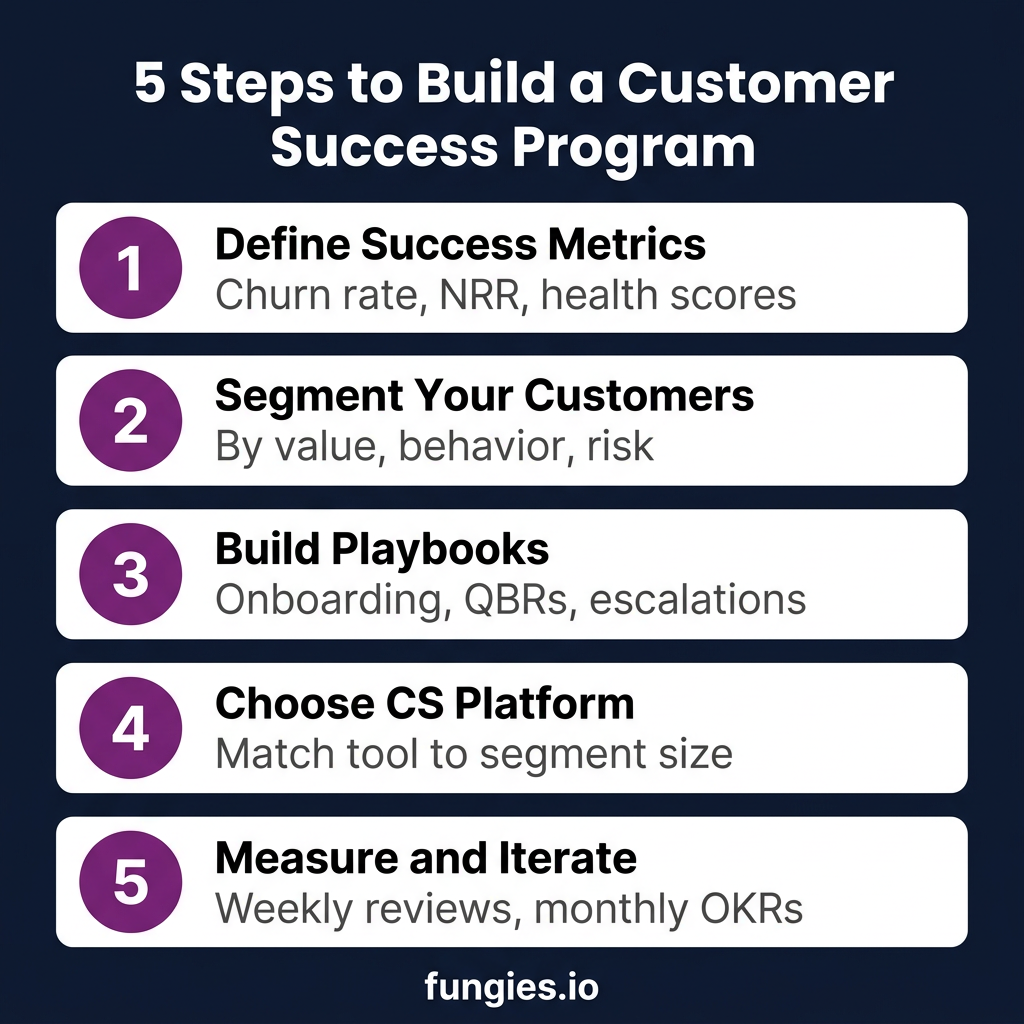
With so many options, how do you pick? Here’s my decision framework based on implementing CS tools at multiple SaaS companies:
Step 1: Define Your Primary Use Case
Are you trying to reduce churn? Drive expansion revenue? Improve onboarding? Different tools excel at different things. ChurnZero and Custify are churn-focused. Catalyst and Gainsight lean toward expansion. UserGuiding and Appcues specialize in activation.
Step 2: Be Realistic About Your Data Maturity
Vitally and Gainsight are powerful, but they require clean, accessible data. If your product events are a mess and your billing data lives in spreadsheets, start with something simpler like Custify or ClientSuccess. You can always upgrade once your data house is in order.
Step 3: Calculate Total Cost of Ownership
Don’t just look at the subscription price. Factor in implementation costs, ongoing admin time, and integration work. A $500/month tool that requires 40 hours of engineering time is more expensive than a $1,000/month tool with one-click integrations.
Step 4: Test With a Pilot Cohort
Never roll out a CS platform to your entire customer base at once. Start with a single segment — say, your enterprise tier or your most at-risk customers. Run it for 60-90 days, measure the impact, then expand.
Key Customer Success Metrics to Track
Whichever tool you choose, make sure it can track these essential metrics:
- Net Revenue Retention (NRR): The gold standard CS metric. Best-in-class SaaS achieves 120-130%.
- Gross Revenue Retention (GRR): How much revenue you keep without expansion. 85%+ is solid.
- Logo Churn Rate: Percentage of customers lost monthly. Under 2% monthly is the target.
- Time-to-Value (TTV): How quickly new users reach their first success milestone. Under 15 minutes for PLG, under 30 days for enterprise.
- Product Adoption Score: Percentage of features used by active customers. Higher adoption correlates strongly with retention.
- Customer Health Score: Your composite metric combining usage, engagement, support tickets, and NPS.
Most CS platforms calculate these automatically, but verify the methodology matches your business model.
Common Mistakes When Implementing CS Tools
I’ve seen companies waste six-figure budgets on CS platforms that sit unused. Here are the pitfalls to avoid:
- Buying before defining processes: A tool won’t fix broken playbooks. Document your onboarding, QBR, and escalation processes first.
- Over-engineering health scores: Start simple. Three data points that are accurate beat twenty that are questionable.
- Ignoring change management: Your CSMs need training and buy-in. A tool forced top-down without input will face resistance.
- Setting and forgetting: Health score models need quarterly reviews. What predicted churn in Q1 might not work in Q3.
- Measuring activity over outcomes: Don’t celebrate “50 playbooks completed.” Celebrate “churn reduced by 15%.”
Frequently Asked Questions
What’s the difference between a CRM and customer success software?
CRMs like Salesforce track sales opportunities and pipeline. Customer success platforms monitor post-sale behavior, product usage, and health signals to prevent churn and drive expansion. They’re complementary — most companies integrate both.
When should a SaaS company invest in customer success software?
Generally, when you have 50+ paying customers or $1M+ ARR. Before that, you can manage with spreadsheets and your product analytics tool. Once you have a dedicated CSM, it’s time to invest in proper tooling.
Can small SaaS companies afford enterprise CS platforms?
Most can’t — and shouldn’t try. Gainsight and Catalyst are overkill for early-stage companies. Start with Custify, ClientSuccess, or even UserGuiding. Upgrade as you scale.
How long does it take to see ROI from a CS platform?
With proper implementation, you should see measurable churn reduction within 90 days. Full ROI typically comes within 6-12 months as you optimize playbooks and health scoring.
Do I need a dedicated CSM to use these tools?
Not necessarily. Many early-stage SaaS companies have founders or product managers handle CS initially. The tools still provide value through automation and alerts. But you’ll get more from them with dedicated CS ownership.
Conclusion: Invest in Retention Before It’s Too Late
Customer acquisition gets all the glory. But in 2026’s funding environment, retention is what separates the SaaS companies that survive from those that don’t. The right customer success tool won’t fix a broken product, but it will help you identify problems faster, intervene proactively, and systematically reduce churn.
My recommendation? If you’re under $5M ARR, start with Custify or ChurnZero. If you’re enterprise-scale, evaluate Gainsight and Catalyst. And if you’re building a product-led SaaS, don’t sleep on the onboarding specialists like UserGuiding.
Whatever you choose, commit to it. The worst decision is buying a platform, under-implementing it, and switching six months later. Pick one, invest in proper setup, and give your team time to learn it.
Want to see how Fungies handles billing and retention in one platform? Create your free account and start reducing churn today.
Sources
- Gainsight — https://www.gainsight.com
- ChurnZero — https://www.churnzero.com
- Custify — https://www.custify.com
- Vitally — https://www.vitally.io
- Catalyst — https://www.catalyst.io
- Planhat — https://www.planhat.com
- ClientSuccess — https://www.clientsuccess.com
- UserGuiding — https://userguiding.com
- Appcues — https://www.appcues.com
- OpenView Partners — 2026 SaaS Benchmarks Report
- G2 Crowd — Customer Success Software Reviews 2026
- Product-Led Alliance — State of Customer Success 2026