Here’s a sobering statistic: the median SaaS company now spends $2.00 to acquire every dollar of new ARR. Customer acquisition costs have surged 222% over the past 8 years, with a 60% jump in just the last 5 years. If you’re running a SaaS business in 2026, you’re feeling this pressure acutely.
But here’s what most founders miss — not all acquisition channels are bleeding money. While some companies burn $5,000+ per enterprise customer, others are acquiring users for under $300 through smarter, more efficient channels. The difference isn’t luck. It’s strategy.
What Is Customer Acquisition in SaaS?
Customer acquisition in SaaS is the complete process of turning a stranger into a paying subscriber. It spans three distinct phases: lead generation (getting prospects to discover you), lead nurturing (building trust and demonstrating value), and conversion (turning interest into revenue).
Unlike traditional businesses, SaaS acquisition is uniquely challenging because you’re not just selling a product once — you’re convincing someone to commit to a recurring relationship. That means your acquisition strategy needs to attract the right customers, not just any customers. A user who churns after one month costs you more than they generate, no matter how cheap they were to acquire.
Why Your CAC Matters More Than Ever in 2026
The average B2B SaaS customer acquisition cost now sits at $702, but that number hides massive variation. Top-quartile companies spend approximately $1.00 to acquire $1 of ARR, while bottom-quartile companies spend $2.82. That efficiency gap determines who scales and who stalls.
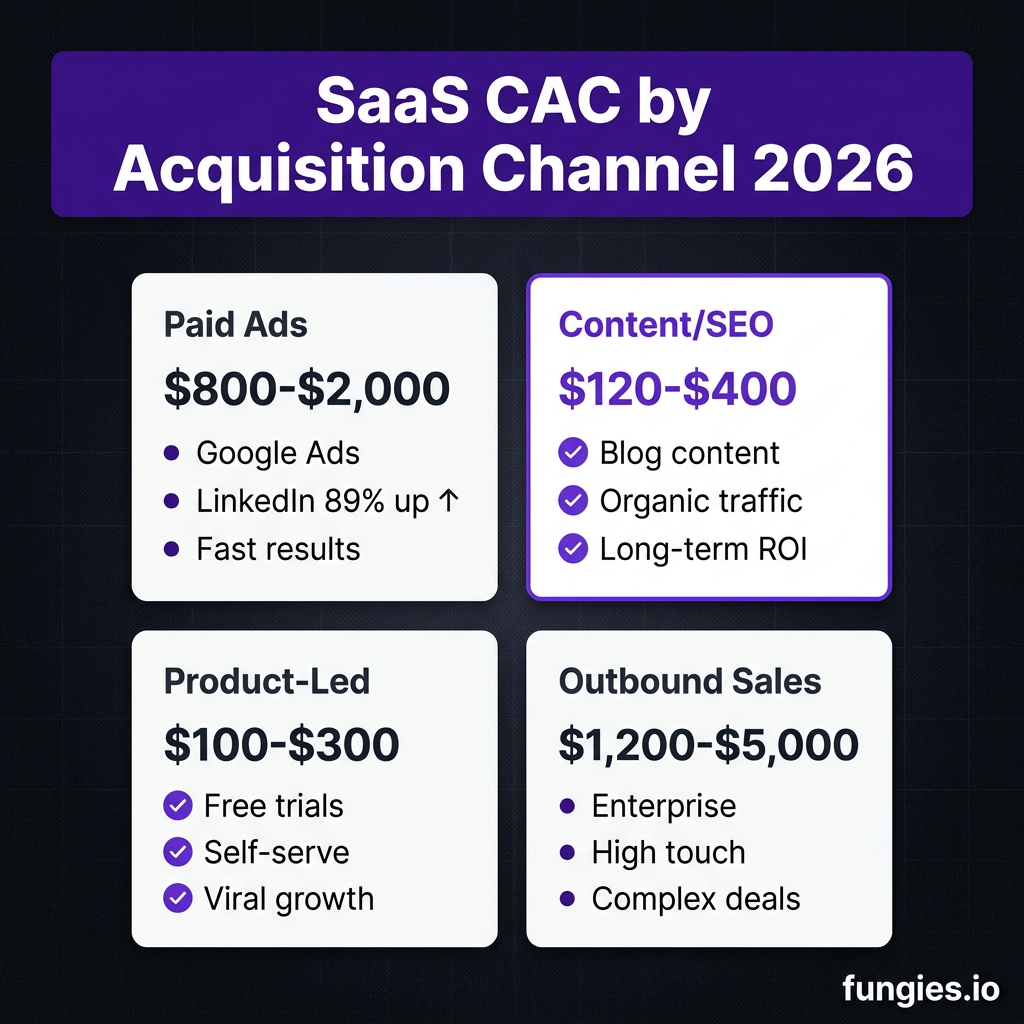
LinkedIn ad costs have surged 89% since 2019. Paid social CAC now exceeds $2,000 for many B2B teams. Meanwhile, organic channels — content marketing, SEO, product-led growth — are delivering customers at a fraction of that cost. The playbook has changed, but not everyone’s caught up.
10 Best SaaS Customer Acquisition Strategies for 2026
These aren’t theoretical tactics. These are the strategies working right now for SaaS companies that are scaling efficiently, not just spending heavily.
1. SEO-Driven Content Marketing
Content marketing isn’t new, but the way top SaaS companies approach it has evolved. The winners aren’t publishing generic blog posts — they’re building topical authority clusters that dominate search results for high-intent keywords.
Here’s what actually works: identify the specific problems your ideal customers are searching for, then create comprehensive resources that solve those problems better than anything else online. A company I analyzed was spending $400 CAC through paid ads while their competitor achieved $120 CAC through content marketing and referrals. The math is brutal and beautiful.
- Best for: SaaS companies with longer sales cycles and educational buyers
- Typical CAC: $120-$400
- Time to results: 6-12 months for significant traction
2. Product-Led Growth (PLG)
Product-led growth lets your product do the selling. Instead of forcing prospects through sales demos and contract negotiations, you give them immediate access to experience value firsthand. Companies like Slack, Calendly, and Dropbox built empires on this model.
The mechanics are simple but execution is nuanced: offer a free trial or freemium tier, optimize your onboarding to deliver value within minutes, and build viral loops that turn users into advocates. When done right, PLG creates a self-reinforcing growth engine where each new user brings more users.
- Best for: Products with quick time-to-value and self-serve onboarding
- Typical CAC: $100-$300
- Key metric: Free-to-paid conversion rate (benchmark: 15-25%)
3. Strategic Paid Advertising
Paid ads still work — you just need to be smarter about them. The spray-and-pray approach of 2019 is dead. In 2026, winning paid strategies are surgical: precise audience targeting, relentless creative testing, and aggressive optimization based on actual revenue, not just clicks.
Google Ads captures high-intent search traffic. LinkedIn reaches decision-makers (at a premium). Reddit and Twitter work surprisingly well for developer tools and B2B products. The key is measuring CAC by channel, not just blended averages. One channel might deliver customers at $200 while another bleeds $2,000 — you need to know which is which.
- Best for: Companies with proven product-market fit and conversion funnels
- Typical CAC: $800-$2,000+ (varies wildly by channel)
- Pro tip: Start with retargeting before prospecting
4. Referral and Affiliate Programs
Word-of-mouth remains one of the most powerful acquisition channels, and referral programs systematize it. Incentivized referral systems don’t just lower CAC — they boost retention because referred customers tend to stick around longer.
The best referral programs offer genuine value to both parties. Dropbox’s legendary program gave free storage to referrers and referees. Modern SaaS companies use credits, extended trials, or cash rewards. The key is making the incentive meaningful enough to motivate action without eroding your unit economics.
- Best for: Products with natural sharing moments or network effects
- Typical CAC: $50-$150 (just the referral reward cost)
- Bonus: Referred customers have 16% higher LTV on average
5. Community-Led Growth
Building a community around your product creates a moat that competitors can’t easily copy. Whether it’s a Slack workspace, Discord server, or dedicated forum, communities transform customers into advocates and advocates into evangelists.
The strategy requires patience. You’re not directly pitching — you’re facilitating connections, answering questions, and establishing your brand as the hub for your niche. Over time, community members become your most efficient acquisition channel, bringing in new users organically.
- Best for: Niche tools with passionate user bases
- Typical CAC: $80-$250 (community management costs)
- Timeline: 12-18 months to mature community
6. Strategic Partnerships and Integrations
Partnering with complementary tools puts your product in front of qualified prospects who already trust related solutions. Integration marketplaces like Slack’s App Directory, Salesforce AppExchange, or HubSpot’s ecosystem can drive significant qualified traffic.
The best partnerships are symbiotic: you solve a problem for their users, they send you qualified leads. Co-marketing campaigns, joint webinars, and integration spotlights can all drive acquisition at a fraction of traditional advertising costs.
- Best for: Tools that fit into existing software ecosystems
- Typical CAC: $150-$400
- Key: Choose partners with overlapping ICPs but non-competing products
7. Outbound Sales (Done Right)
Outbound isn’t dead — bad outbound is dead. Modern outbound sales relies on precise targeting, personalized messaging, and multi-channel sequences. The spray-and-pray email blasts of the past are spam folder fodder.
Effective outbound starts with data quality. If your bounce rate is 5%+, you’re burning budget invisibly. Top-performing teams use intent data to identify prospects already researching solutions, then reach out with relevant, timely messages. It’s expensive per customer, but for high-ACV deals, the math works.
- Best for: Enterprise and high-ACV products
- Typical CAC: $1,200-$5,000+
- Requirement: Average contract value above $10,000/year
8. Email Marketing and Lifecycle Campaigns
Email isn’t flashy, but it’s consistently one of the highest-ROI channels. The key is moving beyond newsletters to sophisticated lifecycle marketing: onboarding sequences that drive activation, re-engagement campaigns that win back churned users, and expansion emails that grow existing accounts.
Personalization matters more than ever. Batch-and-blast emails get ignored. Emails that feel like they were written for one person — based on behavior, segment, and lifecycle stage — drive real results. The best SaaS companies treat email as a product experience, not just a marketing channel.
- Best for: All SaaS companies with existing user bases
- Typical CAC: $50-$200 (mostly tooling costs)
- ROI: $36 return for every $1 spent (DMA benchmark)
9. Social Media and Personal Branding
For B2B SaaS, social media works best when it’s personal, not corporate. Founders and key team members building in public, sharing insights, and engaging authentically often outperform polished brand accounts.
LinkedIn remains the dominant B2B platform, but Twitter/X and niche communities (Reddit, Indie Hackers, Discord) can be incredibly effective for specific audiences. The strategy is simple: provide value consistently, engage genuinely, and let interested prospects come to you.
- Best for: Founder-led companies and technical products
- Typical CAC: $30-$150 (mostly time investment)
- Key: Consistency beats virality
10. Events and Webinars
Virtual and in-person events create high-intent engagement opportunities. A prospect who spends 45 minutes in your webinar is significantly more qualified than someone who clicked an ad. The key is delivering genuine educational value, not thinly veiled sales pitches.
Webinars scale better for most SaaS companies, but industry conferences and local meetups create deeper relationships. The hybrid approach — virtual events for reach, in-person for depth — works best for many companies.
- Best for: Complex products requiring demonstration
- Typical CAC: $200-$600
- Conversion: Webinar attendees convert 3-5x better than cold traffic
Comparison: Which Strategy Is Right for You?
| Strategy | Best For | Typical CAC | Time to Results |
|---|---|---|---|
| SEO/Content | Educational buyers | $120-$400 | 6-12 months |
| Product-Led Growth | Self-serve products | $100-$300 | 3-6 months |
| Paid Ads | Proven funnels | $800-$2,000+ | Immediate |
| Referral Programs | Network effects | $50-$150 | 2-4 months |
| Community | Niche tools | $80-$250 | 12-18 months |
| Partnerships | Ecosystem players | $150-$400 | 3-6 months |
| Outbound Sales | Enterprise | $1,200-$5,000+ | 1-3 months |
| Email Marketing | All SaaS | $50-$200 | 1-2 months |
| Social/Personal Brand | Founder-led | $30-$150 | 6-12 months |
| Events/Webinars | Complex products | $200-$600 | 1-3 months |
How to Choose Your Primary Acquisition Channel
Honestly, most SaaS companies spread themselves too thin across too many channels. The companies that win are the ones that identify their highest-leverage channel and double down before diversifying.
Here’s a simple framework: if your product has a quick time-to-value and simple onboarding, start with product-led growth. If you sell to enterprise with complex implementations, invest in outbound sales and partnerships. If you’re building in a crowded market with educated buyers, content and SEO will compound over time.
The key is measuring CAC by channel, not just blended averages. One channel delivering customers at $200 while another bleeds $2,000 is a pattern you need to spot fast. Segment your metrics religiously.
Reducing CAC: 5 Immediate Actions
If your acquisition costs are too high, here are five moves you can make this quarter:
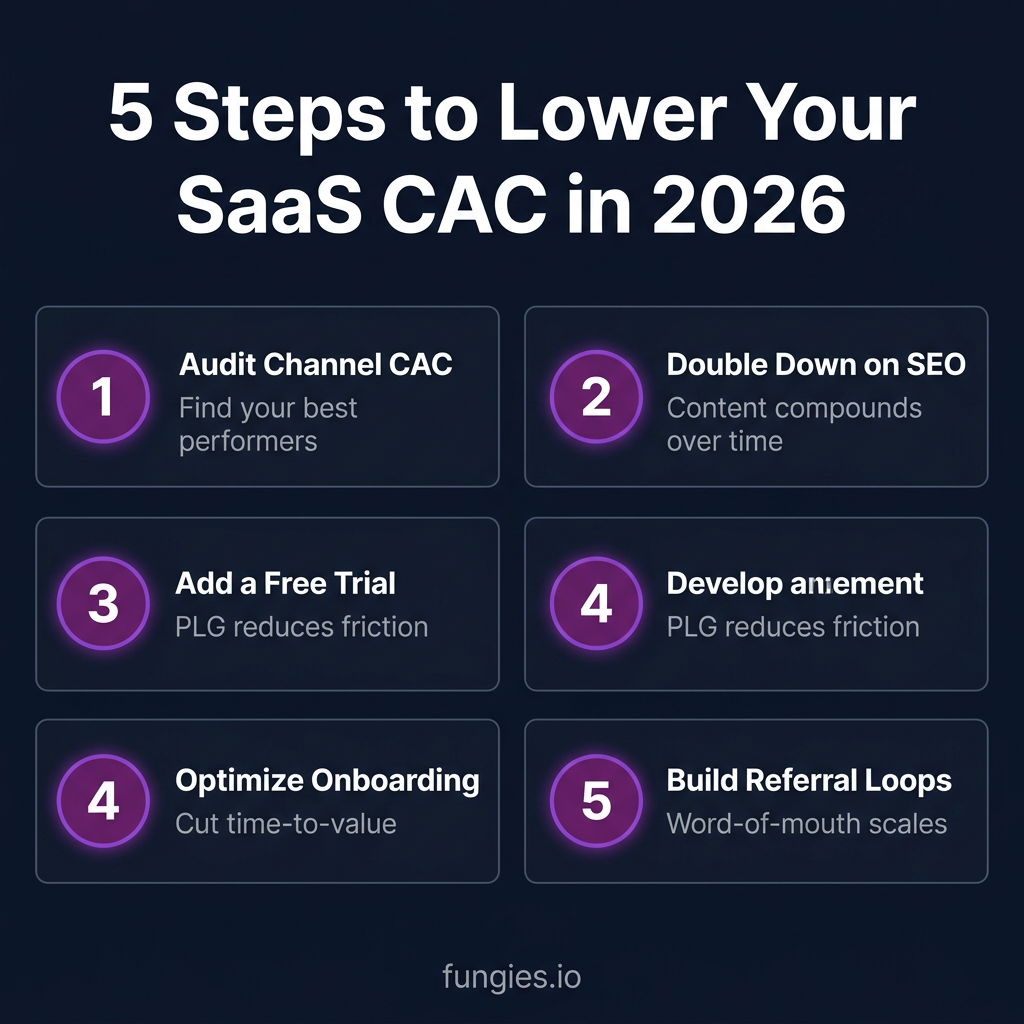
- Audit channel-specific CAC. Blended numbers hide problems. Break down CAC by channel to find your winners and losers.
- Shift budget to organic. Organic CAC is typically 60-80% lower than paid. Content and SEO compound over time.
- Optimize your onboarding. Every day you cut from time-to-value improves conversion rates and reduces acquisition waste.
- Implement a referral program. Referred customers cost less and stay longer. Even a simple program beats none.
- Improve data quality for outbound. Bad data burns budget silently. Clean your lists and verify before sending.
Frequently Asked Questions
What is a good CAC for SaaS?
A good CAC depends on your customer lifetime value (LTV). The golden ratio is 3:1 — your LTV should be at least 3x your CAC. For most B2B SaaS, keeping CAC under $702 (the current average) while maintaining healthy unit economics is a solid benchmark. Top-quartile companies achieve sub-$600 CAC.
How long should CAC payback period be?
Ideally, you want CAC payback under 12 months. Companies with longer payback periods face cash flow challenges that can stall growth. If your payback stretches beyond 18 months, you need to either reduce acquisition costs or increase pricing/retention.
Is product-led growth better than sales-led?
Neither is universally better — it depends on your product and market. PLG works best for simple, self-serve products with quick time-to-value. Sales-led excels for complex, high-ACV enterprise solutions. Many successful SaaS companies now run hybrid models: PLG to land efficiently, sales to expand strategically.
Why has CAC increased so much?
Three factors drive rising CAC: increased competition for ad inventory (LinkedIn costs up 89% since 2019), privacy changes that limit targeting precision, and market saturation in many SaaS categories. The solution isn’t to spend more — it’s to build organic channels and optimize conversion.
Can you reduce CAC without cutting growth?
Absolutely. The companies reducing CAC fastest are actually accelerating growth by shifting from expensive paid channels to efficient organic ones. Content marketing, product-led growth, and referral programs can simultaneously lower CAC and increase growth velocity.
Conclusion: Build Your Acquisition Engine
Customer acquisition isn’t about finding a silver bullet — it’s about building a systematic engine that consistently delivers qualified customers at a cost that makes your unit economics work. The strategies above aren’t mutually exclusive. Most successful SaaS companies eventually run multiple channels, but they start by dominating one.
Start with the strategy that best fits your product, audience, and resources. Measure rigorously. Optimize relentlessly. And remember: the goal isn’t just more customers — it’s more profitable customers who stick around.
Ready to streamline your SaaS operations? Create your free Fungies account and get your checkout, billing, and tax compliance handled in one platform.
Sources
- GTM 80/20 — 38 Customer Acquisition Cost Statistics for B2B SaaS 2026
- SaaS Hero — 2026 SaaS CAC Benchmarks
- Factors.ai — Customer Acquisition Cost Guide 2026
- Prospeo — How to Reduce CAC in 2026
- First Page Sage — SaaS Customer Acquisition Strategy Guide
- Userflow — 10 Best SaaS Customer Acquisition Strategies
- Genesys Growth — CAC Benchmarks 2026