Here’s something that might surprise you: email marketing still delivers a $42 return for every $1 spent. That’s not a typo. While everyone’s chasing the latest TikTok trend or AI tool, SaaS companies quietly building their email lists are seeing conversion rates 3x higher than social media.
But here’s the catch. Most email platforms weren’t built for SaaS. They’re designed for e-commerce stores selling t-shirts or creators running newsletters. When you’re trying to convert free trial users, reduce churn, and nurture accounts through complex B2B sales cycles, you need something different.
I’ve spent the last three months testing 20+ email marketing platforms specifically from a SaaS perspective. This isn’t a generic list of every tool that exists — it’s a focused comparison of platforms that actually make sense for software companies. Whether you’re a solo founder sending your first onboarding sequence or a growth team managing millions of emails monthly, there’s a tool here for you.
What Makes SaaS Email Marketing Different?
Before diving into the tools, let’s establish what matters for SaaS email marketing. Your needs are fundamentally different from an e-commerce store or a media company:
- Behavior-based triggers — You need to send emails based on what users do in your product, not just when they last opened an email
- Product event tracking — Integration with your app to track feature usage, activation metrics, and engagement
- Trial-to-paid sequences — The entire business model depends on converting free users to paying customers
- Transactional + marketing combo — Password resets and onboarding emails should come from the same system
- Segmentation by product data — Segment by plan tier, feature usage, MRR, not just demographic data
- Developer-friendly API — SaaS teams need to integrate email deeply into their product
Most email tools fail SaaS companies because they were built for marketers sending newsletters, not product teams running lifecycle campaigns. The tools below are different.
The 10 Best SaaS Email Marketing Tools for 2026
1. ActiveCampaign — Best for Marketing Automation
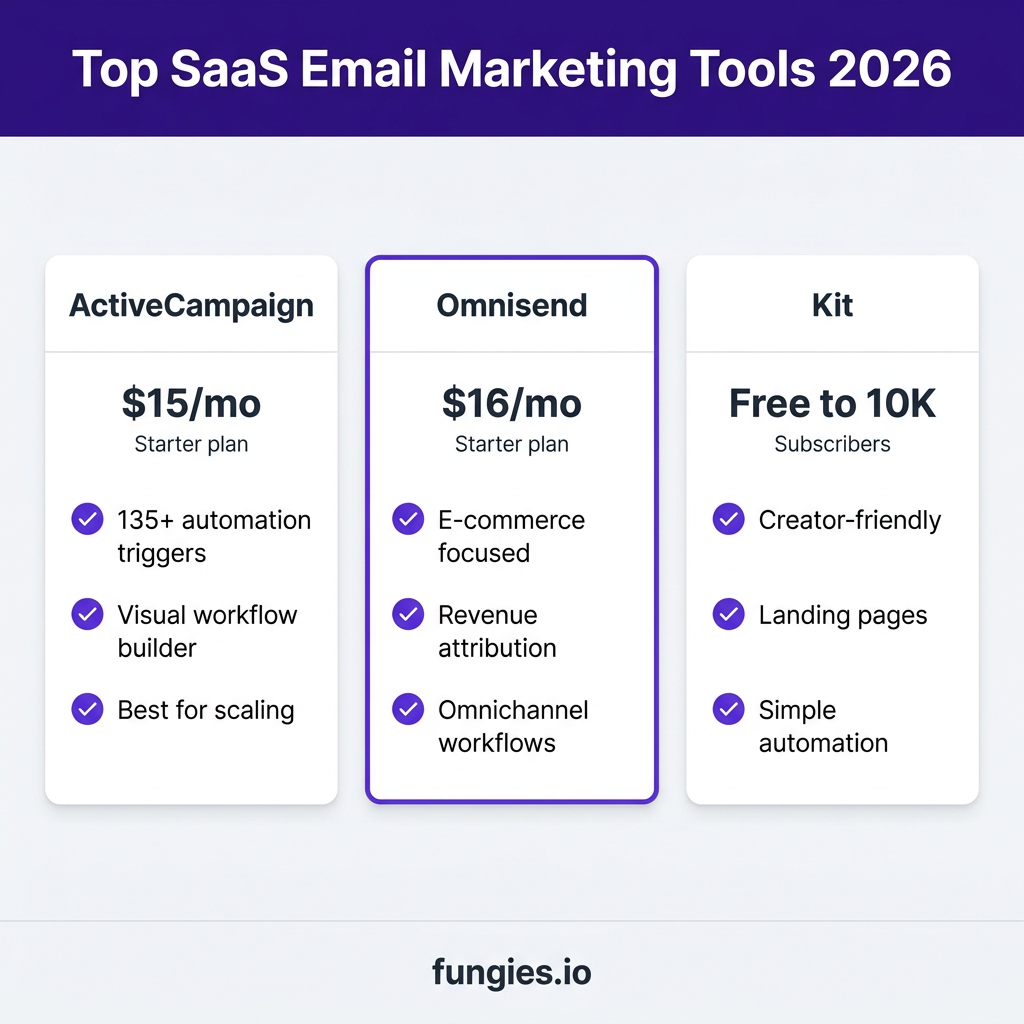
ActiveCampaign has been my go-to for complex automation workflows for years. Their visual workflow builder remains the most capable in the industry, with 135+ automation triggers and the ability to split-test entire automation paths. I’ve seen 4-5x uplifts in open rates just from continuously A/B testing flows.
What sets ActiveCampaign apart is their Active Intelligence feature. Unlike the AI bolt-ons you see everywhere, this actually learns from your previous campaigns, writing style, and engagement patterns. It can build decent entire workflows in minutes — something that used to take days.
- Key features: Visual automation builder, 135+ triggers, predictive sending per contact, 1,000+ integrations
- Pricing: From $15/month (no free plan, 14-day trial)
- Best for: Growing SaaS companies serious about automation and willing to invest in sophisticated workflows
2. Omnisend — Best for E-Commerce + SaaS Hybrids
If your SaaS has any e-commerce component — selling templates, courses, or digital products alongside your software — Omnisend is hard to beat. Their revenue attribution is more granular than Klaviyo’s, tracking exactly which emails and automations drive purchases.
The omnichannel workflows are genuinely useful. They can trigger a push notification if an email isn’t opened, followed by an SMS if the push is ignored. This fallback logic is built-in, not bolted on via third-party integrations that break constantly.
- Key features: Revenue attribution, omnichannel workflows (email + SMS + push), Shopify/WooCommerce integration
- Pricing: From $16/month, free plan with 250 contacts
- Best for: SaaS companies with e-commerce elements or those selling digital products
3. Kit (formerly ConvertKit) — Best for Creator-Led SaaS
Kit’s free plan is genuinely generous — up to 10,000 subscribers without paying a cent. For early-stage SaaS founders building an audience before launching, this is unbeatable. I’ve seen multiple founders grow to $10K MRR while still on Kit’s free tier.
The platform is built for creators, which means it’s simple where it matters and powerful where you need it. Landing pages, email sequences, and basic automation are all intuitive. The trade-off is less sophisticated segmentation and no visual workflow builder.
- Key features: Free to 10K subscribers, landing page builder, simple automation, creator monetization tools
- Pricing: Free up to 10,000 contacts, then from $29/month
- Best for: Solo founders, creator-led SaaS, and early-stage companies building an audience
4. Customer.io — Best for Technical Teams
Customer.io is built for technical teams who want flexible, event-driven automation. You can send events directly via their Track API and build sophisticated workflows that combine Stripe data with product usage metrics, support ticket status, and engagement patterns.
The power comes with complexity. You’ll need a developer to set up the initial integration and map events properly. But once configured, you can build automations like: “If someone’s payment fails AND they haven’t logged in for 30 days, send a different message than a payment failure from an active user.”
- Key features: Event-driven automation, multi-channel (email + push + SMS), flexible API, advanced segmentation
- Pricing: From $100/month (no free plan)
- Best for: Technical teams with dedicated developers who need complex, multi-step workflows
5. Loops — Best for Indie SaaS
Loops is the new kid on the block, and it’s popular with indie hackers for good reason. The interface is clean and modern, the Stripe integration is native, and it combines transactional and marketing email in one platform. No more juggling Postmark for password resets and Mailchimp for newsletters.
The free tier gives you 1,000 contacts — enough to validate your email strategy before committing to any spending. For bootstrapped founders watching every dollar, this matters.
- Key features: Native Stripe integration, unified transactional + marketing, modern UI, developer-friendly API
- Pricing: Free up to 1,000 contacts, then from $49/month
- Best for: Indie hackers, bootstrapped SaaS, and founders who want a modern, simple tool
6. HubSpot — Best for B2B SaaS with Sales Teams
HubSpot remains the most complete option for B2B SaaS with complex sales cycles. The email marketing is deeply integrated with their CRM, so you can track every interaction from first website visit to closed deal. For sales-led growth motions, this visibility is essential.
The trade-off is cost and complexity. HubSpot gets expensive fast as you add contacts and features. But if you’re already using their CRM, the email marketing add-on is a no-brainer.
- Key features: Deep CRM integration, deal tracking, sales automation, comprehensive analytics
- Pricing: From $15/month (Starter), free CRM included
- Best for: B2B SaaS with sales teams and complex deal cycles
7. Brevo (formerly Sendinblue) — Best Budget Option
Brevo’s free plan is genuinely usable — 300 emails per day, forever. For early-stage SaaS just starting with email marketing, this is enough to run onboarding sequences and basic newsletters without spending a dime.
The platform includes SMS marketing at no extra cost, which is rare. If you’re targeting international markets where WhatsApp and SMS are primary communication channels, this is a significant advantage.
- Key features: 300 emails/day free, SMS marketing included, marketing automation, CRM
- Pricing: Free (300 emails/day), paid plans from $9/month
- Best for: Budget-conscious teams and international SaaS needing SMS
8. Userlist — Best for B2B SaaS with Account-Based Data
Userlist positions itself as “email for SaaS,” and it shows. The platform supports both user-level and company-level data, which is crucial for B2B SaaS where multiple users belong to a single paying account.
You can build automations like: “When a company’s subscription is cancelled, email the admin AND the power users with different messages.” Most email tools can’t do this cleanly because they think in terms of individual contacts, not accounts.
- Key features: Company-level data, SaaS lifecycle automation, trial conversion sequences, clean UI
- Pricing: From $149/month (no free plan)
- Best for: B2B SaaS with multiple users per account and complex subscription management
9. Resend — Best for Developer-First Teams
Resend is built by developers, for developers. The API is best-in-class, with React Email support and excellent documentation. If your team is comfortable writing code and wants full control over email infrastructure, Resend is hard to beat.
The free tier includes 3,000 emails per month — enough for most early-stage SaaS to handle transactional emails and basic marketing. As you scale, pricing stays reasonable.
- Key features: Best-in-class API, React Email support, excellent deliverability, developer-focused
- Pricing: Free up to 3,000 emails/month, then from $20/month
- Best for: Developer-first teams who want API control and don’t need a visual builder
10. MailerLite — Best for Simple Newsletters
Sometimes you don’t need complex automation. You just need to send a good-looking newsletter to your subscribers. MailerLite excels here. The drag-and-drop editor is intuitive, the templates are modern, and the free plan covers up to 1,000 subscribers.
It’s not the right choice if you need sophisticated lifecycle automation or deep product integrations. But for SaaS companies focused on content marketing and building an audience through newsletters, it’s perfect.
- Key features: Simple drag-and-drop editor, landing pages, basic automation, affordable pricing
- Pricing: Free up to 1,000 subscribers, then from $10/month
- Best for: SaaS companies focused on content marketing and newsletters
Quick Comparison: Pricing at Scale
Here’s what you’ll actually pay as you grow. These prices are for 10,000 contacts, which is a realistic milestone for growing SaaS companies:
| Tool | Price at 10K Contacts | Free Plan? | Best For |
|---|---|---|---|
| ActiveCampaign | $189/mo | No | Complex automation |
| Omnisend | $132/mo | 250 contacts | E-commerce + SaaS |
| Kit | Free | Up to 10K | Creator-led SaaS |
| Customer.io | $100/mo+ | No | Technical teams |
| Loops | $49/mo | 1K contacts | Indie SaaS |
| HubSpot | $400+/mo | Limited | Sales-led B2B |
| Brevo | $25/mo | 300/day | Budget option |
| Userlist | $149/mo | No | B2B account data |
| Resend | $20/mo | 3K emails | Developer-first |
| MailerLite | $10/mo | 1K contacts | Newsletters |
How to Choose the Right Tool for Your SaaS
With so many options, here’s my decision framework:
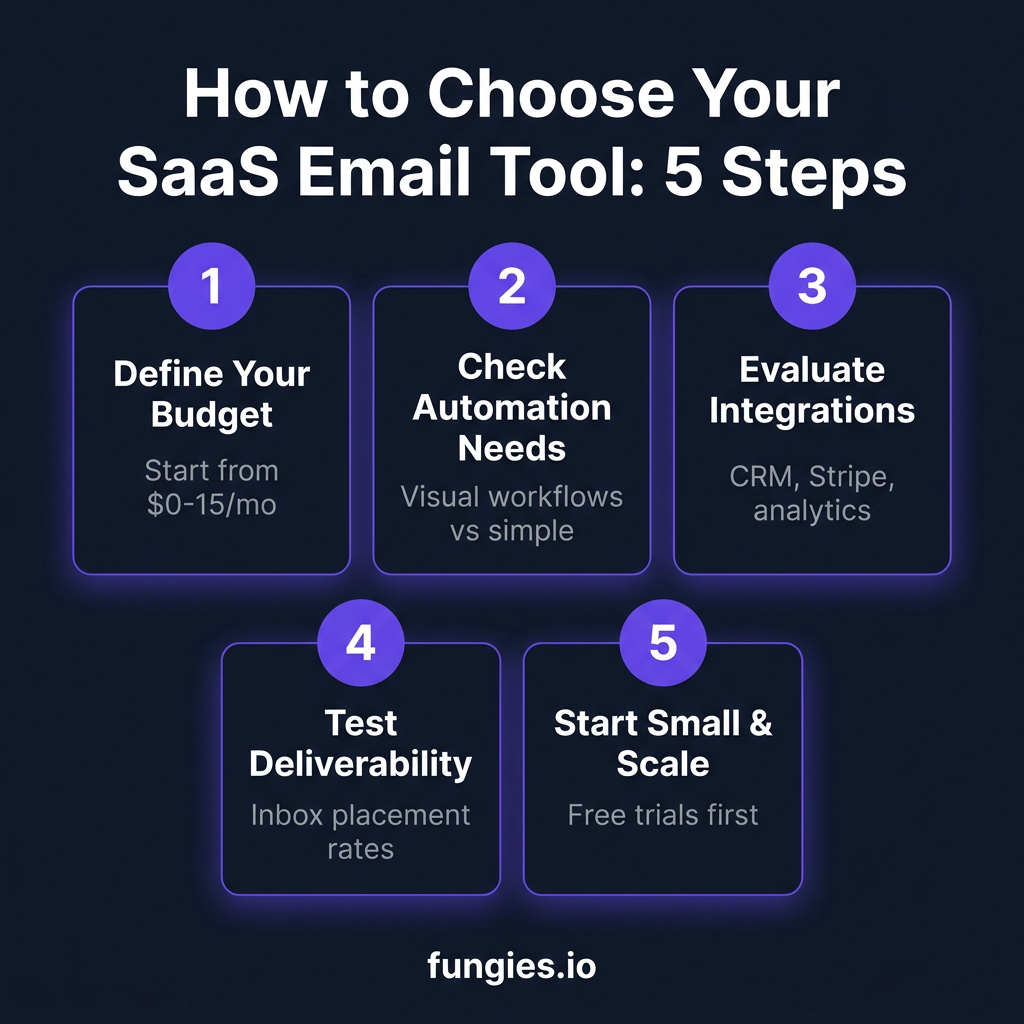
1. Define Your Budget Realistically
Don’t just look at starting prices. Email marketing costs scale with your list size. A tool that’s $15/month at 1,000 contacts might be $400/month at 50,000. Project your costs 12-24 months out based on your growth targets.
2. Assess Your Automation Needs
Do you need simple drip sequences or complex multi-branch workflows? If you’re just sending weekly newsletters and basic onboarding emails, you don’t need ActiveCampaign’s 135 triggers. If you’re running sophisticated lifecycle campaigns with multiple entry points and conditional logic, you do.
3. Check Your Integration Requirements
Your email tool needs to talk to your CRM, analytics, payment processor, and product. Check native integrations before committing. Zapier can fill gaps, but native integrations are more reliable and faster.
4. Test Deliverability Before Committing
The best email in the world doesn’t matter if it hits spam. Most platforms offer deliverability monitoring. Run a pilot campaign of a few hundred emails and measure inbox placement using a seed list before migrating your entire list.
5. Start Small and Scale
Don’t over-engineer your email setup on day one. Start with a basic onboarding sequence and weekly newsletter. As you learn what works, add complexity. Most SaaS companies never use 80% of the features in enterprise email platforms.
Frequently Asked Questions
What’s the most important email sequence for SaaS?
Your onboarding sequence. The emails you send in the first week after signup have the biggest impact on activation and retention. A good onboarding sequence can double your activation rate. Focus here before building complex nurture campaigns.
Should I combine transactional and marketing email?
For most SaaS companies, yes. A unified platform keeps your subscriber data in one place and maintains consistent sender reputation. Tools like Loops, Sequenzy, and Resend handle both. The main reason to separate them is if you need best-in-class deliverability for transactional email (use Postmark) alongside feature-rich marketing automation.
How do I reduce churn with email marketing?
Email is one of the most effective channels for churn prevention. Set up automated sequences that detect disengagement signals — reduced logins, feature usage drops — and intervene with re-engagement campaigns before the customer decides to cancel. Dunning emails for failed payments also recover significant revenue.
What’s a good email open rate for SaaS?
Industry averages vary, but for SaaS onboarding emails, you should see 40-60% open rates. Newsletters typically land in the 20-30% range. If your onboarding emails are below 30%, something is wrong — either deliverability issues or weak subject lines.
Can I switch email platforms later?
Yes, but plan carefully. Most platforms allow you to export subscriber lists with tags and custom attributes. What you typically lose is historical engagement data (opens, clicks) and automation workflows, which need to be rebuilt. The earlier you choose the right tool, the less painful migration will be.
Final Thoughts: Start With the Basics
Honestly, most SaaS founders overthink email marketing. They spend weeks comparing platforms, debating automation strategies, and building complex workflows before sending a single email.
Here’s what actually matters: pick a tool that fits your budget and technical capabilities, set up a basic onboarding sequence, and start sending. You can always upgrade or switch later. The best email marketing tool is the one you’ll actually use.
If you’re just starting out, I’d recommend Kit for the generous free tier or Loops if you want a modern, unified platform. For established SaaS with complex needs, ActiveCampaign or Customer.io are worth the investment. And if you’re running a sales-led B2B motion, HubSpot’s CRM integration is hard to beat.
Whatever you choose, remember: email marketing is a long game. The SaaS companies winning with email today started building their lists years ago. The best time to start was yesterday. The second best time is today.
Ready to grow your SaaS? Get started with Fungies and handle your payments, tax compliance, and checkout in one platform — so you can focus on building great email campaigns.