Here’s a stat that should keep every SaaS founder up at night: executives spend just 11.5 hours over their entire business lifetime on pricing strategy. That’s less time than most people spend choosing a new laptop. Yet this oversight costs companies 10-15% of potential revenue annually.
Honestly? Most SaaS companies treat pricing like a set-it-and-forget-it decision. They pick a number, slap it on a pricing page, and hope for the best. But the data tells a different story. Companies using value-based pricing metrics grow at 2x the rate of those that don’t. Hybrid pricing models (subscription + usage) report the highest median growth rate at 21%.
What Is SaaS Pricing Strategy?
SaaS pricing strategy is the framework you use to charge customers for your software. It defines what customers pay for (users, features, usage), how much they pay, and when they pay. Your pricing model isn’t just about revenue—it’s a strategic lever that determines which customers you attract, how quickly you grow, and whether your business ultimately succeeds.
The right pricing structure aligns your product with customer needs, differentiates your offering from competitors, and supports long-term monetization. Get it wrong, and you’ll struggle with low conversion rates, high churn, and stalled growth. Get it right, and pricing becomes your most efficient profit lever.
Why Your Pricing Strategy Matters More Than You Think
Pricing directly influences your unit economics—the relationship between customer acquisition cost (CAC) and lifetime value (LTV). Companies that optimize pricing can support higher CAC ratios while maintaining healthy margins. This matters because CAC in B2B SaaS averages $205 per customer. Losing customers to poor pricing strategy means burning that money repeatedly.
Net Revenue Retention (NRR) above 100% is a key metric attracting institutional investment. For public SaaS companies, the average NRR is around 114%, with pricing directly influencing this metric through upsells and retention. Companies with NRR above 120% demonstrate pricing power and product stickiness that correlates with long-term market dominance.
Your billing cadence also impacts cash flow predictability. Annual billing provides 80-90% revenue predictability compared to just 60-70% for monthly models, while reducing payment processing fees by 83%. The operational efficiency gains compound as you scale.
10 Best SaaS Pricing Strategies for 2026
After analyzing data from hundreds of SaaS companies and researching the latest industry benchmarks, here are the 10 most effective pricing strategies for 2026. Each has its place depending on your product, market, and growth stage.
1. Value-Based Pricing
Value-based pricing sets prices based on the perceived value your product delivers to customers, rather than your costs or competitor prices. This approach requires deep customer research to understand what outcomes they value most.
Key Features:
- Prices tied to measurable customer outcomes (time saved, revenue generated)
- Requires clear value metrics that correlate with customer success
- Enables premium pricing for high-value use cases
- Demands continuous customer research and validation
Best For: SaaS products with clear, measurable ROI where customers can easily quantify the value received. Think analytics platforms, revenue optimization tools, or automation software.
2. Tiered Subscription Pricing (Good-Better-Best)
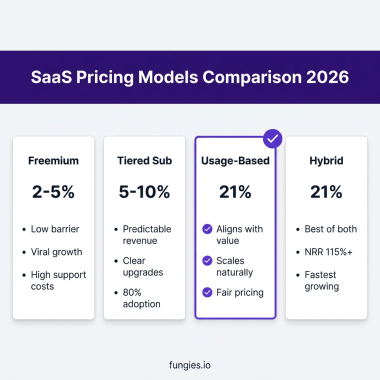
The most widely adopted SaaS pricing model. Customers select from multiple subscription tiers, each with increasing features, support levels, and usage limits. Companies typically offer an average of 3.5 tiers.
Key Features:
- Highly predictable recurring revenue (80-90% predictability with annual billing)
- Clear upgrade paths maximize customer lifetime value
- Appeals to different buyer personas simultaneously
- 5-10% annual churn for annual plans vs 30-50% for monthly
Best For: Most B2B SaaS products, especially those serving multiple customer segments from SMB to enterprise. Examples include Slack, HubSpot, and Salesforce.
3. Usage-Based Pricing
Customers pay for actual consumption—measured by API calls, data processed, storage consumed, or transactions. This creates perfect alignment between costs incurred and value delivered.
Key Features:
- Lowers barrier to entry (small users pay proportionally less)
- Scales revenue with customer growth without friction
- 38% of SaaS companies now employ usage-based pricing
- Requires robust metering infrastructure
Best For: Infrastructure products, APIs, data platforms, and any service where usage varies dramatically by customer. Examples: AWS, Stripe, Snowflake.
4. Hybrid Pricing (Subscription + Usage)
Hybrid models combine a base subscription fee with usage overage charges. This structure balances predictability with fairness—and it’s driving the highest growth rates in SaaS.
Key Features:
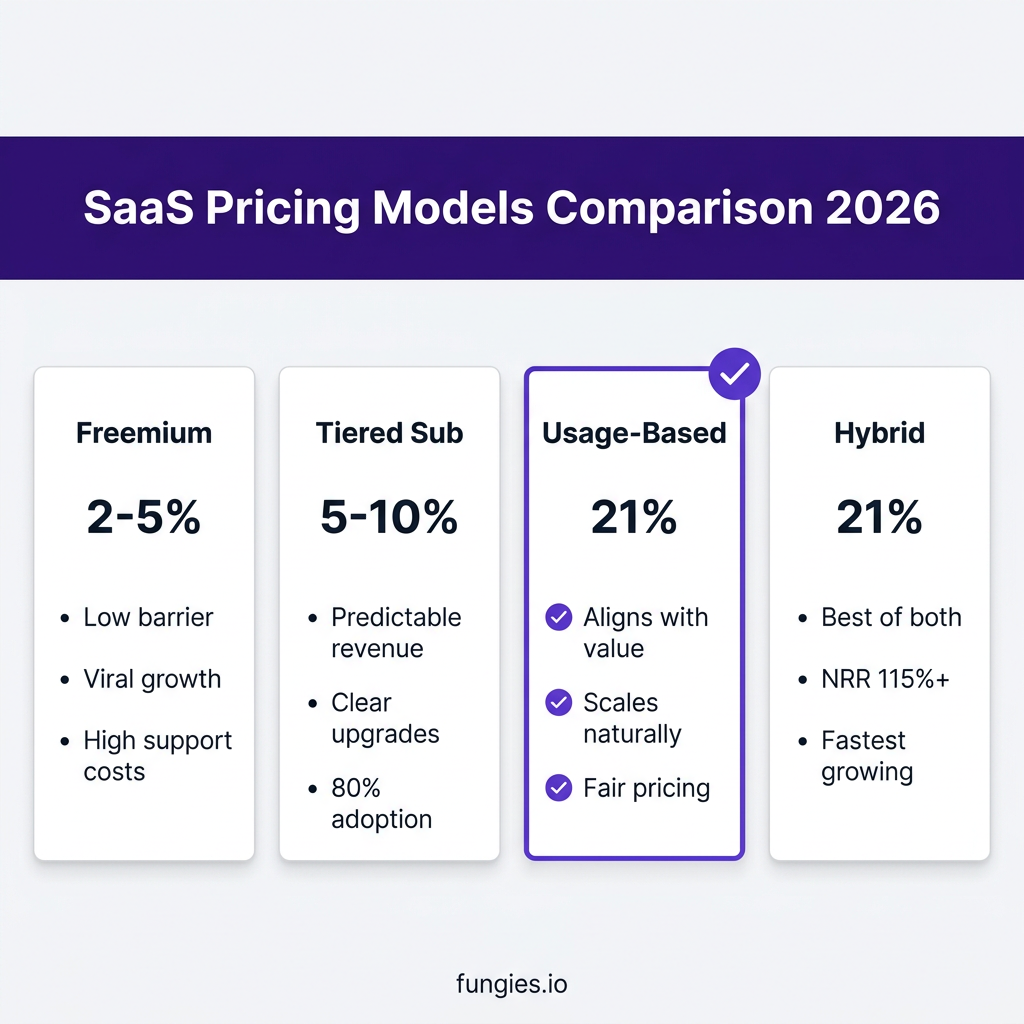
- Highest median growth rate at 21%, outperforming pure models
- 57% of teams achieve NRR above 100%
- Provides revenue predictability plus growth potential
- Prevents “whale” customers from consuming disproportionate resources
Best For: Growing SaaS companies that want predictable revenue while capturing upside from power users. This is becoming the dominant model for scaling SaaS.
5. Freemium Pricing
The freemium model offers a free basic tier with paid premium features. Users access core functionality at no cost while paying to unlock advanced capabilities, premium support, or increased usage limits.
Key Features:
- Dramatically lowers acquisition friction (zero-price effect)
- Ideal conversion rates: 2-5% for B2B SaaS
- Builds large user bases quickly through viral adoption
- Requires strong product-market fit to justify free tier investment
Best For: Products with strong network effects (communication tools, collaboration platforms) or low marginal costs. Think Slack, Notion, or Canva.
6. Per-Seat (Per-User) Pricing
Customers pay a fixed amount per user or team member, regardless of usage levels. The total bill scales linearly with headcount. This model creates transparent pricing that’s easy to forecast.
Key Features:
- Transparent and easy for customers to understand and budget
- Revenue scales naturally with customer growth
- Works well when value clearly ties to user count
- Can create ceiling effects where customers limit seat adoption
Best For: Collaboration tools, CRM systems, and project management software where value increases with each additional user.
7. Outcome-Based Pricing
An emerging model where customers pay only after achieving specific, measurable results—such as revenue generated, costs saved, or tasks completed. This represents the ultimate alignment between price and value.
Key Features:
- Maximum alignment between vendor and customer incentives
- Requires clear attribution of outcomes to your product
- High trust requirement—customers must believe you’ll deliver
- Complex to implement but powerful when done right
Best For: Performance marketing tools, sales enablement platforms, and any product where outcomes are directly measurable and attributable.
8. Feature-Based Pricing
Customers pay based on which features they access, with higher tiers unlocking more advanced functionality. This differs from tiered pricing by allowing more modular selection.
Key Features:
- Allows customers to build custom packages
- Clear upgrade path through feature gating
- Enables precise value capture for premium features
- Can become complex if not well-designed
Best For: Products with distinct feature modules serving different use cases, or platforms with wide functionality ranges.
9. Dynamic/Personalized Pricing
Prices adjust based on customer segment, usage patterns, or market conditions. This can include regional pricing (purchasing power parity) or segment-specific offers.
Key Features:
- Regional pricing increases global revenue by 25-40%
- Enables price discrimination by willingness to pay
- Requires sophisticated pricing infrastructure
- Risk of customer backlash if perceived as unfair
Best For: Global SaaS companies serving markets with different purchasing power, or products with highly variable value by segment.
10. Free Trial Pricing (Opt-In vs Opt-Out)
While not a long-term pricing model, how you structure free trials significantly impacts conversion. Opt-in trials (no credit card) convert at 17-18%, while opt-out trials (credit card required) convert at 48-50%.
Key Features:
- Opt-in drives 3-5x higher trial volume but lower conversion
- Opt-out filters for higher intent but reduces signups by 60-70%
- Trial length typically 14-30 days for B2B SaaS
- Time-to-paid conversion averages 12-18 days for trials
Best For: All SaaS products should offer trials—the question is opt-in vs opt-out. Enterprise products often benefit from opt-in, while SMB products may prefer opt-out.
SaaS Pricing Strategy Comparison Table
| Pricing Model | Growth Rate | Revenue Predictability | Best For |
|---|---|---|---|
| Value-Based | 2x vs non-value | Medium | High-ROI tools |
| Tiered Subscription | 19% median | High (80-90%) | Multi-segment SaaS |
| Usage-Based | 18% median | Low-Medium | Infrastructure/APIs |
| Hybrid | 21% median | High | Scaling SaaS |
| Freemium | Variable | Low | Viral/PLG products |
| Per-Seat | Steady | High | Collaboration tools |
| Outcome-Based | Emerging | Variable | Performance tools |
| Feature-Based | Steady | Medium | Modular platforms |
| Dynamic | Variable | Medium | Global SaaS |
| Free Trial | Conversion lever | N/A | All SaaS |
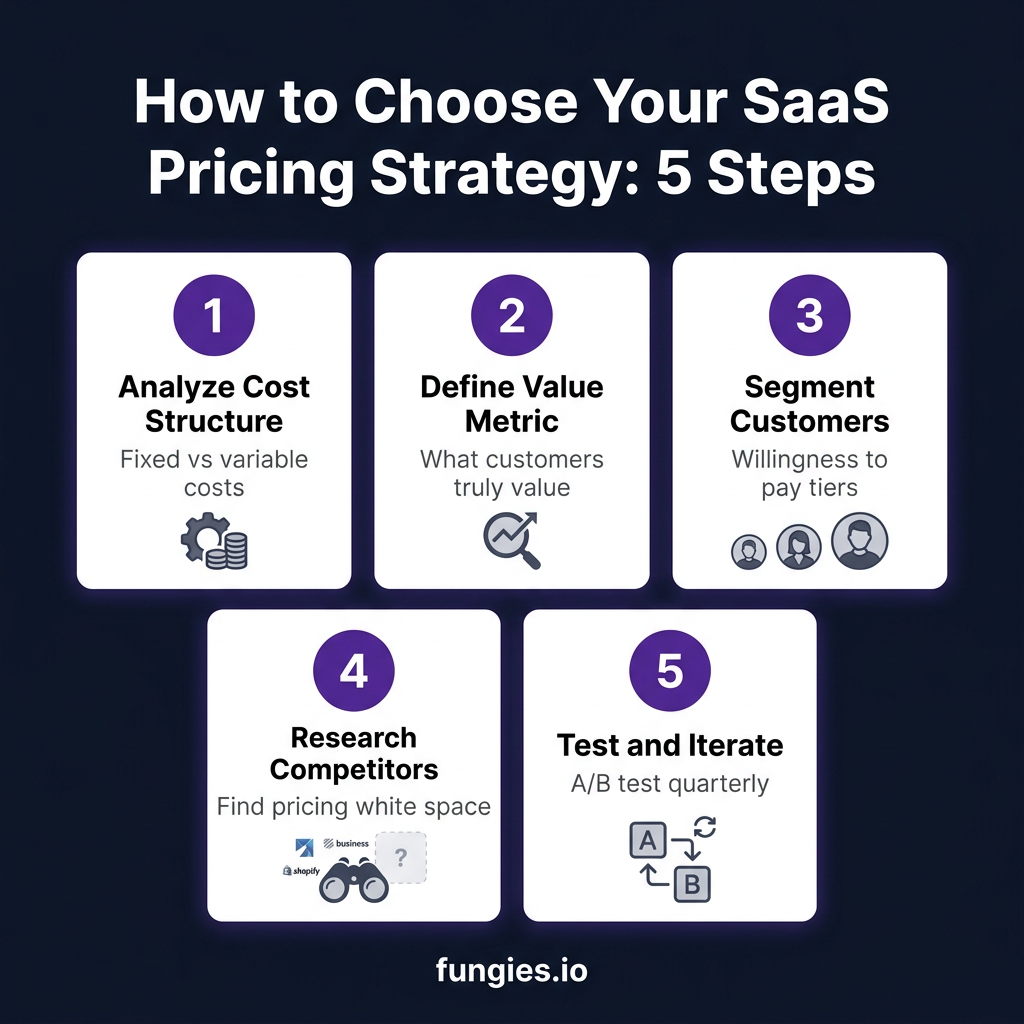
How to Choose the Right Pricing Strategy for Your SaaS
Choosing the right pricing strategy isn’t about copying your competitors. It’s about aligning your pricing with your cost structure, customer value, and growth stage. Here’s a framework to help you decide:
Step 1: Understand Your Cost Structure
Your pricing model should align with how costs scale in your business. Fixed-cost businesses (content libraries, pre-built tools) favor subscription models. Variable-cost businesses (compute, storage, API calls) favor usage-based models. Hybrid cost structures benefit from hybrid pricing.
Step 2: Define Your Value Metric
Your value metric is the unit that ties price to value delivery. Examples: messages sent (Slack), transactions processed (Stripe), data processed (Snowflake). The ideal value metric satisfies three criteria: customers understand it intuitively, it correlates with value delivered, and it aligns with your cost structure.
Step 3: Analyze Customer Segmentation
Map your customers across willingness to pay, usage patterns, and predictability requirements. Enterprise often demands predictability (subscription), SMB values flexibility (usage-based), and startups value low barriers (freemium).
Step 4: Research Competitive Pricing
While copying competitors is a mistake, understanding the landscape is essential. Use competitive research to identify white space—underserved segments or pricing approaches competitors haven’t adopted yet.
Step 5: Test and Iterate
Validate through landing page testing, A/B testing different tiers, customer interviews, and cohort analysis. Companies reviewing pricing quarterly grow 23% faster than those reviewing annually.
Common SaaS Pricing Mistakes to Avoid
Even with the right strategy, execution matters. Here are the most common pricing mistakes I see SaaS companies make:
- Spending insufficient time on pricing: 11.5 hours over a business lifetime is nowhere near enough. Dedicate resources to pricing optimization.
- Setting pricing without a clear value metric: Companies using value metrics grow at 2x the rate of those that don’t.
- Excessive discounting: 80% of SaaS companies discount by 25%+, but these customers churn at 3-5x higher rates.
- Set-and-forget pricing: Companies reviewing pricing quarterly grow 23% faster than those reviewing annually.
- Poor tier design: If more than 60% of customers choose your lowest tier, your basic tier is too feature-rich.
FAQ: SaaS Pricing Strategy
How often should I review my SaaS pricing?
Early-stage companies should review pricing quarterly and adjust every 6 months. Mature companies should review quarterly but adjust every 6-12 months. Never go more than 12 months without reviewing pricing data. Companies reviewing quarterly grow 23% faster than those reviewing annually.
What’s the ideal number of pricing tiers?
The industry standard is 3-4 tiers. Research shows companies typically offer an average of 3.5 tiers. Three tiers work well for simple products (Basic, Professional, Enterprise), while four tiers accommodate more complex segmentation. More than 5 tiers creates analysis paralysis and reduces conversion.
Should I require a credit card for free trials?
It depends on your goals. Card-required trials convert at 48-50% while card-optional trials convert at 17-18%. However, card-optional drives 3-5x higher trial volume. For enterprise products targeting high-value customers, card-optional works better. For SMB products needing volume, card-required filters for higher intent.
What’s a healthy LTV:CAC ratio for SaaS?
The ideal minimum is 3:1 (earn three dollars over customer lifetime for every dollar spent acquiring). Top quartile performers achieve 5:1 or higher through superior retention and expansion. Companies with LTV:CAC below 3:1 struggle to achieve profitability without significant pricing or efficiency improvements.
Should I offer annual discounts?
Yes, annual discounts are standard practice. Typical discounts range from 15-20% for annual versus monthly billing. Annual billing reduces churn by 20-30%, improves revenue predictability from 60-70% to 80-90%, and reduces payment processing fees by 83%. The discount pays for itself through improved retention and cash flow.
Conclusion: Make Pricing Your Growth Lever
Selecting the right pricing strategy represents one of the highest-leverage decisions in building a SaaS business. Your pricing model should align with your cost structure, reflect customer value, enable clear segmentation, support your growth stage, and drive the behaviors you want.
Whether you choose value-based pricing for maximum revenue capture, hybrid models for the best growth rates, or freemium for rapid market penetration, the key is treating pricing as a strategic lever worthy of ongoing focus and optimization.
Ready to implement a pricing strategy that scales? Get started with Fungies.io—the Merchant of Record platform that handles all your billing, tax compliance, and global payments with transparent 5% + $0.50 pricing. No monthly fees. No hidden charges. Just predictable, scalable revenue infrastructure for your SaaS.