Here’s a sobering statistic: the average SaaS company loses 3.5% of its customers every month to churn. For a business with $100K MRR, that’s $3,500 walking out the door monthly — $42,000 annually. And that’s just the average. Some verticals see churn rates as high as 7-10%.
The worst part? By the time you notice a customer is at risk, it’s usually too late to save them. They’ve already mentally checked out, evaluated alternatives, and made the switch. That’s where churn prediction software comes in — and why it’s become one of the highest-ROI investments for SaaS companies in 2026.
What Is Churn Prediction Software?
Churn prediction software uses machine learning and behavioral analytics to identify which customers are likely to cancel their subscriptions before they actually do. Instead of reactive firefighting when a customer submits a cancellation request, these tools give you a 30-60 day heads-up to intervene proactively.
Here’s how it works in practice: the software analyzes patterns across your product usage data, support tickets, billing history, and CRM activity. It looks for signals like declining login frequency, reduced feature adoption, increased support requests, or payment failures. When the algorithm detects a combination of risk factors, it flags the account and alerts your customer success team.
The best tools don’t just predict churn — they tell you why a customer is at risk and recommend specific actions to take. This transforms customer success from a reactive cost center into a proactive revenue protection engine.
Why Churn Prediction Matters More Than Ever in 2026
Customer acquisition costs have skyrocketed across every SaaS vertical. According to recent benchmarks, B2B SaaS CAC has increased 60-70% since 2022. When it costs 5-7x more to acquire a new customer than retain an existing one, reducing churn isn’t just nice to have — it’s essential for survival.
Consider this: a 5% reduction in churn can increase profitability by 25-95%, depending on your business model. For SaaS companies with recurring revenue, the compounding effect of retention is even more dramatic. A customer who stays for 3 years instead of 1 generates 3x the LTV without any additional acquisition spend.
But here’s the challenge most SaaS teams face: they don’t know which customers are at risk until it’s too late. Traditional health scores based on simple rules (“logged in within 30 days = healthy”) miss the nuanced behavioral patterns that actually predict churn. Modern AI-powered tools analyze hundreds of data points to surface risks that human intuition would never catch.
10 Best Churn Prediction Software for SaaS in 2026
After evaluating 20+ platforms across accuracy, ease of use, integrations, and pricing, here are the 10 best churn prediction tools for SaaS companies in 2026.
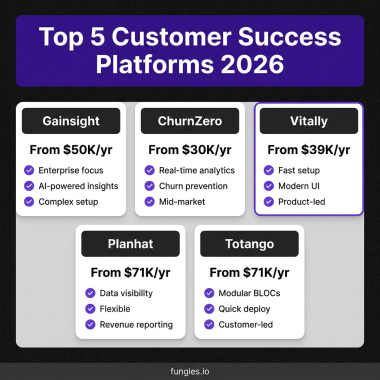
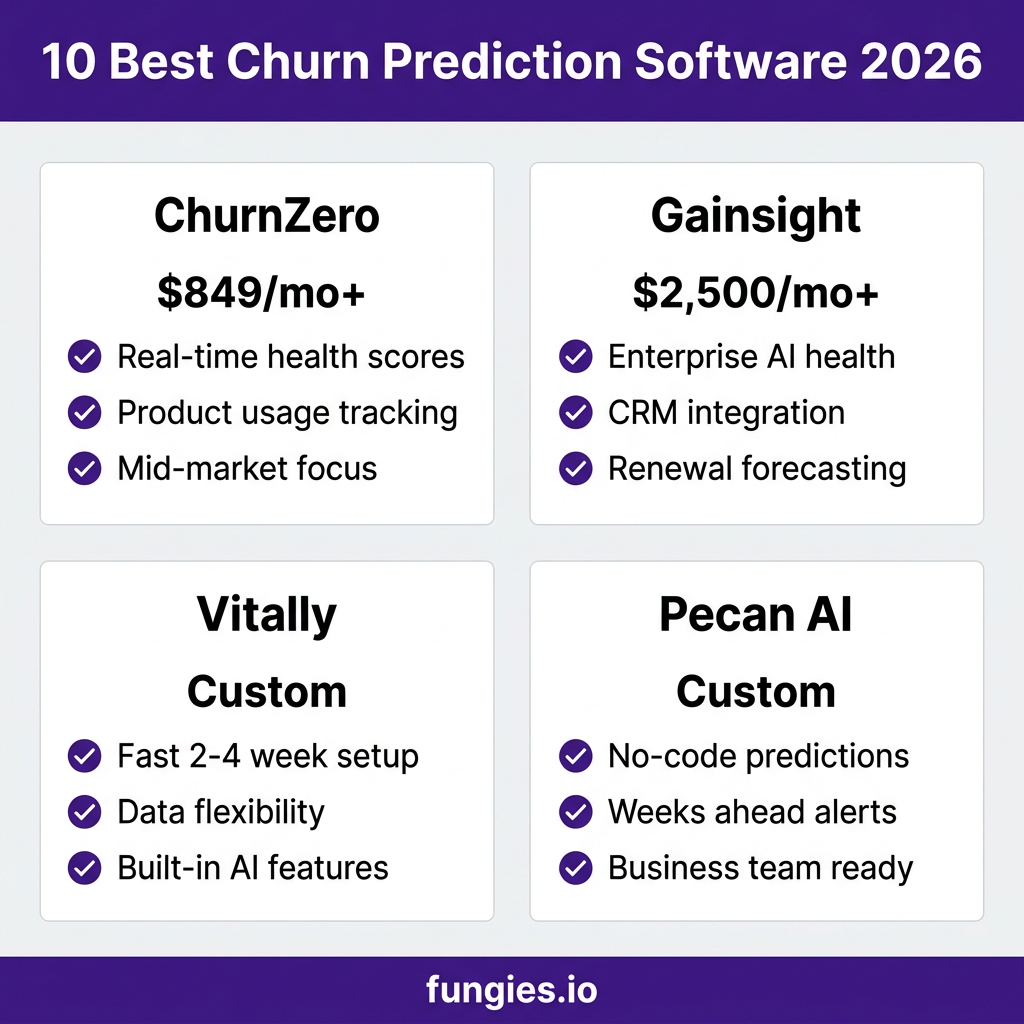
1. ChurnZero — Best for Mid-Market SaaS
ChurnZero is purpose-built for customer success teams at mid-market SaaS companies. Unlike enterprise platforms that require months of implementation, ChurnZero gets you up and running in weeks with real-time health scoring and automated playbooks.
- Key Features: Real-time health scores, in-app engagement tools, automated workflows, product usage tracking
- Integrations: Salesforce, HubSpot, Slack, Zendesk, Mixpanel, Segment
- Pricing: Starts around $849/month; most mid-market teams pay $1,500-$3,000/month
- Best For: SaaS companies with 50-500 customers who need fast time-to-value
2. Gainsight — Best for Enterprise
Gainsight is the 800-pound gorilla of customer success platforms. It’s built for enterprise teams running CS as a revenue discipline across complex account hierarchies. If you need renewal forecasting, NRR planning, and executive-ready reporting, Gainsight delivers.
- Key Features: Multi-signal health scoring, renewal forecasting, Success Plans, advanced lifecycle orchestration
- Integrations: Deep Salesforce integration, plus 50+ connectors
- Pricing: Enterprise pricing starts around $2,500/month; median customer pays $84,000/year
- Best For: Large SaaS companies ($1M+ ARR) with dedicated CS ops teams
3. Vitally — Best for Data-Driven Teams
Vitally stands out for its flexibility and speed of implementation. With one of the fastest setup times in the industry (2-4 weeks average), it’s ideal for teams that want powerful analytics without the enterprise overhead.
- Key Features: Flexible data integration, built-in AI features, advanced collaboration tools, customizable health scoring
- Integrations: 100+ native integrations including data warehouses
- Pricing: Custom pricing based on customer count; typically $1,000-$2,500/month
- Best For: Mid-market B2B SaaS with data-savvy CS teams
4. Pecan AI — Best No-Code Option
Pecan AI takes a different approach: instead of being a full CS platform, it’s a predictive AI agent that identifies at-risk accounts weeks in advance. The best part? You don’t need a data science team to use it.
- Key Features: No-code predictive modeling, automated data preparation, weeks-ahead churn alerts, CRM integration
- Integrations: Salesforce, HubSpot, Snowflake, BigQuery, Redshift
- Pricing: Custom pricing based on data volume and prediction frequency
- Best For: Teams without data scientists who need fast, accurate predictions
5. Pendo Predict — Best for Product-Led Growth
Pendo Predict leverages the product usage data Pendo already collects to generate AI-powered churn predictions. If you’re already using Pendo for product analytics, adding Predict is a no-brainer.
- Key Features: Product behavioral data analysis, in-app guidance triggers, expansion opportunity detection
- Integrations: Salesforce, HubSpot, Slack, plus full Pendo suite
- Pricing: Custom pricing; requires existing Pendo subscription
- Best For: Product-led SaaS companies already using Pendo
6. Kumo.ai — Best for Relational Data
Kumo.ai uses graph neural networks to analyze relational data patterns that other tools miss. It can detect when a customer’s peers are churning — a signal that flat-table models are blind to.
- Key Features: Graph-based predictions, multi-table data analysis, 89% accuracy on enterprise benchmarks
- Integrations: Data warehouse connectors (Snowflake, Databricks, BigQuery)
- Pricing: Custom enterprise pricing
- Best For: Data-mature companies with complex customer relationships
7. DataRobot — Best for Advanced ML Teams
DataRobot is an AutoML platform that includes churn prediction among its many use cases. It’s overkill if you just need churn prediction, but powerful if you want to build custom models across multiple business problems.
- Key Features: Automated machine learning, model explainability, deployment automation
- Integrations: Extensive API and data connector ecosystem
- Pricing: Starts around $2,500/month for production deployments
- Best For: Growth-stage SaaS with data science teams
8. Churnkey — Best for Voluntary Churn Prevention
Churnkey focuses specifically on the cancellation flow — using personalized offers, surveys, and retention tactics to save customers at the moment they’re trying to leave. It’s not predictive, but it’s highly effective at the bottom of the funnel.
- Key Features: Cancellation flow optimization, personalized retention offers, exit surveys, dunning
- Integrations: Stripe, Paddle, Chargebee, Recurly
- Pricing: Usage-based; typically $200-$800/month
- Best For: SaaS companies with high cancellation rates needing immediate intervention
9. Zendesk AI — Best for Support-Driven Churn
Zendesk’s AI-powered QA tools analyze 100% of customer interactions across support channels to gauge sentiment and predict churn risk. If support quality is a key retention driver for your business, this is worth considering.
- Key Features: Sentiment analysis across all channels, Spotlight feature for urgent cases, AI-powered QA
- Integrations: Native Zendesk ecosystem
- Pricing: Included in Zendesk Suite Enterprise ($149/agent/month+)
- Best For: Companies already using Zendesk with support-heavy customer relationships
10. Userpilot — Best for In-App Engagement
Userpilot combines product analytics with churn prediction and in-app engagement tools. It’s particularly strong for teams that want to act on predictions directly within the product experience.
- Key Features: Product analytics, churn prediction, in-app guidance, user segmentation
- Integrations: Segment, Amplitude, Mixpanel, Salesforce, HubSpot
- Pricing: Starts at $249/month; prediction features on higher tiers
- Best For: Product-led SaaS wanting integrated analytics and engagement
Churn Prediction Software Comparison Table
| Tool | Best For | Starting Price | Setup Time | Key Strength |
|---|---|---|---|---|
| ChurnZero | Mid-market SaaS | $849/mo | 2-4 weeks | Real-time health scores |
| Gainsight | Enterprise | $2,500/mo | 2-3 months | Renewal forecasting |
| Vitally | Data-driven teams | Custom | 2-4 weeks | Flexible data integration |
| Pecan AI | No-code predictions | Custom | 1-2 weeks | Business team ready |
| Pendo Predict | PLG companies | Custom | 1-2 weeks | Product usage insights |
| Kumo.ai | Complex data | Custom | 2-4 weeks | Relational predictions |
| DataRobot | ML teams | $2,500/mo | 4-8 weeks | Advanced AutoML |
| Churnkey | Cancellation flow | $200/mo | 1 week | Retention offers |
| Zendesk AI | Support-driven | $149/agent | 2-3 weeks | Sentiment analysis |
| Userpilot | In-app engagement | $249/mo | 1-2 weeks | Product analytics |
How to Implement Churn Prediction: A 5-Step Framework
Buying the software is just the start. Here’s how to actually make churn prediction work for your business.
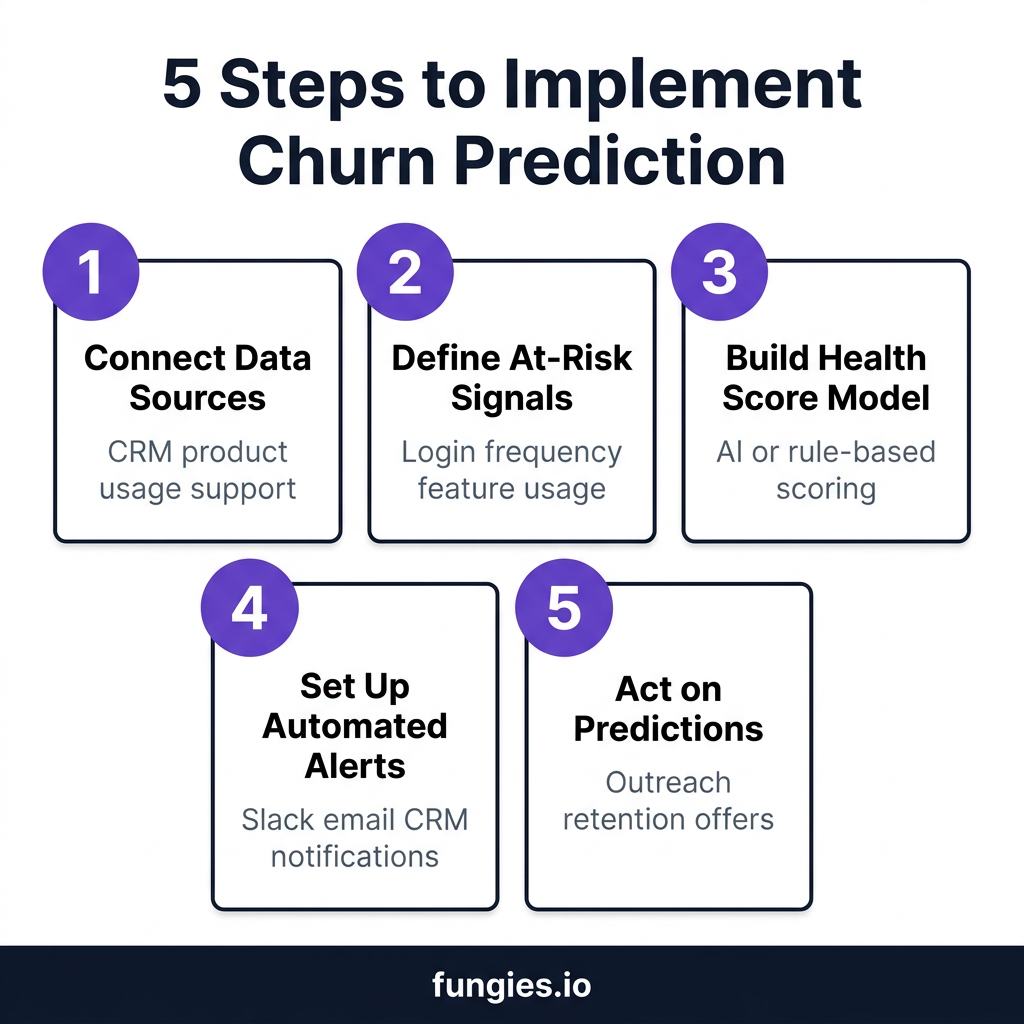
Step 1: Connect Your Data Sources
Churn prediction is only as good as the data you feed it. At minimum, you’ll want to connect your CRM (for account and contact data), product analytics (for usage patterns), support platform (for ticket history), and billing system (for payment data). The more data sources you integrate, the more accurate your predictions will be.
Step 2: Define At-Risk Signals
Work with your customer success team to identify the behaviors that typically precede churn. Common signals include declining login frequency, reduced feature usage, increased support tickets, NPS score drops, and payment failures. Don’t just guess — look at historical data from customers who’ve already churned to find patterns.
Step 3: Build Your Health Score Model
Most tools let you build either rule-based or AI-powered health scores. If you’re just starting out, begin with simple rules (e.g., “no login in 14 days = at risk”) and evolve to ML models as you collect more data. The key is to start simple and iterate based on results.
Step 4: Set Up Automated Alerts
Configure alerts to notify the right people when a customer becomes at-risk. This might be the assigned CSM, a Slack channel, or a specific email address. Make sure the alerts include context — why the customer is flagged and what actions to take.
Step 5: Act on Predictions
This is where most companies fail. Predictions are worthless without action. Create playbooks for different risk scenarios: a low-usage customer gets an onboarding refresher, a support-heavy account gets a check-in call, a payment-failing customer gets a dunning sequence. Track which interventions work and refine your approach.
Churn Prediction ROI: What to Expect
Let’s talk numbers. A typical mid-market SaaS company might pay $1,500-$3,000/month for churn prediction software. Is it worth it?
Here’s the math: if the tool helps you retain just 5 additional customers per month, and each customer is worth $500 MRR, that’s $2,500 in protected monthly revenue — or $30,000 annually. Most companies see ROI within 3-6 months.
But the real value goes beyond immediate retention. Churn prediction surfaces insights about product gaps, onboarding weaknesses, and customer segments you should avoid. These strategic insights can reshape your entire go-to-market approach.
FAQ: Churn Prediction Software
What’s the difference between churn prediction and customer health scoring?
Health scoring is typically rule-based (e.g., “logged in within 30 days = green”), while churn prediction uses machine learning to analyze hundreds of data points and identify patterns humans would miss. Health scores are simpler but less accurate; predictions are more sophisticated but require more data.
How accurate are churn prediction models?
Accuracy varies by tool and data quality. Simple rule-based models might achieve 60-70% accuracy, while advanced ML models from platforms like Kumo.ai can reach 85-90% on enterprise benchmarks. The key is measuring accuracy against your actual churn outcomes and continuously refining the model.
Can small SaaS companies benefit from churn prediction?
Honestly, if you have fewer than 100 customers, you’re probably better off with simple rules and direct customer relationships. Churn prediction becomes valuable when you have enough customers and data volume that manual monitoring becomes impossible — typically 200+ customers.
How long does it take to see results?
Most companies see initial insights within 2-4 weeks of implementation. However, it takes 3-6 months to fully train models on your specific customer patterns and build effective intervention playbooks. Churn prediction is a long-term investment, not a quick fix.
Do I need a data science team to use churn prediction software?
Not anymore. Platforms like Pecan AI and ChurnZero are built for business teams, not data scientists. They handle the technical complexity behind the scenes while giving you actionable insights. That said, having someone who understands data will help you get more value from the tool.
Final Thoughts: Start Before You Think You Need It
Here’s the thing about churn: by the time it becomes a visible problem, you’ve already lost months of revenue and damaged your growth trajectory. The SaaS companies that win are the ones that invest in retention early — when churn is still “manageable” and they have time to build the right systems.
If you’re doing $50K+ MRR and don’t have a systematic approach to predicting and preventing churn, you’re leaving money on the table. Pick a tool from this list, start with a simple implementation, and iterate. Your future self — and your revenue — will thank you.
Ready to reduce churn and grow your SaaS revenue? Get started with Fungies — we handle the payments, taxes, and billing complexity so you can focus on keeping customers happy.
Sources
- Average Churn Rate by Industry SaaS: 2025 Report – Focus Digital
- B2B SaaS Churn Rate Benchmarks – Optifai
- SaaS Churn Rate: How to Calculate and Improve – Orb
- Best Churn Prediction Tools for SaaS Teams – Pendo
- Best Churn Prediction Software for Enterprise – Kumo.ai
- Best Churn Prediction Software in 2026 – ChurnTools
- Compare ChurnZero and Gainsight – ChurnZero
- AI Customer Churn Prediction Software – Pecan AI