The digital marketing landscape has reached an unprecedented inflection point in 2026. With global spending projected to hit $818.6 billion this year and soar to $1.84 trillion by 2034, the industry is experiencing its most transformative phase yet. Artificial intelligence isn’t just augmenting marketing workflows—it’s fundamentally rewriting the rules of customer engagement, content creation, and campaign optimization. For businesses navigating this rapidly evolving ecosystem, understanding the data, trends, and competitive dynamics isn’t optional—it’s survival.
This comprehensive analysis draws from the latest market research, industry reports, and real-world performance data to give you the complete picture of where digital marketing stands in 2026 and where it’s headed. Whether you’re a CMO planning your annual budget, a marketing manager optimizing campaign performance, or a business owner looking to understand the landscape, this report provides the actionable insights you need to make informed decisions in an increasingly complex environment.

Market Overview: The $818.6 Billion Digital Marketing Ecosystem
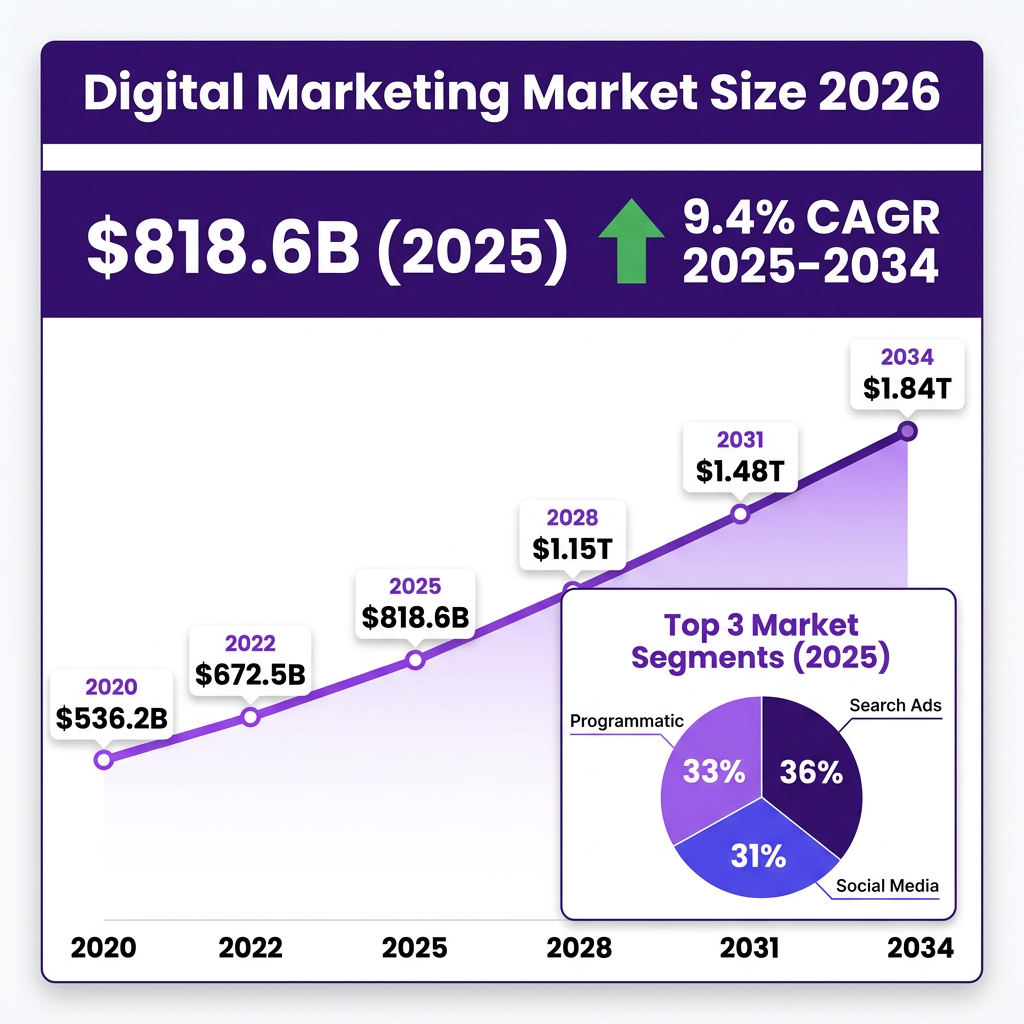
The global digital marketing market has evolved from an experimental channel to the dominant force in advertising. In 2025, the market reached approximately $734.6 billion in global ad spending, and 2026 marks a pivotal year as investment accelerates across all major categories. According to Dimension Market Research, the Global Digital Marketing Spending Market is anticipated to reach USD 818.6 billion in 2025 and expand at a compound annual growth rate (CAGR) of 9.4% between 2025 and 2034, ultimately reaching approximately USD 1.84 trillion by 2034.
This growth trajectory reflects a fundamental shift in how businesses allocate their marketing budgets. Digital channels now command the majority of advertising investment globally, with traditional media continuing to lose share. The acceleration is driven by several converging factors: the proliferation of internet and smartphone users worldwide, the increasing sophistication of targeting and personalization technologies, and the measurable ROI that digital channels provide compared to traditional alternatives.
The market’s composition reveals interesting dynamics across different segments. Search engine marketing remains the largest single category, with Google continuing to dominate despite increasing competition from Microsoft and emerging AI-powered search alternatives. Social media marketing has grown to represent over 20% of total digital ad budgets, with spending projected to reach $219 billion in 2026. Video advertising now accounts for 38% of total digital ad budgets, reflecting the dominance of short-form content and streaming platforms.
Mobile advertising deserves special attention as it approaches $495 billion in 2026, representing nearly half of all digital ad investments. This mobile-first reality has reshaped everything from creative formats to attribution models, forcing marketers to think in terms of thumb-stopping content and seamless mobile experiences. The shift to mobile isn’t just about screen size—it’s about context, immediacy, and the always-on nature of modern consumer behavior.
Regional variations in market maturity create both opportunities and challenges. North America remains the most developed programmatic advertising market, with the United States alone accounting for a significant portion of global spend. However, the fastest growth is occurring in Asia-Pacific markets, where mobile-first consumer behavior and rapidly expanding internet penetration are driving unprecedented investment in digital channels. Europe presents its own unique landscape, with stricter privacy regulations shaping how marketers can collect and use data.
The evolution of the digital marketing ecosystem reflects broader changes in consumer behavior and technology adoption. As consumers spend more time online and across multiple devices, the opportunities for marketers to reach them have multiplied—but so has the complexity of orchestrating coherent experiences. The $818.6 billion invested in digital marketing in 2026 represents not just advertising spend, but a massive bet on the continued digitalization of commerce, communication, and culture.
Key Statistics and Data Points Defining Digital Marketing in 2026
The numbers tell a compelling story about the scale and impact of digital marketing in 2026. Here are the critical statistics that every marketer, business owner, and strategist needs to understand to navigate this complex landscape effectively.
Global Market Metrics
The sheer scale of the digital marketing industry is staggering. The global market has grown from a niche channel to a dominant economic force that rivals traditional advertising in scope and impact. Understanding these macro-level metrics provides essential context for strategic planning and budget allocation.
- $818.6 billion: Global digital marketing spending in 2025-2026, representing the total investment across all digital channels including search, social, display, video, and emerging formats
- $1.84 trillion: Projected market size by 2034, indicating more than doubling over the next decade
- 9.4% CAGR: Compound annual growth rate through 2034, significantly outpacing overall economic growth
- $1.02 trillion: Total global ad spend projected for 2026, with digital capturing the majority share
- 65%: Share of total media spend commanded by digital channels, up from less than 50% just five years ago
- $495 billion: Mobile advertising spend in 2026, approaching half of all digital investment
- $457-654 billion: Range of estimates for the global digital marketing market depending on methodology and scope
Channel-Specific Performance
Not all digital channels are created equal. Each platform and format offers distinct advantages, audience characteristics, and performance benchmarks. Understanding these nuances is essential for effective budget allocation and campaign planning.
- $219 billion: Social media ad spend in 2026, up 14% from 2024, making it one of the fastest-growing categories
- 38%: Video advertising’s share of total digital ad budgets, reflecting the medium’s dominance in capturing attention
- $180 billion: Programmatic display advertising in the U.S. alone, demonstrating the scale of automated buying
- $32.55 billion: Influencer marketing market size in 2026, having grown from virtually nothing a decade ago
- 33% CAGR: Influencer marketing compound annual growth rate over the past decade, the fastest-growing major category
- $47.32 billion: AI marketing segment size in 2025, growing at an explosive 37% annually
- $24.55 billion: Programmatic advertising market size in 2025, projected to reach $237.16 billion by 2034
ROI and Performance Benchmarks
Return on investment remains the ultimate measure of marketing effectiveness. These benchmarks help marketers evaluate performance and justify continued investment in digital channels.
- $5: Average return for every $1 spent on digital marketing across all channels
- 4000% ROI: Email marketing return on investment, making it the highest-ROI digital channel
- $36-$79: Revenue generated per dollar spent on email and SMS marketing for e-commerce brands
- $2.5-$3: Return from paid advertising per dollar spent, varying significantly by platform and industry
- 30-60% higher CTR: Brands using AI creative generation achieve compared to manually designed ads
- 80% reduction: In creative production costs with AI automation platforms
- $5.78: Average return per dollar spent on influencer marketing
- 2-3 weeks to under 2 days: Reduction in time-to-launch for omnichannel campaigns with AI automation
Social Media and User Behavior
Understanding how consumers use social platforms is essential for effective marketing. These statistics reveal the scale of social media’s impact on consumer behavior and purchase decisions.
- 5.66 billion: Active social media users worldwide in 2026, representing over two-thirds of the global population
- 5.17 billion: People worldwide using social media regularly
- 2 hours 21 minutes: Average daily time spent on social media per user
- 60%+: Product discovery happening on TikTok, Instagram, and YouTube, surpassing traditional search
- 18%: Engagement rates on TikTok for creator content, the highest of any major platform
- 1.8%: Average social media post engagement rate across all platforms
- 73%: Consumers who say they’ll switch to a competitor if a brand doesn’t respond on social media
- 207 million: Active creators worldwide participating in the creator economy
AI and Automation Impact
Artificial intelligence is transforming every aspect of marketing operations. These statistics quantify the impact of AI adoption on productivity, performance, and profitability.
- 92%: Businesses wanting to invest in generative AI for marketing applications
- 75%: Reduction in campaign launch times with AI-powered workflows
- 47%: Improvement in click-through rates with AI-driven campaigns
- 30%: Increase in ROI from AI optimization across channels
- 63%: Organizations using generative AI reporting measurable productivity gains
- 86%: Sales teams seeing positive AI ROI within the first year of adoption
- 12%: Average profit margin lift from AI-driven pricing optimization
- 20-30%: Conversion rate improvement when companies integrate predictive AI
- 42%: Share of all business tasks expected to be automated by 2027
Programmatic Advertising Growth
Programmatic advertising has become the backbone of digital media buying. These statistics illustrate the scale and growth trajectory of automated advertising.
- $24.55 billion: Programmatic advertising market in 2025
- $237.16 billion: Projected programmatic market by 2034
- 28.66% CAGR: Programmatic advertising growth rate, among the fastest in digital marketing
- $15.68 billion: Global programmatic market size in 2025 (alternative research estimate)
- $38.84 billion: Expected programmatic market by 2030
- 19.5% CAGR: Growth rate through 2030
- 20%: Share of CTV ad inventory now bought programmatically
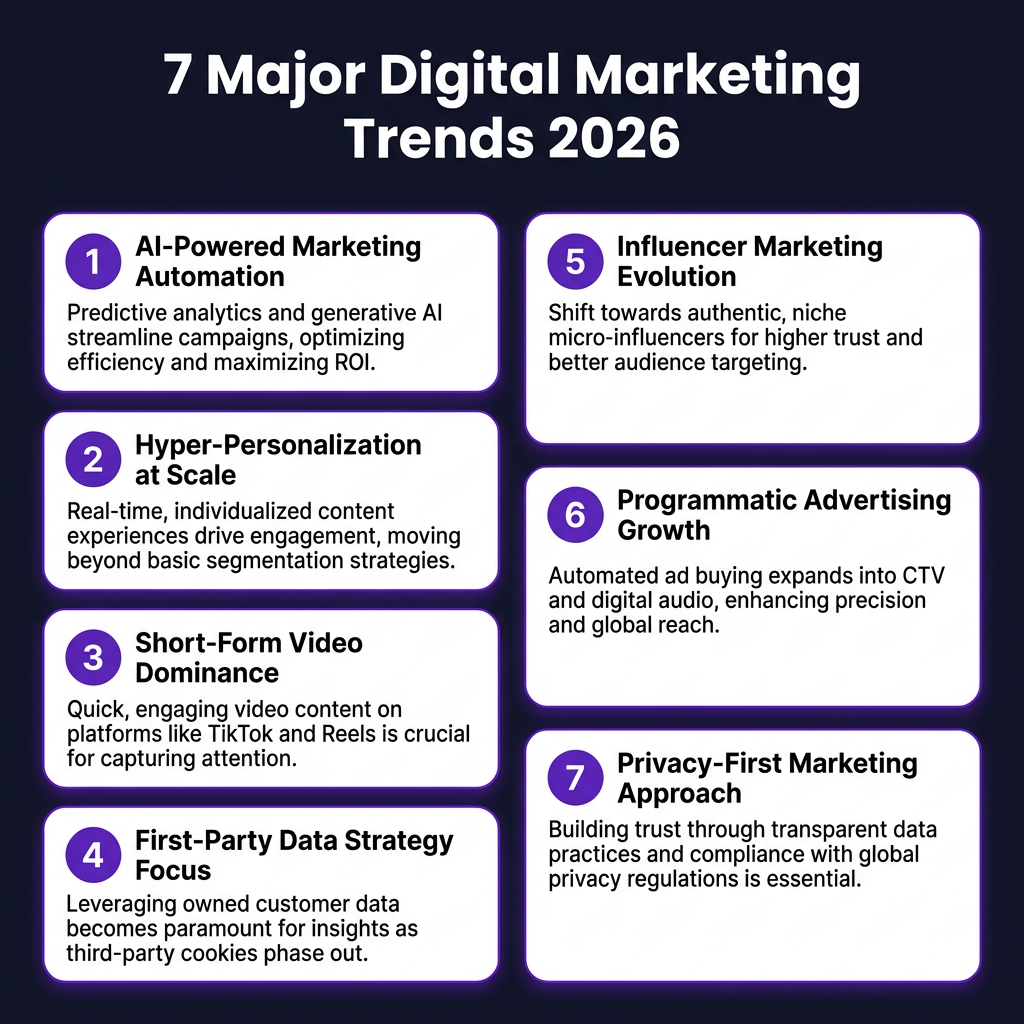
Seven Major Trends Shaping Digital Marketing in 2026
The digital marketing landscape of 2026 is defined by seven transformative trends that are reshaping how brands connect with consumers, optimize campaigns, and drive growth. Understanding these trends is essential for any organization seeking to maintain competitive advantage in an increasingly crowded and complex marketplace.
1. AI-Driven Decision Intelligence
Artificial intelligence has evolved from a supporting tool to the central nervous system of modern marketing operations. According to Zeta Global’s 2026 predictions, AI is becoming the operating system for marketing, with superintelligent marketing agents representing a new paradigm in how campaigns are planned, executed, and optimized. This shift goes beyond simple automation—AI now handles complex decision-making across targeting, creative optimization, budget allocation, and customer journey orchestration.
The impact is measurable and significant: AI-driven campaigns launch 75% faster while delivering 47% better click-through rates and up to 30% higher ROI. The key to success lies in adopting human-in-the-loop processes where AI agents and human marketers collaborate, combining machine precision with human creativity and strategic judgment. Organizations that fail to integrate AI into their marketing operations risk being outpaced by competitors who can move faster, optimize better, and deliver more personalized experiences at scale.
The applications of AI in marketing span the entire funnel. At the top, AI-powered tools can generate content variations, optimize headlines, and predict which creative elements will resonate with specific audiences. In the middle of the funnel, AI enables sophisticated lead scoring, predictive analytics for customer behavior, and automated nurturing sequences. At the bottom, AI optimizes conversion rates through dynamic pricing, personalized offers, and real-time bidding strategies.
2. Hyper-Personalization at Scale
Personalization has reached new heights in 2026, enabled by advances in AI and the strategic use of first-party data. Modern personalization goes beyond inserting a customer’s name into an email—it encompasses dynamic content adaptation, predictive product recommendations, individualized customer journeys, and real-time offer optimization based on behavioral signals. The convergence of adtech and martech finally allows marketers to deliver truly unified experiences across channels.
Identity-rich data, consistent decisioning, and cross-channel intelligence enable personalization that feels helpful rather than creepy, building trust while driving conversion. The key is using data to anticipate needs and deliver value, not just to push products. Customers increasingly expect brands to understand their preferences and deliver relevant experiences—but they’re also increasingly sensitive to privacy concerns and will quickly abandon brands that cross the line into invasive territory.
Successful hyper-personalization requires investment in customer data platforms, identity resolution capabilities, and real-time decisioning engines. It also requires organizational alignment—breaking down silos between marketing, sales, and customer service to ensure consistent experiences across touchpoints. The brands that master hyper-personalization will build deeper customer relationships and achieve sustainable competitive advantage.
3. Short-Form Video Dominance
Short-form video has become the dominant content format for both organic and paid marketing. TikTok, Instagram Reels, and YouTube Shorts collectively account for over 60% of product discovery, surpassing traditional search for many consumer categories. The format’s success stems from its ability to capture attention in seconds, deliver value quickly, and drive immediate engagement through likes, comments, and shares.
Video advertising now commands 38% of total digital ad budgets, and platforms are continuously innovating with shoppable video, interactive elements, and improved attribution. For marketers, this means rethinking creative production workflows to prioritize video-first content strategies. The shift to video isn’t just about format—it’s about storytelling, authenticity, and the ability to convey emotion and information in a compressed timeframe.
The platforms driving short-form video growth each have distinct characteristics. TikTok remains the leader in viral discovery and creator culture, with its algorithm capable of catapulting unknown creators to massive audiences overnight. Instagram Reels leverages the platform’s existing social graph and shopping infrastructure to bridge content and commerce. YouTube Shorts benefits from the platform’s massive user base and integration with Google’s advertising ecosystem.
4. First-Party Data Strategy
The deprecation of third-party cookies has accelerated the shift toward first-party data strategies. With Safari and Firefox having blocked third-party cookies years ago and Chrome’s timeline shifting, the reality is clear: the future of targeting and personalization depends on consented, first-party data collected directly from customers. This shift represents a fundamental change in how marketers think about data, moving from third-party acquisition to first-party cultivation.
Successful organizations are building direct customer relationships through email, loyalty programs, community platforms, and gated content. This shift requires investment in consent management infrastructure, customer data platforms, and privacy-compliant measurement systems—but the payoff is stronger customer relationships and more durable competitive advantage. First-party data is not only more privacy-compliant but also typically more accurate and actionable than third-party alternatives.
The transition to first-party data requires rethinking the entire customer experience. Every touchpoint becomes an opportunity to collect consented data and deepen the relationship. Value exchange is critical—customers will share information when they receive clear benefits in return, whether that’s personalized recommendations, exclusive content, or loyalty rewards. Organizations that build trust through transparent data practices will be positioned for long-term success.
5. Influencer Marketing Maturation
Influencer marketing has evolved from an experimental channel to a core component of the marketing mix. The industry is projected to reach $32.55 billion in 2026, having grown 19x since 2016. What’s changed is the sophistication: clear performance benchmarks, established pricing models, and increasingly sophisticated measurement capabilities now define the space. Influencer marketing is no longer about vanity metrics—it’s about driving measurable business results.
The data reveals important nuances that inform strategy. Nano-influencers achieve 1.73% engagement on Instagram versus 0.68% for mega-influencers, demonstrating that bigger isn’t always better. The average return of $5.78 per dollar spent makes influencer marketing one of the highest-ROI digital channels, though success depends heavily on creator selection and campaign strategy. Authenticity and alignment matter more than reach.
The influencer landscape is also diversifying. While Instagram remains the top platform preferred by 57% of brands, TikTok has emerged as a powerhouse for reaching younger demographics. YouTube continues to dominate for long-form content and evergreen discovery. LinkedIn is growing for B2B influencer marketing. Successful programs typically work across multiple platforms and creator tiers to achieve both reach and engagement.
6. Programmatic Advertising Expansion
Programmatic advertising has become the default transaction model for digital media. What started as a remnant-inventory exchange now encompasses display, video, audio, connected TV, retail media, and digital out-of-home. The market is projected to grow from $24.55 billion in 2025 to $237.16 billion by 2034 at a 28.66% CAGR. Programmatic is no longer just for direct response—it’s increasingly used for brand building and upper-funnel objectives.
Key developments include the convergence of formats and devices into single-workflow buying, the rise of retail media networks leveraging first-party shopper data, and privacy regulation accelerating contextual intelligence and clean-room adoption. For advertisers, programmatic offers efficiency, scale, and increasingly sophisticated targeting capabilities. The ability to buy across channels through a unified platform simplifies operations and enables better cross-channel optimization.
Retail media is a particularly dynamic segment of programmatic. Amazon, Walmart, Target, and other retailers are building significant advertising businesses by leveraging their first-party shopper data. This creates new opportunities for brands to reach consumers at the point of purchase intent, but also adds complexity as marketers must manage an expanding set of platforms and data sources.
7. Privacy-First Marketing
Privacy has moved from a compliance checkbox to a strategic imperative. Consumers expect transparency and control over their data, and regulations worldwide continue to tighten. The shift to privacy-first marketing requires fundamental changes in how campaigns are measured, how audiences are built, and how personalization is delivered. Privacy isn’t just about avoiding fines—it’s about building trust and sustainable competitive advantage.
Contextual advertising—serving ads based on content rather than user behavior—is experiencing a renaissance. Server-side tracking, consent management platforms, and privacy-preserving measurement techniques are becoming standard infrastructure. Organizations that embrace privacy as a competitive advantage are building stronger customer trust and more sustainable marketing operations. The brands that thrive will be those that deliver relevant experiences without crossing privacy boundaries.
The regulatory landscape continues to evolve. GDPR in Europe set the standard, but similar regulations are emerging worldwide. The patchwork of requirements creates complexity for global brands, but also opportunities for those who can navigate it effectively. Privacy-by-design is becoming the default approach, with data protection integrated into products and processes from the beginning rather than added as an afterthought.
Key Players and Competitive Landscape
The digital advertising duopoly of Google and Meta is experiencing a historic shift in 2026. For the first time, Meta is projected to surpass Google in global digital ad revenue, marking the end of an era that has lasted more than a decade. This shift reflects fundamental changes in how consumers discover products, how advertisers allocate budgets, and how platforms monetize attention.
The New Advertising Hierarchy
According to eMarketer’s latest forecast, Meta is expected to generate approximately $243.46 billion in global ad revenue in 2026, slightly ahead of Google’s $239.54 billion. In market share terms, Meta is forecast to capture 26.8% of global digital ad spend, compared with Google’s 26.4%. While the margin is slim, the symbolic importance is significant—Meta has achieved what many thought impossible just a few years ago.
This shift reflects Meta’s accelerating growth rate, which is expected to increase from 22.1% in 2025 to 24.1% in 2026. The company’s success stems from its dominance in short-form video through Instagram Reels, its AI-driven ad targeting capabilities, and its ability to monetize the shift toward social commerce. Meta has successfully adapted to the TikTok threat by embracing short-form video and leveraging its massive user base and sophisticated advertising infrastructure.
Google, while losing its top position, remains one of the most powerful advertising companies in the world. Its search business continues to generate massive revenue, and YouTube’s growth provides diversification. However, the company faces increasing competition in search from AI-powered alternatives like ChatGPT and Perplexity, and the ongoing challenge of maintaining relevance as social platforms capture more product discovery. Google’s strength in intent-based advertising remains unmatched, but the top of the funnel is increasingly dominated by social platforms.
The Triopoly and Beyond
Together with Amazon, Meta and Google form a triopoly that accounts for 62.3% of 2026 digital ad spending globally. Amazon’s advertising business continues to grow rapidly, leveraging its first-party shopper data and retail media network to capture budgets from both brand and performance marketers. Amazon’s unique position at the point of purchase gives it a distinct advantage in closing the loop between advertising and sales.
Beyond the big three, several trends are reshaping the competitive landscape and creating new opportunities for advertisers:
- TikTok: Despite regulatory challenges in some markets, TikTok remains a major force in digital advertising, particularly for reaching younger demographics. Its 18% engagement rates for creator content and dominance in product discovery make it essential for consumer brands. TikTok’s advertising business is growing rapidly as it builds out its infrastructure and measurement capabilities.
- Microsoft: The company’s advertising business is growing through its partnership with OpenAI and the integration of AI into Bing search. While still small compared to Google, Microsoft’s AI-powered search represents a credible alternative that could capture meaningful share as search behavior evolves.
- Retail Media Networks: Walmart, Target, Instacart, and other retailers are building significant advertising businesses by leveraging their first-party shopper data. This trend is fragmenting the market and creating new opportunities for advertisers to reach consumers at the point of purchase intent.
- Connected TV Platforms: Roku, Hulu, Netflix, and other streaming services are capturing a growing share of video advertising budgets as viewing continues to shift from traditional TV to streaming. Programmatic buying is making CTV more accessible to a broader range of advertisers.
- Apple: While Apple has limited its own advertising ambitions, its privacy changes have reshaped the entire industry. The company’s App Tracking Transparency framework has made third-party tracking significantly more difficult, accelerating the shift toward first-party data strategies.

Challenges and Pain Points in Digital Marketing
Despite the opportunities, digital marketing in 2026 faces significant challenges that require strategic attention and operational investment. Organizations that fail to address these challenges risk falling behind competitors who can navigate the complexity more effectively.
1. Attribution and Measurement Crisis
Marketing attribution—the practice of assigning credit to touchpoints that influence customer actions—is breaking down. The deprecation of third-party cookies, privacy regulations like GDPR and CCPA, and platform restrictions have made it increasingly difficult to track customer journeys across devices and channels. The traditional last-click attribution model was always flawed, but now even that limited visibility is disappearing.
Without strong first-party IDs and reliable event instrumentation, conversions may get attributed to “direct” traffic or show up with missing context. This makes it harder to connect engagement to outcomes and optimize campaigns effectively. Marketers are flying blind, unable to determine which channels and tactics are actually driving results. Organizations are responding by shifting toward first-party data, experimentation-based measurement, and customer lifecycle value (CLV) analytics.
The measurement crisis has profound implications for budget allocation. If you can’t accurately attribute conversions, how do you know where to invest? Marketing mix modeling is experiencing a renaissance as a privacy-safe alternative, though it requires significant data and analytical capabilities. Incrementality testing—running controlled experiments to measure true lift—is becoming standard practice for sophisticated marketers.
2. Privacy and Signal Loss
The loss of third-party cookies and mobile identifiers has fundamentally changed how marketers can target and measure campaigns. A recent US survey found that 54% of advertisers plan to spend more on channels like connected TV due to privacy laws and signal loss. The implications extend beyond targeting to include frequency capping, attribution, and audience insights.
This challenge requires investment in new infrastructure: consent management platforms, server-side tracking, first-party data strategies, and privacy-preserving measurement techniques. Organizations that fail to adapt risk losing their ability to target effectively and measure ROI accurately. The transition is costly and complex, but there’s no alternative—the old ways of working are gone and not coming back.
Privacy regulations continue to tighten worldwide. Europe’s GDPR set a high bar, but similar frameworks are emerging globally. California’s CCPA and its successor CPRA, Virginia’s CDPA, and numerous other state laws in the US are creating a complex compliance landscape. For global brands, navigating this patchwork of requirements is a significant operational challenge.
3. Content Saturation and Attention Scarcity
The explosion of content across platforms has created a scarcity of attention. Consumers are overwhelmed with messages, and breaking through the noise requires increasingly sophisticated creative strategies and significant investment in quality content production. The average social media post engagement rate across platforms is just 1.8%, reflecting the difficulty of capturing attention.
Success requires understanding platform algorithms, creating thumb-stopping content, and building genuine community rather than simply broadcasting messages. The bar for content quality has never been higher—consumers have endless options and will quickly scroll past anything that doesn’t immediately capture their interest. Brands must compete not just with other brands, but with creators, publishers, and the entire universe of content available to consumers.
The cost of content production is rising as expectations increase. High-quality video production, professional photography, and polished creative are table stakes in many categories. At the same time, the volume of content required to maintain presence across platforms has increased. This creates a tension between quality and quantity that marketers must navigate.
Opportunities and Growth Strategies
Amid the challenges, significant opportunities exist for organizations that adapt their strategies and invest in the right capabilities. The marketers who thrive in 2026 will be those who embrace change and build competitive advantages that are difficult to replicate.
1. AI-Powered Creative Production
AI is transforming creative production, enabling brands to generate personalized content at scale while reducing costs. Brands using AI creative generation report 30-60% higher click-through rates compared to manually designed ads, along with an 80% reduction in creative production costs. This isn’t about replacing human creativity—it’s about augmenting it and enabling personalization that would be impossible with manual processes.
Time-to-launch for omnichannel campaigns has been reduced from 2-3 weeks to under 2 days with AI automation. This speed enables more agile marketing, faster testing, and rapid optimization based on performance data. Marketers can test dozens of creative variations, identify winners quickly, and scale successful concepts across channels.
The applications of AI in creative production span the entire content lifecycle. AI can generate headlines, write copy, create image variations, and even produce video content
. The technology is advancing rapidly, with AI-generated content becoming increasingly indistinguishable from human-created work.
2. First-Party Data Monetization
Organizations with strong first-party data assets are finding new ways to monetize this advantage. Retail media networks, data clean rooms, and direct partnerships are creating revenue streams while enabling better targeting and measurement. The key is building direct customer relationships through valuable experiences, transparent data practices, and clear value exchange.
Customers will share information when they receive clear benefits in return, whether that’s personalized recommendations, exclusive content, or loyalty rewards. Organizations that invest in first-party data infrastructure today will have sustainable competitive advantages as third-party alternatives continue to fade. The brands that master first-party data will be able to deliver personalized experiences while maintaining privacy compliance.
3. Social Commerce Integration
The integration of shopping functionality into social platforms represents a major opportunity. As social platforms account for over 60% of product discovery, the ability to complete purchases without leaving the app creates a seamless customer experience and reduces friction. This trend is particularly strong among younger consumers who expect to discover, research, and purchase products all within their favorite social apps.
Success in social commerce requires understanding platform-specific behaviors, creating native shopping experiences, and building influencer partnerships that drive both discovery and conversion. The brands that excel at social commerce treat it as a distinct channel with its own best practices, rather than simply repurposing e-commerce content.
Case Studies and Success Stories
Case Study 1: Small Fitness Brand’s TikTok Breakthrough
A small fitness brand in Austin, Texas, posted a short behind-the-scenes clip on TikTok. Within 48 hours, that video had over 2.3 million views, tripled their followers, and caused their website to crash from unexpected traffic. The success wasn’t luck—it was the result of understanding TikTok’s algorithm, creating authentic content, and tapping into fitness community trends.
The key lesson: short-form video can deliver explosive growth for brands of any size when the content resonates with platform culture and community interests. The brand continued to invest in TikTok, building a community of engaged followers and converting viral attention into sustained business growth. They now generate 40% of their revenue from customers who discovered them on TikTok.
Case Study 2: Email Marketing ROI Excellence
Multiple studies confirm that email marketing continues to deliver exceptional ROI, with returns ranging from $36 to $79 for every dollar spent. One e-commerce brand implemented advanced segmentation and personalization, combining email with SMS marketing to create coordinated customer journeys that delivered the right message at the right time.
The result was a 40% increase in revenue from email channels and a 25% improvement in customer lifetime value. The investment in marketing automation and customer data infrastructure paid for itself within six months, demonstrating the power of first-party data and personalized communication. The brand now attributes 35% of total revenue to their email and SMS programs.
Case Study 3: AI-Driven Campaign Optimization
A B2B software company implemented AI-driven campaign optimization across their paid media channels. By leveraging predictive analytics for audience targeting, creative optimization, and bid management, they achieved a 47% improvement in click-through rates and a 30% increase in ROI. The AI tools identified patterns in customer behavior that human analysts had missed.
Campaign launch times were reduced by 75%, enabling the team to test more creative variations and optimize faster. The AI tools paid for themselves within the first quarter of implementation, and the company has since expanded AI usage across other marketing functions including content generation and lead scoring.
Future Outlook and Predictions (2026-2030)
The digital marketing landscape will continue evolving rapidly through 2030. Here are the key predictions that should inform long-term strategy and investment decisions.
Market Growth Trajectory
The global digital marketing market is expected to reach $1.84 trillion by 2034, growing at a 9.4% CAGR. This growth will be driven by continued shift from traditional to digital channels, expansion in emerging markets, and new formats like the metaverse and immersive advertising. The compound effect of this growth means that digital marketing will command an ever-larger share of global advertising investment, potentially reaching 75% of total media spend by 2030.
AI Integration Deepens
By 2030, AI will be embedded in every aspect of marketing operations. Agentic AI—autonomous systems that can plan and execute marketing tasks—will become standard. The “AI in marketing” market is expected to grow at a CAGR of 26.7% through 2034, significantly outpacing overall market growth. Organizations that don’t invest in AI capabilities will find themselves unable to compete on efficiency or effectiveness.
According to Gartner, search traffic will decrease by 25% by 2026 and 50% by 2028 as AI-generated answers and social discovery replace traditional search behavior. This shift will require fundamental changes in SEO and content strategies, with brands needing to optimize for AI-generated responses and social platform algorithms rather than just traditional search rankings.
Privacy-First Becomes Standard
By 2030, privacy-first marketing will be the default, not the exception. Third-party cookies will be a distant memory, and all targeting and measurement will rely on first-party data, contextual signals, and privacy-preserving technologies. Organizations that build privacy-compliant infrastructure today will be positioned for success in this new environment. Privacy will become a competitive differentiator, with consumers preferring brands that respect their data.
Immersive and Interactive Formats
AR, VR, and immersive advertising will capture growing share of budgets as the technology matures and consumer adoption increases. Social platforms are already integrating AR shopping experiences, and this trend will accelerate through 2030. Brands that experiment with immersive formats today will build capabilities that differentiate them in the future. The metaverse, while still nascent, represents a potential new frontier for brand engagement.
Key Takeaways for Digital Marketers in 2026
- Invest in AI capabilities: AI is no longer optional—it’s the foundation of competitive marketing. Start with creative generation and campaign optimization, then expand to more sophisticated applications.
- Build first-party data assets: The future of targeting and personalization depends on consented, first-party data. Invest in customer relationships, loyalty programs, and data infrastructure.
- Embrace short-form video: Video dominates attention and discovery. Prioritize TikTok, Instagram Reels, and YouTube Shorts in your content strategy.
- Prepare for privacy-first marketing: Third-party cookies are ending. Build privacy-compliant measurement and targeting systems now.
- Diversify beyond Google and Meta: While the duopoly remains dominant, retail media networks, connected TV, and emerging platforms offer new opportunities.
- Focus on measurable ROI: With economic uncertainty, every marketing dollar must demonstrate return. Invest in attribution, experimentation, and performance analytics.
- Think in customer journeys, not campaigns: The most successful marketers orchestrate experiences across touchpoints, using data to deliver the right message at the right time.
Sources and Citations
- Dimension Market Research – Digital Marketing Spending Market Report 2025-2034
- eMarketer – Meta vs Google Ad Revenue Forecast 2026
- Sender.net – Growth Rate Statistics in Marketing 2025-2026
- Sprout Social – Social Media Marketing Statistics 2026
- Hootsuite – Social Media Statistics Marketers Need to Know 2026
- Zeta Global – Predictions 2026: How AI Will Redefine Marketing
- Gartner – Future of Marketing: 5 Trends and Predictions for 2026
- Research and Markets – Generative AI in Advertising Market Report 2026
- Omneky – AI Advertising Statistics 2026
- Digital Applied – AI Marketing Statistics 2026: 200+ Adoption Insights
- The Influencer Marketing Factory – 2026 Creator Economy Report
- Renub.com – Programmatic Advertising Market Outlook 2026
- Business Research Company – Programmatic Advertising Global Market Report 2026
- DemandSage – 158 Digital Marketing Statistics 2026
- Omnisend – Ecommerce Digital Marketing Statistics and Benchmarks 2026
- New Media – 200+ Affiliate Marketing Statistics for 2026
- Peer39 – Cookie Deprecation in 2026: What Happened & What Comes Next
- Braze – Challenges of Marketing Attribution in 2026
- Oracle – Digital Marketing in 2030: Major Changes & How to Adapt