Here’s a sobering statistic: 42% of SaaS startups fail because they build something nobody needs. But here’s the one that should really keep you up at night — even when you do build something people want, 90% of software features can now be replicated by a solo founder with Cursor and an API key over a weekend.
The old playbook of “build great features and customers will stay” is dead. In 2026, your feature advantage has an expiration date measured in weeks, not years. The only thing that matters now is whether you have a competitive moat — a structural reason customers stay even when cheaper or shinier alternatives show up.
What Is a SaaS Competitive Moat (And Why It Matters More Than Ever)
A competitive moat is your business’s built-in structural advantage that makes it hard for rivals to steal your customers or erode your profits. Charlie Munger defined it as “the intrinsic characteristic that gives the business a durable competitive advantage.”
But here’s what’s changed in 2026: AI has weakened almost every traditional moat. Features that took months to build now take days. Code is no longer defensible. The conversations I’m having with founders have shifted dramatically — investors now ask one question first: “What’s stopping an AI-enabled team from replicating this in a month?”
The answer, if you have one, is your moat. And without it, you’re building on quicksand.
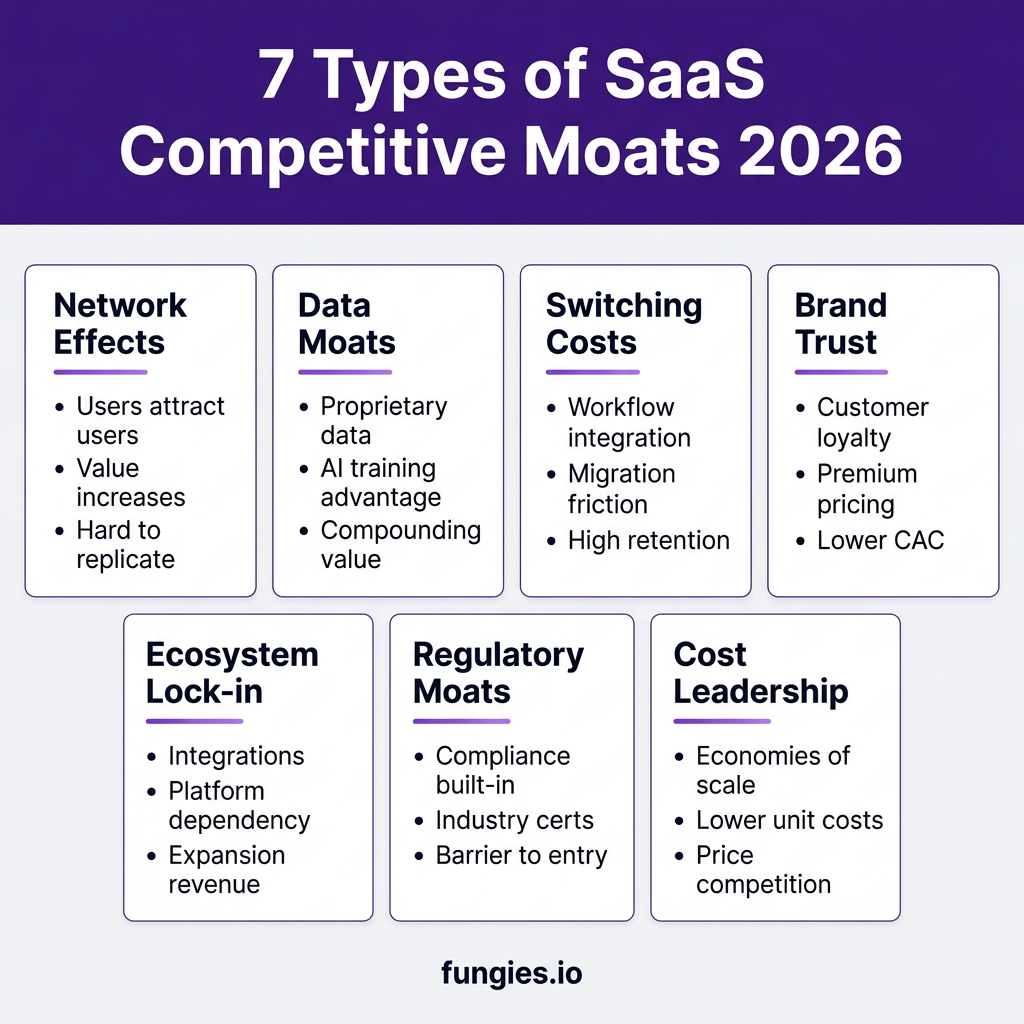
The 7 Types of SaaS Moats That Actually Work in 2026
Not all moats are created equal. Some are shallow ditches that competitors cross easily. Others are genuine structural advantages that compound over time. Here are the seven moat types that still matter — ranked by their durability in the AI era.
1. Network Effects: The Holy Grail
Network effects exist when each new customer increases the value of your product for all existing and future customers. It’s the most desired moat in SaaS because it creates a self-reinforcing growth loop that’s nearly impossible to replicate.
Think about Slack. Every new team that joins makes the platform more valuable for teams already using it. You can’t just build a better chat app — you’d need to migrate entire networks at once. That’s why Slack spread team by team without a traditional sales force.
The challenge? True network effects are rare in B2B SaaS. Most products don’t naturally facilitate connections between users. But when they do exist, they’re the strongest moat possible.
2. Data Moats: The AI-Era Winner
If network effects are the holy grail, data moats are the most practical path to defensibility in 2026. Here’s why: AI doesn’t just make code easier to build — it makes proprietary data exponentially more valuable.
When your product generates proprietary data that improves your AI features, you create a compounding advantage. Every user interaction trains your models. Better models create better user experiences. Better experiences attract more users. More users generate more data.
Tesla’s FSD (Full Self-Driving) is the classic example — 50 billion miles of real-world driving data creates a barrier no competitor can cross quickly. In B2B SaaS, think about CRM data, analytics patterns, or workflow optimization insights that improve with scale.
3. Switching Costs: The Retention Engine
Switching costs measure what it would take for a customer to leave — in time, money, and operational disruption. The higher the switching costs, the stronger the moat.
In 2026, the median B2B SaaS company loses 4.7% of customers monthly to churn. But companies with high switching costs? They’re achieving net negative churn for the first time ever — growing revenue from existing customers alone.
The key is workflow embedding. When your product becomes deeply integrated into daily operations — when it connects to other tools, automates critical processes, and stores years of historical data — leaving becomes genuinely painful. Not because of contracts, but because of operational reality.
4. Brand Trust: The Underrated Moat
Here’s something that might surprise you: brand is actually the strongest moat in B2B SaaS. Not features. Not technology. Brand.
When a buyer chooses Salesforce over a cheaper alternative, they’re not paying for functionality. They’re paying for trust — the confidence that Salesforce will still exist, still be supported, still integrate with everything else in five years.
Brand moats take years to build but deliver compound returns: lower CAC, higher willingness to pay, and defensibility that no AI can replicate quickly.
5. Ecosystem Lock-in: The Platform Play
Ecosystem moats exist when customers depend on your platform for multiple workflows, integrations, and third-party tools. The more connections, the higher the switching costs.
Salesforce’s AppExchange is the textbook example. Thousands of integrations, millions of custom workflows, entire businesses built on the platform. You can’t just “switch” — you’d need to rebuild your entire operational stack.
For early-stage SaaS, the lesson is clear: prioritize integrations early. Every connection deepens your moat.
6. Regulatory Moats: The Compliance Barrier
In regulated industries — healthcare, finance, legal — compliance isn’t just a checkbox. It’s a moat. The time, expertise, and ongoing investment required to maintain SOC 2, HIPAA, GDPR compliance creates a barrier that casual competitors can’t cross.
This is particularly relevant for payment and data processing. When your product handles sensitive financial or personal data, regulatory compliance becomes a competitive advantage that smaller players can’t easily replicate.
7. Cost Leadership: The Scale Advantage
Cost leadership moats come from economies of scale — when you can deliver the same value at lower unit costs than competitors. AWS is the obvious example: their infrastructure scale creates pricing no competitor can match.
For most SaaS companies, pure cost leadership is hard to achieve. But operational efficiency — lower CAC, faster sales cycles, higher LTV:CAC ratios — creates a version of this moat that compounds over time.
The 5-Step Framework for Building Your SaaS Moat
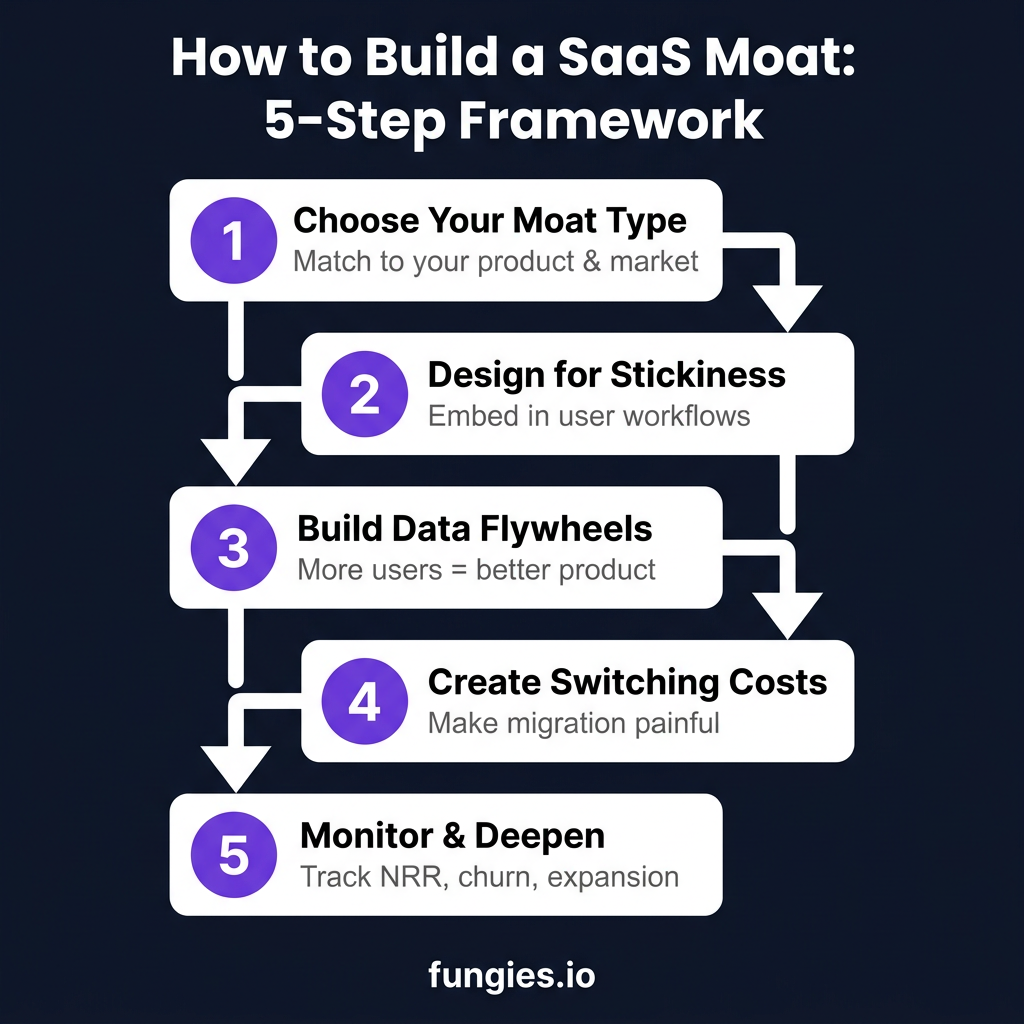
Moat-building isn’t something you do after achieving product-market fit. It’s a design-stage decision that shapes what you build, how users interact with it, and what it would cost them to leave. Here’s the framework:
Step 1: Choose Your Moat Type
Not every moat fits every product. Network effects require user-to-user interaction. Data moats need usage volume. Regulatory moats need industry alignment.
Honestly assess your product, market, and capabilities. Pick one primary moat type to optimize for. Trying to build all seven simultaneously means building none effectively.
Step 2: Design for Stickiness
Ask this question in every product decision: “What would it take for a user to leave?” Then build in the opposite direction.
Deep workflow integration has to be designed early. Retrofitting stickiness is exponentially harder than building it in from day one. Companies with strong onboarding (time-to-first-value under 7 days) see 50% lower churn rates.
Step 3: Build Data Flywheels
If you’re building a data moat, design explicit feedback loops. Every user interaction should improve the product for future users. This might mean training ML models, aggregating anonymized insights, or building recommendation engines that get smarter with scale.
The key metric: does your product get measurably better as you add users? If not, you don’t have a data flywheel.
Step 4: Create Switching Costs
Switching costs aren’t about being difficult — they’re about being deeply integrated. Export functionality, API access, data portability — these actually increase trust and willingness to commit deeply.
The real switching cost is operational: custom workflows, team training, integration dependencies. The more embedded you are in daily operations, the higher the effective switching cost.
Step 5: Monitor and Deepen
Moats aren’t set-and-forget. They need active maintenance. Track the metrics that matter for your moat type:
- Net Revenue Retention (NRR): Companies with NRR over 110% can grow from existing customers alone
- Churn by cohort: Are newer customers staying longer than older ones?
- Expansion revenue: Are customers deepening their usage over time?
- Time-to-value: Faster activation correlates with lower churn
Companies investing in proactive retention — health scoring, activation milestones, behavioral triggers — are pulling away from those that only react when customers hit cancel.
Real-World SaaS Moat Examples
Theory is useful. But let’s look at how this plays out in practice:
| Company | Primary Moat | How It Works |
|---|---|---|
| Slack | Network Effects | Each new team increases value for connected teams |
| Salesforce | Ecosystem + Brand | AppExchange integrations + enterprise trust |
| Notion | Switching Costs | Users build custom workspaces that are hard to migrate |
| Stripe | Developer Experience | Reduced payments to 7 lines of code — friction elimination |
| Zoom | Network Effects | Video quality improves with user density |
| HubSpot | Data Moat | CRM data improves recommendations and automation |
The AI Era: Threat or Opportunity?
There’s a narrative that AI is destroying SaaS moats. The reality is more nuanced. Yes, AI has made code replication trivial. But it’s also made certain moats — particularly data moats and workflow integration — more valuable than ever.
The companies thriving in 2026 understood something fundamental: defensibility was never really about the code. It was always about structural advantages that compound over time — data, networks, workflow depth, and trust.
AI is a tool. It can help you build faster, but it can also help competitors replicate faster. The question isn’t whether you’re using AI. It’s whether you have something that gets stronger the longer customers stay.
Common Moat-Building Mistakes
I’ve watched dozens of SaaS companies attempt to build moats. Here are the most common failures:
- Assuming features = moats: They don’t. Features are replicable. Moats are structural.
- Waiting too long: Moat-building gets exponentially harder after launch. Start at the design stage.
- Chasing multiple moats: Pick one primary moat type and optimize for it. Depth beats breadth.
- Ignoring metrics: You can’t improve what you don’t measure. Track NRR, churn, and expansion religiously.
- Confusing lock-in with value: Making it hard to leave isn’t a moat. Making it valuable to stay is.
FAQ: SaaS Competitive Moats
Can an early-stage startup have a moat before revenue?
Yes, but it’s usually potential rather than realized. Early network effects, proprietary data collection mechanisms, or regulatory positioning can all be moat foundations. Investors at seed and Series A look for signals that a moat could develop — not proof that it already exists.
What’s the strongest moat type for B2B SaaS?
Network effects are theoretically strongest but hardest to achieve. For most B2B SaaS, data moats combined with high switching costs offer the best practical path to defensibility. Brand becomes increasingly important as you scale.
How do investors evaluate moats during due diligence?
At Series A, investors look for demonstrable switching costs (measured by retention), early network effects visible in usage data, and data flywheel metrics showing product improvement correlated with usage growth. The key question: what happens if a well-funded competitor launches tomorrow?
Is AI killing SaaS moats?
AI is killing feature-based moats. Code is no longer defensible. But AI is strengthening data moats (more data = better AI) and making workflow integration more valuable (AI agents need systems to work within). The nature of moats is evolving, not disappearing.
How long does it take to build a moat?
Real moats take years, not months. Network effects and data advantages compound over time. The companies seeing genuine defensibility typically have 3-5 years of usage data and customer relationships. Start building on day one, but expect it to take time.
Conclusion: Start Building Your Moat Today
In 2026, building a SaaS product without thinking about moats is like building a castle without walls. You might survive for a while, but eventually, someone stronger will show up.
The good news? Moats are buildable. They’re not luck or magic — they’re deliberate structural decisions that compound over time. Pick your moat type. Design for stickiness. Build data flywheels. Create switching costs. And measure relentlessly.
The SaaS companies that will dominate the next decade aren’t just building great products. They’re building products that get stronger with every customer they serve. That’s the real definition of a competitive moat — and it’s never been more important than right now.
Ready to build a SaaS business with defensibility built in? Get started with Fungies — the merchant of record platform that handles global payments, tax compliance, and checkout infrastructure so you can focus on building what matters: a product customers can’t leave.
Sources
- Designli: How to Build a SaaS Moat in 2026
- Levera Partners: AI’s Implications for SaaS in 2026
- Waveup: What Is a Competitive Moat?
- ChurnTools: The State of SaaS Churn in 2026
- Data Mania: B2B SaaS Benchmarks 2026
- SaaStr: 10 Ways to Build a Moat in SaaS
- CRV: What Is a Moat?
- Startup GTM: Network Effects in SaaS