The digital downloads market is exploding. In 2026, creators are earning $500 to $50,000+ per month selling ebooks, templates, courses, and digital art — all without holding inventory or shipping physical products. Whether you’re a designer selling Canva templates, a developer selling code snippets, or a coach selling online courses, there’s never been a better time to monetize your expertise.
But here’s the reality: most creators get stuck on the technical side. Which platform should you use? How do you handle payments? What about taxes? This guide cuts through the noise and shows you exactly how to sell digital downloads online — from choosing your niche to scaling your income.
What Are Digital Downloads?
Digital downloads are intangible products delivered electronically. Unlike physical goods, you create them once and sell them infinitely. Popular types include:
- Ebooks and guides — $10-$100 per sale
- Templates (Notion, Excel, Canva) — $5-$50 per sale
- Online courses — $50-$2,000 per sale
- Stock photos and graphics — $5-$50 per bundle
- Software and plugins — $20-$500+ per license
- Music and audio files — $10-$100 per track
- Printables (planners, journals) — $3-$20 per item
The beauty? Margins are typically 90-95% after platform fees. No manufacturing, no shipping, no storage costs.
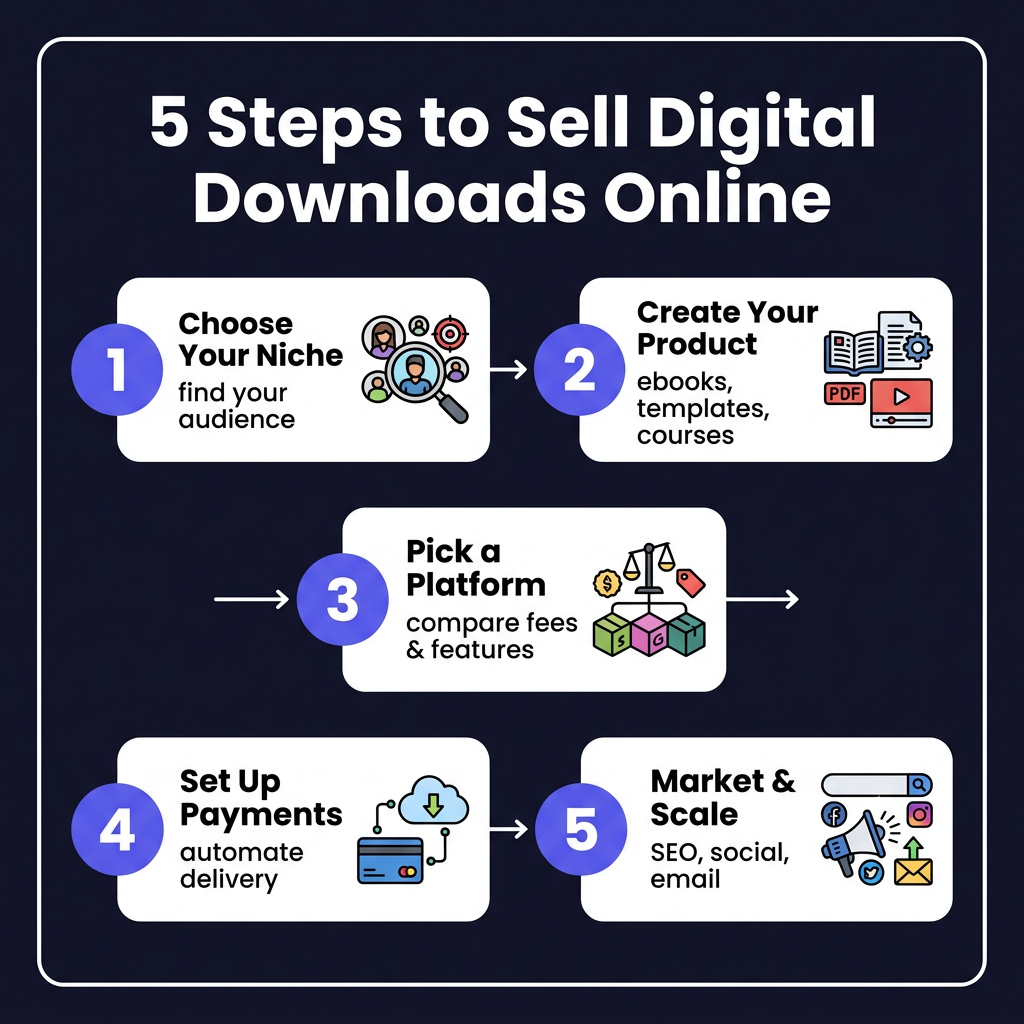
Step 1: Choose Your Niche and Validate Demand
Don’t create a product and hope people buy it. Start with demand, then build. Here’s how to validate:
- Search Reddit and forums — What problems do people complain about? What are they asking for help with?
- Check Etsy and Gumroad — What digital products have 500+ sales? That’s proof of demand.
- Use Google Trends — Is interest in your topic growing or declining?
- Survey your audience — If you have an email list or social following, ask what they’d pay for.
Profitable niches in 2026 include productivity templates, AI prompt libraries, notion dashboards, social media content packs, and business automation tools.
Step 2: Create Your Digital Product
Quality matters. A mediocre product gets refunds and bad reviews. A great product generates word-of-mouth and repeat customers. Here’s the creation framework:
- Solve one specific problem — Don’t try to teach everything. Solve one pain point deeply.
- Make it actionable — Include templates, checklists, or step-by-step instructions.
- Invest in design — Use Canva Pro, Adobe Creative Suite, or hire a designer on Fiverr.
- Test before selling — Give free copies to 5-10 people in exchange for honest feedback.
Tools we recommend: Canva for templates, Notion for databases, Teachable for courses, and Descript for video content.
Step 3: Choose the Right Platform
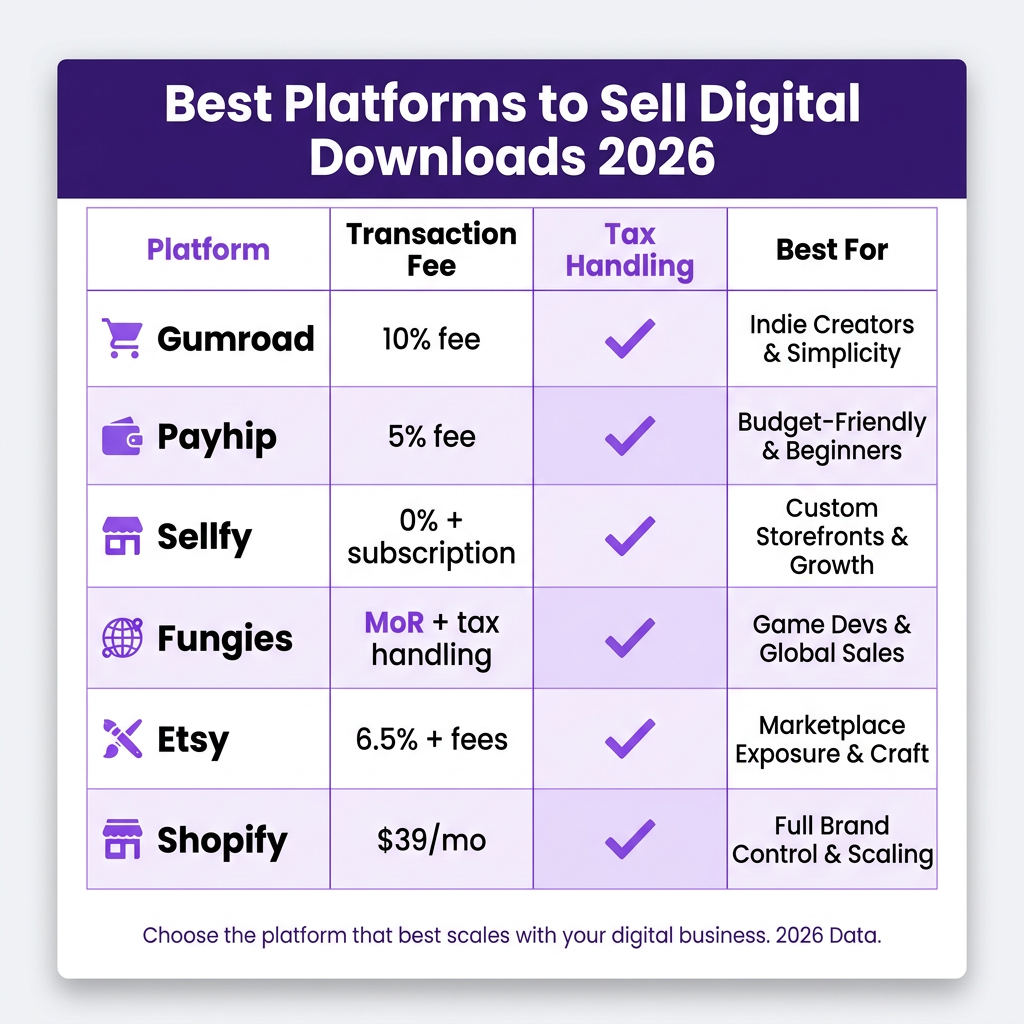
Your platform choice affects your fees, branding, and tax obligations. Here’s a breakdown of the top options:
Gumroad
Best for beginners. 10% flat fee (plus payment processing). Easy setup, built-in audience, handles basic EU VAT. Great for creators just starting out.
Payhip
5% transaction fee with no monthly cost. Good for selling ebooks and courses. Simple checkout experience but limited customization.
Sellfy
0% transaction fee but requires $29-$159/month subscription. Better for established sellers with consistent monthly revenue.
Fungies.io
Merchant of Record solution that handles all tax compliance automatically — VAT, sales tax, GST worldwide. No tax headaches, no registration in multiple countries. Best for creators selling globally who want to stay compliant without the complexity.
Etsy
6.5% transaction fee plus listing fees. Massive built-in traffic but crowded marketplace. Great for printables and creative templates.
Shopify
$39/month plus 2.9% + 30¢ per transaction. Full control and customization but requires more setup. Best for creators building a full brand.
Step 4: Set Up Payments and Delivery
Automation is key. You can’t manually email files to every customer. Here’s what you need:
- Instant delivery — Customers receive download links immediately after purchase
- Secure hosting — Files should be hosted on CDN for fast downloads
- Payment protection — Fraud detection and chargeback handling
- Multiple payment methods — Cards, PayPal, Apple Pay, Google Pay
- Tax handling — Automatic VAT/sales tax calculation and remittance
Most platforms handle delivery automatically. If you’re self-hosting, use tools like SendOwl or FetchApp for secure file delivery.
Ready to Sell Digital Downloads Without the Tax Headaches?
Fungies.io handles VAT, sales tax, and global compliance automatically — so you can focus on creating and selling.
No credit card required • Instant setup
Step 5: Price Your Digital Product
Pricing psychology matters. Price too low and you signal low quality. Price too high without justification and you get no sales. Here’s the framework:
- Anchor high — Show a “value” price crossed out, then your actual price
- Use charm pricing — $27 sells better than $30, $97 better than $100
- Offer tiers — Basic ($27), Pro ($67), Premium ($197) versions
- Test different prices — Start at $47, if it sells well, try $67
General pricing guidelines: Templates ($7-$47), Ebooks ($17-$97), Courses ($97-$997), Software ($20-$500+).
Step 6: Market Your Digital Downloads
Build it and they won’t come. You need active marketing. Here’s what works in 2026:
Content Marketing
Create free content that solves related problems. Blog posts, YouTube videos, TikToks — all pointing to your paid product. Example: If you sell a Notion template for freelancers, write blog posts about “How to manage client projects” and link to your template.
Email Marketing
Email converts 40x better than social media. Offer a free lead magnet (mini-guide, checklist) in exchange for email addresses. Then nurture subscribers with valuable content before pitching your product.
Social Proof
Display testimonials, review counts, and “X customers served” badges. Social proof reduces purchase anxiety significantly.
Affiliate Program
Let others sell for you. Offer 30-50% commission to affiliates. Platforms like Rewardful or Tapfiliate integrate with most checkout systems.
The Tax Reality Most Creators Ignore
Here’s what platforms don’t tell you upfront: if you sell to customers in the EU, UK, or many US states, you’re legally required to collect and remit sales tax/VAT.
Requirements include:
- EU VAT — Register for VAT MOSS, charge VAT based on customer’s country, file quarterly returns
- UK VAT — Register with HMRC if sales exceed £85,000
- US Sales Tax — Economic nexus rules mean you may owe tax in 20+ states
- Record keeping — Maintain transaction records for 6-10 years depending on jurisdiction
This is why many creators use a Merchant of Record like Fungies. We handle all tax registration, collection, and remittance globally — you just get paid.
FAQ: Selling Digital Downloads
Do I need a business license to sell digital downloads?
Requirements vary by location. In the US, most states require a business license if you’re operating under a name other than your own. Consult a local accountant or use a Merchant of Record that handles business compliance.
How do I protect my digital products from piracy?
Use secure download links that expire after a set time. Watermark PDFs with customer information. For high-value products, consider license keys or membership areas. But don’t obsess over piracy — it affects less than 2% of sales for most creators.
What’s the best platform for beginners?
Gumroad or Payhip for simplicity. Fungies if you want tax compliance handled from day one. Etsy if you want built-in traffic but don’t mind higher fees.
How long does it take to make money?
With an existing audience: first week. Starting from scratch: 3-6 months of consistent content creation before significant revenue. The creators who win are those who publish consistently for 6+ months.
Can I sell digital downloads on my own website?
Yes, using WooCommerce (WordPress), Shopify, or a Merchant of Record like Fungies with embeddable checkout. You keep more control but handle more technical setup.
Conclusion: Start Selling Today
Selling digital downloads is one of the most accessible business models in 2026. Low startup costs, high margins, and infinite scalability. The key is to start simple — pick one product type, one platform, and focus on creating something genuinely useful.
Don’t let tax complexity hold you back. If you’re selling globally (or plan to), use a Merchant of Record to handle compliance automatically. The peace of mind is worth it.
Ready to launch? Create your free Fungies account and start selling digital downloads with built-in global tax compliance.