The digital seller landscape has undergone a seismic transformation. In 2026, the digital goods market alone has reached $124.32 billion, representing a fundamental shift in how consumers discover, evaluate, and purchase products online. With 68% of internet users now paying for digital content monthly and transaction volumes surging nearly 70% between 2022 and 2024, the era of digital commerce has fully matured into a dominant economic force.
But this isn’t just about numbers on a spreadsheet. Behind these statistics lies a profound change in consumer behavior, technological capability, and market opportunity. Digital sellers today operate in an ecosystem where artificial intelligence drives personalization, social platforms double as storefronts, and creators can build six-figure businesses from their laptops. The barriers to entry have never been lower, yet the competition has never been fiercer.
This comprehensive analysis examines the digital seller market in 2026, drawing from extensive research across industry reports, market data, and real-world success stories. Whether you’re an established ecommerce operator, a creator looking to monetize your expertise, or an investor seeking to understand this rapidly evolving space, this report provides the data-driven insights you need to make informed decisions.

Market Overview: The $124 Billion Digital Goods Ecosystem
The digital seller market encompasses a vast and diverse ecosystem of products, platforms, and business models. At its core, digital goods—downloadable or streamable products that exist purely in electronic form—have become a cornerstone of modern commerce. From ebooks and online courses to software, templates, and digital art, these products offer unique advantages that physical goods cannot match: zero inventory costs, instant delivery, unlimited scalability, and margins that often exceed 90%.
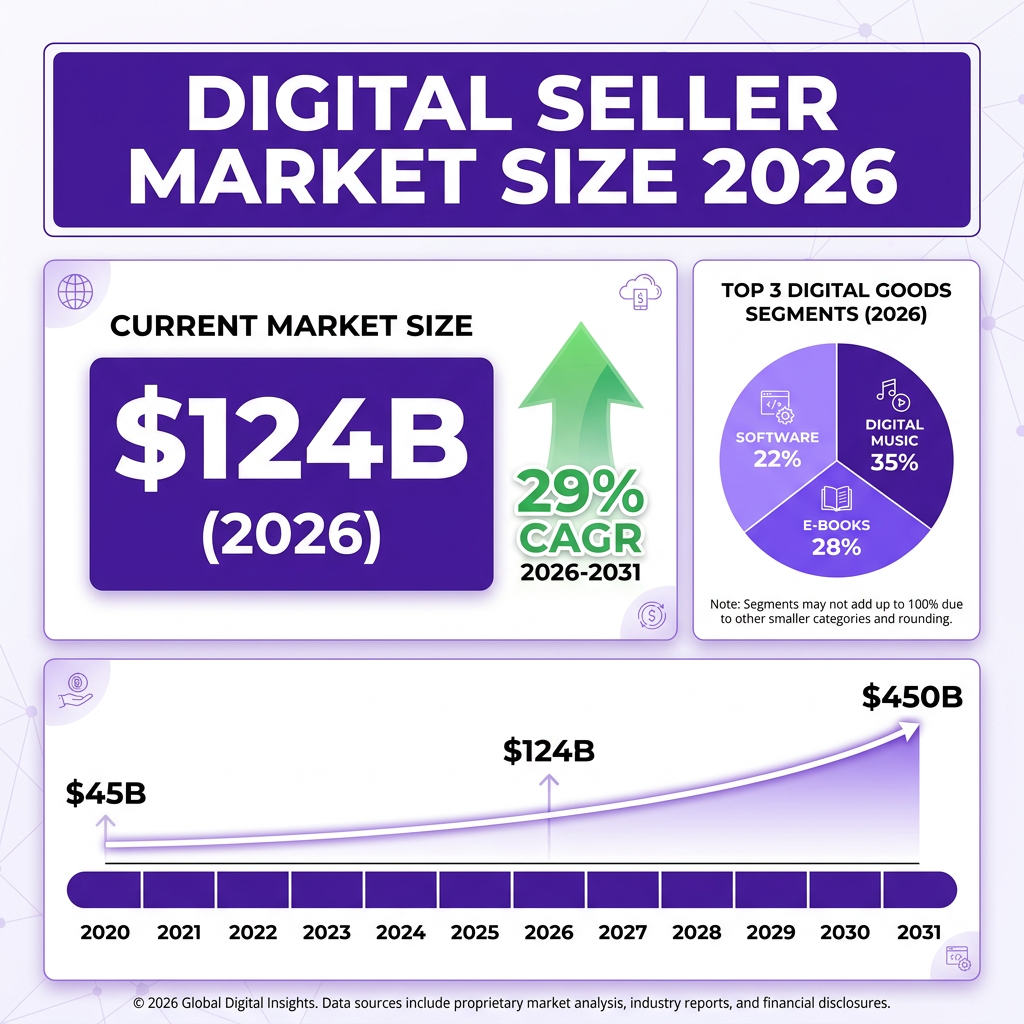
The global digital goods market was valued at $124.32 billion in 2026, representing substantial growth from previous years. This figure, while impressive, tells only part of the story. When we expand our view to include the broader digital commerce ecosystem—encompassing all transactions conducted online—the numbers become truly staggering. The global digital commerce market reached $8.06 trillion in 2026 and is projected to grow to approximately $29.29 trillion by 2035, reflecting a compound annual growth rate (CAGR) that underscores the sector’s explosive potential.
Looking at the even broader ecommerce landscape, global ecommerce sales are projected to reach $39.7 trillion in 2026, with forecasts suggesting this figure could climb to $155.9 trillion by 2033. This represents one of the most significant economic shifts in modern history, as traditional brick-and-mortar retail continues to cede ground to digital alternatives. The COVID-19 pandemic accelerated this transition, but the momentum has proven sustainable as consumers have grown accustomed to the convenience, selection, and competitive pricing that digital commerce offers.
Breaking down the digital goods market by category reveals interesting patterns. Digital music and podcasts represent the largest segment at approximately 35% of the market, driven by the continued dominance of streaming services and the podcasting boom. E-books and digital publishing account for roughly 28%, with the self-publishing revolution enabling independent authors to reach global audiences without traditional gatekeepers. Software and digital tools comprise about 22%, reflecting the SaaS explosion and the proliferation of productivity, creative, and utility applications. The remaining 15% encompasses a diverse array of products including digital art, templates, presets, online courses, and virtual goods.
The geographic distribution of digital sales reveals both mature markets and emerging opportunities. North America and Europe continue to lead in per-capita digital spending, with consumers in these regions showing high comfort levels with online transactions and digital ownership. However, the fastest growth is occurring in Asia-Pacific markets, particularly in Southeast Asia and India, where rapidly expanding internet penetration and mobile-first consumer behavior are creating massive new audiences for digital sellers.
Perhaps most significant for digital sellers is the shift in consumer psychology. Research indicates that digital products now create more than $2.5 trillion in value per year globally. Internet users spent over $560 billion on digital media in 2024, representing a 12% year-over-year increase. This spending isn’t limited to entertainment—consumers are increasingly willing to pay for educational content, productivity tools, creative assets, and specialized knowledge. The stigma around paying for digital products has largely evaporated, replaced by an understanding that digital goods can deliver value equal to or greater than their physical counterparts.
The historical trajectory of digital commerce provides important context for understanding current opportunities. In the early 2000s, selling digital products required significant technical expertise—sellers needed to handle hosting, payment processing, file delivery, and customer support with custom solutions. The barrier to entry was high, limiting participation to technically sophisticated operators or those with resources to hire developers.
The 2010s saw the emergence of platforms that democratized digital selling. Gumroad, launched in 2011, made it possible for creators to sell digital products with minimal technical knowledge. Etsy expanded beyond handmade goods to include digital downloads. Shopify’s app ecosystem enabled sophisticated digital product sales without custom development. These platforms lowered barriers to entry, enabling the creator economy to flourish.
The 2020s have brought further maturation. Payment processing has become seamless, with solutions handling tax compliance, fraud prevention, and global currencies automatically. AI tools have democratized creation, allowing individuals to produce professional-quality assets without traditional skills. Social commerce has created new distribution channels, enabling sellers to reach audiences where they already spend time. The infrastructure for digital selling has never been more robust or accessible.
Key Statistics and Data: 25 Numbers Every Digital Seller Must Know
Data drives decisions in the digital seller ecosystem. Understanding the key metrics, benchmarks, and trends is essential for anyone looking to succeed in this competitive landscape. Here are the critical statistics that define the digital seller market in 2026:
Market Size and Growth: The digital goods market reached $124.32 billion in 2026, growing at a CAGR of approximately 29% for the forecast period through 2031. The broader digital commerce market stands at $8.06 trillion, while global ecommerce exceeds $39.7 trillion. These figures represent not just growth, but a fundamental restructuring of global commerce.
Consumer Behavior: 68% of internet users now pay for digital content on a monthly basis. This represents a dramatic shift from the early days of the internet, when free content dominated and paying for digital goods was the exception rather than the rule. Transaction volumes in the digital goods space surged nearly 70% between 2022 and 2024, indicating accelerating adoption.
Platform Economics: Shopify powers approximately 4.65-6.9 million active stores globally, commanding 26.2% of the ecommerce platform market share. WooCommerce follows closely, powering over 3.5 million websites with market share estimates ranging from 20.1% to 36% depending on measurement methodology. Among high-traffic websites, Shopify’s dominance is even more pronounced, with 28.8% market share among the top 1 million websites compared to WooCommerce’s 18.2%.
Social Commerce Explosion: The social commerce market has reached $2.11 trillion in 2026, growing at a 29% CAGR. TikTok Shop alone generated $23 billion in US sales, while live shopping experiences achieve conversion rates of 30%—far exceeding traditional ecommerce conversion rates of 2-3%. US social commerce crossed $100 billion for the first time in 2026, growing 18% year-over-year.
Creator Economy Scale: The broader creator economy is projected to reach $234.65 billion by 2026, fueled by over 207 million content creators worldwide. Online courses represent a $200 billion global market, with successful creators regularly achieving six-figure incomes from digital product sales. The shift from ad revenue to owned digital products has become a crucial strategy for creator sustainability.
Mobile Dominance: Mobile commerce now accounts for over 70% of all ecommerce transactions globally. The mobile-first approach isn’t just recommended—it’s essential. Consumers increasingly discover, research, and purchase products entirely through mobile devices, making mobile optimization a baseline requirement rather than a competitive advantage.
AI Adoption: Gartner projects that by the end of 2026, more than 75% of ecommerce businesses will use AI automation for at least one core function. McKinsey data shows that businesses adopting AI-driven automation see up to a 30% improvement in operational efficiency. AI-powered personalization, inventory management, and customer service are becoming standard rather than differentiating features.
Payment Processing: Payment processing costs typically range from 1.5% to 3.5% per transaction, depending on pricing models, card types, and business volume. Digital wallets now represent the preferred payment method for 45% of online transactions globally, surpassing credit cards in many markets. Buy-now-pay-later (BNPL) options have achieved 25% adoption among major retailers, driving higher average order values.
Subscription Growth: Subscription-based digital products have seen 18% year-over-year growth, with consumers showing increased willingness to pay recurring fees for ongoing value. The subscription model provides predictable revenue for sellers and ongoing value for buyers, creating a win-win dynamic that has fueled the success of countless digital businesses.
Cross-Border Commerce: Cross-border ecommerce now accounts for 22% of all online transactions, with digital products particularly well-suited for international sales due to the absence of shipping complexities. Sellers who optimize for global audiences can access markets that would be unreachable with physical products.
Content Marketing ROI: Digital sellers who invest in content marketing see 3x higher conversion rates than those relying solely on paid advertising. The cost of customer acquisition through content is 62% lower than traditional advertising, making it an essential strategy for sustainable growth.
Email Marketing Persistence: Despite the rise of social media, email marketing maintains a 4,200% ROI for digital sellers. For every $1 spent on email marketing, sellers see an average return of $42. Automated email sequences for onboarding, engagement, and retention remain among the highest-leverage activities for digital businesses.
Conversion Benchmarks: Average ecommerce conversion rates range from 2-3%, but top-performing digital sellers achieve 5-10% through optimization. Landing page conversion rates for digital products average 8-12%, significantly higher than physical products due to lower friction and instant delivery. A/B testing consistently improves conversion rates by 15-30% for sellers who implement it systematically.
Customer Lifetime Value: The average customer lifetime value (LTV) for digital product businesses ranges from $150-$500, depending on the product category. Subscription businesses see significantly higher LTV, with annual values of $300-$1,200 per subscriber. The ratio of LTV to customer acquisition cost (CAC) should exceed 3:1 for sustainable unit economics.
Refund and Chargeback Rates: Digital products see average refund rates of 5-10%, higher than physical products due to buyer’s remorse and mismatched expectations. Chargeback rates for digital goods average 0.5-1.5%, with higher rates in certain categories like online courses. Clear product descriptions, preview content, and responsive customer service can significantly reduce these rates.
Major Trends Shaping Digital Selling in 2026
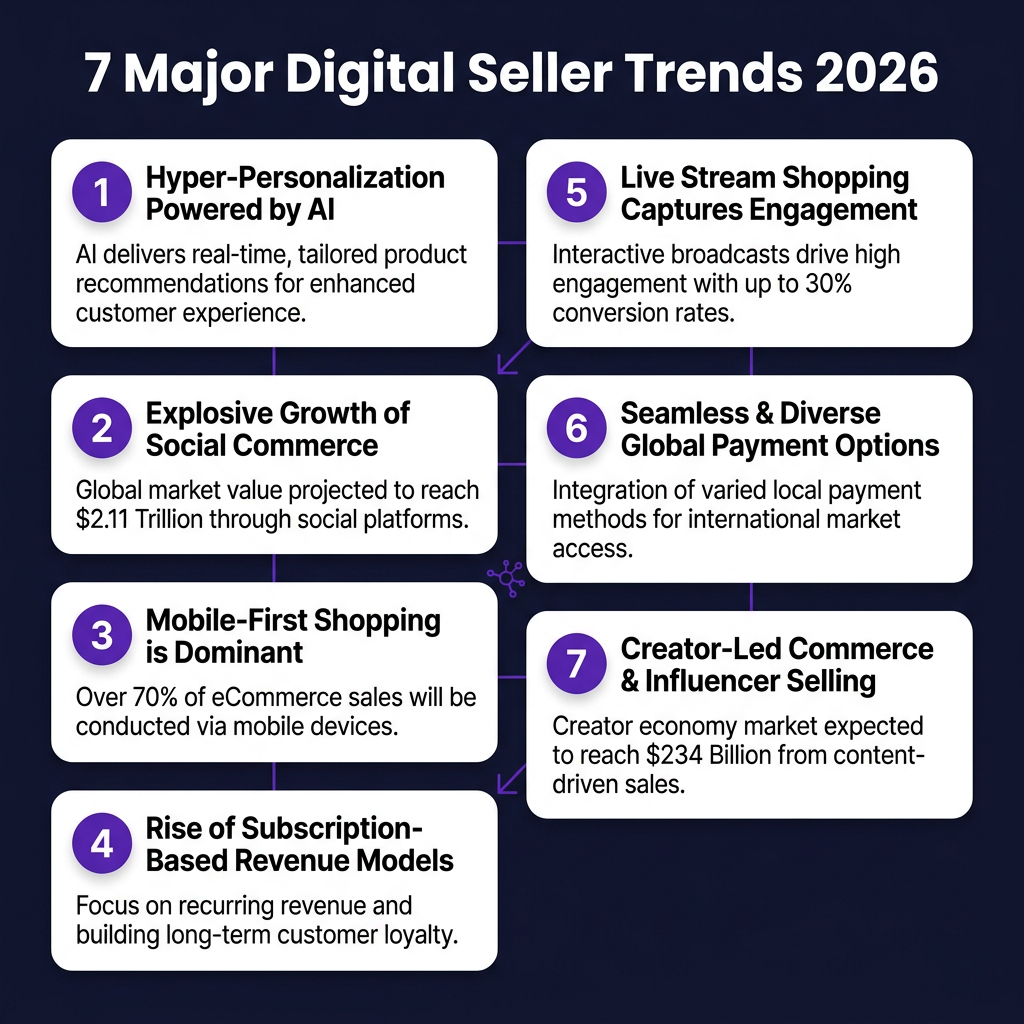
The digital seller landscape is being reshaped by seven major trends that are redefining how products are created, marketed, sold, and consumed. Understanding these trends is essential for anyone looking to build or grow a digital selling business in 2026 and beyond.
1. AI-Powered Personalization at Scale
Artificial intelligence has moved from experimental technology to essential infrastructure for digital sellers. AI-powered personalization systems analyze customer behavior, preferences, and purchase history to deliver tailored experiences in real-time. Unlike traditional rule-based personalization, which might show the same recommendations to every user in a demographic, AI systems adapt dynamically, learning from each interaction to improve relevance.
The impact is measurable: businesses implementing AI personalization see 20% increases in conversion rates and 15% increases in average order value. For digital sellers, this means the ability to deliver personalized product recommendations, customized landing pages, and targeted email content without the manual effort previously required. AI tools now handle product descriptions, email copy, social media posts, and even customer service interactions, allowing sellers to focus on strategy and product development.
The sophistication of AI personalization has reached remarkable levels. Modern systems can predict which products a customer is likely to purchase based on browsing patterns, adjust pricing dynamically based on willingness-to-pay estimates, and generate personalized email content that resonates with individual preferences. For digital sellers with large catalogs, AI-powered search and discovery has become essential—customers expect to find relevant products quickly, and AI delivers this capability at scale.
2. Social Commerce and Live Shopping
The distinction between social media and ecommerce has effectively disappeared. Social commerce—a $2.11 trillion market growing at 29% CAGR—enables consumers to discover and purchase products without leaving their favorite platforms. TikTok Shop, Instagram Shopping, and Facebook Marketplace have transformed social feeds into storefronts, with the feed becoming the new homepage for many consumers.
Live shopping represents the most exciting frontier within social commerce. With conversion rates of 30%—ten times higher than traditional ecommerce—live shopping combines entertainment, education, and commerce into a single experience. Sellers demonstrate products in real-time, answer questions, and create urgency through limited-time offers. Gary Vaynerchuk has noted that live social shopping is “in the place that social media was in 2009″—early, but poised for explosive growth.
The mechanics of social commerce differ fundamentally from traditional ecommerce. Discovery is algorithm-driven rather than search-driven, meaning sellers must optimize for engagement rather than just keywords. Content quality matters more than ever—products that tell stories and demonstrate value in native formats outperform traditional product listings. The most successful social commerce sellers think like content creators first and merchants second.
3. Mobile-First Everything
With over 70% of ecommerce transactions now occurring on mobile devices, the mobile-first approach has become non-negotiable. This means more than responsive design—it means rethinking the entire user experience for mobile contexts. One-click purchasing, mobile-optimized checkout flows, and app-like experiences within browsers are now baseline expectations.
For digital sellers, mobile-first also means optimizing product discovery for mobile behaviors. Vertical video, thumb-stopping visuals, and frictionless purchasing are essential. The sellers winning in 2026 are those who recognize that their customers’ primary computing device is the smartphone, and design their entire funnel accordingly.
Mobile optimization extends to payment methods. Digital wallets like Apple Pay, Google Pay, and Shop Pay have reduced checkout friction significantly, with conversion rates 2-3x higher than traditional credit card entry. Sellers who don’t offer these options are leaving money on the table.
4. The Subscription Economy
Subscription models have expanded far beyond software and media. Digital sellers across categories are discovering the power of recurring revenue. Templates, courses, creative assets, and even consulting services are being packaged as subscriptions, providing predictable income and ongoing customer relationships.
The subscription model aligns incentives between sellers and buyers: sellers are motivated to continuously deliver value to maintain the relationship, while buyers gain access to evolving content and ongoing support. With 18% year-over-year growth in subscription-based digital products, this trend shows no signs of slowing.
Successful subscription businesses focus on retention metrics—churn rate, monthly recurring revenue (MRR) growth, and customer lifetime value. The economics of subscriptions differ fundamentally from one-time sales: acquisition costs are higher, but lifetime values are substantially greater. Sellers must be prepared to invest in customer success to realize the full potential of the subscription model.
5. Creator-Led Commerce
The creator economy has matured into a sophisticated commercial ecosystem. With 207 million content creators worldwide and a market value of $234.65 billion, creators have become a powerful distribution channel for digital products. The most successful digital sellers in 2026 are those who either are creators themselves or partner effectively with creators to reach engaged audiences.
This trend represents a shift from traditional advertising to trust-based marketing. Consumers increasingly prefer recommendations from creators they follow over traditional advertisements. Digital sellers who understand how to work with creators—providing affiliate opportunities, exclusive content, and authentic partnerships—gain access to highly targeted, engaged audiences.
The creator partnership model has evolved beyond simple sponsored posts. Successful collaborations involve co-creation, where creators help develop products that genuinely serve their audiences. Long-term ambassador relationships outperform one-off campaigns, building sustained credibility and driving consistent sales.
6. Global Payment Infrastructure
The friction of international selling has been dramatically reduced by advances in payment infrastructure. Digital wallets, local payment methods, automatic currency conversion, and tax compliance solutions have made it possible for solo creators to sell globally with the sophistication previously reserved for multinational corporations.
Cross-border ecommerce now accounts for 22% of online transactions, and digital products are particularly well-suited for international sales. A creator in Poland can sell to customers in Brazil, Japan, and Nigeria with the same ease as selling domestically. This global reach represents one of the most significant opportunities for digital sellers willing to optimize for international audiences.
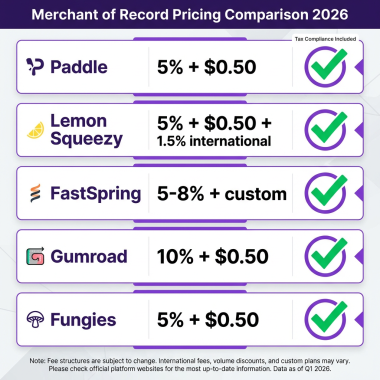
Tax compliance has historically been a barrier to international selling, with VAT in Europe, sales tax in the US, and GST in Australia each having different requirements. Modern Merchant of Record solutions handle these complexities automatically, calculating, collecting, and remitting taxes on behalf of sellers. This infrastructure has democratized global commerce.
7. AI-Generated Products and Content
AI isn’t just changing how digital products are marketed—it’s changing what products are created. AI-generated art, music, code, and written content have created entirely new categories of digital products. While this has raised questions about quality and authenticity, it has also democratized creation, enabling individuals to produce professional-quality assets without traditional skills or expensive software.
The most successful AI-augmented sellers use AI as a tool to enhance their unique perspectives rather than replace them. AI handles repetitive tasks and generates initial drafts, while human creators add the judgment, creativity, and personal touch that differentiate premium products from commodities.
Transparency about AI usage has become a best practice. Consumers generally accept AI-assisted products when quality is high and value is clear, but they expect honesty about how products are created. Sellers who are upfront about their use of AI build trust, while those who try to hide it risk backlash if discovered.
Key Players and Competitive Landscape
The digital seller ecosystem is served by a diverse array of platforms, tools, and service providers. Understanding the competitive landscape is essential for choosing the right infrastructure for your digital selling business.
Ecommerce Platforms: The platform wars continue to shape the digital selling landscape. Shopify maintains its position as the market leader, powering 4.65-6.9 million active stores with 26.2% market share. The platform’s strength lies in its ease of use, extensive app ecosystem, and scalability from startup to enterprise. Shopify’s recent investments in AI-powered tools, social commerce integrations, and B2B capabilities have reinforced its position.
WooCommerce remains the primary open-source alternative, powering over 3.5 million websites with market share estimates between 20.1% and 36%. WooCommerce’s flexibility and WordPress integration make it popular with developers and content-focused businesses. However, it requires more technical expertise than hosted alternatives, creating a trade-off between control and convenience.
BigCommerce has carved out a niche serving mid-market and enterprise clients who have outgrown simpler platforms but want to avoid the complexity of custom builds. Squarespace and Wix continue to serve the entry-level market, while newer platforms like Gumroad, Payhip, and Stan Store have gained traction among creators selling digital products specifically.
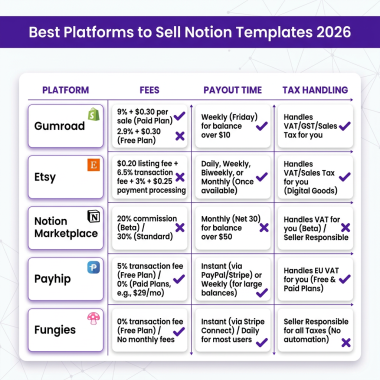
Digital Product Marketplaces: Marketplaces provide built-in audiences at the cost of reduced control and higher fees. Etsy dominates the creative digital products space, with millions of active buyers searching for templates, planners, and design assets. Creative Market and Creative Fabrica serve professional designers seeking high-quality assets. Gumroad has become the platform of choice for independent creators selling courses, ebooks, and software, while Udemy, Skillshare, and Teachable compete in the online course space.
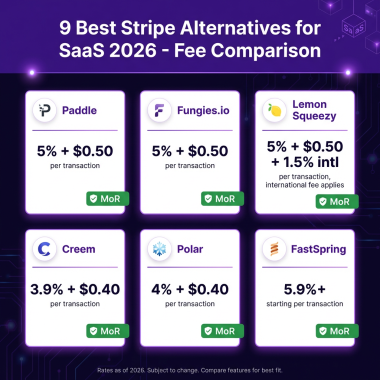
Payment Processors: Stripe and PayPal remain the dominant payment processors for digital sellers, but the landscape is diversifying. Specialized solutions like Fungies.io offer Merchant of Record services that handle tax compliance, fraud prevention, and global payments—essential for sellers targeting international audiences. Buy-now-pay-later providers like Klarna and Afterpay have integrated into checkout flows, driving higher average order values.
AI and Automation Tools: The AI tool ecosystem for digital sellers has exploded. Jasper, Copy.ai, and Writesonic handle content creation. Canva and Adobe Firefly enable AI-assisted design. ChatGPT and Claude power customer service automation. Zapier and Make connect disparate tools into automated workflows. The sellers achieving the highest margins in 2026 are those who have effectively integrated these tools into their operations.
Marketing and Analytics: Google Analytics 4, despite its controversial transition, remains the standard for web analytics. Meta’s advertising platform continues to dominate paid social, while TikTok’s advertising tools have matured significantly. Email marketing platforms like ConvertKit, Mailchimp, and Klaviyo have added AI-powered segmentation and automation. SEO tools like Ahrefs, Semrush, and Surfer SEO help sellers capture organic traffic.

Challenges and Pain Points
Despite the immense opportunities, digital sellers face significant challenges that can make or break their businesses. Understanding these pain points is the first step toward addressing them effectively.
1. Customer Acquisition Costs and Platform Dependency
The cost of acquiring customers has risen dramatically across all channels. Meta’s advertising costs have increased 25% year-over-year, while organic reach on social platforms has declined as algorithms prioritize paid content. Digital sellers find themselves in a difficult position: they need platforms to reach audiences, but those platforms extract an increasing share of revenue through fees and advertising costs.
Platform dependency creates vulnerability. Sellers who build their businesses entirely on Instagram, Etsy, or Amazon face the risk of algorithm changes, policy enforcement, or account suspensions that can destroy their business overnight. The most resilient digital sellers diversify their channels, building owned audiences through email lists and direct relationships that can’t be taken away by platform decisions.
2. Payment Processing Complexity
Payment processing costs of 1.5-3.5% per transaction eat into margins, but the complexity goes beyond fees. International selling requires handling multiple currencies, local payment methods, and complex tax compliance. VAT in Europe, sales tax in the US, and GST in Australia each have different requirements, and failure to comply can result in significant penalties.
Chargebacks represent another significant challenge, with digital products particularly vulnerable due to the inability to physically verify delivery. Fraud prevention adds another layer of complexity, requiring sophisticated systems to distinguish legitimate customers from bad actors without creating excessive friction for genuine buyers.
3. Content Saturation and Differentiation
The low barriers to entry in digital selling have created a saturated market. With 207 million content creators worldwide, standing out requires more than just a good product—it requires a unique value proposition, strong branding, and effective marketing. The democratization of creation tools means that everyone has access to the same capabilities, making differentiation increasingly difficult.
AI-generated content has exacerbated this challenge, flooding markets with competent but generic products. Sellers must find ways to add unique value that AI cannot replicate—personal experience, community, ongoing support, or specialized expertise that demonstrates genuine authority.
Opportunities and Growth Strategies
Within every challenge lies opportunity. Digital sellers who navigate the landscape strategically can build highly profitable, sustainable businesses. Here are the key growth strategies working in 2026:
1. Build Owned Audiences
The most valuable asset for any digital seller is a direct relationship with their audience. Email lists, SMS subscribers, and community memberships provide channels that can’t be taken away by platform algorithm changes. Successful sellers prioritize list-building from day one, offering valuable lead magnets in exchange for contact information and nurturing those relationships through consistent, valuable communication.
The math is compelling: email marketing delivers a 4,200% ROI, and owned audiences convert at 3-5x the rate of cold traffic. Every dollar invested in audience building pays dividends for years.
2. Embrace the Subscription Model
Recurring revenue transforms business dynamics. Instead of constantly chasing new customers, subscription businesses can focus on retention and lifetime value. Digital products are particularly well-suited to subscriptions—templates can be updated monthly, courses can be released in cohorts, and communities can provide ongoing value.
The predictability of subscription revenue also enables better planning and investment. Banks and investors view recurring revenue more favorably than one-time sales, opening additional growth capital options.
3. Optimize for International Markets
Digital products have no shipping costs, no inventory constraints, and no physical limitations. A seller in one country can serve customers globally with the same ease as serving locally. Yet many sellers leave international money on the table by failing to optimize for global audiences.
International optimization includes localizing pricing, accepting local payment methods, translating key content, and understanding cultural differences in buying behavior. Solutions like Fungies.io handle the complexity of international tax compliance, making global selling accessible to businesses of all sizes.
Case Studies and Success Stories
Theory is valuable, but real-world examples demonstrate what’s possible. Here are three case studies of digital sellers who have built significant businesses in the 2026 landscape:
Case Study 1: The Template Creator
A former marketing executive began creating Notion templates as a side project in 2024. By 2026, her template shop generated $45,000 monthly revenue with 85% profit margins. Her strategy focused on three elements: solving specific problems for specific audiences (freelancers managing client work), building an email list of 50,000 subscribers through free valuable content, and leveraging TikTok to drive traffic. She now employs two virtual assistants and has expanded into courses and coaching.
Case Study 2: The Course Creator
A software developer created a comprehensive course on a niche programming framework. Rather than competing on price, he positioned his course as the definitive resource, charging $997 when competitors charged $97. The higher price enabled him to invest in production quality and ongoing updates. Through strategic partnerships with complementary tool creators and a focus on student success, he achieved a 4% refund rate and $2 million in annual revenue with a team of three.
Case Study 3: The Digital Agency Pivot
A design agency struggling with client work scalability pivoted to selling design systems and UI kits. By productizing their expertise, they transformed from a services business with 20% margins to a products business with 90% margins. Their strategy involved pre-selling products to their existing client base, using that revenue to fund development, and then marketing to broader audiences. The product line now generates $500,000 monthly with minimal ongoing effort.
Future Outlook and Predictions (2026-2030)
Looking ahead, several trends will shape the digital seller landscape through 2030:
AI Agents and Autonomous Commerce: By 2028, AI agents will handle significant portions of the digital selling process—from product creation to customer service to marketing optimization. Sellers will act as curators and strategists rather than operators, with AI handling execution.
Virtual and Augmented Reality Commerce: As VR and AR technologies mature, digital products will be experienced in immersive environments. Virtual showrooms, AR product previews, and metaverse storefronts will become standard for premium digital sellers.
Blockchain and Digital Ownership: NFTs and blockchain-based ownership will evolve beyond speculation to provide genuine utility for digital products. Provable scarcity, transferable ownership, and creator royalties will enable new business models for digital goods.
Regulatory Evolution: As digital commerce grows, so will regulation. Data privacy, consumer protection, and platform accountability will see increased legislative attention. Sellers who build compliance into their operations from the start will have advantages over those forced to retrofit.
Market Consolidation: The platform landscape will consolidate as winners emerge in each category. Sellers should be cautious about building on platforms that may not survive, while taking advantage of the best-in-class tools that are likely to persist.
Key Takeaways
- The digital goods market reached $124.32 billion in 2026, growing at 29% CAGR, while broader digital commerce exceeds $8 trillion globally
- 68% of internet users now pay for digital content monthly, with transaction volumes up 70% since 2022
- Seven major trends define 2026: AI personalization, social commerce ($2.11T market), mobile-first everything, subscription models, creator-led commerce, global payment infrastructure, and AI-generated products
- Platform dependency is the greatest risk; building owned audiences through email lists provides resilience and higher conversion rates
- International selling represents massive untapped opportunity for digital products, with cross-border ecommerce at 22% of transactions
- Success requires differentiation through unique expertise, community, or ongoing value that AI cannot replicate
- The creator economy ($234.65B) and social commerce (30% conversion rates for live shopping) offer the highest-growth channels for digital sellers
Sources and Citations
- Mordor Intelligence — Digital Goods Market Size & Share Analysis (2026-2031): https://www.mordorintelligence.com/industry-reports/digital-goods-market
- Precedence Research — Digital Commerce Market Size and Trends: https://www.precedenceresearch.com/digital-commerce-market
- Grand View Research — E-commerce Market Size and Share Report: https://www.grandviewresearch.com/industry-analysis/e-commerce-market
- Swell — 32 Digital Product Sales Statistics Shaping Ecommerce: https://www.swell.is/content/digital-product-sales-statistics
- Whop — 100+ Digital Products Statistics for 2026: https://whop.com/blog/digital-product-statistics
- Behind the Scenes — Digital Product Trends 2026: https://behindthescenes.com/blogs/digital-product-trends-2026-trends-stats-what-s-next
- Ringly.io — 47 Social Commerce Statistics You Need to Know: https://www.ringly.io/blog/social-commerce-statistics-2026
- MobileLoud — WooCommerce vs Shopify Market Share Insights: https://www.mobiloud.com/blog/woocommerce-vs-shopify-market-share-statistics
- DHL — 2026 E-Commerce Trends Report: https://www.dhl.com/global-en/microsites/ec/ecommerce-insights/insights/reports/2026-ecommerce-trends-report.html
- Fin AI — 15 Best AI Tools for Ecommerce in 2026: https://fin.ai/learn/best-ai-tools-ecommerce
Digital Product Categories: Where the Opportunity Lies
Understanding the landscape of digital product categories helps sellers identify opportunities and position their offerings effectively. Each category has unique dynamics, customer expectations, and competitive considerations.
Educational Products: Online courses, ebooks, tutorials, and coaching programs represent one of the largest and fastest-growing categories. The global e-learning market exceeds $400 billion, with individual creators capturing significant portions of this spend. The key to success in educational products is transformation—customers don’t buy information, they buy results. The most successful educational products promise and deliver specific, measurable outcomes.
Creative Assets: Templates, design resources, stock photography, video assets, and music form the backbone of the creator economy. These products serve other creators and businesses, creating a multiplier effect where each sale enables further creation. The market for creative assets is highly competitive, but quality and specificity win—generic stock assets compete on price, while specialized resources command premium pricing.
Software and Tools: From productivity apps to specialized utilities, software products offer the highest margins and strongest customer lock-in. The SaaS model has proven particularly powerful, with recurring revenue and network effects creating defensible businesses. However, software development requires technical expertise and ongoing maintenance, creating higher barriers to entry than other categories.
Digital Services: Consulting, coaching, and done-for-you services delivered digitally blur the line between products and services. These offerings command premium prices due to their personalized nature and direct access to expertise. The challenge is scalability—time-for-money trades limit growth unless carefully productized.
The Psychology of Digital Buyers
Understanding why people buy digital products is as important as understanding what they buy. Digital purchases are driven by a unique psychology that differs from physical goods in important ways.
Instant Gratification: Digital products deliver immediate value. There’s no shipping delay, no waiting, no uncertainty about delivery. This instant gratification is powerful—buyers can start using their purchase within seconds of completing the transaction. Sellers who emphasize this immediacy in their marketing see higher conversion rates.
Perceived Risk: Without physical presence, buyers worry about quality and value. Will this course actually teach me what I need? Will these templates work with my software? Addressing these concerns through previews, testimonials, guarantees, and clear value propositions is essential for conversion.
Identity and Aspiration: Digital products often sell identity as much as utility. The fitness program promises the body and lifestyle of the instructor. The business course promises the freedom and success of the creator. Successful sellers understand that they’re selling transformation and identity, not just information or tools.
Community and Belonging: Many digital purchases include or lead to community access. Buyers aren’t just purchasing a product—they’re joining a group of like-minded individuals. This community aspect increases perceived value and drives retention for subscription products.
Building a Sustainable Digital Selling Business
Sustainability in digital selling requires thinking beyond individual transactions to build systems and assets that compound over time.
Product Ecosystems: Single-product businesses are vulnerable. Sustainable digital sellers build ecosystems of complementary products that serve customers at different stages of their journey. A customer might start with a free lead magnet, purchase an entry-level product, upgrade to a comprehensive course, and subscribe to ongoing coaching. Each product in the ecosystem increases customer lifetime value and creates multiple touchpoints for relationship building.
Brand Equity: In a world of AI-generated content and commoditized tools, brand becomes a crucial differentiator. Strong brands command premium pricing, attract better customers, and create loyalty that transcends individual products. Building brand equity requires consistency, authenticity, and a clear point of view that resonates with a specific audience.
Operational Excellence: As businesses scale, operational complexity increases. Customer service, refund requests, technical issues, and platform maintenance can overwhelm solo creators. Sustainable businesses invest in systems, automation, and team building before they’re strictly necessary, creating capacity for growth rather than reacting to it.
Diversification: Relying on a single platform, traffic source, or product creates vulnerability. Sustainable digital sellers diversify across channels, products, and audiences. If one platform changes its algorithm or one product loses relevance, the business continues.