Here’s a sobering statistic: 75% of SaaS users churn within the first week if they don’t experience your product’s value. Not the first month. The first week. With customer acquisition costs now averaging $650-$1,100 in B2B SaaS, every failed onboarding is like setting $700 on fire.
I’ve spent years optimizing onboarding flows for SaaS companies, and I’ll be honest—most teams treat onboarding as an afterthought. They pour resources into acquisition, then watch new users bounce because the first experience feels like navigating a maze blindfolded.
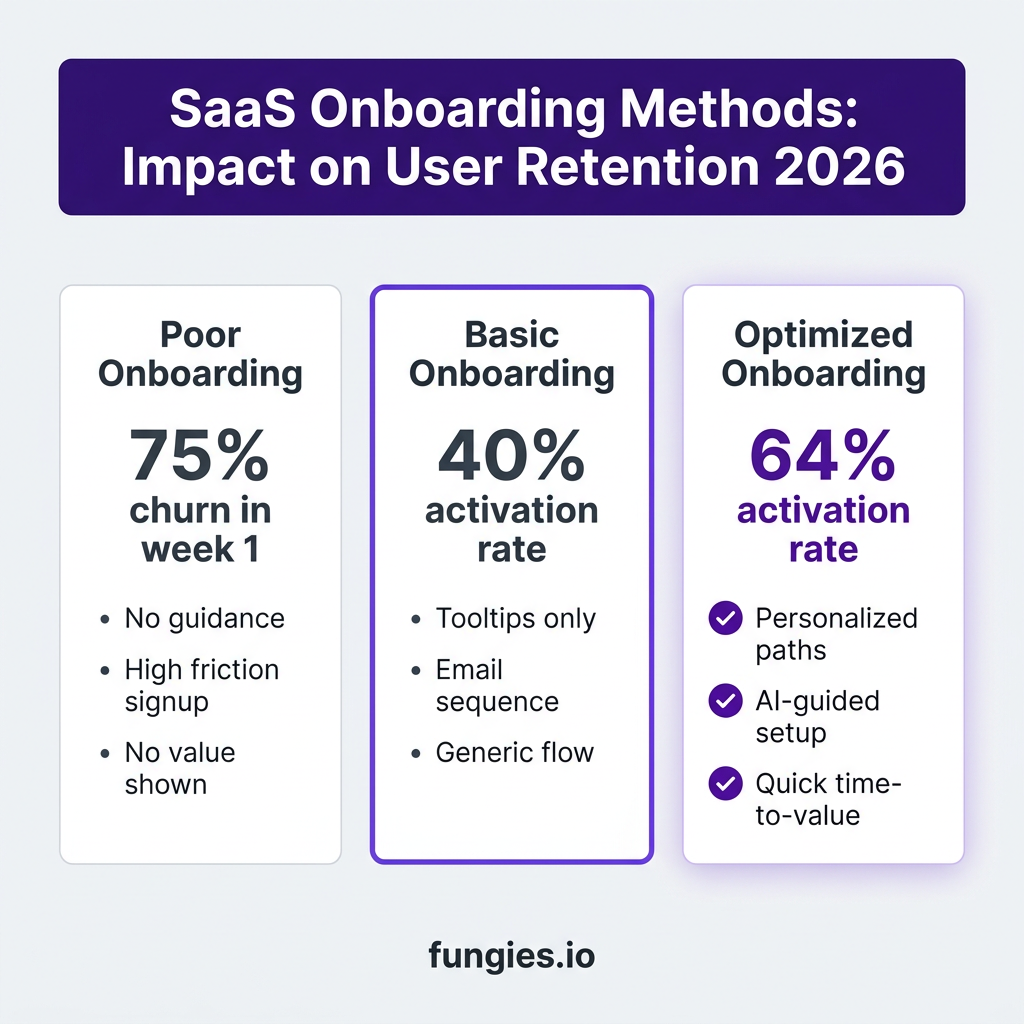
The good news? Companies that nail their saas user onboarding see activation rates jump from 25% to 64%. That’s not a marginal improvement—that’s the difference between a product that stalls and one that scales.
What Is SaaS User Onboarding (And Why Most Teams Get It Wrong)
SaaS user onboarding is the structured process of guiding new users from signup to their first “aha moment”—that point where they genuinely understand your product’s value. It’s not a product tour. It’s not a welcome email. It’s a carefully engineered journey that turns curious signups into engaged users.
Here’s where most teams mess up: they confuse education with activation. They bombard users with feature explanations before the user even knows why they should care. Your onboarding shouldn’t teach users how to use your product. It should help them achieve something meaningful in the shortest time possible.
The BJ Fogg Behavior Model explains why this matters. Behavior happens when motivation, ability, and a trigger converge. Most SaaS onboarding focuses on ability (teaching features) while ignoring motivation (showing value). That’s backwards. You need to spike motivation first, then make the path to value effortless.
The Real Cost of Poor Onboarding (With Data)
Let me put some hard numbers on this. According to 2025 research from UserGuiding and Exec, here’s what happens when onboarding fails:
- 90% of users churn if they don’t see value within the first week
- Average time-to-value for SaaS: 1 day, 12 hours, 23 minutes—way too long
- 70% of customers churn within 90 days when onboarding falls short
- Companies lose $1M+ annually in revenue leaks from onboarding failures
But here’s the flip side: a 25% increase in user activation results in a 34% rise in monthly recurring revenue over 12 months. When you compound that over 24 months, you’re looking at 25-50% increases in customer lifetime value.
The math is simple. Better onboarding doesn’t just reduce churn—it creates a growth multiplier that compounds every quarter.
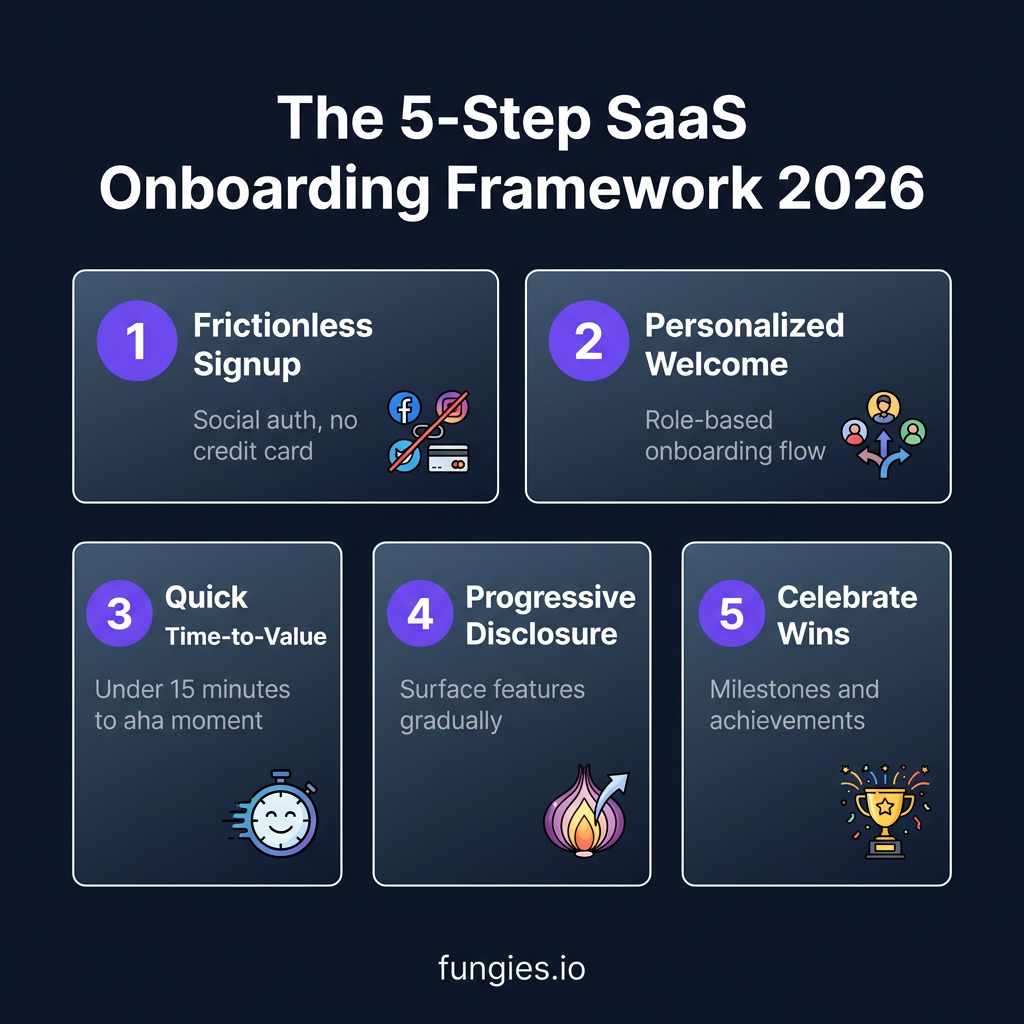
The 5-Step SaaS Onboarding Framework That Actually Works
After analyzing hundreds of onboarding flows and working with 60+ Y Combinator alumni, I’ve distilled what works into a repeatable framework. This isn’t theory—these are the exact tactics that lifted activation rates by 42% in real implementations.
Step 1: Frictionless Signup (The 30-Second Rule)
Your signup flow is a conversion killer hiding in plain sight. Every field you add, every confirmation email you require, every CAPTCHA you deploy—it’s all friction. And friction kills momentum.
The best SaaS onboarding experiences follow the 30-second rule: a new user should be inside your product, experiencing value, within 30 seconds of landing on your signup page. That means:
- Social authentication (Google, GitHub, Slack) as the primary option
- No credit card required for trial (unless you’re doing opt-out trials with a specific strategy)
- Progressive profiling—collect data after the user sees value, not before
- Single-page signup with 3 fields max
Notion’s signup is a masterclass here. One field—email. Click the magic link. You’re in. No passwords to remember, no forms to fill. Just immediate access to value.
Step 2: Personalized Welcome (Segment by Intent)
Generic onboarding is dead. Users today expect experiences tailored to their specific context and goals. The moment someone signs up, you should know enough to customize their journey.
Role-based onboarding flows increase activation by 30-50%. Here’s how to implement it:
- Ask one qualifying question during signup: “What’s your role?” or “What’s your primary goal?”
- Use that data to route users to different onboarding paths
- Customize the “aha moment” based on their use case
- Show relevant templates, examples, and case studies
Wave, the invoicing software, does this brilliantly. During onboarding, they ask about your business type. A freelancer sees different features highlighted than a small agency. Both get to value faster because the path is relevant.
Step 3: Accelerate Time-to-Value (The 15-Minute Goal)
Time-to-value (TTV) is the most underappreciated metric in SaaS. It’s the time from signup to the moment a user experiences meaningful value. The best SaaS products achieve this in under 15 minutes.
To hit this target, you need to:
- Identify your product’s core “aha moment”—the single action that delivers value
- Remove every step that doesn’t directly lead to that moment
- Use in-app guidance (tooltips, hotspots, checklists) to keep users on track
- Pre-populate data where possible—empty states are momentum killers
Canva’s onboarding is the gold standard. Sign up, pick a template, make an edit, download your design—all in under 5 minutes. You don’t need to learn the tool to get value from it.
Step 4: Progressive Disclosure (Don’t Overwhelm)
The biggest mistake in SaaS onboarding? Showing users everything at once. Your product probably has 50+ features. A new user needs to know about 3 of them. The rest is noise.
Progressive disclosure means revealing features gradually, as users become ready for them. This isn’t about hiding functionality—it’s about surfacing the right capability at the right time.
- Start with the minimum viable feature set for the user’s goal
- Use behavioral triggers to introduce advanced features (“You’ve created 3 projects—ready to try templates?”)
- Create contextual tooltips that appear based on user actions
- Build a “power user” unlock sequence for engaged users
Slack does this perfectly. Day 1, you see channels and messages. Day 7, you discover integrations. Day 30, you’re exploring workflows and automation. Each feature is introduced when you’re ready for it.
Step 5: Celebrate Wins (Behavioral Reinforcement)
Humans are driven by progress and achievement. The best onboarding experiences tap into this psychology by celebrating milestones and creating a sense of accomplishment.
This isn’t gamification fluff—it’s behavioral science. When users feel progress, they’re more likely to continue. Here’s how to implement it:
- Create a “getting started” checklist with 3-5 items
- Show progress bars and completion percentages
- Send celebration emails for milestones (“You sent your first campaign!”)
- Use confetti animations or micro-celebrations for key actions
LinkedIn’s profile completion bar is a classic example. It’s not there to help you—it’s there to make you feel incomplete until you hit 100%. That psychological pull drives behavior.
Onboarding Email Sequences: The Unsung Hero
In-app onboarding gets all the attention, but email sequences are equally critical. They’re your safety net for users who don’t activate immediately. A well-crafted onboarding email sequence can recover 15-20% of users who would otherwise churn.
Here’s the framework that works:
| Timing | Focus | Goal |
|---|---|---|
| Immediate | Welcome + quick win | Confirm signup, set expectations |
| Day 1 | Core feature education | Drive to first key action |
| Day 3 | Use case inspiration | Show what’s possible |
| Day 7 | Social proof + case study | Build confidence |
| Day 14 | Re-engagement or upgrade | Recover inactive users |
The key is relevance. Batch-and-blast onboarding emails don’t work anymore. Segment by behavior—users who completed setup get different emails than users who didn’t. Personalize based on the data you collected during signup.
Measuring Onboarding Success: The Metrics That Matter
You can’t improve what you don’t measure. But most SaaS teams track vanity metrics that don’t predict success. Here are the metrics that actually matter for saas user onboarding:
- Activation Rate: Percentage of users who reach the “aha moment”—aim for 40%+
- Time-to-Value (TTV): Time from signup to first value—target under 15 minutes
- Onboarding Completion Rate: Users who finish your core onboarding flow
- Day 7 Retention: Percentage of users still active one week later—critical early indicator
- Feature Adoption Breadth: Number of core features used in first 30 days
Tools like Mixpanel, Amplitude, and Heap make tracking these metrics straightforward. Set up funnel analysis to see exactly where users drop off. Use cohort analysis to compare onboarding performance over time.
Common Onboarding Mistakes (And How to Avoid Them)
I’ve audited hundreds of SaaS onboarding flows. The same mistakes show up again and again. Here are the most common—and how to fix them:
Mistake 1: The Empty State Problem
New users land in your product and see… nothing. No data, no context, no guidance. Just a blank canvas staring back at them. This is the moment most users bounce.
Fix: Pre-populate data. Show sample projects, demo content, or template galleries. Give users something to interact with immediately. Notion’s template gallery is a perfect example—new users see possibilities, not emptiness.
Mistake 2: Feature Dumping
Your product team spent months building features. You want to show them all off. But overwhelming new users with every capability is a recipe for confusion.
Fix: Identify the 3 features that deliver 80% of value for new users. Focus your onboarding on those. Introduce advanced features contextually as users grow.
Mistake 3: Ignoring Mobile Onboarding
30-40% of SaaS signups happen on mobile devices. If your onboarding only works on desktop, you’re losing a third of potential users before they start.
Fix: Design mobile-first onboarding flows. Test every step on small screens. Consider SMS-based onboarding for mobile users.
Mistake 4: One-Size-Fits-All Approach
A freelancer and an enterprise team have different needs, different goals, and different definitions of value. Treating them the same is inefficient at best.
Fix: Segment your onboarding by user type, company size, or use case. Even simple branching (“Are you a developer or a marketer?”) can dramatically improve activation.
AI-Powered Onboarding: The 2026 Advantage
The onboarding landscape is changing fast. AI is making it possible to deliver personalized experiences at scale without massive engineering teams.
Here’s what’s working in 2026:
- AI-powered chatbots that guide users in real-time, answering questions contextually
- Behavioral prediction that identifies at-risk users before they churn
- Dynamic content personalization that adapts based on user actions
- Automated video generation for personalized welcome messages
Companies using AI in their onboarding are seeing 64% activation rates compared to 40% for traditional approaches. The technology is accessible—even startups can implement AI-powered onboarding with tools like Product Fruits, Appcues, or Userpilot.
Putting It All Together: Your 30-Day Onboarding Roadmap
Ready to overhaul your onboarding? Here’s a practical 30-day roadmap:
- Week 1: Audit your current onboarding. Map every step. Identify drop-off points using analytics.
- Week 2: Define your “aha moment.” What’s the single action that delivers value? Optimize your flow to get users there faster.
- Week 3: Implement quick wins—reduce form fields, add social auth, create empty state content.
- Week 4: Launch and measure. A/B test your new flow against the old. Track activation rate, TTV, and Day 7 retention.
Don’t try to fix everything at once. Start with the biggest bottleneck—usually signup friction or time-to-value—and iterate from there.
Frequently Asked Questions About SaaS User Onboarding
What is a good activation rate for SaaS onboarding?
A good activation rate is 40% or higher. Top-performing SaaS companies achieve 60-70% activation. If you’re below 25%, you have significant room for improvement. The median across all SaaS is around 35%.
How long should SaaS onboarding take?
Time-to-value should be under 15 minutes for simple products, under 1 hour for complex B2B tools. The entire onboarding experience (getting users to regular usage) typically spans 7-14 days across multiple sessions.
Should I require a credit card for free trials?
It depends on your strategy. Opt-out trials (requiring credit cards) convert at 48.8% but get fewer signups. Opt-in trials (no credit card) convert at 18.2% but get 3-5x more signups. Most SaaS companies see better total revenue from opt-in trials.
What’s the difference between onboarding and activation?
Onboarding is the process. Activation is the outcome. Onboarding includes everything you do to guide users. Activation is the moment they experience value. Good onboarding leads to high activation.
How do I reduce time-to-value in my SaaS product?
Focus on three things: eliminate signup friction, pre-populate data so users see content immediately, and guide users directly to your core value proposition. Remove every step that doesn’t directly lead to the “aha moment.”
Conclusion: Onboarding Is Your Growth Lever
Here’s the truth: you can double your marketing budget, hire the best sales team, and run perfect ads. But if your onboarding fails, you’re pouring water into a leaky bucket.
The companies winning in 2026 aren’t necessarily the ones with the best products. They’re the ones with the best saas user onboarding—the ones that turn curious signups into engaged users in the shortest time possible.
Start with the framework I’ve outlined. Measure your current activation rate. Identify your biggest bottleneck. And start iterating. Even a 10% improvement in activation can translate to 25%+ revenue growth over 12 months.
Your users are giving you their attention in those first critical minutes. Don’t waste it.
Ready to streamline your SaaS payments and billing? Get started with Fungies.io and handle global tax compliance, multiple payment methods, and subscription management—all with one simple integration. No monthly fees, just 5% + $0.50 per transaction.
Sources
- UserGuiding SaaS Onboarding Statistics 2025 – userguiding.com
- Benchmarkit 2025 SaaS Performance Metrics – benchmarkit.ai
- ProductLed Onboarding Best Practices 2025 – productled.com
- Flowjam SaaS Onboarding Guide 2025 – flowjam.com
- Mixpanel State of Digital Analytics 2026 – mixpanel.com
- SaaS Capital 2026 Spending Benchmarks – saas-capital.com