Polar.sh raised its base rate 25% in May 2026 — here’s what that actually means for your revenue
Polar.sh launched as the developer-first Merchant of Record with a headline rate of 4% + $0.40 per transaction. That rate attracted thousands of indie hackers and open-source developers who were tired of Paddle’s enterprise friction and Lemon Squeezy’s uncertainty post-Stripe acquisition.
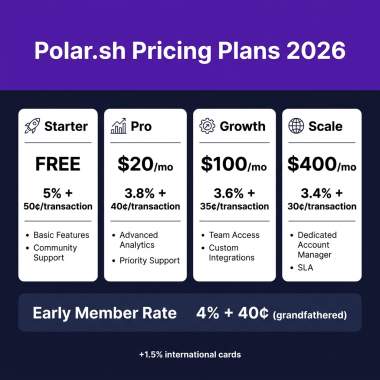
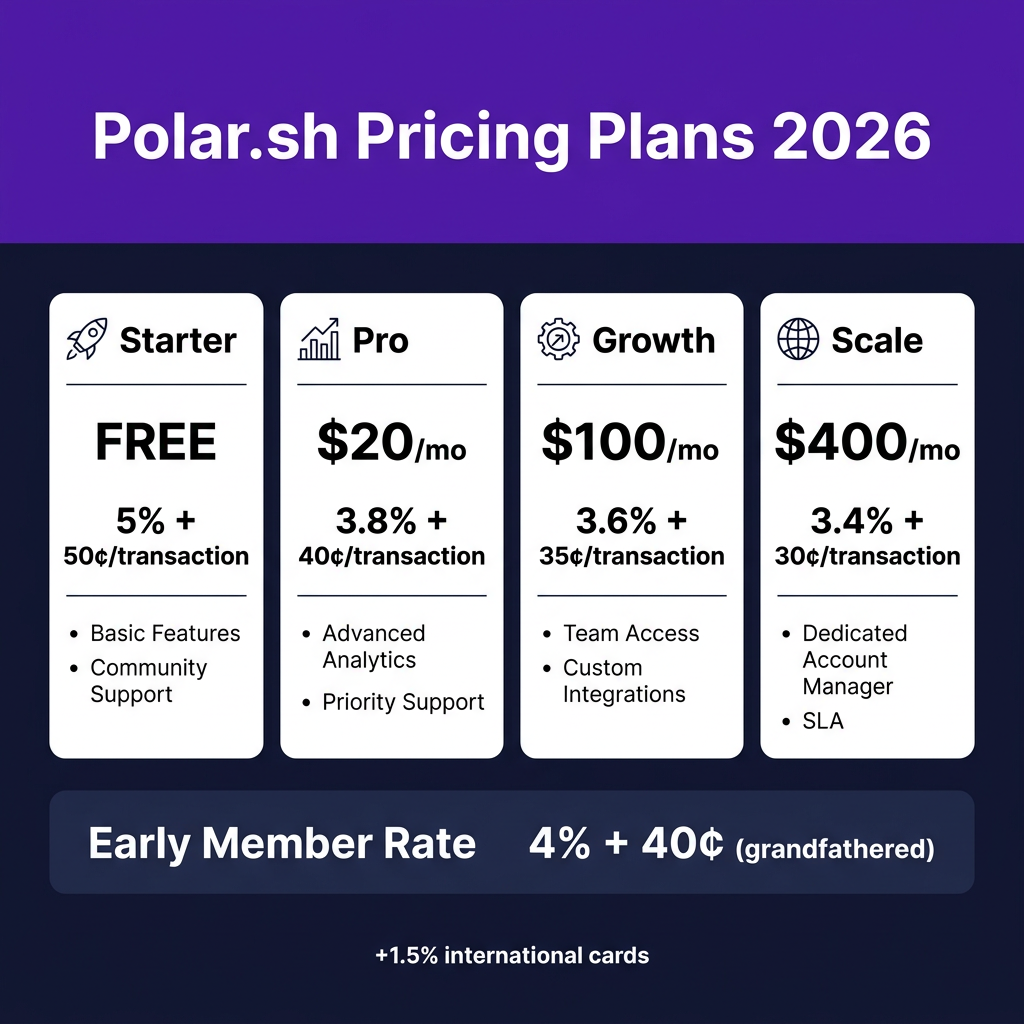
Then, on May 27, 2026, everything changed. Polar restructured its pricing from a flat 4% + $0.40 to a tiered model where the free Starter plan now costs 5% + $0.50 per transaction — a 25% increase on both the percentage and fixed fee components. To get anything close to the old rate, you now pay a monthly platform fee.
Is Polar.sh still worth it? That depends entirely on your revenue stage, your audience geography, and how much you value open-source tooling over predictable costs. This review breaks all of that down with actual numbers.
What Is Polar.sh?
Polar.sh is an open-source Merchant of Record (MoR) platform built specifically for developers monetizing software, SaaS, and digital products. It’s built on top of Stripe’s infrastructure but adds the legal and compliance layer that Stripe itself doesn’t provide — global tax remittance, VAT collection, chargeback liability, and invoice generation.
What makes Polar different from Paddle or Lemon Squeezy is its developer-first positioning. The platform is fully open source (you can inspect the codebase on GitHub), provides a TypeScript-first SDK, supports framework adapters for Next.js and other modern stacks, and recently pivoted to position itself as “a billing platform for the intelligence era” — targeting AI SaaS and usage-based billing use cases.
Key features include:
- Merchant of Record with global tax compliance (VAT, GST, US sales tax)
- Subscription billing with usage-based and seat-based options
- License key management (built-in, not a third-party add-on)
- Customer portal for self-service billing management
- Affiliate program tooling
- TypeScript SDK with framework adapters
- Open-source codebase on GitHub
- AI billing infrastructure (usage metering, inference cost management)
Polar.sh Pricing in 2026: The Full Breakdown
Here’s what you actually pay, plan by plan:
| Plan | Monthly Fee | Per Transaction | Breakeven vs Starter |
|---|---|---|---|
| Starter (free) | $0 | 5% + $0.50 | — |
| Pro | $20/mo | 3.8% + $0.40 | ~$1,379/mo in sales |
| Growth | $100/mo | 3.6% + $0.35 | ~$5,634/mo in sales |
| Scale | $400/mo | 3.4% + $0.30 | ~$19,048/mo in sales |
| Early Member* | $0 | 4% + $0.40 | Grandfathered pre-May 27 |
*Early Member rate is permanent for accounts created before May 27, 2026 — as long as they don’t upgrade to a paid plan.
Hidden fees you need to know
The headline rate isn’t everything. Stack these on top:
- +1.5% for international cards (non-US). If your audience is global — which it almost certainly is if you’re selling B2C SaaS — this applies to a huge percentage of transactions.
- Payout fees from Stripe: $2/month active + 0.25% + $0.25 per payout
- Cross-border currency conversion: 0.25% (EU) to 1% (other countries)
- Early Member subscription fee: +0.5% for subscription payments on the old plan. This was removed on Starter/paid plans — but it means early adopters on subscriptions are paying 4.5% + $0.40, not 4% + $0.40.
So at Starter tier with a global audience: a $29/month SaaS subscription could actually cost you 5% + 1.5% + payout fees = effectively 7%+ per transaction.
Polar.sh vs Competitors: The Honest Fee Comparison
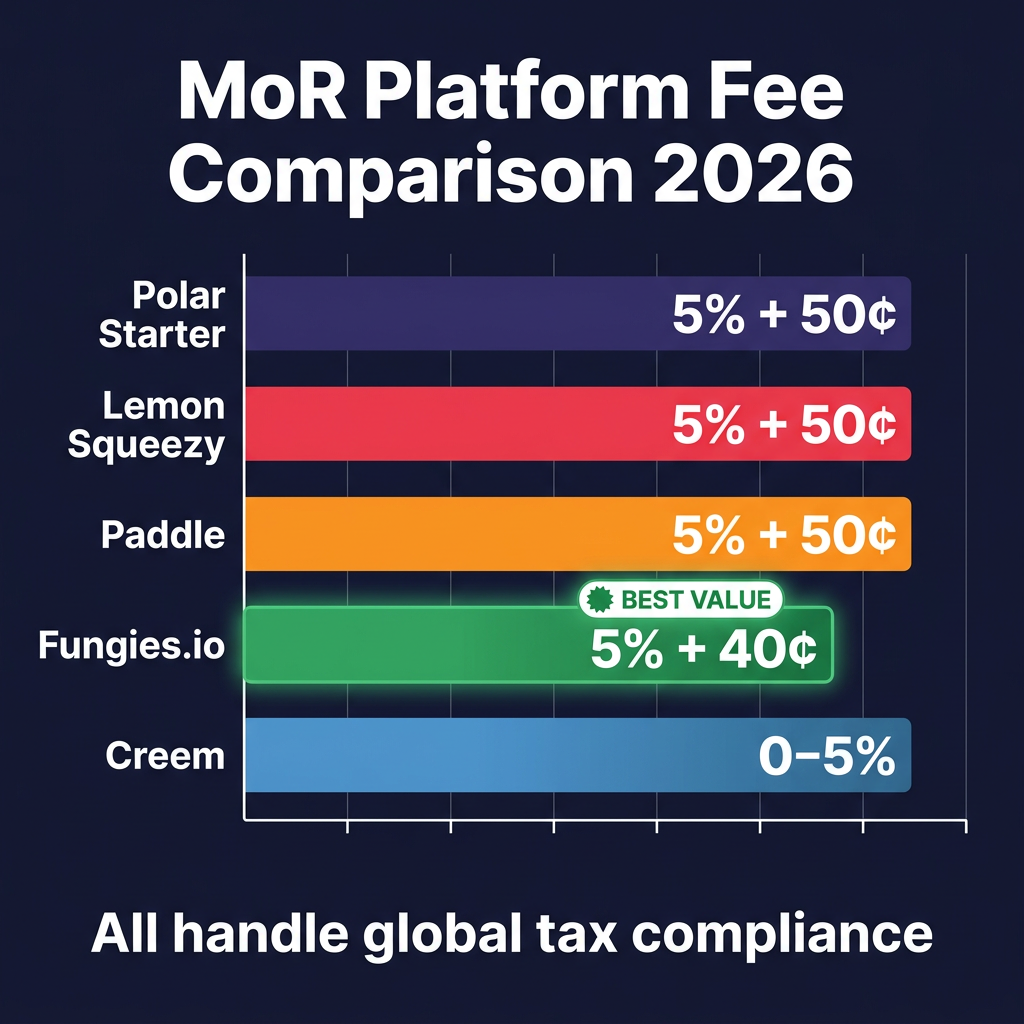
Let’s run actual math at $5,000/month in revenue (100 subscriptions × $50):
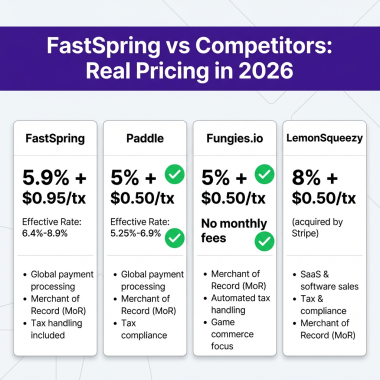
| Platform | Base Rate | Fees on $5k/mo | Monthly Take-home | Tax Handling |
|---|---|---|---|---|
| Polar Starter | 5% + $0.50 | $300 | $4,700 | Full MoR ✅ |
| Polar Pro | 3.8% + $0.40 + $20/mo | $230 | $4,770 | Full MoR ✅ |
| Paddle | 5% + $0.50 | $300 | $4,700 | Full MoR ✅ |
| Lemon Squeezy | 5% + $0.50 | $300 | $4,700 | Full MoR ✅ |
| Fungies.io | 5% + $0.40 | $290 | $4,710 | Full MoR ✅ |
| Creem | 0% to €1K, then 3.5% | ~$175 | ~$4,825 | Full MoR ✅ |
The takeaway: at the Starter level, Polar now matches Paddle and Lemon Squeezy exactly. It’s no longer the price leader. Creem has the lowest effective rate at scale; Fungies.io has the same full MoR coverage with a slightly lower per-transaction fee than Polar’s base rate.
Where Polar wins on pricing is the Pro plan at ~$1,379/month in sales. Above that threshold, Pro pays off over Starter. But you’re also paying $20/month for the privilege — and smaller founders below that breakeven are paying the same rate as every other platform.
Developer Experience: Where Polar Actually Wins
If pricing parity with Paddle and Lemon Squeezy makes you question Polar’s value proposition, the developer experience is where it genuinely differentiates:
TypeScript-first SDK
Polar’s SDK is built TypeScript-first with full type inference. The checkout integration is 6 lines of code in Next.js. Compare that to Paddle’s integration which requires reading through multiple layers of docs and Lemon Squeezy’s JS SDK that hasn’t been updated since November 2024.
Open-source codebase
This isn’t a marketing line. You can inspect how Polar handles tax collection, webhook delivery, and subscription state management on GitHub. For security-conscious teams building fintech-adjacent products, this transparency is genuinely valuable.
Built-in license key management
License key generation and validation is native — no third-party integration required. If you’re selling software with license-key activation, this saves real engineering time.
AI/usage-based billing
Polar is pushing hard into AI infrastructure billing — usage metering, inference cost tracking, credit systems. This is forward-looking positioning that Paddle and Lemon Squeezy don’t currently match.
Framework adapters
Next.js, Nuxt, SvelteKit, Astro, and Express adapters ship out of the box. Getting a working checkout in any of these frameworks takes under 30 minutes.
Polar.sh Pros and Cons
The real pros
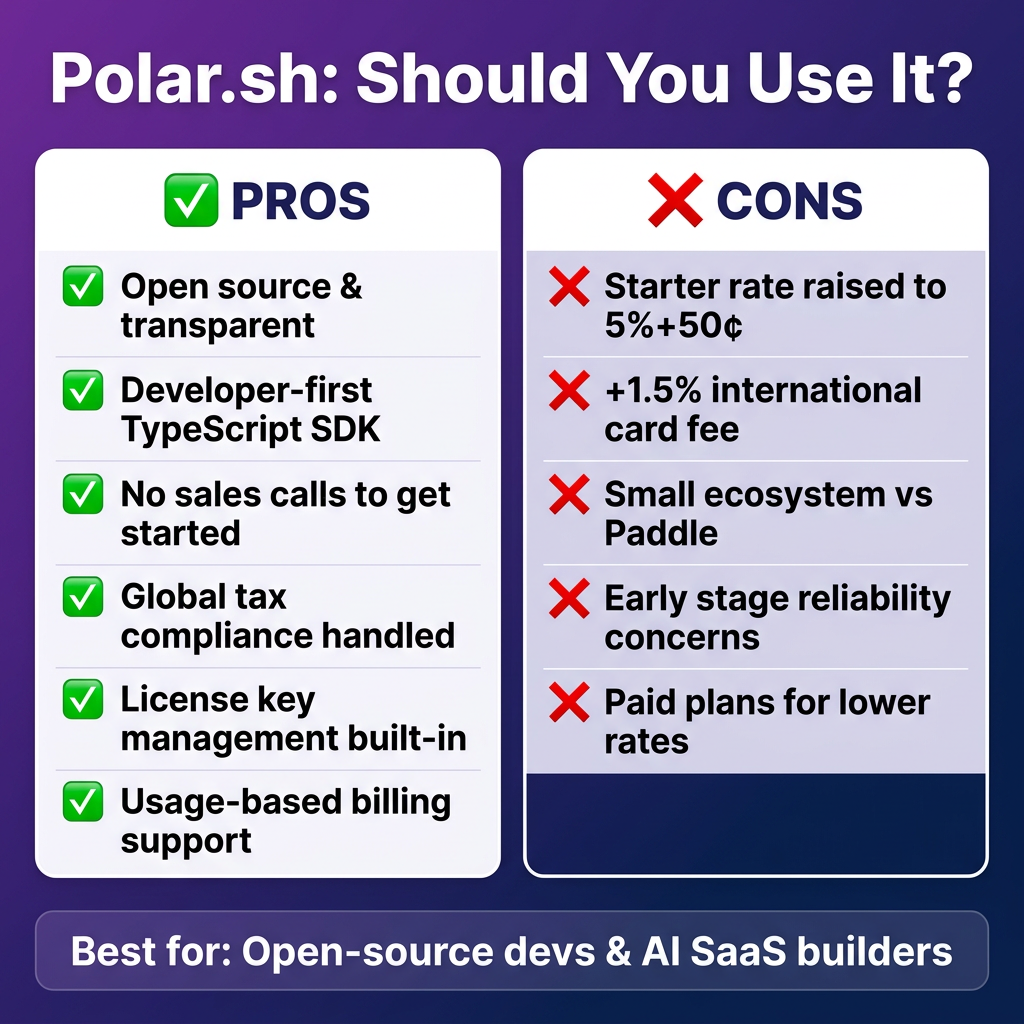
- Open source: Full visibility into the platform you’re trusting with your revenue
- Modern tooling: TypeScript-first, framework adapters, excellent DX
- No sales process: Self-serve onboarding, live checkout in minutes
- Global tax compliance: Handles VAT, GST, US sales tax in 130+ countries
- License keys built in: Native, not a bolt-on
- Usage-based billing: Proper support for consumption and seat-based models
- Transparent pricing: Posted publicly, no volume negotiation theater
The real cons
- Starter rate is now 5% + $0.50 — same as Paddle and Lemon Squeezy, no longer a discount
- +1.5% international cards significantly increases effective cost for global audiences
- Early Member rate trap: If you upgrade to a paid plan, you lose the grandfathered rate permanently
- Young platform: 13 Trustpilot reviews. Limited ecosystem of integrations compared to Paddle
- Payout fees add up: Stripe’s payout costs are passed through with no markup — but they’re still real costs
- EU-US split support: Primarily built by and for a developer audience; enterprise billing edge cases are less mature
Who Should Use Polar.sh in 2026?
Use Polar if:
- You’re building an AI SaaS or API product that needs usage-based billing
- You want an open-source MoR where you can inspect and contribute to the codebase
- Your audience is primarily US-based (reduces the +1.5% international sting)
- You care deeply about developer experience and TypeScript tooling
- You’re early-stage and self-serve onboarding matters more than enterprise features
- You signed up before May 27, 2026 and still have your Early Member rate
Look elsewhere if:
- Your audience is heavily international — the +1.5% per transaction adds up fast
- You need proven enterprise-grade reliability and SLA guarantees
- You’re doing $1K–$5K/month and want the lowest possible flat rate without monthly fees
- You need a large ecosystem of integrations and third-party tools
Polar.sh vs Fungies.io: Direct Comparison for Indie Founders
| Feature | Polar.sh (Starter) | Fungies.io |
|---|---|---|
| Base fee | 5% + $0.50 | 5% + $0.40 |
| International cards | +1.5% | Included |
| Merchant of Record | Yes ✅ | Yes ✅ |
| Global tax compliance | Yes ✅ | Yes ✅ |
| Subscription billing | Yes ✅ | Yes ✅ |
| License keys | Yes ✅ | Yes ✅ |
| Checkout embedding | Popup + hosted | Embedded + hosted |
| Affiliate programs | Yes ✅ | Yes ✅ |
| Open source | Yes ✅ | No |
| AI/usage billing | Yes ✅ | In development |
| Self-serve onboarding | Yes ✅ | Yes ✅ |
| Enterprise maturity | Early stage | Established |
The practical difference for most indie founders: if your audience is global, Fungies.io’s included international handling means you don’t get hit with an extra 1.5% on every European, Asian, or Latin American customer. At 60% international transactions on a $5K/month book, that’s $45/month in extra Polar fees — real money for an early-stage product.
Key Takeaways
- Polar Starter is now priced at market rate — 5% + $0.50 matches Paddle and Lemon Squeezy exactly. The early-adopter discount is gone for new signups.
- The open-source moat is real — no other MoR lets you inspect how your revenue is processed. If that matters to you, Polar is genuinely the only option.
- Usage-based billing for AI products is Polar’s clearest differentiation in 2026 — it’s being built for the AI era in a way competitors haven’t matched.
- International founders beware: the +1.5% for non-US cards significantly changes the economics if your users aren’t US-based.
- If you signed up before May 27, 2026 and kept your Early Member rate — don’t upgrade to a paid plan unless you cross the breakeven threshold. Losing that rate is permanent.
FAQ
Is Polar.sh a Merchant of Record?
Yes. Polar.sh is a full Merchant of Record — it becomes the legal seller of your products, handles global VAT and sales tax collection and remittance, takes on chargeback liability, and generates compliant invoices. This is different from Stripe, which is a payment processor and leaves tax compliance to you.
What happened to Polar.sh’s 4% + $0.40 rate?
In May 2026, Polar restructured pricing. The 4% + $0.40 rate became the “Early Member” rate, grandfathered for accounts created before May 27, 2026 that don’t upgrade to a paid plan. New accounts start at 5% + $0.50 (Starter), with paid plans offering lower variable rates in exchange for a monthly fee.
How does Polar.sh compare to Paddle in 2026?
At the Starter tier, Polar and Paddle now charge identical rates (5% + $0.50). Polar wins on developer experience (open source, better TypeScript tooling, faster self-serve onboarding). Paddle wins on platform maturity, enterprise reliability, and ecosystem integrations. For indie developers and AI SaaS founders, Polar is a strong choice; for growth-stage SaaS, Paddle’s track record may justify the equivalent cost.
Can I use Polar.sh for subscription SaaS?
Yes, Polar supports subscription billing natively including monthly, annual, usage-based, and seat-based models. Note: if you’re on the Early Member (grandfathered) plan, there’s an additional +0.5% subscription fee. On Starter and paid plans, there’s no extra subscription fee on top of the base transaction rate.
Conclusion
Polar.sh is a genuinely impressive platform built by developers who care about the craft. The open-source transparency, TypeScript-first tooling, and forward-thinking AI billing infrastructure set it apart from every other MoR on the market.
But the pricing reset in May 2026 changes the calculus. If you’re a new signup, you’re paying the same as Paddle and Lemon Squeezy — and stacking the international card surcharge on top. The value is in the developer experience and open-source ethos, not the fees.
If you need a Merchant of Record that handles global tax compliance, gives you clean checkout embedding, supports subscriptions and license keys — and you want to compare your options before committing — try Fungies.io free. No monthly platform fee, full MoR coverage, and international card handling included in the base rate.