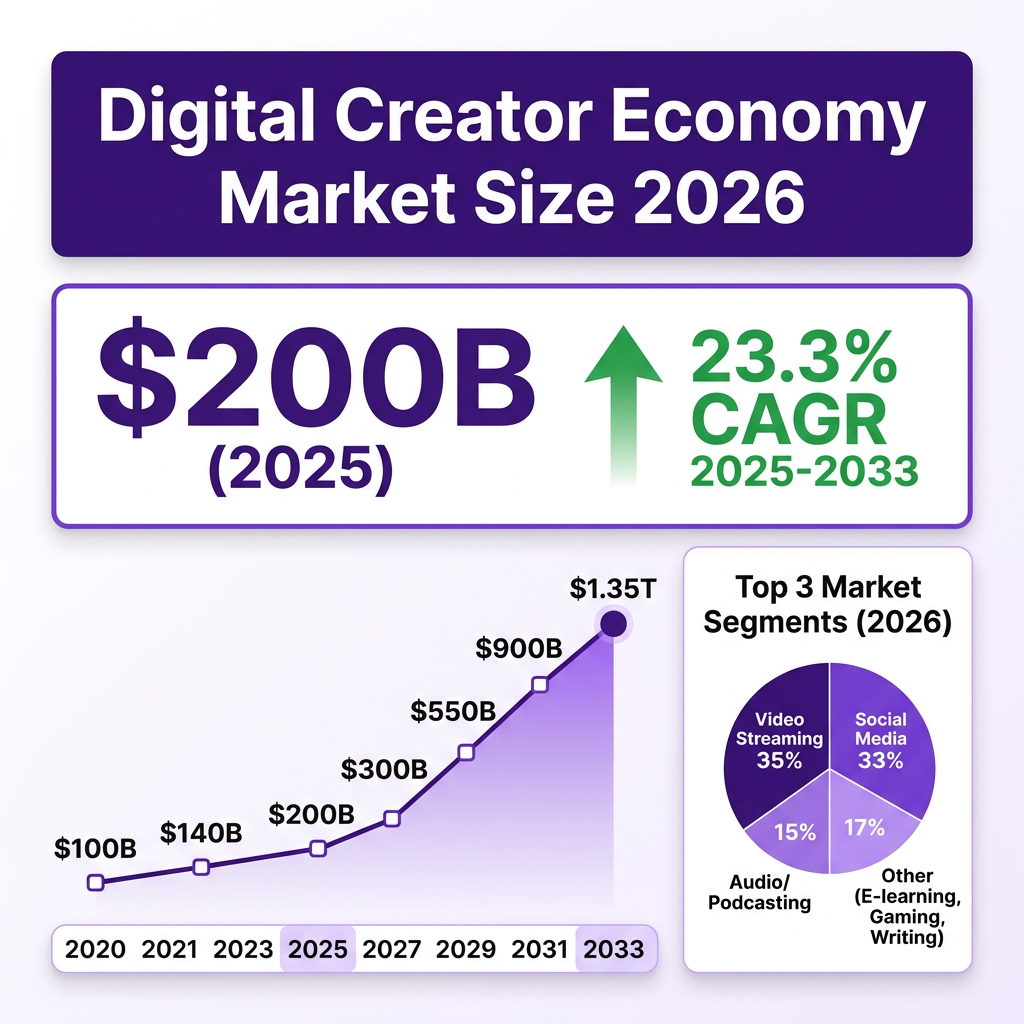
The digital creator economy has evolved from a niche side hustle into one of the most significant economic forces of the 21st century. What started with a handful of YouTubers and bloggers experimenting with monetization has ballooned into a $200 billion global industry that employs over 207 million content creators worldwide. By 2033, analysts project this market will exceed $1.35 trillion, representing one of the fastest-growing segments in the entire digital economy.
This transformation isn’t just about numbers—it’s about a fundamental shift in how value is created, distributed, and consumed in the digital age. The creator economy has democratized media production, giving individuals the power to build audiences, monetize their expertise, and establish sustainable businesses without traditional gatekeepers. From TikTok dancers and YouTube educators to podcasters and newsletter writers, creators are reshaping industries and redefining what it means to build a career in the digital age.
The implications of this shift extend far beyond individual creators. Traditional media companies are being forced to adapt or risk obsolescence. Advertising budgets are being reallocated from television and print to creator partnerships. Educational institutions are seeing their monopoly on knowledge dissemination challenged by independent experts who can reach global audiences directly. The creator economy is not just a new way to make money—it’s a fundamental restructuring of how information, entertainment, and influence flow through society.

Market Overview: The $200 Billion Creator Ecosystem
The creator economy’s growth trajectory is nothing short of extraordinary. According to Grand View Research, the market was valued at $205.25 billion in 2024 and is projected to reach $1.35 trillion by 2033, representing a compound annual growth rate (CAGR) of 23.3%. This explosive expansion places the creator economy among the fastest-growing sectors in the global digital landscape, outpacing traditional media and advertising industries by significant margins.
Research and Markets provides an even more aggressive near-term projection, estimating the market will grow from $255.66 billion in 2025 to $323.48 billion in 2026 at a CAGR of 26.5%. Meanwhile, Goldman Sachs Research expects the creator economy to approach half a trillion dollars by 2027, with the 50 million global creators growing at a 10-20% compound annual growth rate during the next five years. These projections underscore the sector’s immense potential and the confidence that major financial institutions have in its continued expansion.
The geographic distribution of the creator economy reveals interesting patterns of growth and opportunity. North America dominated the global market in 2024, accounting for 34.2% of total revenue, with the United States alone representing a $50.9 billion market. The U.S. market is projected to reach $297.3 billion by 2034, growing at a 19.3% CAGR. However, the Asia-Pacific region is emerging as the fastest-growing market, driven by massive user bases in countries like India, Indonesia, and the Philippines, where mobile-first content consumption is exploding.
Europe represents the second-largest regional market, with strong creator ecosystems in the UK, Germany, and France. Latin America and the Middle East are also experiencing rapid growth, fueled by increasing internet penetration and the proliferation of affordable smartphones. This global expansion means that the creator economy is no longer a phenomenon limited to Western markets—it’s becoming a truly worldwide economic force that transcends cultural and linguistic boundaries.
The market segmentation within the creator economy provides additional insights into where value is being created. By platform type, video streaming accounts for the largest market revenue share, reflecting the dominance of YouTube, TikTok, and other video-first platforms. Social media platforms represent 32.8% of the market, while audio platforms including podcasts and music streaming are experiencing rapid growth. E-commerce platforms that enable creator commerce are also capturing an increasing share of the market as more creators move into direct product sales.
Key Statistics and Data: Understanding the Creator Landscape
The scale of the creator economy becomes even more impressive when examining the underlying statistics that define this ecosystem. With over 207 million content creators worldwide, the sector has created a new class of digital entrepreneurs who are building businesses around their creativity, expertise, and personality. These creators span every imaginable niche—from gaming and beauty to finance and education—demonstrating the economy’s remarkable diversity and the universal appeal of authentic, personality-driven content.
Advertising spend within the creator economy reached $37 billion in the United States alone in 2025, growing four times faster than the total media industry at 26% year-over-year. This massive investment from brands reflects a fundamental shift in marketing strategy: companies are increasingly recognizing that creator partnerships deliver better ROI than traditional advertising channels. According to a Sprout Social study, 61% of consumers say they trust recommendations from creators more than they trust brand advertising, highlighting the power of authentic advocacy over polished corporate messaging.
The revenue distribution within the creator economy reveals a tiered structure that mirrors broader economic patterns. While top-tier creators can earn millions annually, the majority operate in what industry analysts call the “creator middle class.” According to Circle’s data, 44% of creator communities have between 1 and 100 members, showing that much of the growth is happening at a smaller, more intimate scale. This suggests that the creator economy is not just about mega-influencers—it’s about building sustainable businesses at every scale, from nano-creators with a few hundred followers to global superstars with millions.
Platform dynamics play a crucial role in shaping creator earnings and career trajectories. YouTube’s Partner Program alone includes millions of creators worldwide who earn revenue through advertising, channel memberships, and Super Chat. TikTok has created its own ecosystem of monetization through the Creator Fund, Creator Marketplace, and live streaming gifts. Instagram’s monetization features include Subscriptions, Badges in Live, and branded content partnerships. The emergence of newer platforms like Substack, Patreon, and Stan Store has enabled creators to build direct relationships with their audiences, reducing dependence on algorithm-driven social media platforms.
Demographic data shows that the 25-34 age group is now the largest audience segment across major platforms, while younger users increasingly rely on creator content for search, recommendations, and purchasing decisions. This generational shift has profound implications for how brands approach marketing and how creators develop content strategies. The creator economy is not just reaching audiences—it’s shaping how entire generations discover and consume information, replacing traditional search engines and media outlets with personality-driven recommendations.
By end use, individual content creators led the market with the largest revenue share of 58.7% in 2024, while businesses and media organizations accounted for the remainder. This statistic highlights the individual nature of the creator economy—despite the presence of large media companies and MCNs (Multi-Channel Networks), the vast majority of economic value is created by individual creators operating independently or in small teams.

Major Trends Shaping the Digital Creator Economy in 2026
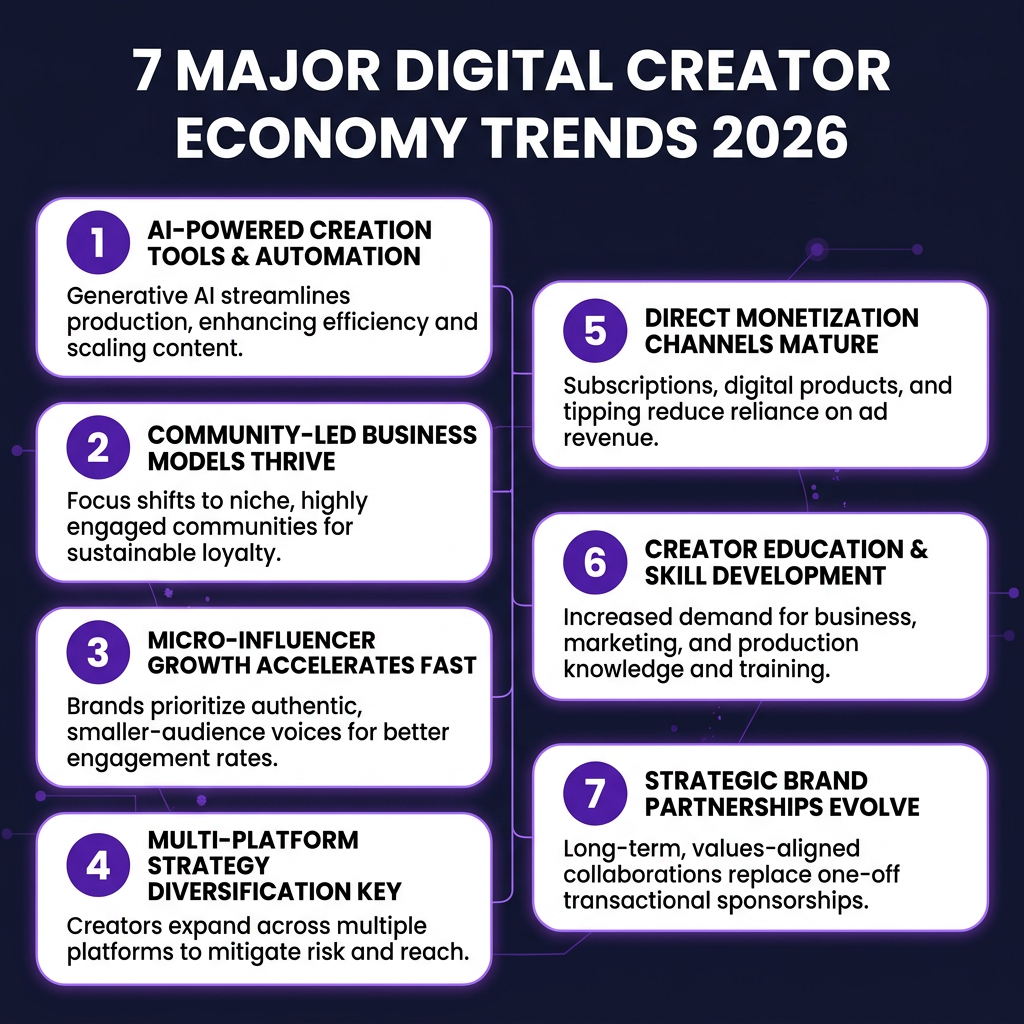
1. AI-Powered Content Creation
Artificial intelligence has become an indispensable tool for creators, with 84% of creators already leveraging AI-powered tools in their workflows. AI is transforming every aspect of content creation—from video editing and thumbnail generation to script writing and audience analytics. Rather than replacing human creativity, AI is acting as an amplifier, allowing creators to produce higher-quality content more efficiently and focus on strategic aspects of their businesses.
The emergence of AI-generated influencers represents perhaps the most disruptive development in the creator economy. Virtual creators like Aitana Lopez, created by Spanish agency The Clueless, are gaining massive followings and securing brand partnerships despite not being real people. These AI influencers offer brands complete control over messaging and eliminate the risks associated with human creators, such as scandal or controversy. While this trend raises ethical questions about authenticity and transparency, it’s clear that AI-generated content is becoming a permanent feature of the creator landscape.
2. Community-Led Business Models
As burnout and attention scarcity reshape member behavior, community-led business models and owned memberships are emerging as the most sustainable foundation for creator income. Creators are increasingly moving away from dependence on algorithm-driven platforms and building direct relationships with their audiences through newsletters, private communities, and membership programs.
This shift is driven by the recognition that social media platforms can change their algorithms or policies at any moment, potentially devastating a creator’s reach and income overnight. By building owned audiences through email lists and private communities, creators are creating “insurance policies” against platform changes. This trend is fueling the growth of platforms like Circle, Skool, and Mighty Networks, which enable creators to build branded communities outside of traditional social media.
3. The Rise of Micro and Nano Influencers
Micro- and nano-influencers will claim 45.5% of influencer marketing spending in 2026, according to eMarketer. This represents a fundamental shift in how brands approach creator partnerships. Rather than focusing solely on creators with massive followings, brands are recognizing that smaller creators often deliver higher engagement rates and more authentic connections with their audiences.
Nano creators (those with 1,000-10,000 followers) typically achieve engagement rates of 4-8%, significantly higher than the 1-3% rates common among macro influencers. These micro-communities trust nano-creators’ opinions more than mega-influencers, making them particularly valuable for brands seeking authentic advocacy. The result is a more democratized creator economy where quality of engagement matters more than quantity of followers.
4. Multi-Platform Strategy
Smart creators are building multi-platform strategies that maximize reach while maintaining authentic connections with their audiences. Rather than betting everything on a single platform, successful creators distribute content across YouTube, TikTok, Instagram, podcasts, newsletters, and emerging platforms. This diversification protects against algorithm changes and platform-specific risks while allowing creators to reach audiences wherever they consume content.
The most sophisticated creators are treating their content like a media company, repurposing core ideas across multiple formats and platforms. A single piece of long-form content might be adapted into short-form videos, quote graphics, newsletter sections, podcast episodes, and blog posts. This approach maximizes the return on creative investment while building a cohesive brand presence across the digital landscape.
5. Direct Monetization and Creator Commerce
Creators are increasingly bypassing traditional advertising models in favor of direct monetization through product sales, courses, coaching, and digital products. Nearly 69% of creators still rely on brand collaborations as their primary income source, but a growing number are building diversified revenue streams that include merchandise, digital products, and paid communities.
Platforms like Stan Store, Shopify, and Gumroad have made it easier than ever for creators to sell directly to their audiences. This shift toward creator commerce is blurring the lines between content creation and e-commerce, with creators becoming full-fledged entrepreneurs who happen to use content as their primary marketing channel. The most successful creators are building product ecosystems that extend their brand beyond content into physical and digital goods.
6. Professionalization of Creator Education
As the creator economy matures, so does the infrastructure supporting it. Creator education has become a significant sub-sector, with courses, coaching programs, and mastermind groups teaching aspiring creators how to build sustainable businesses. From technical skills like video editing and SEO to business skills like negotiation and contract management, the professionalization of creator education is raising the bar for the entire industry.
This trend is also reflected in the increasing sophistication of creator tools. Analytics platforms, content management systems, and financial tools designed specifically for creators are becoming more advanced, enabling creators to operate like professional media companies rather than solo operators. The result is a more professional, sustainable creator economy where business acumen matters as much as creative talent.
7. Strategic Brand Partnerships
Influencer marketing has evolved from experimental partnerships to permanent line items in global marketing budgets. In 2026, creators are no longer treated as experimental partners—they are now essential and integral to how companies build awareness, trust, and long-term loyalty. Brands are developing sophisticated creator programs that include long-term ambassadorships, co-creation of products, and equity partnerships.
This evolution reflects a maturation of the industry. Rather than one-off sponsored posts, brands are building relationships with creators who genuinely align with their values and can serve as authentic advocates. The result is more effective marketing campaigns and more sustainable income for creators who can demonstrate real business impact through sophisticated measurement and attribution.
Key Players and Competitive Landscape
The creator economy ecosystem comprises a diverse array of platforms, tools, and services that enable creators to produce, distribute, and monetize content. Understanding the competitive landscape is essential for creators looking to build sustainable businesses and for brands seeking to navigate this complex ecosystem.
Platform Giants
YouTube remains the dominant force in the creator economy, with its Partner Program providing monetization opportunities for millions of creators worldwide. The platform’s advertising revenue-sharing model has created a sustainable income stream for creators across every niche imaginable. YouTube’s recent investments in Shorts demonstrate its commitment to competing with TikTok in the short-form video space, while its long-form content remains the gold standard for educational and entertainment content.
TikTok has revolutionized content discovery with its algorithm-driven For You Page, enabling creators to reach massive audiences regardless of their follower count. The platform’s Creator Fund and Creator Marketplace have established it as a major player in creator monetization, particularly for younger demographics. However, ongoing regulatory concerns in various markets present potential challenges for the platform’s continued growth and creator confidence.
Instagram continues to evolve its creator offerings, with Reels competing directly with TikTok and features like Subscriptions enabling direct fan support. The platform’s shopping features have also made it a significant player in creator commerce, allowing creators to tag products and earn commissions directly from their content. Meta’s massive investment in the creator economy reflects its recognition that creators are essential to the future of social media.
Emerging Platforms
Beyond the major social platforms, a new generation of creator-focused companies is reshaping the landscape. Patreon pioneered the direct fan support model, enabling creators to earn recurring revenue from dedicated fans. Substack has disrupted the publishing industry by allowing writers to build newsletter-based businesses with direct subscription revenue, creating a new class of independent journalists and thought leaders.
Stan Store and Beacons have created link-in-bio commerce platforms that enable creators to sell products and services directly to their audiences. These platforms recognize that creators need more than just content distribution—they need business infrastructure that enables them to monetize their influence effectively.
Community platforms like Circle, Skool, and Mighty Networks are enabling creators to build private communities outside of traditional social media. These platforms offer creators more control over their audiences and the ability to create deeper relationships with their most dedicated fans, often at higher price points than advertising-supported content.
Creator Tools and Infrastructure
The creator economy infrastructure extends far beyond content platforms. Analytics tools like CreatorIQ and HypeAuditor provide creators and brands with sophisticated data on performance and audience demographics. Content creation tools like Canva, Adobe Creative Suite, and AI-powered editing software have democratized professional-quality production, enabling creators with limited technical skills to produce polished content.
Financial tools like Stir and Karat provide creators with business banking and credit solutions tailored to their unique income patterns. Management platforms like GRIN and AspireIQ help creators and brands manage partnerships at scale. According to Business Insider, over a dozen creator economy startups pulled in at least $50 million in new funding in 2025, with more than half of the roughly $2 billion in funding going to eight startups building AI tools to help users speed up content creation.
Challenges and Pain Points in the Creator Economy
1. Platform Dependency and Algorithm Risk
The most significant risk facing creators is their dependence on platforms they don’t control. Social media companies can change algorithms, policies, or monetization structures at any moment, potentially devastating a creator’s reach and income overnight. This “building on rented land” problem has led to numerous cases where creators lost their livelihoods due to platform changes, account bans, or algorithm updates that suddenly reduced their visibility.
The solution—building owned audiences through email lists and private communities—requires significant effort and often means slower initial growth. Many creators struggle to balance the reach of social platforms with the security of owned channels, leading to a persistent tension in creator business models. The most successful creators are those who have successfully diversified across multiple platforms while building direct relationships with their most valuable audience members.
2. Creator Burnout and Mental Health
The pressure to consistently produce content, maintain engagement, and grow audiences has led to widespread creator burnout. The always-on nature of social media creates expectations of constant availability that can be mentally and emotionally exhausting. Many creators report feeling trapped in a hamster wheel of content production, with little time for rest or creative exploration.
The public nature of creator work also exposes individuals to unprecedented levels of scrutiny, criticism, and harassment. Mental health challenges are increasingly recognized as a significant issue in the creator community, with many high-profile creators taking breaks or leaving the industry entirely due to burnout. Platforms and creator tools are beginning to address this with features that help creators manage their workload and mental health, but the problem remains pervasive.
3. Income Inequality and Sustainability
While headlines focus on creators earning millions, the reality for most is far more modest. The creator economy exhibits significant income inequality, with a small percentage of top creators capturing the majority of earnings. Many creators struggle to earn sustainable incomes, particularly in the early stages of their careers when they’re building audiences and establishing revenue streams.
The unpredictable nature of creator income—dependent on algorithm performance, brand deal availability, and audience engagement—makes financial planning challenging. Unlike traditional employment, creator income can fluctuate dramatically month to month, creating stress and uncertainty. This volatility is particularly challenging for creators with families or financial obligations that require stable income.
4. Brand Safety and Authenticity Concerns
As the creator economy matures, questions of authenticity and brand safety have become increasingly important. Brands are becoming more sophisticated in evaluating creator partnerships, looking beyond vanity metrics to assess genuine audience engagement and brand alignment. Creators, in turn, must navigate the tension between monetization and authenticity, ensuring that sponsored content doesn’t alienate their audiences.
The rise of AI-generated content also raises questions about transparency and disclosure. As AI tools become more sophisticated, audiences may struggle to distinguish between human-created and AI-generated content, potentially eroding trust in the creator ecosystem. Regulation in this area is likely to increase, requiring creators to be more transparent about their use of AI and sponsored content.
Opportunities and Growth Strategies for 2026
1. Building Owned Audiences
The most significant opportunity for creators in 2026 is the shift toward owned audiences. By building email lists, private communities, and direct relationships with fans, creators can reduce their dependence on algorithm-driven platforms and create more stable, predictable income streams. This strategy requires a long-term perspective and consistent effort, but the payoff is a more sustainable and valuable business.
Creators who successfully build owned audiences often find that their businesses become more resilient to platform changes and algorithm updates. They also typically achieve higher monetization rates, as direct relationships enable premium pricing and deeper engagement. The key is providing unique value that justifies the direct relationship, whether through exclusive content, community access, or personalized interaction.
2. Diversifying Revenue Streams
Relying on a single revenue source—whether brand deals, platform ad revenue, or fan subscriptions—creates significant risk. Successful creators in 2026 are building diversified income portfolios that include multiple revenue streams: advertising, sponsorships, affiliate marketing, product sales, courses, coaching, consulting, and speaking engagements.
This diversification not only reduces risk but also enables creators to optimize their businesses for different audience segments and market conditions. A creator might use free content to build awareness, low-priced digital products to acquire customers, and high-ticket coaching or consulting to maximize revenue from their most dedicated fans. This funnel approach creates a sustainable business model that can weather changes in any single revenue source.
3. Leveraging AI and Automation
AI represents both a challenge and an opportunity for creators. Those who embrace AI tools for content creation, audience analysis, and business operations can achieve significant productivity gains. AI can handle repetitive tasks like editing, scheduling, and basic customer service, freeing creators to focus on high-value activities like strategy, creative development, and community building.
The key is using AI as an amplifier of human creativity rather than a replacement. Creators who maintain their unique voice and perspective while leveraging AI for efficiency will have a significant advantage in the increasingly competitive creator landscape. The most successful creators will be those who can harness AI to scale their output without sacrificing the authenticity that audiences value.
4. Developing Niche Expertise
As the creator economy becomes more crowded, generalist creators face increasing competition. The opportunity lies in developing deep expertise in specific niches where creators can establish themselves as the go-to authority. Whether it’s a specific industry, skill, or interest area, niche creators can build highly engaged audiences and command premium rates for their expertise.
This specialization also opens opportunities for B2B monetization, with businesses paying premium rates for creators who can reach specific professional audiences. A creator who dominates a niche in healthcare, finance, or technology can build a highly profitable business with a relatively modest but highly valuable audience. The key is becoming truly indispensable to a specific community rather than moderately interesting to a broad one.
Case Studies and Success Stories
Case Study 1: The Multi-Platform Educator
A finance educator built a multi-million dollar creator business by leveraging multiple platforms and revenue streams. Starting with a YouTube channel explaining complex financial concepts in accessible ways, they expanded into a podcast, newsletter, and online courses. By treating their content like a media company and repurposing core ideas across platforms, they built a diversified business that generates revenue from advertising, sponsorships, course sales, and affiliate marketing.
The key to their success was consistency and quality. By publishing valuable content regularly over several years, they built trust with their audience that translated into strong performance across all monetization channels. Their story demonstrates the power of the multi-platform strategy and the importance of playing the long game in creator business building. They now employ a small team to help with production and operations, demonstrating how creator businesses can scale beyond individual effort.
Case Study 2: The Community-First Creator
A fitness creator built a thriving business by prioritizing community over reach. Rather than chasing viral content, they focused on building a private community of dedicated members who pay for exclusive workouts, nutrition guidance, and direct access. This community-first approach generated more sustainable revenue than advertising or brand deals alone, while creating deeper relationships with their most dedicated fans.
The creator used social media primarily as a funnel to their owned community, posting free content to attract new members while reserving their best material for paying subscribers. This model demonstrates how creators can build sustainable businesses with relatively modest audiences by focusing on depth of engagement rather than breadth of reach. The community aspect also created network effects, with members recruiting friends and family to join.
Case Study 3: The AI-Enhanced Creator
A technology reviewer transformed their creator business by embracing AI tools for content production. Using AI for research, script writing, and video editing, they were able to increase their output by 300% while maintaining quality. This productivity gain allowed them to expand into new platforms and formats, building a multi-channel presence that reaches audiences across YouTube, TikTok, newsletters, and podcasts.
The creator maintained their unique voice and perspective throughout, using AI as a tool rather than a replacement for their expertise. Their success demonstrates how creators can leverage technology to scale their businesses without sacrificing the authenticity that audiences value. They now share their AI workflows with other creators, creating an additional revenue stream through education and consulting.
Future Outlook and Predictions (2026-2030)
The creator economy is entering a new phase of maturity and consolidation. As Forbes described it, 2026 marks “The Era of Consolidation”—a shift from the wild west early days to a more structured, professionalized industry. This consolidation will bring both challenges and opportunities for creators, brands, and platforms as the industry matures and professional standards emerge.
Market Projections
By 2030, the creator economy is projected to reach between $528 billion and $1.35 trillion, depending on the analysis. This growth will be driven by several factors: continued expansion of internet access globally, the proliferation of AI tools that lower barriers to content creation, increasing brand investment in creator partnerships, and the professionalization of creator careers as a legitimate path for ambitious individuals.
Goldman Sachs Research expects the 50 million global creators to grow at a 10-20% compound annual growth rate during the next five years. This growth will be accompanied by increasing sophistication in how creators build businesses, with more emphasis on sustainability, diversification, and professional management. The creator economy will increasingly resemble traditional media and entertainment industries in its structure and practices.
Technology Trends
AI will continue to transform the creator economy, with more sophisticated tools for content creation, audience analysis, and business operations. Virtual and augmented reality will create new formats for creator content, enabling immersive experiences that go beyond current video and audio formats. Blockchain and Web3 technologies may enable new monetization models through NFTs, tokenization, and decentralized platforms that give creators more control over their content and revenue.
The platforms that are best positioned to attract both influential creators and a larger share of total spending are those that will offer multiple forms of monetization, robust analytics, and creator-friendly policies. We can expect continued competition among platforms to attract and retain top creator talent, with creators becoming increasingly sophisticated in negotiating favorable terms.
Industry Maturation
As the creator economy matures, we can expect to see more professional infrastructure supporting creators. This includes better financial services tailored to creator income patterns, more sophisticated analytics and business intelligence tools, and professional services like management, legal, and accounting specifically designed for creators. The industry will develop standards and best practices that help creators build more sustainable businesses.
The relationship between creators and brands will also mature, with more long-term partnerships, equity arrangements, and co-creation of products. Creators will increasingly be viewed as strategic business partners rather than marketing channels, with deeper integration into brand strategy and product development. This shift will create more stable income for creators while delivering better results for brands.
Key Takeaways
- The digital creator economy reached $200 billion in 2025 and is projected to exceed $1.35 trillion by 2033, growing at a 23.3% CAGR.
- Over 207 million content creators worldwide are building businesses around their creativity, expertise, and personality.
- AI-powered tools are transforming content creation, with 84% of creators already leveraging AI in their workflows.
- Community-led business models and owned audiences are emerging as the most sustainable foundation for creator income.
- Micro- and nano-influencers will claim 45.5% of influencer marketing spending in 2026, reflecting a shift toward authentic engagement over follower count.
- North America currently dominates with 34.2% of global revenue, but Asia-Pacific is the fastest-growing region.
- Creator burnout and platform dependency remain significant challenges requiring strategic solutions.
- The most successful creators in
2026 are building diversified revenue streams and treating their content like media companies.
Brand partnerships are evolving from one-off sponsored posts to long-term strategic relationships with equity arrangements.
The creator economy is entering an era of consolidation and professionalization, creating both challenges and opportunities for participants.
Video streaming continues to dominate the market, while audio platforms and creator commerce are experiencing rapid growth.
Successful creators are increasingly adopting multi-platform strategies to maximize reach while maintaining authentic audience connections.
The professionalization of creator education is raising the bar for the entire industry, with sophisticated tools and business training becoming essential.
Direct monetization through product sales, courses, and coaching is becoming increasingly important as creators seek to reduce platform dependency.
The rise of AI-generated content presents both opportunities for productivity gains and challenges around authenticity and transparency.
Building owned audiences through email lists and private communities is emerging as the most sustainable strategy for long-term creator success.
The creator economy represents a fundamental shift in how value is created and distributed in the digital age, with implications extending far beyond individual creators to reshape entire industries.
Sources and Citations
- Grand View Research – Creator Economy Market Report 2025-2033: https://www.grandviewresearch.com/industry-analysis/creator-economy-market-report
- Goldman Sachs Research – The Creator Economy Could Approach Half a Trillion Dollars by 2027: https://www.goldmansachs.com/insights/articles/the-creator-economy-could-approach-half-a-trillion-dollars-by-2027
- Research and Markets – Creator Economy Global Market Insights 2025: https://www.researchandmarkets.com/reports/6170479/creator-economy-global-market-insights
- Circle Blog – Creator Economy Statistics for 2026: https://circle.so/blog/creator-economy-statistics
- eMarketer – Creator Economy 2026: https://www.emarketer.com/content/creator-economy-2026
- Forbes – The Creator Economy In 2026: The Era Of Consolidation: https://www.forbes.com/sites/jasondavis/2026/01/26/the-creator-economy-in-2026—the-era-of-consolidation
- The Influencer Marketing Factory – Creator Economy Report 2026: https://theinfluencermarketingfactory.com/creator-economy
- Business Insider – Creator Economy Trends and VC Funding 2026: https://www.businessinsider.com/creator-economy-trends-helped-startups-pull-in-funding-2026-1
- SNS Insider – Creator Economy Market Report 2026-2035: https://www.snsinsider.com/reports/creator-economy-market-8072
- Exploding Topics – Creator Economy Market Size 2025-2030: https://explodingtopics.com/blog/creator-economy-market-size
Deep Dive: Creator Economy Revenue Models
Understanding the various revenue models available to creators is essential for anyone looking to build a sustainable business in this ecosystem. The creator economy offers multiple pathways to monetization, each with its own advantages, challenges, and optimal use cases. Successful creators typically combine several revenue streams to build resilient businesses that can weather changes in any single channel.
Advertising and Platform Revenue
Advertising remains the most common revenue source for creators, particularly those on video platforms like YouTube and TikTok. YouTube’s Partner Program allows creators to earn a share of advertising revenue generated from their content, with rates varying based on factors like viewer demographics, content category, and seasonality. While this model provides passive income once content is published, it also leaves creators vulnerable to algorithm changes and advertiser boycotts that can dramatically impact earnings.
Platform-specific monetization features have expanded significantly in recent years. TikTok’s Creator Fund pays creators based on views and engagement, while Instagram offers Badges in Live streams and Subscriptions for exclusive content. These platform-native monetization options provide additional revenue streams but often come with eligibility requirements and revenue-sharing arrangements that favor the platforms.
Brand Partnerships and Sponsorships
Brand partnerships represent the largest revenue opportunity for many creators, with influencer marketing spend reaching $37 billion in the United States alone in 2025. These partnerships range from one-off sponsored posts to long-term ambassadorships and even equity arrangements where creators receive ownership stakes in the brands they promote. The most successful brand partnerships are those where the creator genuinely uses and believes in the product, allowing for authentic recommendations that resonate with their audience.
Pricing for brand partnerships varies dramatically based on creator tier, platform, and content format. Nano creators with 1,000-10,000 followers might charge $100-500 per post, while mega-influencers with millions of followers can command six or seven figures for major campaigns. The industry has seen a shift toward performance-based pricing, where creators earn based on measurable outcomes like clicks, conversions, or sales rather than flat fees.
Affiliate Marketing
Affiliate marketing allows creators to earn commissions by promoting products and services through unique tracking links. This model aligns creator incentives with merchant goals, as creators only earn when they drive actual sales. Amazon Associates remains the largest affiliate program, but specialized networks like RewardStyle, LTK, and individual brand programs offer higher commissions for specific niches.
The key to successful affiliate marketing is authenticity and relevance. Creators who promote products they genuinely use and that align with their audience’s interests can build sustainable affiliate revenue streams. Disclosure requirements have become stricter in recent years, with regulators requiring clear labeling of affiliate links to maintain transparency with audiences.
Direct Fan Support
Direct fan support models have gained significant traction as creators seek to reduce dependence on advertising and algorithms. Platforms like Patreon, Ko-fi, and Buy Me a Coffee allow fans to make recurring or one-time payments to support their favorite creators. These models work best for creators who have built strong relationships with their audiences and can offer exclusive value in exchange for support.
Subscription models through platforms like Substack for newsletters or OnlyFans for exclusive content have created new categories of creator businesses. These models provide predictable recurring revenue and deeper audience relationships, though they require consistent delivery of value to maintain subscriber retention.
Digital Products and Courses
Digital products represent one of the highest-margin revenue opportunities for creators. E-books, templates, presets, and digital tools can be created once and sold repeatedly with minimal marginal cost. Online courses have become particularly popular, with platforms like Teachable, Thinkific, and Kajabi enabling creators to package their expertise into structured learning experiences.
The key to successful digital products is solving specific problems for a well-defined audience. Creators who have built authority in a particular niche can command premium prices for products that deliver clear value. Marketing digital products effectively requires understanding audience pain points and positioning solutions in compelling ways.
Physical Products and Merchandise
Many creators have expanded into physical products, from branded merchandise to original products that extend their brand. Print-on-demand services like Printful and Spring have lowered the barriers to entry for merchandise, while dropshipping and fulfillment services enable creators to sell physical products without managing inventory.
The most successful creator product lines go beyond simple logo merchandise to offer products that genuinely serve their audience’s needs. A fitness creator might launch a supplement line, while a cooking creator might develop kitchen tools. These product extensions can generate significant revenue while deepening audience relationships.
Regional Analysis: Creator Economy Around the World
The creator economy is a global phenomenon, but its development varies significantly by region. Understanding these regional differences is crucial for creators looking to expand internationally and for brands seeking to engage global audiences through creator partnerships.
North America
North America remains the largest creator economy market, with the United States alone representing a $50.9 billion market in 2024. The region benefits from mature digital infrastructure, high advertising spending, and a culture that celebrates entrepreneurship and personal branding. Silicon Valley’s influence has created a robust ecosystem of creator tools and platforms, while Los Angeles and New York serve as hubs for creator talent and brand partnerships.
The U.S. creator economy is characterized by high monetization rates and sophisticated brand partnerships. American creators were among the first to professionalize their operations, treating content creation as a serious business rather than a hobby. This professionalization has raised standards for the entire industry and created models that creators in other regions are now adopting.
Europe
Europe represents the second-largest regional market, with strong creator ecosystems in the UK, Germany, France, and the Nordics. European creators often operate across multiple languages and markets, requiring more sophisticated content strategies than their American counterparts. The region’s strong regulatory environment, including GDPR privacy regulations, has shaped how creators collect and use audience data.
European creators have been particularly successful in areas like sustainability, fashion, and lifestyle content, reflecting regional values and consumer interests. The diversity of European markets also creates opportunities for creators who can navigate cultural differences and build audiences across borders.
Asia-Pacific
The Asia-Pacific region is the fastest-growing creator economy market, driven by massive user bases in countries like India, Indonesia, and the Philippines. Mobile-first content consumption is the norm, with short-form video platforms like TikTok and local equivalents dominating the landscape. The region’s younger demographics and rapidly expanding middle class create enormous opportunities for creator businesses.
Live streaming commerce has been particularly successful in Asia, with creators in China and Southeast Asia generating billions in product sales through live streams. This model is now being adopted in Western markets, suggesting that Asia-Pacific innovations will continue to shape the global creator economy.
Latin America and Middle East
Latin America and the Middle East are emerging as significant creator economy markets, fueled by increasing internet penetration and smartphone adoption. These regions often leapfrog traditional media development, moving directly to digital and mobile content consumption. Local creators are building massive audiences by creating content in regional languages and addressing culturally specific interests.
The growth in these regions presents opportunities for both local creators and international brands seeking to reach emerging markets. However, challenges around payment infrastructure, regulatory environments, and platform availability can complicate monetization efforts compared to more mature markets.