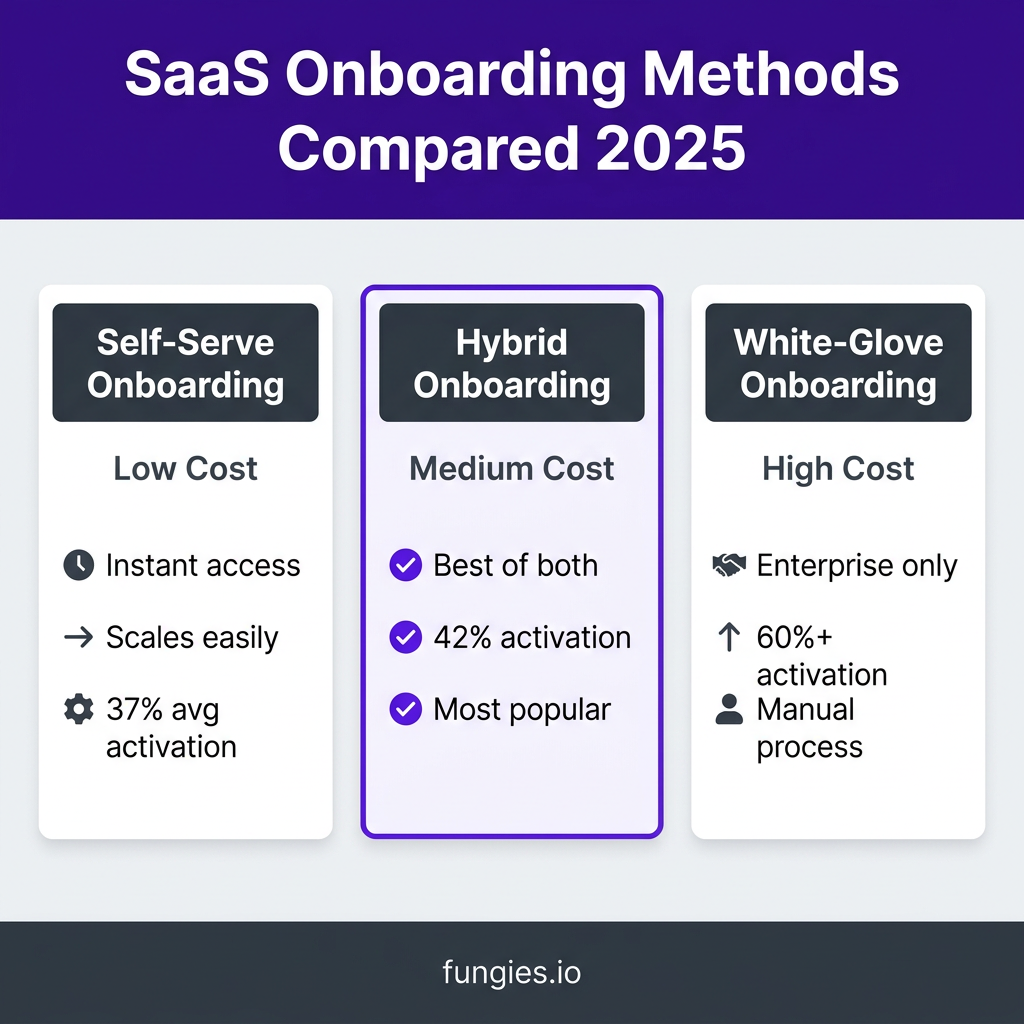
Here is a sobering statistic: across 62 B2B SaaS companies analyzed in 2024, the average user activation rate sits at just 37.5%. That means nearly two-thirds of people who sign up for your product never experience the core value it was built to deliver. They do not churn loudly. They simply never come back.
The culprit? Poor onboarding. In a world where 75% of users abandon a product within the first week if they struggle during setup, your onboarding flow is not just a nice-to-have — it is the single highest-leverage point for reducing churn and driving sustainable growth.
What Is Time-to-Value (TTV) and Why Does It Matter?
Time-to-Value (TTV) measures the time between a user signing up and experiencing their first “aha” moment — the instant they realize your product can actually solve their problem. In SaaS, this metric is make-or-break.
Amplitude’s 2025 benchmark data, drawn from over 2,600 companies, found that over 98% of new users churn within two weeks when they never hit a value milestone. Conversely, companies that successfully reduce TTV see activation rates climb by 30-50%.
Honestly, most SaaS teams I talk to obsess over acquisition while completely neglecting what happens after signup. They pour budget into ads, content, and sales — then watch 60% of that investment evaporate because users get lost in a confusing onboarding flow.
The Real Cost of Poor Onboarding
Let me put this in concrete terms. According to recent research:
- 68% of users report abandoning products because of poor onboarding
- 89% of customers who have a bad onboarding experience will turn to a competitor
- 55% of customers will stop using a product they do not understand
- 80% of users have uninstalled an app due to lack of understanding of how to use it
But here is the flip side — and why this matters so much for your bottom line. Companies that increase customer retention by just 5% see profit increases of 25% to 95%. In SaaS, where recurring revenue is the name of the game, onboarding is quite literally the foundation of your entire business model.
Understanding the Activation Funnel
Before we dive into optimization tactics, let us map what we are actually trying to improve. The activation funnel in SaaS typically looks like this:
- Signup — User creates an account
- Setup — User completes initial configuration
- First Action — User engages with core feature
- Aha Moment — User experiences value for the first time
- Activation — User forms habit around core value
Most drop-offs happen between steps 3 and 4. Users complete setup but never reach that critical value moment. Your job is to collapse the distance between signup and aha.
Step 1: Define Your Activation Event
You cannot optimize what you cannot measure. The first step in any onboarding optimization project is defining exactly what “activated” means for your product.
An activation event is not just any action — it is the specific behavior that correlates most strongly with long-term retention. For Slack, it is sending 2,000 messages. For Dropbox, it is uploading a file to a shared folder. For Figma, it is creating a design file with multiple collaborators.
To find yours:
- Pull cohort retention data for the past 6 months
- Identify which early actions separate users who stick around from those who churn
- Look for the “magic number” — the threshold where retention curves flatten
- Validate with user interviews: ask retained users what moment convinced them to stay
This might take a few days of analysis, but do not skip it. Everything that follows depends on knowing exactly what success looks like.
Step 2: Audit Your Current Onboarding Flow
Now that you know your target, map the current journey users take to get there. Sign up for your own product with fresh eyes — better yet, watch five real users do it via screen recording.
Look for these common friction points:
- Form fatigue — Are you asking for too much information upfront?
- Empty states — Do users land in a blank dashboard with no guidance?
- Feature overload — Are you trying to explain everything at once?
- Dead ends — Can users get stuck with no clear next step?
- Technical barriers — Do users need to install something or integrate before seeing value?
Document every drop-off point with data. If you are using a product analytics tool like Amplitude or Mixpanel, build a funnel view showing conversion rates between each step.
Step 3: Reduce Friction in the Critical Path
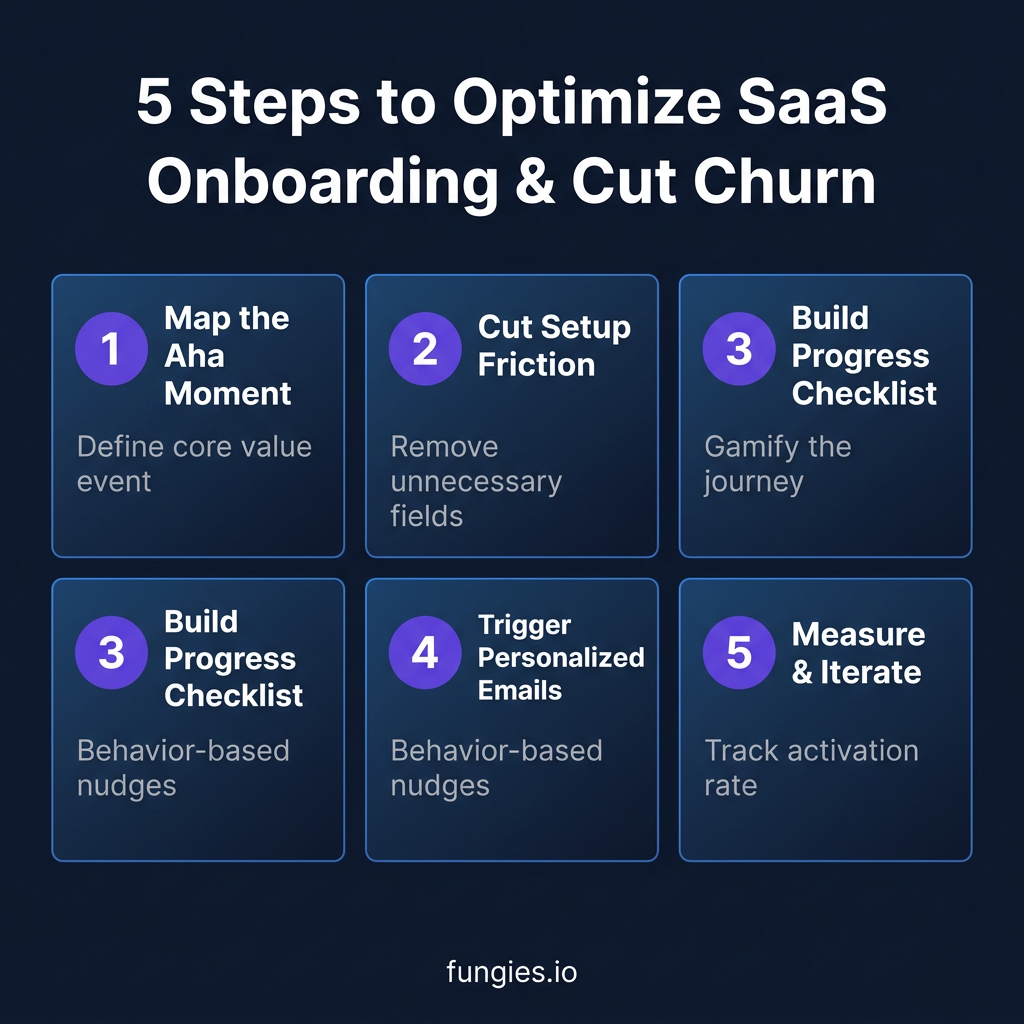
Here is a rule that has served me well: every field you add to your signup form kills conversion. Stripe famously reduced their onboarding to email + password only. Everything else gets collected later, contextually.
Some specific tactics that work:
Progressive Profiling
Instead of asking for everything upfront, spread data collection across the first few sessions. Ask for company size when they are setting up their team. Ask for use case when they are creating their first project.
Smart Defaults
Pre-populate everything you can. If you can detect their industry from their email domain, set sensible defaults. If they are coming from a specific landing page, pre-configure settings for that use case.
Skip Options
Make every non-essential step skippable. Users who are eager to explore should be able to bypass tutorials. You can always bring them back contextually later.
Single Sign-On (SSO)
Google, Microsoft, and Slack SSO options reduce signup friction dramatically. For B2B SaaS, this is table stakes in 2025.
Step 4: Build an Interactive Onboarding Checklist
One of the most effective onboarding patterns I have seen is the progress checklist. It gamifies the journey to activation and gives users a clear sense of what comes next.
A good onboarding checklist:
- Has 3-5 items max (too many feels overwhelming)
- Starts with an easy win (completing profile, inviting a teammate)
- Progresses logically toward the activation event
- Shows clear progress (checkboxes, progress bars, completion percentages)
- Offers help at each step (tooltips, videos, chat support)
Tools like Appcues, Userflow, or Chameleon make this easy to implement without engineering resources. Even a simple checklist built in your own UI can increase activation rates by 20-30%.
Step 5: Personalize by Use Case
Not all users are the same. A solo founder and a 500-person enterprise team need completely different onboarding experiences. The best SaaS products segment users early and personalize accordingly.
Simple ways to personalize:
- Role-based flows — Ask “What is your role?” during signup and adjust the experience
- Use-case templates — Offer pre-built setups for common scenarios
- Team size adaptations — Solo users get one flow; teams get collaboration features highlighted
- Industry customization — Language, examples, and defaults tailored to vertical
Role-based onboarding flows have been shown to increase activation by 30-50% compared to one-size-fits-all approaches.
Step 6: Leverage Lifecycle Email
Email is your safety net. When users drop off or get stuck, a well-timed email can bring them back.
The essential onboarding email sequence:
| Timing | Purpose | |
|---|---|---|
| Welcome | Immediately | Set expectations, confirm value proposition |
| Quick Win | Day 1 | Guide to first small success |
| Activation Nudge | Day 3 | Push toward core value moment |
| Social Proof | Day 7 | Show how others are succeeding |
| Re-engagement | Day 14 | Win back users who have gone dark |
Make these emails behavior-triggered, not time-triggered. If a user already completed the activation event, skip the nudge. If they have not logged in for 3 days, accelerate the re-engagement.
Step 7: Measure What Matters
You have optimized the flow. Now you need to know if it worked. Here are the metrics that actually matter for onboarding:
| Metric | Benchmark | What It Tells You |
|---|---|---|
| Activation Rate | 35-45% | % of signups reaching value moment |
| Time-to-Value | <15 minutes | How quickly users see value |
| Onboarding Completion | 60-70% | % finishing onboarding flow |
| Day 7 Retention | 20-40% | Users still active after one week |
| Free-to-Paid Conversion | 15-25% | Trials converting to paid |
Track these weekly. Set up dashboards. When numbers move, dig into why. The best onboarding teams treat this like a product feature — constantly iterating, testing, and improving.
Common Onboarding Mistakes to Avoid
Before we wrap up, let me share the biggest mistakes I see SaaS companies make with onboarding:
Mistake 1: The Feature Dump
Trying to show users every feature in the first session. This overwhelms them and delays value. Focus on the one thing that delivers core value. Everything else can wait.
Mistake 2: The Empty State Desert
Dumping users into a blank dashboard with no guidance. Use sample data, templates, or demo content to show what success looks like.
Mistake 3: The Set-It-and-Forget-It
Building onboarding once and never touching it again. Your product evolves. Your onboarding should too. Review quarterly at minimum.
Mistake 4: The Engineering-Only Approach
Relying solely on in-product tours without human touch. For higher-ACV products, a 15-minute onboarding call can increase activation by 40%.
Putting It All Together: Your 30-Day Onboarding Optimization Plan
Here is a concrete plan you can execute starting today:
- Week 1: Define activation event, audit current flow, identify biggest drop-off
- Week 2: Reduce signup friction, implement progress checklist
- Week 3: Personalize by use case, set up lifecycle emails
- Week 4: Launch, measure, iterate based on data
This is not theoretical. I have seen teams implement these changes and watch activation rates jump from 25% to 45% in a single month. That translates directly to revenue.
Frequently Asked Questions
What is a good activation rate for SaaS?
The average activation rate across B2B SaaS is 37.5%. A “good” rate depends on your vertical — AI/ML tools average 54.8%, CRM/Sales tools hit 42.6%, while MarTech products struggle at 24% due to heavy setup requirements. Aim for 40%+ as a baseline.
How long should SaaS onboarding take?
Time-to-value should be under 15 minutes for self-serve products. Complex enterprise tools may take days or weeks, but users should see some value within the first session. The faster you deliver value, the higher your retention.
Should I offer a product tour during onboarding?
Product tours can help, but keep them short (3-5 steps max) and skippable. The best tours are contextual — triggered when a user first encounters a feature, not dumped on them at login. Interactive checklists generally outperform passive tours.
How do I reduce churn during onboarding?
Focus on three things: reduce time-to-value (get users to aha faster), eliminate friction in the critical path, and proactively reach out to users who stall. A 25% increase in activation leads to a 34% increase in MRR over 12 months.
What tools should I use for onboarding optimization?
For in-product experiences: Appcues, Userflow, Chameleon, or Pendo. For email: Customer.io, Iterable, or Mailchimp. For analytics: Amplitude, Mixpanel, or Heap. For session recording: FullStory or Hotjar.
Conclusion: Onboarding Is Your Growth Engine
Here is the truth: you can spend millions on acquisition, but if your onboarding leaks users, you are pouring water into a broken bucket. The companies that win in SaaS are not necessarily the ones with the best features — they are the ones that help users experience value fastest.
Start with your activation event. Cut every bit of friction between signup and that moment. Measure relentlessly. Iterate constantly. Your churn rate will thank you.
And if you are building a SaaS business and need a payment infrastructure that handles the complexity of global transactions, tax compliance, and subscription billing — so you can focus on building a great product and onboarding experience — check out Fungies.io. We handle the payments, you handle the product.
Sources
- Digital Applied — Time to Value: The 2026 SaaS Onboarding Metrics Framework
- Cloud Coach — 51 Statistics: The State of SaaS Onboarding 2025
- Userpilot — User Activation Rate Benchmark Report 2024
- Amplitude — 2025 State of Digital Analytics Report
- Context.dev — 10 Actionable SaaS Onboarding Best Practices
- Candu — Best SaaS Onboarding Examples & Checklist 2025