Here’s a number that should keep every SaaS founder up at night: the typical B2B SaaS company now spends $2.00 in sales and marketing to acquire every $1.00 of new ARR. That ratio got worse by 14% in 2024 alone. Customer acquisition costs have surged roughly 60% over the past five years, and the trend shows no signs of reversing.
If you’re running a SaaS business — or planning to launch one — understanding your Customer Acquisition Cost (CAC) isn’t just a nice-to-have metric. It’s the difference between scaling profitably and burning cash until your runway disappears.
What Is Customer Acquisition Cost (CAC) in SaaS?
Customer Acquisition Cost is the total amount you spend to acquire one new paying customer. The math is straightforward: add up your sales and marketing expenses for a period, then divide by the number of new customers you gained during that same period.
But here’s where it gets tricky. Most founders calculate CAC wrong. They look at ad spend alone and ignore the fully-loaded costs: salaries for your sales team, marketing software subscriptions, content production, event costs, and even the portion of your time spent on acquisition activities.
A more honest calculation looks like this:
Fully-Loaded CAC = (Sales Team Salaries + Marketing Spend + Tools/Software + Content Costs + Events) / New Customers Acquired
That fully-loaded number is what matters when you’re evaluating whether your business model actually works. A company reporting $200 “CAC” based on ad spend alone might have a true CAC of $800 when you factor in the two salespeople they hired last quarter.
SaaS CAC Benchmarks by Channel (2026 Data)
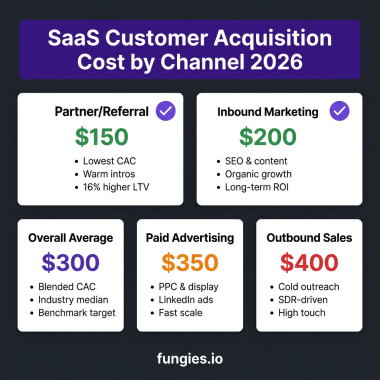
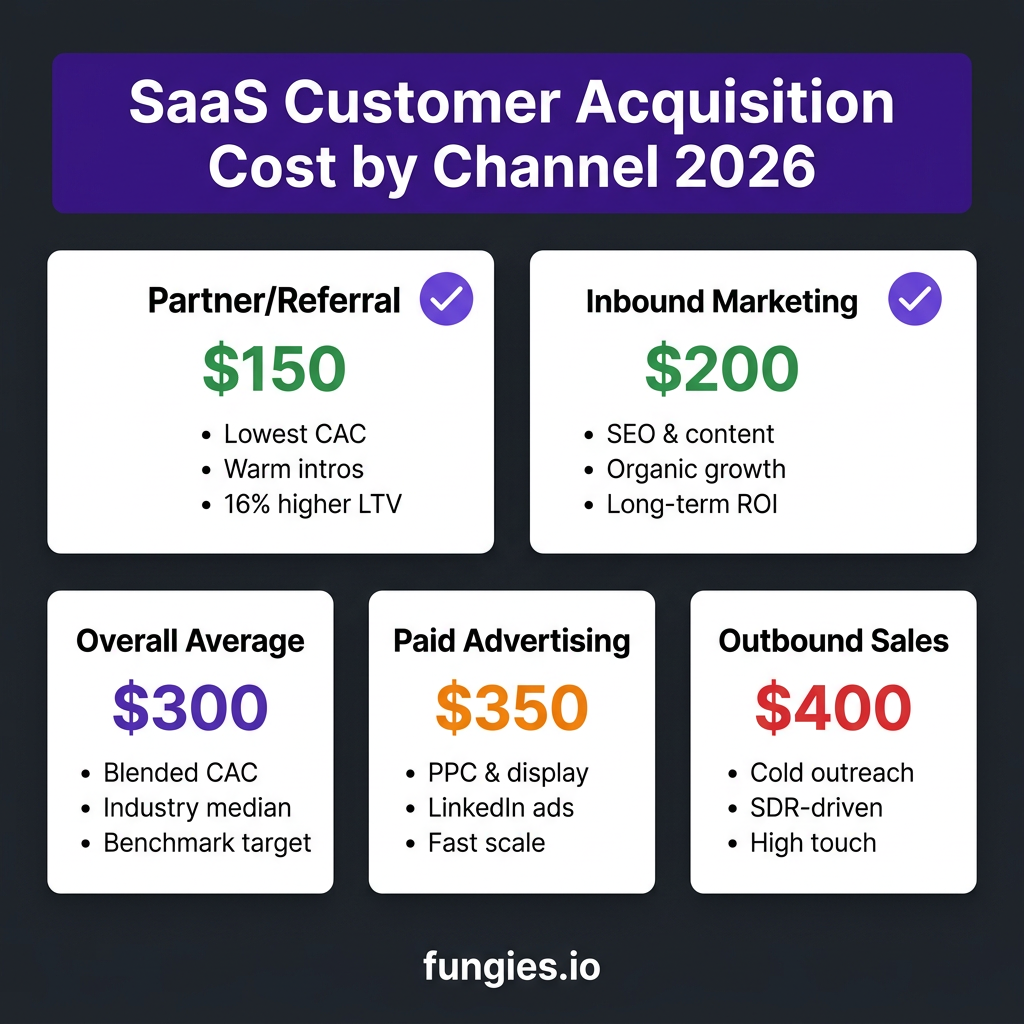
Not all acquisition channels are created equal. Recent benchmark data from 939 B2B companies (Q2 2025-Q1 2026) reveals dramatic differences in CAC across channels:
| Channel | Average CAC | Best For |
|---|---|---|
| Partner/Referral | $150 | Warm intros, high LTV customers |
| Inbound Marketing | $200 | Sustainable long-term growth |
| Overall Average | $300 | Blended benchmark target |
| Paid Advertising | $350 | Rapid scaling, testing |
| Outbound Sales | $400 | Enterprise deals |
| Events/Conferences | $500 | Relationship-driven sales |
The gap between the cheapest and most expensive channels is more than 3x. Yet I see founders dumping 70% of their budget into paid ads and outbound while ignoring partnerships that could cut their CAC in half.
CAC Benchmarks by SaaS Segment
Your target market dramatically impacts what “good” CAC looks like. Here’s how the numbers break down by segment:
| Segment | CAC Range | Typical Sales Cycle |
|---|---|---|
| SMB SaaS (Product-Led) | $150 – $250 | Days to weeks |
| Mid-Market SaaS | $300 – $500 | 1-3 months |
| Enterprise SaaS | $800 – $1,500+ | 3-12 months |
| Self-Serve B2B | ~$702 | Minutes to days |
| Sales-Led Enterprise | ~$11,400 | 6-18 months |
That 16x gap between self-serve and sales-led enterprise acquisition is the widest it’s ever been. The lesson? Your go-to-market motion should match your target customer. Trying to apply enterprise sales tactics to a $29/month product will destroy your unit economics.
The CAC Payback Period Problem
Raw CAC numbers only tell half the story. What really matters is how quickly you recover that investment. This is your CAC payback period — the number of months it takes for a customer’s revenue to cover their acquisition cost.
Here’s the reality check: with a fully-loaded CAC of $1,800 and an ARPU of $150 at 80% gross margin, you’re looking at roughly 15 months to break even on each customer. That’s over a year of cash tied up before you see profit.
| Payback Period | Assessment | Action Required |
|---|---|---|
| < 6 months | Excellent | Can scale aggressively |
| 6-12 months | Good | Sustainable growth |
| 12-18 months | Warning | Cash flow pressure |
| > 18 months | Critical | Unit economics broken |
Most SaaS companies I analyze fall into that 12-18 month warning zone. They’re technically profitable on paper, but the cash cycle creates real constraints on how fast they can grow.
5 Proven Strategies to Reduce Your CAC by 30%
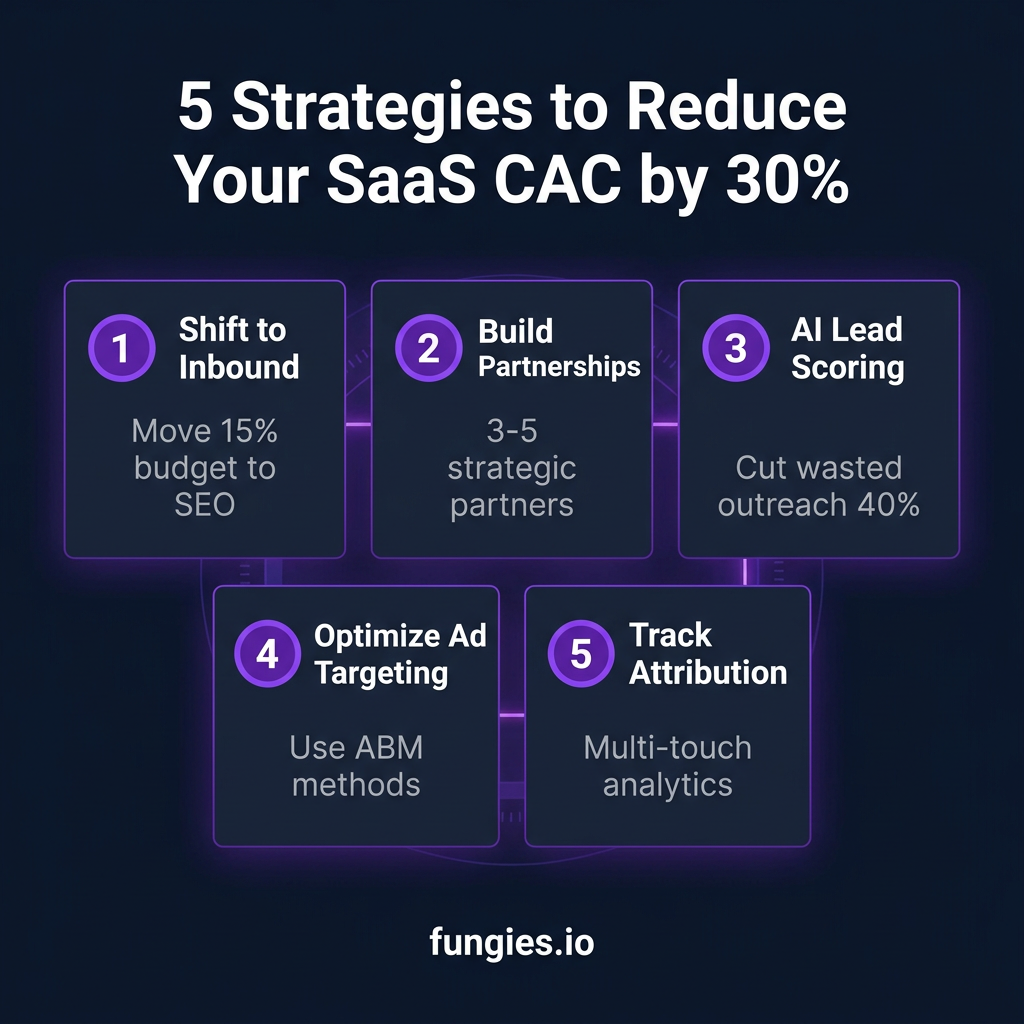
The good news? CAC isn’t a fixed cost of doing business. Companies that actively optimize their acquisition strategy consistently achieve 30% lower CAC than their competitors. Here’s what actually works:
1. Shift Budget from Outbound to Inbound
Move 10-15% of your acquisition budget from outbound sales and paid ads into content marketing, SEO, and organic channels. High-performing companies maintain a balanced mix: roughly 30% inbound, 25% partnerships, 20% paid ads, 15% outbound, and 10% events.
This isn’t about abandoning paid channels — it’s about building sustainable acquisition engines that don’t require constant cash injection.
2. Build a Partner Network
Partner-sourced customers cost $141-$200 in CAC, deliver 16% higher lifetime value, and are 4x more likely to refer others. Yet most SaaS companies treat partnerships as an afterthought.
Start with 3-5 strategic partners who serve your target audience but don’t compete directly. Co-selling arrangements, integration partnerships, and referral programs can become your lowest-CAC channel within 6 months.
3. Implement AI-Powered Lead Scoring
Companies using AI for lead scoring report 40% reduction in wasted outbound effort. The technology isn’t magic — it simply helps your sales team focus on prospects that actually fit your ICP instead of spraying and praying.
Even basic scoring based on firmographic data (company size, industry, tech stack) beats no scoring at all.
4. Optimize Paid Ad Targeting with ABM
Broad targeting on LinkedIn and Google Ads is expensive. Account-based marketing (ABM) approaches — targeting specific companies and decision-makers — consistently deliver 2-3x better conversion rates at the same or lower CAC.
The key is matching your targeting precision to your deal size. ABM makes sense when your ACV is $5,000+. For lower-priced products, focus on intent-based keywords and lookalike audiences.
5. Track True Channel Attribution
Most SaaS companies use last-click attribution, which massively overvalues paid search and undervalues content marketing. Multi-touch attribution reveals the true CAC of each channel and typically shows that organic content drives 60-70% of customers in successful SaaS companies.
Without proper attribution, you’re flying blind on where to invest.
The LTV:CAC Ratio That Actually Matters
Here’s the golden rule: your Lifetime Value to Customer Acquisition Cost ratio should be at least 3:1. That means for every $1 you spend acquiring a customer, you should expect to earn $3 back over their lifetime.
| LTV:CAC Ratio | Assessment |
|---|---|
| < 1:1 | You’re losing money on every customer |
| 1:1 to 2:1 | Unsustainable — need immediate fixes |
| 3:1 | Healthy target for most SaaS businesses |
| 5:1+ | Excellent — room to invest more in growth |
A 3:1 ratio leaves enough margin for overhead, R&D, and profit. Go below 2:1 and you’re in dangerous territory. Above 5:1 suggests you might be under-investing in growth.
Common CAC Mistakes That Kill SaaS Growth
I’ve audited dozens of SaaS companies’ acquisition strategies. The same mistakes show up repeatedly:
- Ignoring fully-loaded costs: Only counting ad spend while ignoring sales salaries and overhead
- Channel over-concentration: Putting 70%+ of budget into one channel (usually paid ads)
- Wrong GTM motion: Using enterprise sales for low-ACV products or self-serve for complex solutions
- No attribution tracking: Can’t tell which channels actually drive customers
- Neglecting retention: A 5% improvement in retention drives 25-95% profit increases, yet 75% of software companies saw declining retention in 2024
That last point is crucial. The cheapest customer to acquire is the one you already have. Churn directly increases your effective CAC because you have to replace lost revenue before you can grow.
FAQ: SaaS Customer Acquisition Cost
What is a good CAC for a SaaS startup?
For SMB-focused SaaS with product-led growth, aim for $150-$250 CAC. Mid-market SaaS typically sees $300-$500, while enterprise SaaS can justify $800-$1,500+ due to higher deal values. The key is your LTV:CAC ratio — anything above 3:1 is healthy.
How do I calculate CAC for my SaaS business?
Divide your total sales and marketing expenses (including salaries, software, and overhead) by the number of new customers acquired in the same period. For accuracy, use a 3-month rolling average to smooth out timing differences.
Why has SaaS CAC increased so much?
CAC has risen 60% over five years due to: increased competition, longer B2B consideration cycles (14% more touchpoints per deal vs 2023), cookie deprecation inflating reported CAC by 25-45%, and rising labor costs in sales-led motions.
What’s the difference between blended and paid CAC?
Blended CAC includes all customers from all channels (including organic, referrals, and brand-direct). Paid CAC only counts customers from paid channels. A 2.4x to 3.1x ratio of paid to blended CAC means roughly 60-70% of your customers arrive through unpaid channels.
How can I reduce my SaaS CAC quickly?
Fast wins include: shifting 10-15% of budget from outbound to inbound, implementing lead scoring to reduce wasted effort, optimizing ad targeting with ABM, and building 3-5 strategic partnerships. Most companies see 20-30% blended CAC improvement from channel reallocation alone.
Conclusion: Make CAC Your North Star Metric
Customer Acquisition Cost isn’t just another SaaS metric to track — it’s the fundamental indicator of whether your business model works. In an environment where acquisition costs have surged 60% in five years, the companies that win will be those that treat CAC optimization as a continuous discipline, not a one-time project.
Start by calculating your true, fully-loaded CAC today. Compare it to the benchmarks in this guide. Identify your highest-cost channels and test the optimization strategies we’ve covered. Most importantly, remember that sustainable growth comes from building acquisition engines — not just buying customers.
Ready to streamline your SaaS payments and reduce operational overhead? Get started with Fungies.io — the merchant of record platform that handles tax compliance, global payments, and checkout so you can focus on acquiring customers profitably.