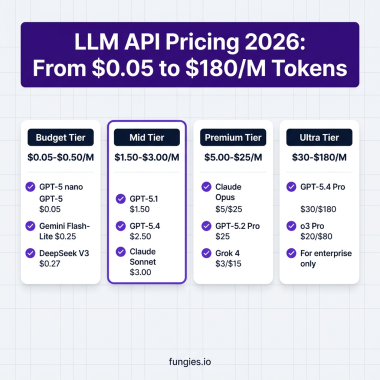
Choosing the wrong LLM API can cost your SaaS thousands of dollars per month. In 2026, the price gap between the cheapest and most expensive models has ballooned to 600x — from $0.10 to $30 per million input tokens. Yet many developers still pick models based on brand recognition rather than actual fit.
This guide cuts through the noise. You’ll get real pricing data, benchmark comparisons, and a decision framework that matches LLM capabilities to your specific use case. No fluff. Just numbers that affect your bottom line.
Why LLM Selection Matters More Than Ever in 2026
AI infrastructure now represents 15-40% of operating costs for AI-native SaaS companies. A poorly chosen model doesn’t just hurt your margins — it limits your product capabilities.
Here’s what changed in 2026:
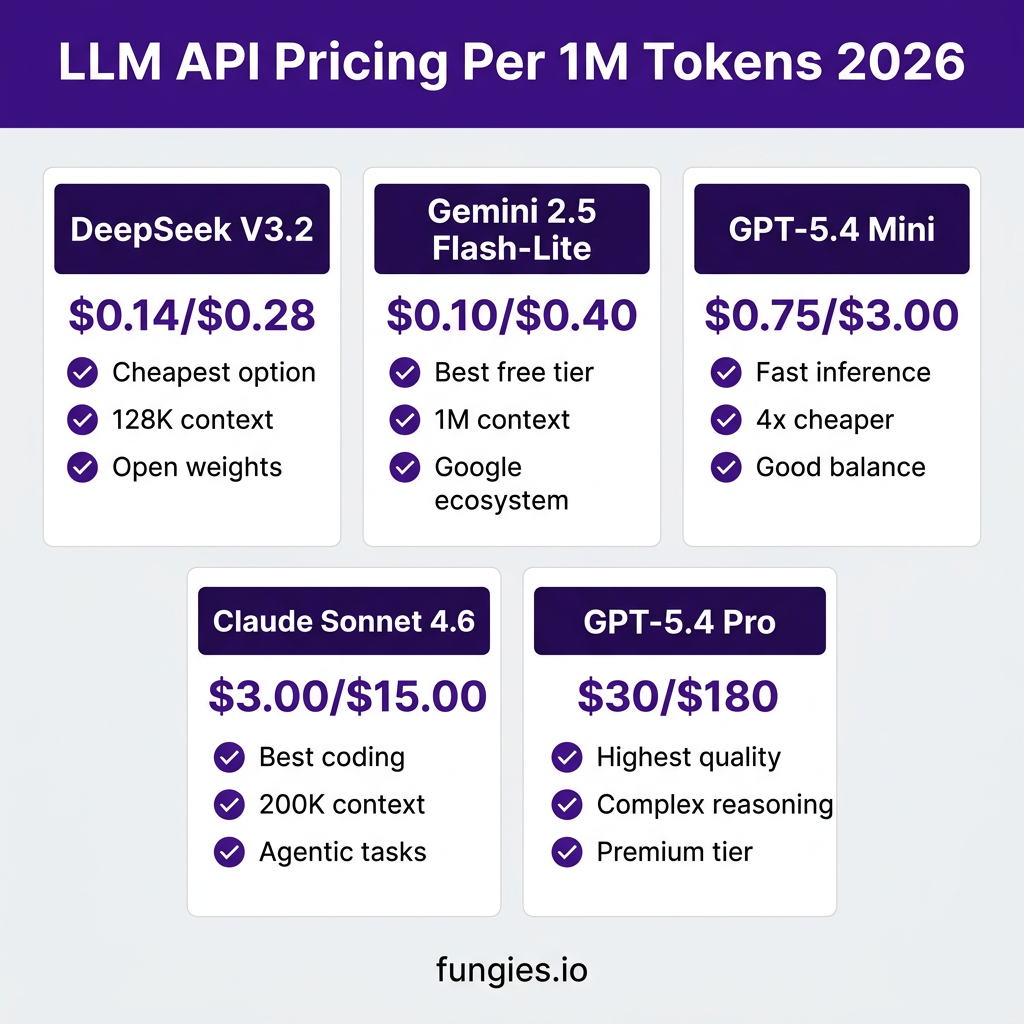
- Google’s Gemini 2.5 Flash-Lite hit $0.10 per million input tokens — the cheapest production-ready API
- Anthropic’s Claude Sonnet 4.6 became the go-to for coding tasks with 80.9% SWE-bench scores
- OpenAI’s GPT-5 series introduced tiered pricing from $0.625 (GPT-5) to $30 (GPT-5.4 Pro)
- DeepSeek V3.2 emerged as the open-weights champion at $0.14 per million tokens
The market has fragmented. “Just use GPT-4” is no longer valid advice.
The 2026 LLM API Landscape: Real Pricing Data
Here’s the current pricing breakdown per million tokens, sourced from official API documentation as of May 2026:
| Model | Provider | Input | Output | Context |
|---|---|---|---|---|
| Gemini 2.5 Flash-Lite | $0.10 | $0.40 | 1M | |
| DeepSeek V3.2 | DeepSeek | $0.14 | $0.28 | 128K |
| Gemini 2.5 Flash | $0.30 | $2.50 | 1M | |
| GPT-5.4 Mini | OpenAI | $0.75 | $3.00 | 128K |
| GPT-5 | OpenAI | $0.625 | $5.00 | 400K |
| Claude Haiku 4.5 | Anthropic | $1.00 | $5.00 | 200K |
| GPT-4.1 | OpenAI | $2.00 | $0.50 | 1M |
| Gemini 2.5 Pro | $1.25 | $10.00 | 1M | |
| Claude Sonnet 4.6 | Anthropic | $3.00 | $15.00 | 200K |
| Claude Opus 4.7 | Anthropic | $5.00 | $25.00 | 200K |
| GPT-5.4 Pro | OpenAI | $30.00 | $180.00 | 128K |
Source: Official API documentation from Google AI Studio, OpenAI, Anthropic, and DeepSeek (May 2026)
Use Case Matching: Which LLM for What
Pricing isn’t everything. A $0.10 model that can’t handle your task is infinitely more expensive than a $3 model that can. Here’s how to match models to use cases:
Customer Support Chatbots
Best choice: Gemini 2.5 Flash-Lite or DeepSeek V3.2
Chatbots need speed and low cost more than reasoning depth. At $0.10-0.14 per million input tokens, these models handle 90% of support queries at 1/20th the cost of premium models. Google’s 1M context window also lets you stuff in entire knowledge bases.
Code Generation and Review
Best choice: Claude Sonnet 4.6
Anthropic’s Sonnet 4.6 leads on coding benchmarks with 80.9% on SWE-bench Verified. At $3/$15 per million tokens, it’s not cheap — but it’s 5x cheaper than Opus while delivering 95% of the coding performance. The 200K context window handles large codebases without breaking a sweat.
Complex Reasoning and Analysis
Best choice: Claude Opus 4.7 or GPT-5.4 Pro
When you need deep reasoning — financial analysis, legal document review, scientific research — the premium models justify their cost. Opus 4.7 at $5/$25 and GPT-5.4 Pro at $30/$180 are expensive, but they handle tasks that cheaper models simply can’t.
General-Purpose SaaS Features
Best choice: GPT-5 or Gemini 2.5 Flash
For text summarization, content generation, and general AI features, the mid-tier models hit the sweet spot. GPT-5 at $0.625/$5 offers broad capability, while Gemini 2.5 Flash at $0.30/$2.50 gives you Google’s ecosystem benefits with a 1M context window.
Hidden Costs That Kill Your Budget
The per-token price is just the start. Here are the costs that catch SaaS founders off guard:
Output Token Multipliers
Most LLMs charge 2-6x more for output than input. GPT-5.4 Pro is the extreme case: $30 input, $180 output. If your use case generates long responses (code, analysis, creative writing), output costs dominate.
Context Window Premiums
Anthropic charges long-context pricing for requests over 200K tokens. Google’s 1M context is standard on Gemini Pro models. Know your typical prompt size before committing.
Caching Savings
DeepSeek offers 90% discounts on cache hits ($0.028 vs $0.28). Anthropic and OpenAI offer 50% prompt caching discounts. If you’re sending similar prompts repeatedly, caching can cut costs in half.
Batch Processing
All major providers offer ~50% discounts for batch API calls with 24-hour SLA. Perfect for non-real-time tasks like content tagging, sentiment analysis, or report generation.
Performance Benchmarks: What the Numbers Actually Mean
Benchmarks don’t tell the whole story, but they help narrow the field. Here’s how the major models stack up on key metrics:
| Model | SWE-Bench | MMLU | HumanEval | Speed (tok/s) |
|---|---|---|---|---|
| Claude Sonnet 4.6 | 80.9% | 88.5% | 92.1% | 45 |
| GPT-5.4 | 78.2% | 89.1% | 91.5% | 65 |
| DeepSeek V3.2 | 76.3% | 86.4% | 89.2% | 85 |
| Gemini 2.5 Pro | 75.8% | 87.2% | 90.1% | 55 |
| Claude Opus 4.7 | 82.1% | 90.3% | 93.5% | 35 |
Sources: SWE-bench Verified, MMLU Pro, HumanEval (May 2026)
The pattern is clear: you trade speed for quality. DeepSeek V3.2 processes 85 tokens per second but lags on reasoning benchmarks. Claude Opus 4.7 tops quality metrics but crawls at 35 tokens per second.
Free Tiers: Where to Start Testing
Every major provider offers free tiers. Here’s what’s actually usable:
- Google Gemini: Most generous — 2.5 Pro, Flash, and Flash-Lite all have free tiers with rate limits
- OpenAI: $5 free credits for new accounts, no credit card required
- Anthropic: Limited free tier via console, mainly for testing
- DeepSeek: Free tier available with rate limits on V3.2
Google wins on free tier accessibility. You can run production-like tests without spending a dollar.
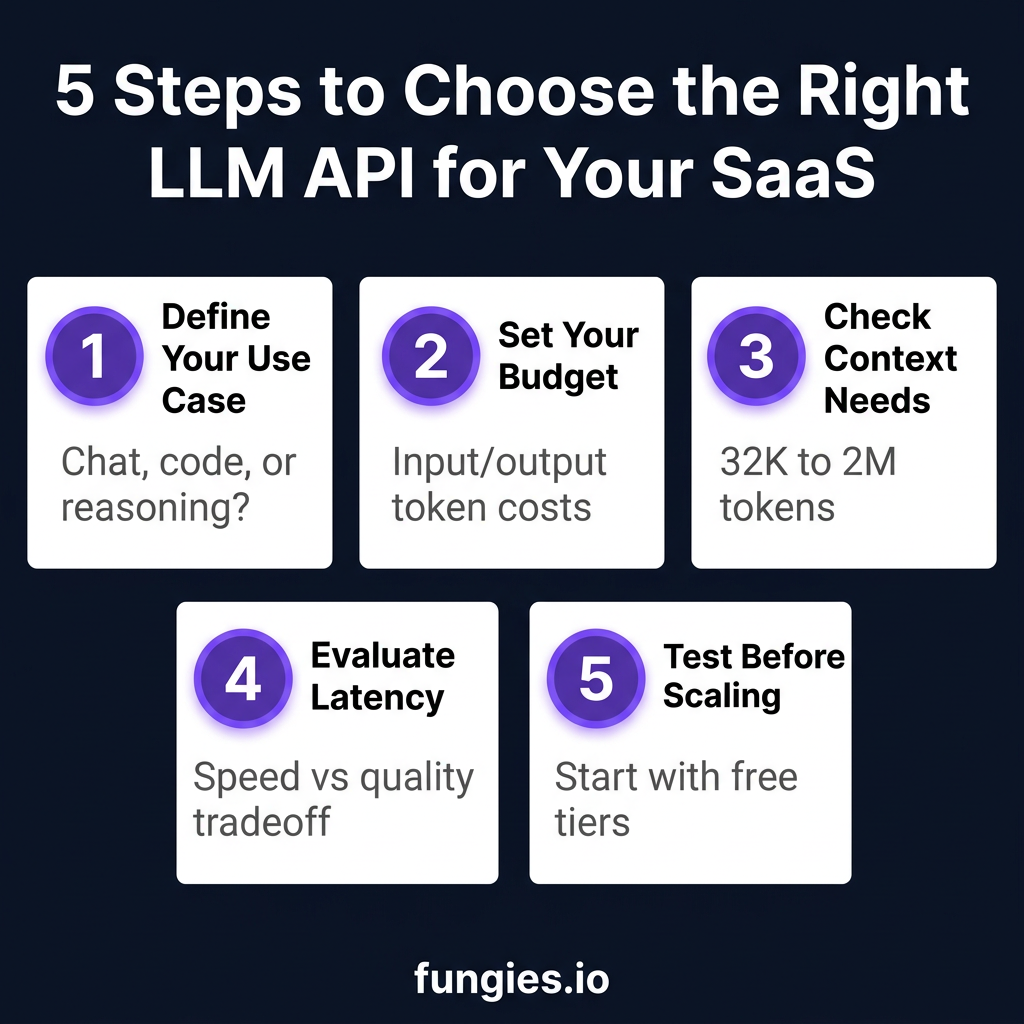
The Decision Framework: 5 Steps to the Right Choice
Here’s the process we use at Fungies.io when evaluating LLM providers:
Step 1: Define Your Use Case
Be specific. “Customer support” isn’t enough. Is it simple FAQ retrieval or complex troubleshooting? The answer determines whether you need a $0.10 or $3 model.
Step 2: Set Your Budget
Calculate your expected monthly token volume. At 10M input tokens and 5M output tokens monthly, the difference between Gemini Flash-Lite ($3,000) and GPT-5.4 Pro ($1,050,000) is existential.
Step 3: Check Context Requirements
Do you need to process entire documents? Codebases? Conversation histories? Context windows range from 32K to 2M tokens. Pick accordingly.
Step 4: Evaluate Latency Needs
Real-time chat needs fast models (DeepSeek, GPT-5.4 Mini). Batch processing can use slower, higher-quality models (Opus, GPT-5.4 Pro).
Step 5: Test Before Scaling
Run A/B tests with real user queries. Benchmarks are starting points; your actual data is what matters. Start with free tiers, measure quality and cost, then scale.
Key Takeaways
- Price range is massive: 600x difference between cheapest ($0.10) and most expensive ($30) models
- Google Gemini 2.5 Flash-Lite is the value leader for most SaaS use cases at $0.10/$0.40
- Claude Sonnet 4.6 dominates coding tasks at $3/$15 — worth the premium for developer tools
- DeepSeek V3.2 offers the best open-weights option at $0.14/$0.28 with strong performance
- Free tiers from Google and OpenAI let you test extensively before committing
- Hidden costs (output multipliers, context premiums) can exceed base pricing — model accordingly
Frequently Asked Questions
What’s the cheapest LLM API in 2026?
Google’s Gemini 2.5 Flash-Lite at $0.10 per million input tokens. DeepSeek V3.2 is close at $0.14 and offers open weights.
Which LLM is best for coding?
Claude Sonnet 4.6 leads with 80.9% on SWE-bench Verified. It’s 5x cheaper than Opus while delivering comparable coding performance.
Is GPT-5.4 Pro worth $30 per million tokens?
For most use cases, no. GPT-5.4 Pro excels at complex reasoning and analysis where errors are costly. For general tasks, GPT-5 at $0.625 or GPT-5.4 Mini at $0.75 are far more cost-effective.
Can I use multiple LLM providers?
Yes, and many SaaS companies do. Route simple queries to cheap models (Gemini Flash-Lite) and complex ones to premium models (Claude Sonnet). This hybrid approach can cut costs by 70-80%.
What’s the best free tier for testing?
Google Gemini offers the most generous free tier with access to 2.5 Pro, Flash, and Flash-Lite models. OpenAI provides $5 in free credits for new accounts.
Conclusion
The LLM API market in 2026 rewards informed decision-making. The 600x price spread between models isn’t just about quality — it’s about matching capabilities to needs. A $0.10 model that handles your use case is infinitely better than a $30 model that’s overkill.
Start with the decision framework. Test on free tiers. Measure real performance with your data. Then scale with confidence.
Building a SaaS that needs global payment processing? Fungies.io handles payments, tax compliance, and checkout so you can focus on picking the right LLM for your AI features.