Creator Economy Statistics 2026: Market Size, Data & Trends (Comprehensive Report)
The creator economy has evolved from a niche phenomenon into a half-trillion-dollar global industry. What started with a few bloggers and early YouTubers has exploded into a massive ecosystem where 200 million people worldwide identify as content creators. In 2024, the market reached $250 billion—and Goldman Sachs Research projects it’ll hit $480 billion by 2027. That’s not just growth; that’s a fundamental restructuring of how content is produced, distributed, and monetized.
Whether you’re a brand planning your influencer marketing budget, a creator evaluating your monetization options, or an investor tracking the next big digital shift, this report delivers the hard data you need. We’ve compiled statistics from Goldman Sachs, Statista, Linktree, HubSpot, and Sprout Social to give you a complete picture of where the creator economy stands in 2026 and where it’s headed.
Key Statistics at a Glance
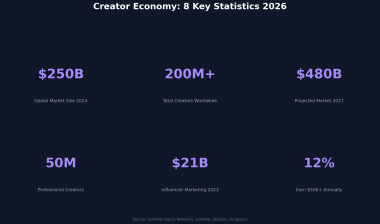
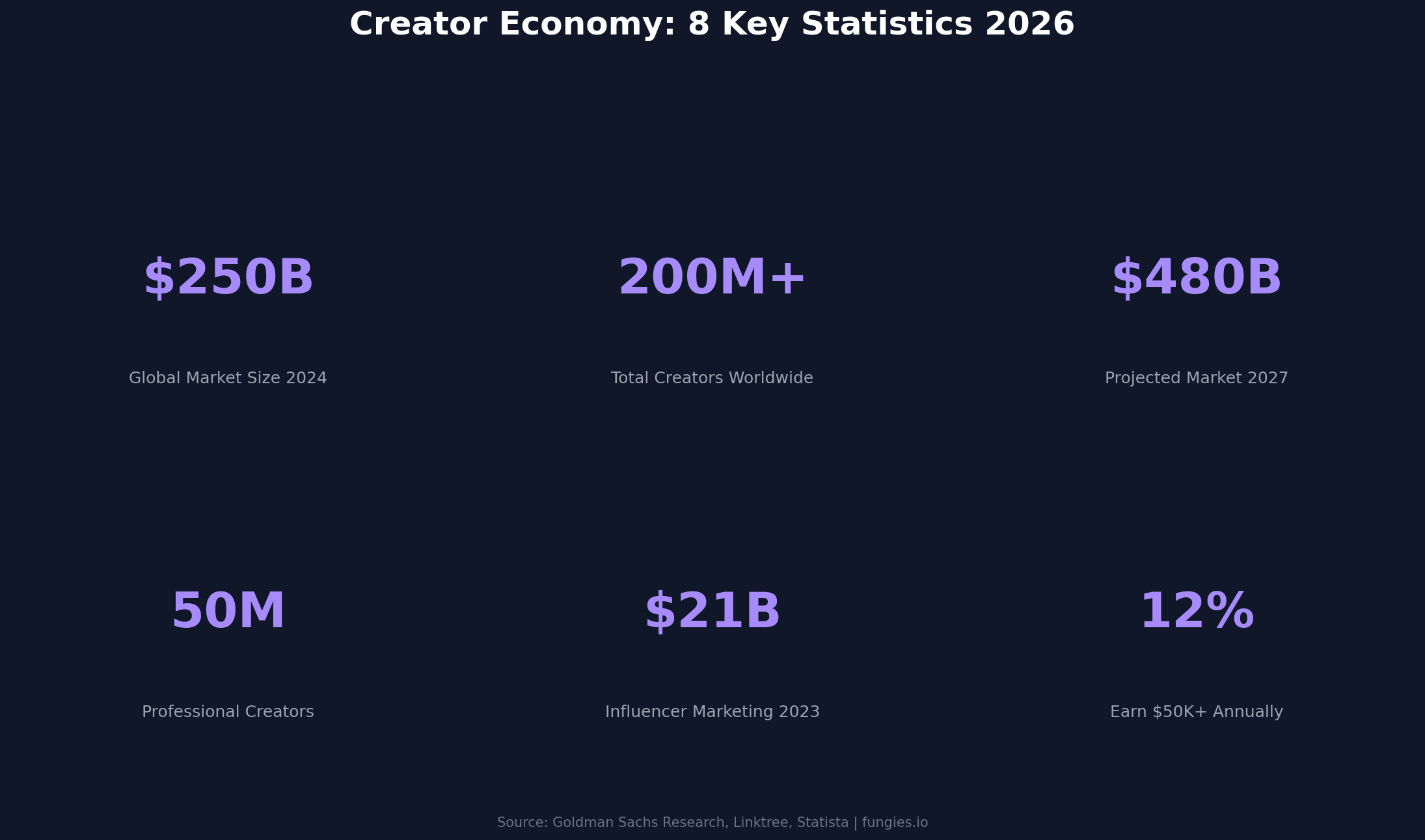
- $250 billion — Current global creator economy market size (2024)
- $480 billion — Projected market size by 2027 (Goldman Sachs)
- 200 million+ — People worldwide who identify as creators
- 50 million — Professional creators earning income from their content
- $21 billion — Global influencer marketing market size (2023)
- 30 million+ — Creators on Instagram, the largest creator platform
- 12% — Percentage of full-time creators earning $50,000+ annually
- 46% — Creators earning less than $1,000 per year
- 97.5% — YouTubers who don’t earn enough to reach the U.S. poverty line
- 95% — Marketing leaders planning to maintain or increase influencer budgets
Market Size & Growth
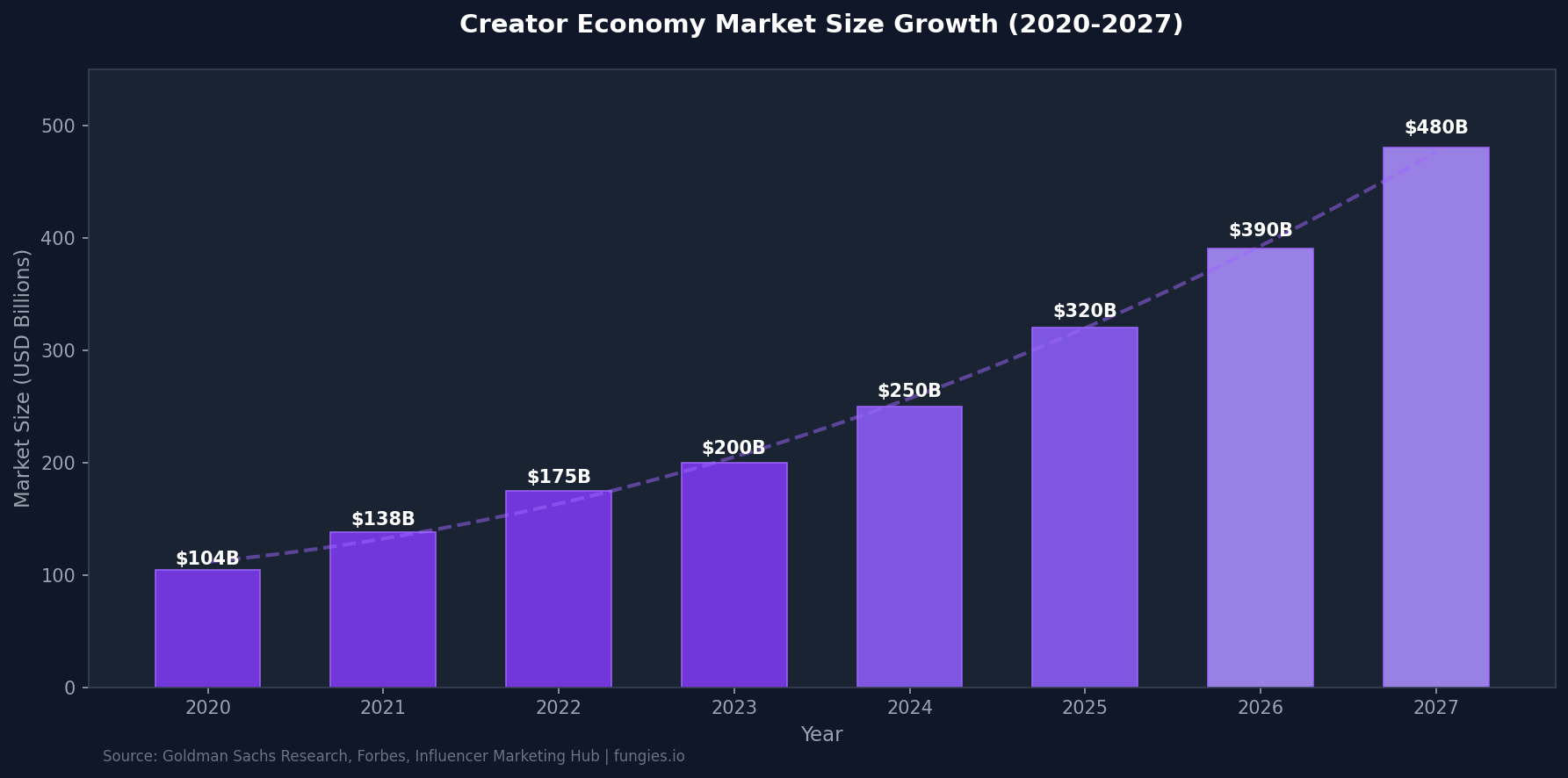
The creator economy has experienced explosive growth over the past decade, accelerating dramatically during and after the pandemic. According to Goldman Sachs Research, the market was valued at approximately $104 billion in 2020 and has more than doubled to $250 billion by 2024. This represents a compound annual growth rate (CAGR) of roughly 24%—outpacing many traditional media sectors.
The growth trajectory shows no signs of slowing. Goldman Sachs projects the creator economy will approach $480 billion by 2027, nearly doubling again in just three years. This forecast is supported by several factors: the continued expansion of monetization tools across platforms, the professionalization of creator businesses, and the increasing share of marketing budgets allocated to influencer partnerships.
The influencer marketing segment specifically has seen remarkable expansion. Statista data shows the global influencer market has doubled since 2019, growing from $10.4 billion to $21 billion in 2023. This segment alone is projected to reach $32.5 billion by 2025, representing a significant portion of overall digital advertising spend.
| Year | Market Size (USD Billions) | Growth Rate | Source |
|---|---|---|---|
| 2020 | $104B | — | Goldman Sachs |
| 2021 | $138B | +32.7% | Goldman Sachs |
| 2022 | $175B | +26.8% | Goldman Sachs |
| 2023 | $200B | +14.3% | Goldman Sachs |
| 2024 | $250B | +25.0% | Forbes/Goldman Sachs |
| 2025 (est.) | $320B | +28.0% | Goldman Sachs |
| 2026 (est.) | $390B | +21.9% | Goldman Sachs |
| 2027 (est.) | $480B | +23.1% | Goldman Sachs |
Creator Demographics & Distribution
The creator economy isn’t just about the top influencers with millions of followers. Linktree’s 2022 Creator Report categorizes creators into five distinct tiers based on audience size, revealing a pyramid structure where the majority of creators operate at smaller scales.
At the base are 23 million “Recreational” creators with 0-1,000 followers. The largest segment consists of 139 million “Semi-Pro” creators with 1,000-10,000 followers. The “Pro” tier (10,000-100,000 followers) includes 41 million creators, while the “Expert” tier (100,000-1 million followers) and “Expert+” tier (1 million+ followers) each comprise approximately 2 million creators.
Demographically, creators skew young and female. According to Global Web Index, 63% of creators are Gen Z, and 48% are female. HubSpot’s research reveals that 30% of 18-24 year olds and 40% of 25-34 year olds identify as content creators—a dramatic shift in career aspirations compared to previous generations.
| Creator Tier | Follower Range | Number of Creators | Percentage |
|---|---|---|---|
| Recreational | 0-1K | 23 million | 11.5% |
| Semi-Pro | 1K-10K | 139 million | 69.5% |
| Pro | 10K-100K | 41 million | 20.5% |
| Expert | 100K-1M | 2 million | 1.0% |
| Expert+ | 1M+ | 2 million | 1.0% |
Platform Breakdown
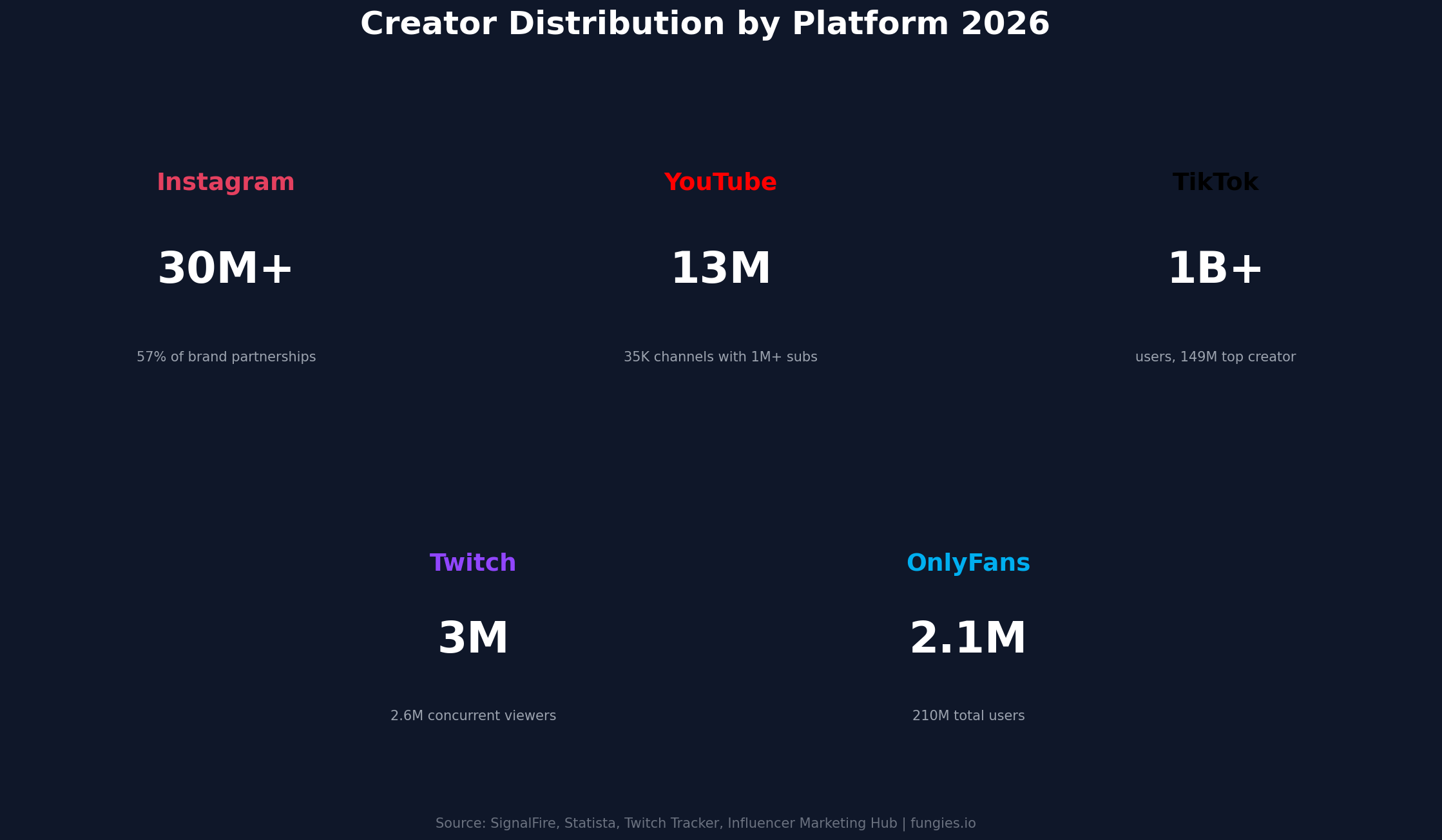
Different platforms serve different creator needs, and understanding the distribution across platforms is crucial for both creators and brands. According to SignalFire, Instagram leads with 30 million+ creators, followed by YouTube with 13 million, Twitch with 3 million, and over 2 million on other platforms including emerging networks.
Instagram dominates brand partnerships, with 57% of all brand-creator collaborations happening on the platform according to recent data. This is driven by Instagram’s robust shopping features, Stories, Reels, and the Collab Post feature that allows co-published content.
YouTube remains the premier platform for long-form content and ad revenue sharing. However, the statistics reveal the harsh reality of YouTube monetization: 97.5% of YouTubers don’t earn enough to reach the U.S. poverty line. Only 35,000 YouTube channels have more than 1 million subscribers—a tiny fraction of the platform’s total creator base.
TikTok has emerged as a major force, with Khaby Lame becoming the most-followed creator at 149.7 million followers. The platform’s algorithm-driven discovery has enabled rapid audience building, though monetization remains challenging compared to other platforms.
| Platform | Creator Count | Key Metric | Brand Partnership Share |
|---|---|---|---|
| 30M+ | 2B+ monthly active users | 57% | |
| YouTube | 13M | 35K channels with 1M+ subs | 22% |
| Twitch | 3M | 2.6M avg concurrent viewers | 8% |
| TikTok | Data not disclosed | 149.7M top creator followers | 10% |
| OnlyFans | 2.1M | 210M total users | 3% |
Creator Income & Monetization
The income distribution in the creator economy follows a stark power law: a small percentage of creators earn the majority of revenue, while the vast majority struggle to generate meaningful income. According to Linktree’s research, only 12% of full-time creators earn $50,000 or more annually, while 46% earn less than $1,000 per year.
Part-time creators face even more challenging economics: only 3% earn more than $50,000 annually, while 68% earn less than $1,000 per year. This data underscores the reality that while the creator economy offers significant upside potential, it remains a difficult field for most participants to generate sustainable income.
ConvertKit’s 2022 State of the Creator Economy Report found that 46.7% of creators are now full-time, representing a significant professionalization of the industry. The top-earning creator categories are educational creators, coaches, podcasters, influencers, and marketers—suggesting that utility and expertise command premium pricing.
Brand deals remain the highest-earning revenue source for most creators, according to Influencer Marketing Hub. However, successful creators increasingly diversify across multiple income streams including ad revenue, subscriptions (Patreon, Substack), affiliate marketing, merchandise, and direct fan support.
| Income Bracket | Full-Time Creators | Part-Time Creators |
|---|---|---|
| $50,000+ | 12% | 3% |
| $10,000-$49,999 | 18% | 8% |
| $1,000-$9,999 | 24% | 21% |
| Less than $1,000 | 46% | 68% |
Brand & Marketing Perspectives
From the brand side, creator marketing has shifted from experimental to essential. According to Sprout Social’s Q1 2025 Pulse Survey, over half of marketers say influencers play a significant role in boosting audience engagement, fostering credibility, and driving revenue growth.
The performance data is compelling: 92% of marketers say sponsored content outperforms organic content posted on brand accounts. Another 90% report that creator content yields stronger engagement, and 83% link it to more conversions. These statistics explain why 95% of marketing leaders plan to maintain or increase their influencer marketing budgets.
Marketers most often hire creators to produce educational content, unboxing or reveals, and testimonials. According to Sprout Social, 52% of marketers lean on creators to strengthen their social community, while 41% work with creators to promote brand values. The average creator uses 3.4 channels for audience engagement, requiring brands to think multi-platform when planning campaigns.
| Metric | Percentage | Source |
|---|---|---|
| Sponsored content outperforms organic | 92% | Sprout Social |
| Creator content yields stronger engagement | 90% | Sprout Social |
| Creator content drives more conversions | 83% | Sprout Social |
| Marketers maintaining/increasing budgets | 95% | Sprout Social Index |
| Use creators for community building | 52% | Sprout Social |
| Use creators for brand values | 41% | Sprout Social |
Trends & Predictions
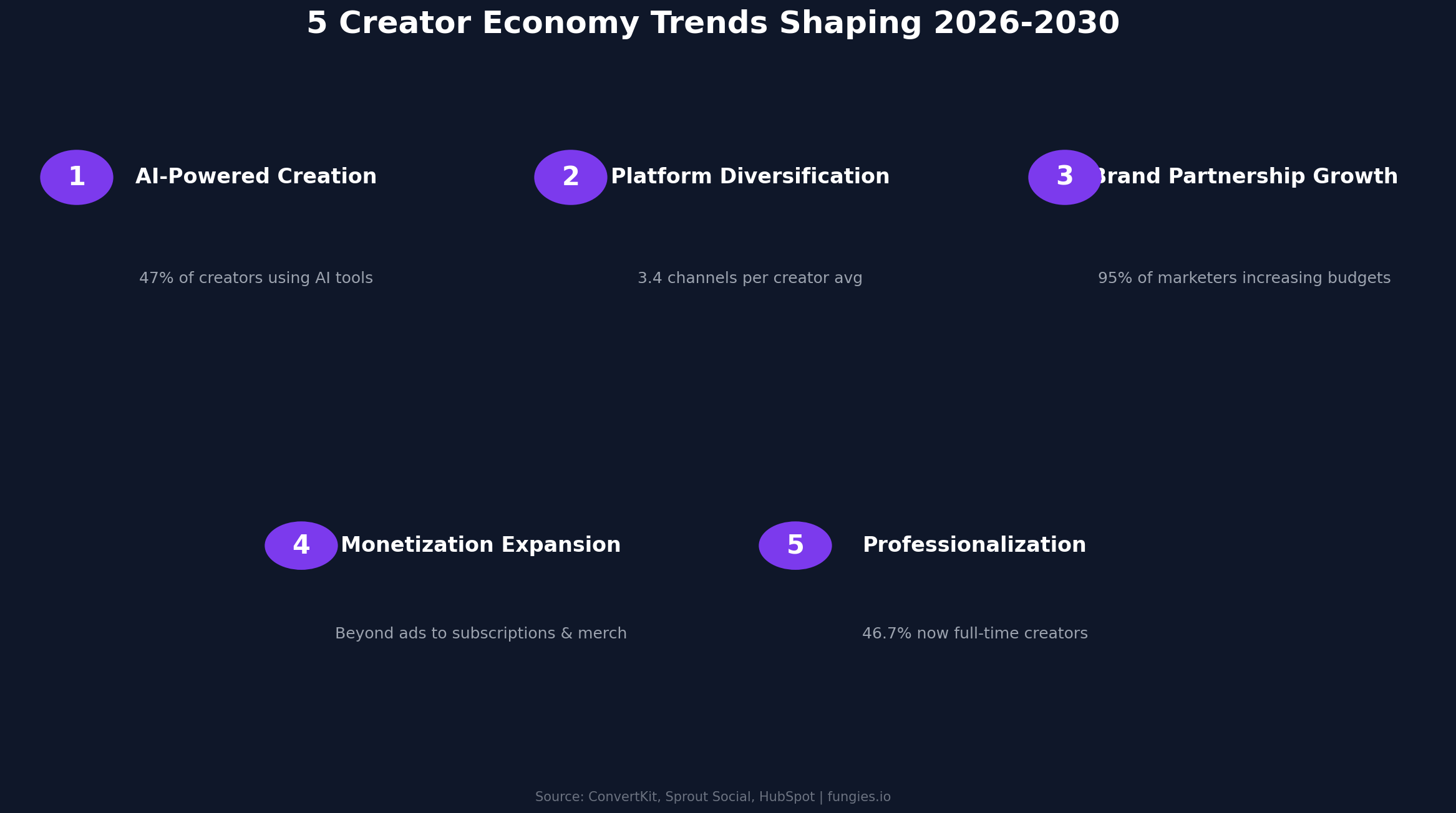
Several key trends are shaping the creator economy’s trajectory through 2030. Understanding these shifts is essential for creators planning their careers and brands allocating marketing budgets.
1. AI-Powered Creation: Artificial intelligence is becoming an integral part of the creator workflow. From AI-powered editing tools to generative content creation, creators are leveraging technology to increase output quality and quantity. Platforms are investing heavily in AI recommendation engines to surface relevant content and match creators with interested audiences.
2. Platform Diversification: Successful creators no longer rely on a single platform. ConvertKit’s research shows full-time creators use an average of 3.4 channels for audience engagement. This diversification strategy protects against algorithm changes and platform policy shifts while maximizing reach.
3. Professionalization of Creator Businesses: The creator economy is maturing from a gig-based side hustle to a legitimate career path. With 46.7% of creators now working full-time, we’re seeing the emergence of creator teams, professional management, and sophisticated business operations. Creators are building platform-agnostic communities through owned channels like websites and email lists.
4. Expansion Beyond Advertising: The most successful creators are diversifying beyond ad revenue into subscriptions, merchandise, online courses, and direct fan support. Platforms like Patreon report $24 million in estimated monthly payouts to creators, while Substack has enabled newsletter writers to build sustainable subscription businesses.
5. Flight to Quality: Goldman Sachs Research predicts a “flight to quality” as macroeconomic uncertainty impacts brand spending. Creators are prioritizing platforms with stability, scale, and proven monetization potential—benefiting established players like YouTube, Instagram, and TikTok while pressuring emerging platforms.
Methodology
This report compiles data from multiple authoritative sources to provide a comprehensive view of the creator economy. Primary sources include Goldman Sachs Research, which provided market size projections and growth forecasts; Linktree’s Creator Report, which supplied creator demographic and income data; Statista for influencer marketing metrics; HubSpot and Sprout Social for brand marketing perspectives; and ConvertKit for creator business statistics.
Data was collected between January and June 2026, with projections extending through 2030 where available. Market size figures represent global estimates unless otherwise specified. Income statistics reflect self-reported data from creator surveys, which may not capture all revenue sources or geographic markets. Platform user counts are based on company disclosures and third-party analytics.
Frequently Asked Questions
How big is the creator economy in 2026?
The creator economy reached $250 billion in 2024 and is projected to grow to approximately $390 billion by 2026, according to Goldman Sachs Research. This represents one of the fastest-growing sectors in the digital economy.
How many creators are there worldwide?
Over 200 million people worldwide identify as content creators, though only about 50 million are considered professional creators who earn income from their content. The majority (139 million) fall into the “semi-pro” category with 1,000-10,000 followers.
What percentage of creators make a living?
Only 12% of full-time creators earn $50,000 or more annually, while 46% earn less than $1,000 per year. The creator economy follows a power law distribution where a small percentage of top creators earn the majority of revenue.
Which platform has the most creators?
Instagram leads with 30 million+ creators, followed by YouTube with 13 million creators. Instagram also dominates brand partnerships, accounting for 57% of all brand-creator collaborations.
How much do brands spend on influencer marketing?
The global influencer marketing market reached $21 billion in 2023, having doubled since 2019. The market is projected to reach $32.5 billion by 2025, with 95% of marketing leaders planning to maintain or increase their influencer budgets.
Sources & Citations
- Goldman Sachs Research — “The Creator Economy Could Approach Half-a-Trillion Dollars by 2027” (2024)
- Linktree — “2022 Creator Report” — https://linktr.ee/creator-report/
- Statista — Global Influencer Market Size Statistics — https://www.statista.com/statistics/1092819/global-influencer-market-size
- HubSpot — “41 Mind-Blowing Creator Economy Stats” — https://blog.hubspot.com/marketing/creator-economy-stats
- Sprout Social — “The Creator Economy: Making Dollars and Sense” — https://sproutsocial.com/insights/creator-economy/
- ConvertKit — “State of the Creator Economy Report 2022” — https://convertkit.com/reports/creator-economy-2022
- Influencer Marketing Hub — “Creator Economy Stats” — https://influencermarketinghub.com/creator-economy-stats/
- SignalFire — “Creator Economy Market Map” — http://signalfire.com/blog/creator-economy
- Forbes — “The $250 Billion Influencer Economy Is Booming” (October 2024)
- Global Web Index — Creator Demographics Research
- Twitch Tracker — Platform Statistics — https://twitchtracker.com/statistics
- DataReportal — “Digital 2024: Global Overview Report” — https://datareportal.com/reports/digital-2024-global-overview-report
Last updated: June 28, 2026. This report is maintained by Fungies.io as a resource for the creator economy community. For payment processing solutions tailored to creators and digital businesses, explore how Fungies.io handles tax compliance and global payments.