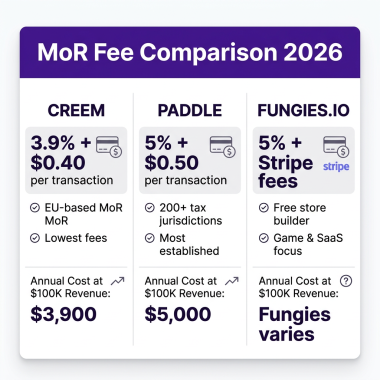
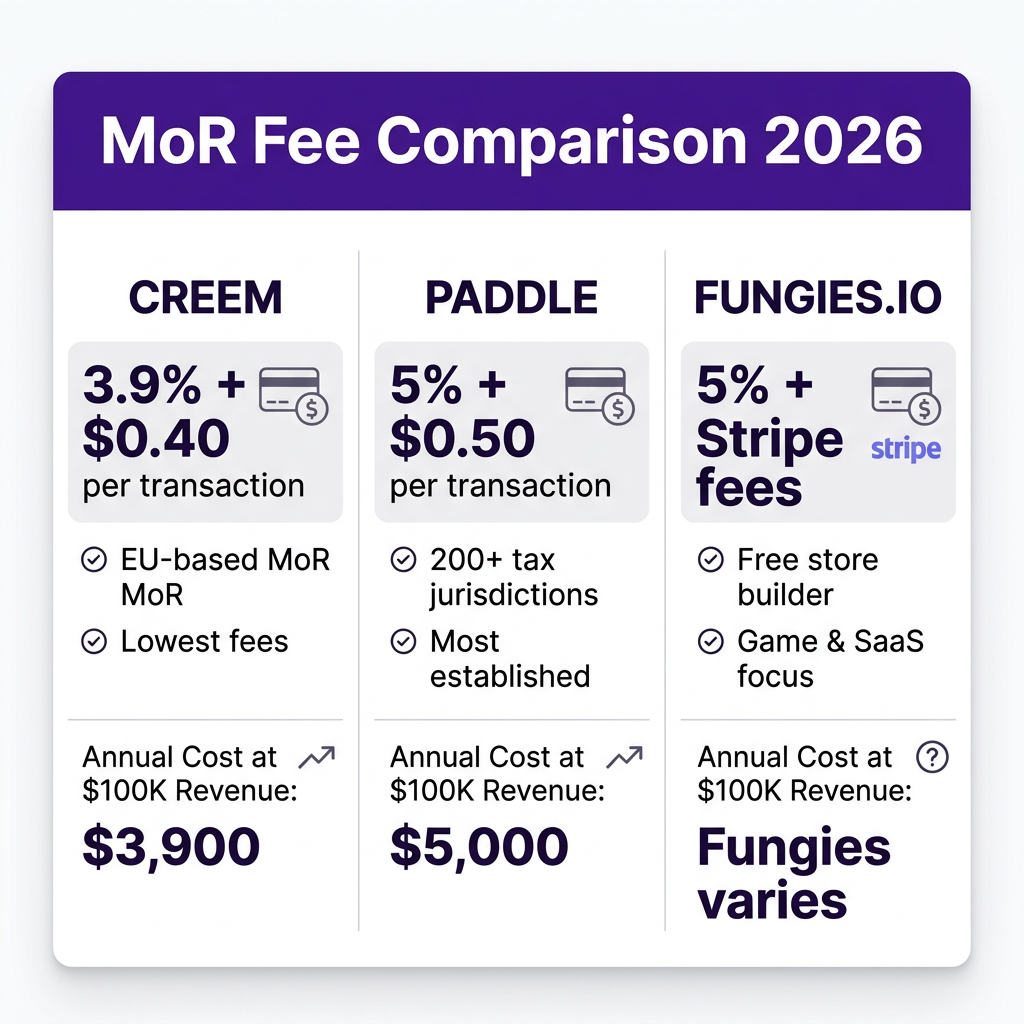
Here’s a number that should focus your attention: at $100K ARR, the fee difference between Creem (3.9% + $0.40) and Paddle (5% + $0.50) is over $1,100 per year. That’s real money — and it doesn’t even account for differences in payout timing, global coverage, and what happens when a customer disputes a charge.
In 2026, three platforms consistently come up when indie SaaS founders talk about Merchant of Record options: Creem, Paddle, and Fungies.io. They all handle tax compliance, chargebacks, and global selling — but they’re built for very different stages and use cases. Choosing the wrong one will either cost you money, slow you down, or put you in a compliance blind spot.
This guide breaks down Creem vs Paddle vs Fungies.io for indie SaaS founders in 2026 — actual pricing, real feature breakdowns, and who should use what based on your stage and goals.
What Is a Merchant of Record (And Why Indie SaaS Founders Need One)
A Merchant of Record (MoR) is the legal entity that takes responsibility for a transaction. When you use a payment processor like Stripe, you’re the merchant — which means you’re responsible for calculating, collecting, and remitting sales tax in every jurisdiction where you have economic nexus. In the US alone, that’s 11,000+ taxing authorities.
An MoR flips this. Instead of you being the seller of record, the platform is. They own the tax liability, handle VAT/GST registration globally, manage chargebacks, and ensure compliance with local digital services regulations. You just get the payout, net of fees.
For indie SaaS founders, this is a no-brainer once you’re selling in more than a handful of countries. The question isn’t whether to use an MoR — it’s which one to use.
Creem: The Lowest-Fee MoR for Early-Stage Indie Hackers
Creem launched in 2023 and has quickly become the go-to MoR for European indie hackers and developers who want the simplest, cheapest option. Their pitch is straightforward: 3.9% + $0.40 per transaction, full MoR coverage, no monthly fees.
What Creem Covers
- Full MoR status — they’re the seller of record, not you
- VAT/GST collection and remittance in 150+ countries
- Chargebacks handled by Creem (not you)
- Subscriptions, one-time payments, and usage-based billing
- Embeddable checkout
- Multi-currency support
- Better Auth plugin for SaaS boilerplates
What’s Missing from Creem
- Waitlist in some regions — Creem has been oversubscribed; not all applications are approved immediately
- Less established than Paddle — fewer integrations, smaller ecosystem
- Fewer enterprise-level features (advanced analytics, B2B invoicing)
- Payout timing varies by region and approval
Creem Pricing at Scale
At $10K MRR: ~$390/month in fees
At $50K MRR: ~$1,950/month in fees
At $100K MRR: ~$3,900/month in fees
Creem’s EU-based entity also makes it attractive for European founders who want to avoid currency conversion and have a provider under EU regulatory frameworks.
Paddle: The Established MoR for Scaling SaaS
Paddle has been the dominant Merchant of Record for SaaS since around 2018. They power 10,000+ software companies globally, including some well-known brands. Their pitch is reliability, coverage, and an all-in-one commerce platform.
What Paddle Covers
- Full MoR status in 200+ tax jurisdictions
- Complete VAT, GST, and sales tax compliance globally
- Built-in subscription management with dunning
- Revenue recovery tools (failed payment recovery)
- Localized checkout (local currencies, local payment methods)
- 24/7 customer support with 93% CSAT
- Analytics dashboard and revenue reporting
- Stripe-like developer API
Paddle Fees
5% + $0.50 per transaction, all-inclusive. No hidden fees, no monthly costs, no migration fees. Paddle’s pricing is transparent — what you see is what you pay.
The catch: at the same revenue level, you pay about 28% more than you would with Creem. At $100K MRR, that’s the difference between ~$3,900/month and ~$5,000/month — over $13,000/year.
Why Paddle Still Wins for Many Founders
Paddle’s 200+ jurisdiction coverage, robust fraud detection, enterprise customer support, and proven track record matter when you’re scaling past $500K ARR. The fee premium buys you reliability, a mature product, and a compliance safety net that has been battle-tested for years.
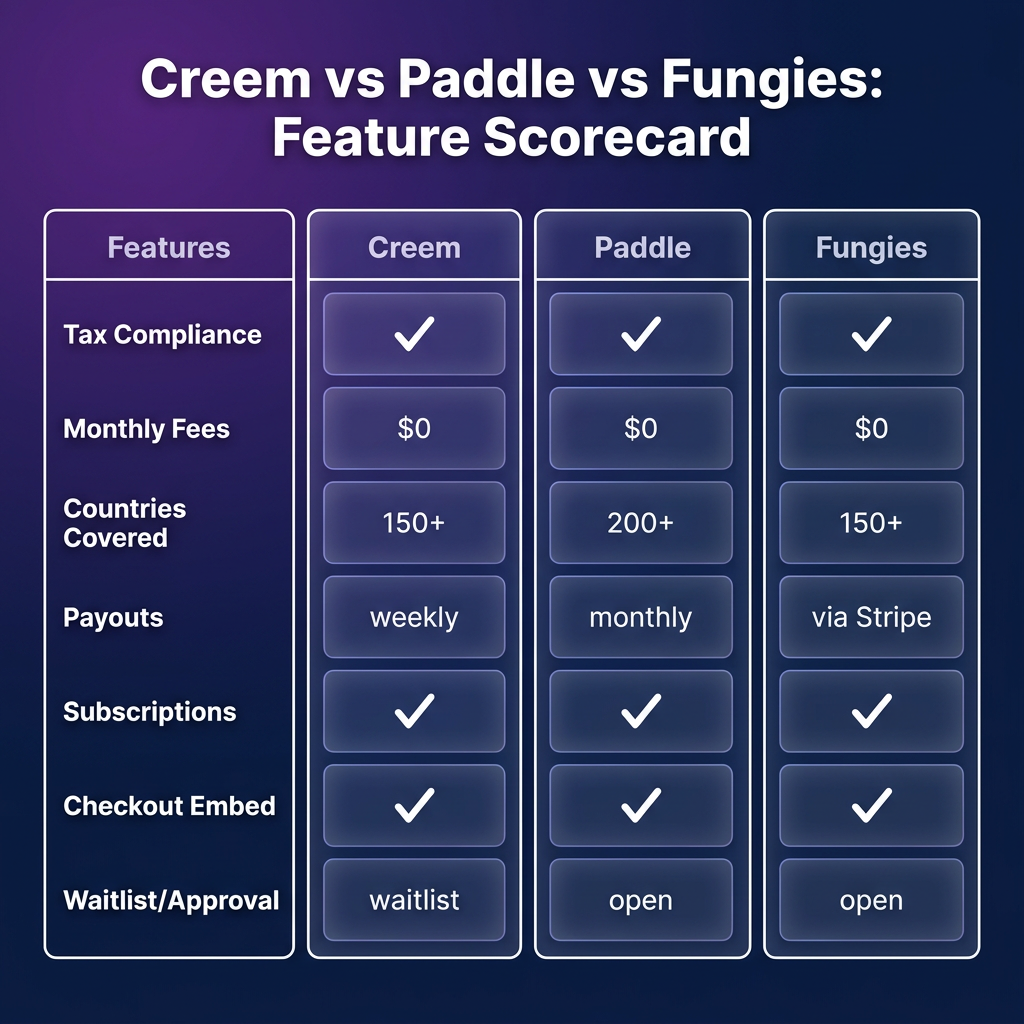
| Feature | Creem | Paddle | Fungies.io |
|---|---|---|---|
| Transaction Fee | 3.9% + $0.40 | 5% + $0.50 | 5% + Stripe fees |
| Monthly Fee | $0 | $0 | $0 |
| Tax Jurisdictions | 150+ | 200+ | 150+ |
| MoR Status | ✅ Full | ✅ Full | ✅ Full |
| Subscriptions | ✅ | ✅ | ✅ |
| Chargebacks Handled | ✅ | ✅ | ✅ |
| Payout Schedule | Weekly (varies) | Monthly | Via Stripe |
| Instant Signup | Waitlist | ✅ Open | ✅ Open |
| Game/Asset Support | ❌ | ❌ | ✅ |
| Store Builder | ❌ | ❌ | ✅ Free |
| Founded | 2023 | 2012 | 2021 |
Fungies.io: The MoR Built for Games, Digital Products, and SaaS
Fungies.io is the outlier in this comparison. While Creem and Paddle are squarely focused on SaaS subscriptions, Fungies was built from the ground up to support not just SaaS, but game developers, digital product sellers, and creators who need a storefront + MoR in one.
What Makes Fungies Different
- Free website/store builder — Fungies includes a full no-code storefront builder at no charge. You don’t need Webflow or a custom site to start selling.
- Game asset support — License keys, downloadable game assets, DLC, and Steam-style distribution are native features
- Stripe-connected — Fungies connects to your existing Stripe account, so payouts come through infrastructure you already control
- Full MoR compliance — EU VAT, US sales tax, GST globally — Fungies handles it all as the merchant of record
- Zero monthly cost — Like Creem and Paddle, no subscription required
Fungies Pricing
Fungies charges a percentage fee on top of Stripe’s standard processing rates. This means your effective fee depends on your Stripe plan and transaction mix, but typically works out to roughly 5-6% for most indie SaaS companies — comparable to Paddle, sometimes slightly more expensive for low-volume sellers.
The Stripe connection is both a strength and a limitation. If you’re already deep in the Stripe ecosystem (using Stripe Radar, Stripe Atlas, existing subscriptions), Fungies integrates cleanly. If you want to move completely away from Stripe, it’s not the right fit.
Who Should Use Fungies
Fungies makes most sense if you’re:
- Building or selling a game alongside a SaaS product
- Selling digital downloads, license keys, or non-subscription digital goods
- Starting from zero and want a store + checkout + MoR in one without hiring a developer
- Already on Stripe and want to add MoR compliance without migrating your stack
Fee Comparison: What You Actually Pay at Each Revenue Level
Let’s run the numbers at three revenue levels, assuming the average transaction is $49 (a typical SaaS monthly subscription):
| Monthly Revenue | Creem (3.9% + $0.40) | Paddle (5% + $0.50) | Savings with Creem |
|---|---|---|---|
| $1,000/mo | $47/mo | $60/mo | $13/mo ($156/yr) |
| $5,000/mo | $235/mo | $300/mo | $65/mo ($780/yr) |
| $10,000/mo | $470/mo | $600/mo | $130/mo ($1,560/yr) |
| $50,000/mo | $2,350/mo | $3,000/mo | $650/mo ($7,800/yr) |
| $100,000/mo | $4,700/mo | $6,000/mo | $1,300/mo ($15,600/yr) |
The fee delta is significant. At $100K MRR, you’re saving $15,600/year by using Creem over Paddle. That’s a junior developer’s salary in many markets, or 6 months of server costs for a lean SaaS startup.
But — and this is important — fees aren’t the only thing that matters. Paddle’s 200+ jurisdiction coverage, chargeback protection, and enterprise support carry real value. You have to weigh what you’re buying with that fee delta.
The Waitlist Problem: Is Creem Actually Available?
One issue that keeps coming up in indie hacker communities: Creem has a significant waitlist. In early 2026, reports suggest the waitlist surpassed 10,000 founders. Not everyone gets approved, and the approval process isn’t always transparent.
This creates a practical problem: Creem might be the cheapest and most appealing option on paper, but if you’re trying to launch in 2 weeks, you might not have access. Paddle and Fungies both offer open, immediate signup with standard verification.
If you’re planning ahead, apply to Creem early. If you need to ship now, Paddle or Fungies are your reliable options.
Integration Ecosystem: Where They Differ
All three platforms offer REST APIs and embeddable checkouts, but their ecosystem integrations differ significantly:
| Integration | Creem | Paddle | Fungies.io |
|---|---|---|---|
| Next.js / React SDK | ✅ | ✅ | ✅ |
| WordPress | Limited | ✅ Plugin | ✅ Plugin |
| Webflow | Via API | ✅ | Via API |
| Zapier/n8n | Webhooks | ✅ | Webhooks |
| Lemon Squeezy Migration | Manual | ✅ Tools | Manual |
| Stripe Connect | ❌ | ❌ | ✅ Native |
| SaaS Boilerplates (Better Auth etc.) | ✅ | ✅ | Partial |
| Affiliate Programs | Via 3rd party | ✅ Native | Via 3rd party |
Paddle wins on ecosystem breadth — they’ve had 10+ years to build integrations. Creem is catching up fast, particularly with modern SaaS boilerplates. Fungies.io’s Stripe Connect integration is genuinely unique and valuable if you’re already in the Stripe world.
Which One Should You Actually Use?
Here’s the honest breakdown by use case:
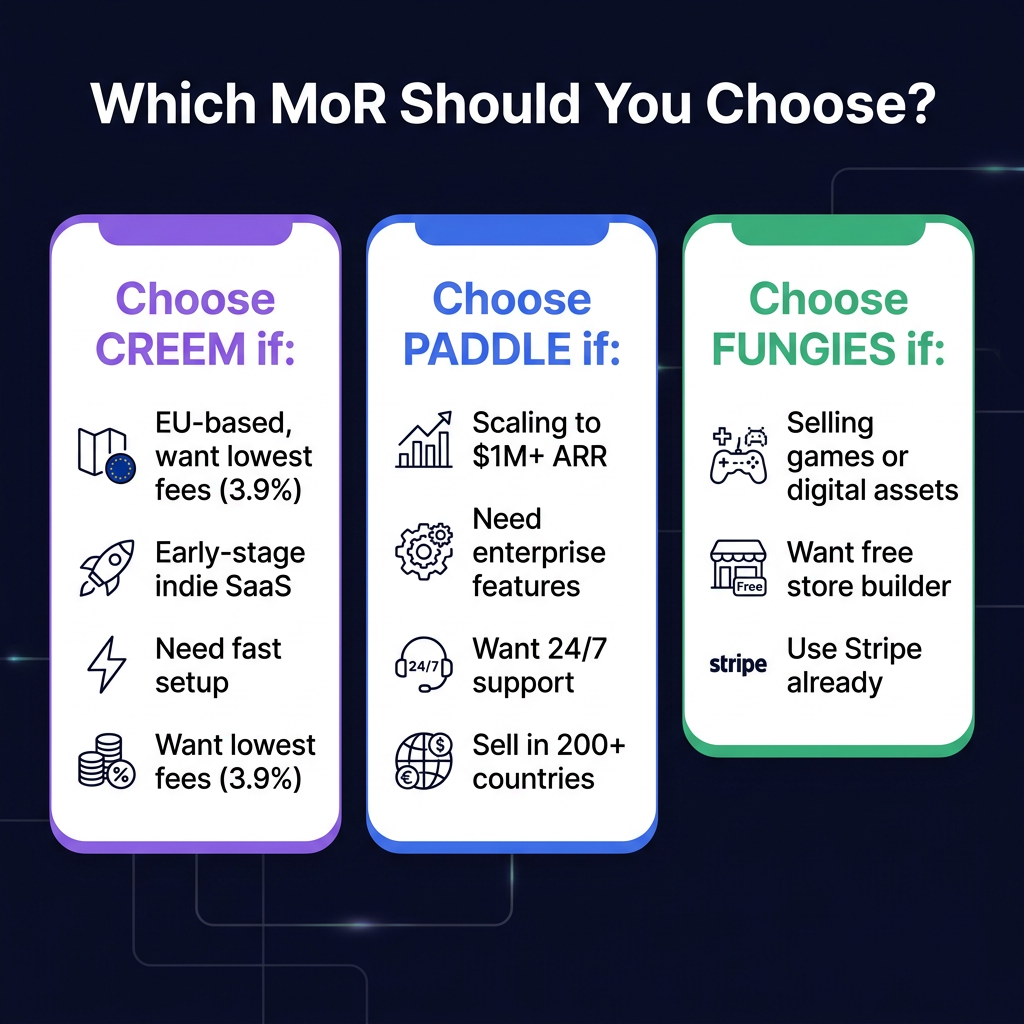
Use Creem if:
- You’re EU-based and want the cheapest MoR option
- You’re early-stage (under $10K MRR) and want to minimize fees
- You’re building a solo indie SaaS and don’t need enterprise features
- You applied early and actually have access
Use Paddle if:
- You need immediate, guaranteed access (no waitlist)
- You’re scaling past $500K ARR and need enterprise-grade support
- You want 200+ jurisdiction coverage with a proven track record
- You sell via Lovable (they’ve partnered with Paddle natively)
- You need advanced dunning and churn recovery tools
Use Fungies.io if:
- You’re selling games, digital assets, or license keys alongside SaaS
- You want a free store builder without buying Webflow or hiring devs
- You’re already on Stripe and want MoR compliance without a full migration
- You need a combined storefront + checkout + MoR in one platform
Key Takeaways
- Creem has the lowest fees (3.9% + $0.40) — at $100K MRR, you save ~$15,600/year vs Paddle
- Paddle offers the most proven, enterprise-grade coverage across 200+ jurisdictions — worth the premium when you’re scaling
- Fungies.io is uniquely positioned for founders who sell games + SaaS, or want a free store builder with MoR compliance
- Creem’s waitlist is real — apply early or default to Paddle/Fungies if you need to ship now
- All three platforms charge zero monthly fees — you only pay when you make a sale
FAQ
Is Creem a legitimate Merchant of Record?
Yes. Creem is a fully licensed MoR based in the EU. They handle VAT collection and remittance, chargeback liability, and tax compliance across 150+ countries. They’re newer than Paddle but have processed millions in transactions for indie SaaS companies globally.
Can I switch from Paddle to Creem or Fungies later?
Yes, but migrations are non-trivial. You’ll need to notify customers, handle proration on active subscriptions, and update your billing portal. Paddle offers migration tools; Creem and Fungies require manual migration. If you’re early-stage, pick the right platform now to avoid migration pain later.
Does Fungies.io work for SaaS subscriptions or just one-time digital products?
Fungies supports both recurring subscriptions and one-time digital purchases. Their strength is the combination — a platform that handles SaaS subscriptions, license keys, digital downloads, and game assets in one place, with full MoR compliance.
What happens to my tax compliance when I use a Merchant of Record?
The MoR takes full legal responsibility for tax collection and remittance. You don’t need to register for VAT in the EU, file sales tax returns in US states, or manage GST in Australia. The MoR does all of this on your behalf — you just receive your payout net of their fees and taxes collected.
Conclusion
For most indie SaaS founders in 2026, the choice comes down to this: Creem if you can get access and want the cheapest fees; Paddle if you need immediate availability and proven scale; Fungies.io if you’re building beyond pure SaaS.
None of these platforms will sink your startup. All of them will handle the tax and compliance work that would otherwise consume weeks of your time every year. The fee differences matter most at scale — at sub-$5K MRR, they’re noise. At $100K+ MRR, they’re material.
The best MoR is the one you can start using today. If you’re ready to launch, create a free Fungies.io account and have your checkout live in under an hour — no waitlist, no monthly fees, full MoR coverage from day one.