Here’s a stat that might surprise you: 81% of B2B buyers now make their vendor decisions before they ever talk to a sales team. They’re not waiting for your demo. They’re asking peers, reading reviews, and trusting recommendations from people they follow.
This shift is why SaaS affiliate marketing has exploded. A well-executed affiliate program can drive 30% revenue increase for software companies, making it one of the highest-ROI acquisition channels available. And unlike paid ads that stop working the moment you stop spending, affiliate partnerships compound over time.
What Is a SaaS Affiliate Marketing Program?
A SaaS affiliate marketing program is a structured partnership system where external promoters (affiliates) earn commissions for referring new customers to your software. Unlike traditional advertising, you only pay when a referred user actually converts and pays.
The model works particularly well for SaaS because of recurring revenue. When an affiliate brings you a customer who stays for 2-3 years, that single referral can generate thousands in lifetime value. Your affiliate gets ongoing commissions, creating alignment between their success and yours.
Here’s what makes SaaS affiliate programs different from e-commerce:
- Recurring commissions: Affiliates earn on every payment, not just the first sale
- Longer sales cycles: B2B buyers research more, so cookie windows need to be generous (60-90 days)
- Higher LTV: A single enterprise customer can be worth $10K+ annually
- Technical integration: Tracking needs to handle trials, upgrades, downgrades, and churn
Why SaaS Companies Need Affiliate Programs in 2026
The affiliate marketing industry is projected to grow from $27.8 billion in 2024 to $48 billion by 2027. For SaaS specifically, the growth rate is even steeper at 15.6% annually through 2028.
But the real reason to launch an affiliate program isn’t just market growth. It’s about acquisition efficiency. Traditional paid channels are getting expensive. Google Ads CPCs for SaaS keywords can hit $50-100. Facebook’s iOS tracking issues made attribution a nightmare.
Affiliate marketing flips the model. You pay for performance, not impressions. Your cost per acquisition is fixed as a percentage of revenue, so you’re never spending more than you can afford. And the trust factor is unmatched — a recommendation from a trusted influencer converts 5-10x better than a cold ad.
SaaS Affiliate Commission Benchmarks for 2026
Setting the right commission structure is critical. Too low and affiliates won’t promote you. Too high and you erode your margins. Here’s what the data shows:
| Commission Type | Typical Rate | Best For |
|---|---|---|
| Recurring revenue share | 15-30% of MRR | Most SaaS products |
| One-time CPA | $50-500 per signup | High-ticket enterprise |
| Hybrid (CPA + recurring) | $100 + 15% | Balanced approach |
| Tiered commissions | 20-30-40% tiers | High-volume affiliates |
The standard for SaaS is 20-30% recurring commission. This aligns incentives — affiliates want customers who stick around because that’s how they keep earning. If your gross margins are 80%+, you can afford to be generous.
Cookie duration matters too. B2B SaaS buyers often take 30-60 days to evaluate. A 30-day cookie loses you conversions. Most successful programs offer 60-90 days, with some going to 120 days for enterprise-focused products.
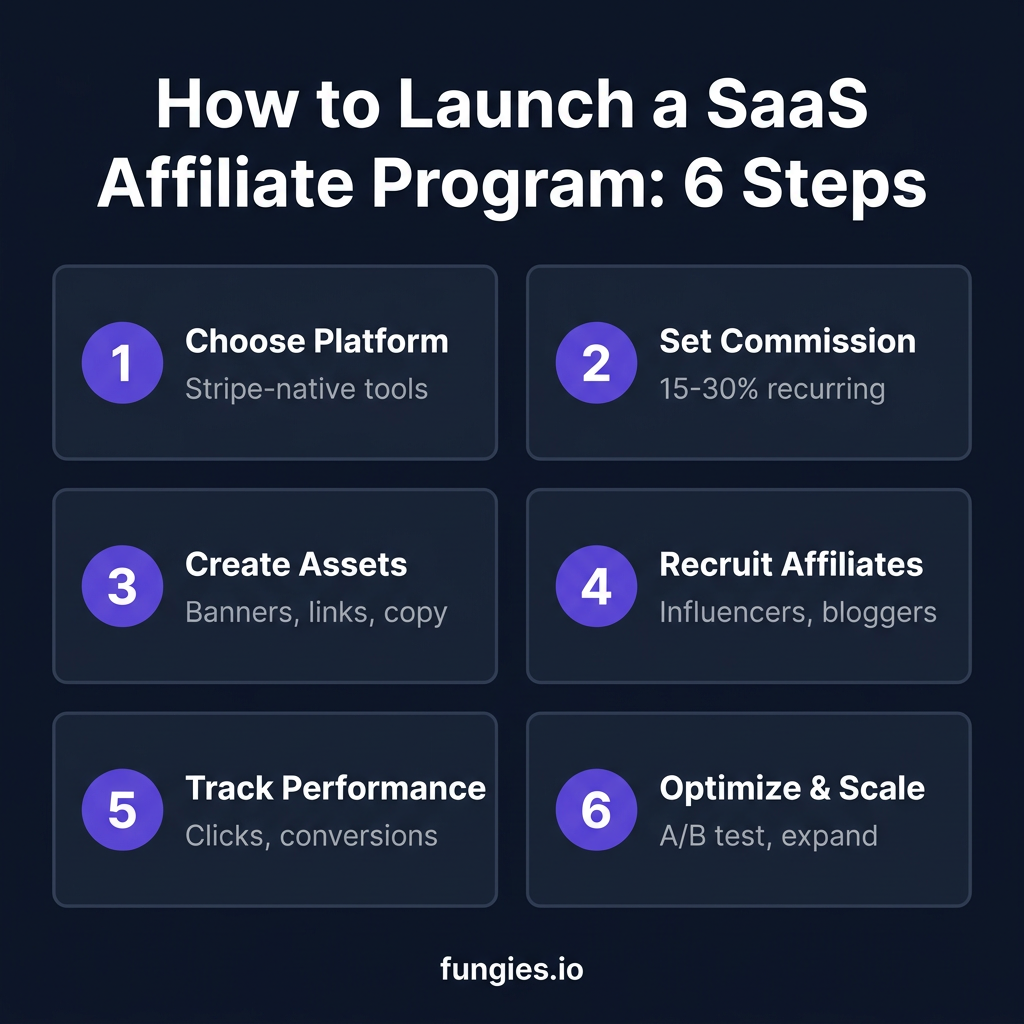
How to Build Your SaaS Affiliate Program: Step-by-Step
Step 1: Choose the Right Affiliate Platform
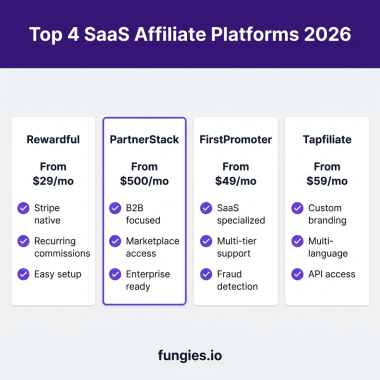
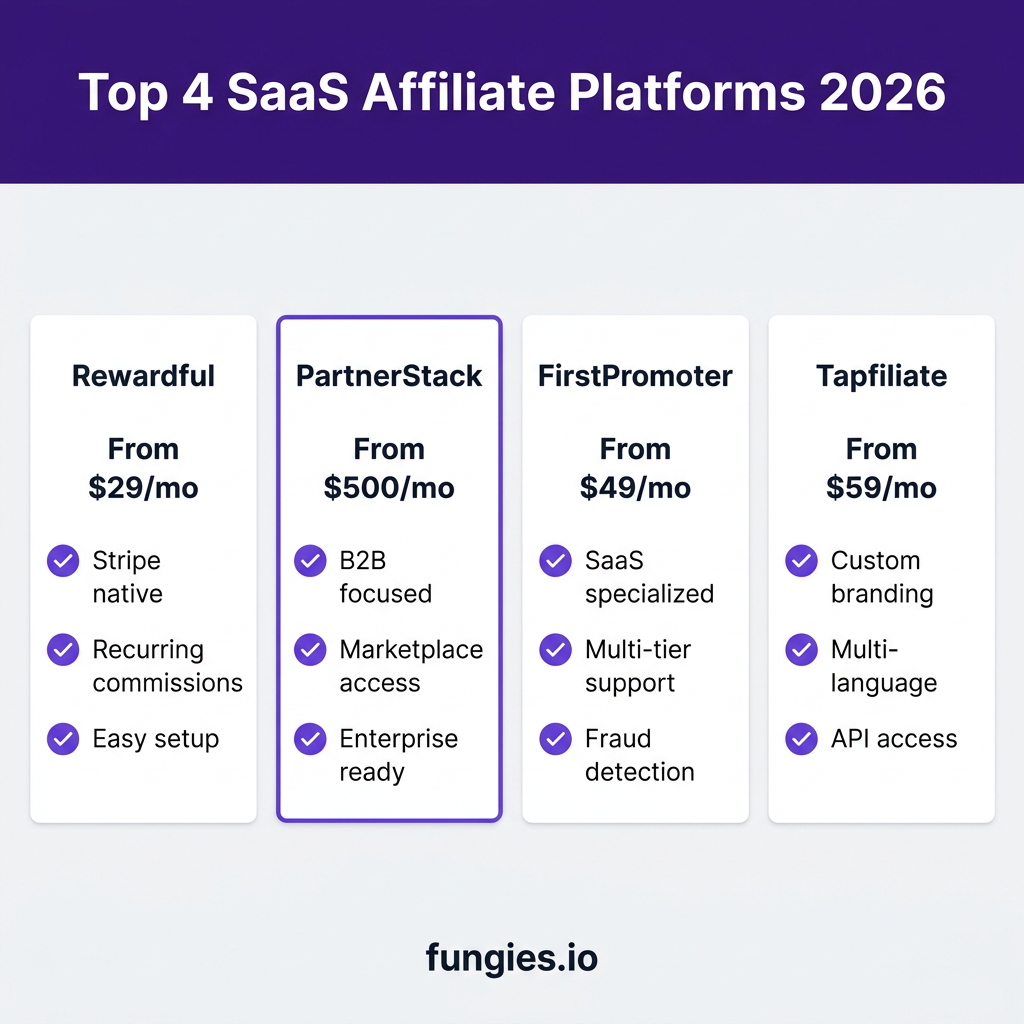
Your platform choice depends on your billing setup and complexity needs. Here are the top options:
- Rewardful: Best for Stripe-native SaaS. Starts at $29/month. Handles recurring commissions automatically when customers upgrade or downgrade.
- PartnerStack: The enterprise choice. $500+/month but includes a marketplace of 80,000+ B2B affiliates ready to promote.
- FirstPromoter: SaaS-focused with advanced fraud detection and multi-tier capabilities. Starts at $49/month.
- Tapfiliate: Strong for international programs with multi-language support and custom branding. Starts at $59/month.
Honestly, if you’re under $1M ARR and use Stripe, just go with Rewardful. It’s the fastest to set up and the Stripe integration is bulletproof.
Step 2: Design Your Commission Structure
Start with this formula: (Customer LTV × 0.20) ÷ Average customer lifespan in months = Monthly commission cap
If your average customer pays $100/month and stays 24 months, their LTV is $2,400. A 20% commission means $480 total, or $20/month. That’s sustainable for most SaaS businesses.
Consider tiered commissions to motivate top performers:
- Standard tier: 20% for first 10 customers/month
- Pro tier: 25% for 11-50 customers/month
- VIP tier: 30% for 50+ customers/month
Step 3: Create Affiliate Assets and Resources
Don’t make affiliates work hard to promote you. Provide everything they need:
- Brand kit: Logos, colors, fonts, approved messaging
- Banner ads: Multiple sizes (300×250, 728×90, 160×600)
- Email templates: Swipe copy they can customize
- Product screenshots: High-res images of your interface
- Case studies: Social proof they can reference
- Demo videos: Loom walkthroughs of key features
Step 4: Recruit Your First Affiliates
The best affiliates are already talking to your target customers. Here’s where to find them:
- Your existing customers: They know your product best. Offer them a higher commission rate.
- Industry newsletters: Authors with engaged subscriber bases
- YouTube creators: Tutorial and review channels in your niche
- Podcasters: B2B shows your audience listens to
- Bloggers: SEO-focused sites ranking for your keywords
- Communities: Active members in Reddit, Discord, or Slack groups
Personal outreach beats mass emails. Research each potential affiliate, mention specific content they’ve created, and explain why your product fits their audience.
Step 5: Set Up Tracking and Attribution
Accurate tracking is non-negotiable. Your system needs to handle:
- Unique referral links for each affiliate
- Cookie-based tracking (60-90 day window)
- Subscription lifecycle events (upgrades, downgrades, cancellations)
- Fraud detection (self-referrals, bot traffic)
- Multi-touch attribution (if using alongside other channels)
Most modern platforms handle this automatically. Just make sure to test thoroughly before launch — nothing kills affiliate relationships faster than missing commissions.
Step 6: Launch, Monitor, and Optimize
Start with a soft launch to 10-20 affiliates. Watch your metrics closely:
| Metric | Good | Excellent |
|---|---|---|
| Click-to-signup rate | 5-10% | 15%+ |
| Signup-to-paid rate | 10-20% | 25%+ |
| Affiliate activation rate | 30% | 50%+ |
| Average commission per affiliate | $200/mo | $500+/mo |
If click-to-signup rates are low, your landing page needs work. If signup-to-paid is low, your onboarding or trial experience is the issue. Fix these before scaling.
Common SaaS Affiliate Program Mistakes to Avoid
I’ve seen dozens of SaaS companies launch affiliate programs. Here are the mistakes that kill them:
Mistake 1: Competing on Commission Alone
A 40% commission sounds impressive, but if your product is hard to sell or has high churn, affiliates will abandon you. Focus on product-market fit first. A great product with 20% commission beats a mediocre product with 40%.
Mistake 2: Neglecting Affiliate Support
Affiliates are partners, not transactions. Answer their questions quickly. Create a private Slack or Discord community. Send them product updates before public announcements. The more supported they feel, the harder they’ll work for you.
Mistake 3: Ignoring Fraud Prevention
Self-referrals, cookie stuffing, and bot traffic can drain your budget. Set up fraud detection rules: block same-IP referrals, flag accounts created with affiliate emails, and manually review high-volume affiliates.
Mistake 4: Setting Cookie Windows Too Short
A 30-day cookie might work for impulse purchases, but B2B SaaS buyers take time. If someone clicks an affiliate link on day 1, signs up on day 45, and your cookie expired, you’ve just stolen that affiliate’s commission. Don’t be that company.
Advanced Strategies for Scaling Your Affiliate Program
Once you’ve got the basics working, here’s how to level up:
Strategy 1: Tiered Rewards and Gamification
Create monthly challenges: “Refer 10 customers this month and get a $500 bonus.” Public leaderboards drive competition. Exclusive perks for top affiliates (early access, co-marketing, advisory calls) build loyalty.
Strategy 2: Co-Marketing Partnerships
Go beyond simple affiliate links. Co-create content: webinars, ebooks, case studies. Guest on each other’s podcasts. Cross-promote to email lists. These deeper partnerships generate 10x the value of passive affiliate links.
Strategy 3: Affiliate-Exclusive Features
Give your top affiliates special capabilities: extended free trials for their audience, exclusive discount codes, or early access to new features. These perks make them more effective promoters.
FAQ: SaaS Affiliate Marketing Programs
How long does it take to see results from an affiliate program?
Expect 3-6 months to see meaningful traction. Affiliates need time to create content, test your product, and build trust with their audience. The first 90 days are about recruiting and onboarding. Month 4-6 is when revenue starts flowing consistently.
What’s a good affiliate activation rate?
Industry average is 30-40% of approved affiliates generating at least one referral within 90 days. If you’re below 25%, your onboarding or commission structure needs work. Above 50% is excellent.
Should I offer lifetime commissions or cap them?
Lifetime commissions attract better affiliates but cost more long-term. Most SaaS companies offer commissions for 12-24 months, which balances affiliate incentive with your unit economics. Enterprise SaaS with 3+ year retention can afford lifetime.
How do I prevent affiliates from competing with my paid ads?
Set clear guidelines: no bidding on your branded keywords, no impersonating your company, no misleading claims. Use negative keyword lists in your Google Ads to avoid competing with affiliates on non-brand terms.
Can I run an affiliate program alongside a referral program?
Absolutely. Use referrals for customers (smaller rewards, easier to share) and affiliates for content creators and influencers (higher commissions, more promotional support). Just make sure tracking doesn’t double-pay for the same customer.
Conclusion: Start Building Your Affiliate Channel Today
SaaS affiliate marketing isn’t a silver bullet, but it’s one of the most efficient growth channels when done right. You get access to trusted audiences, pay only for performance, and build partnerships that compound over time.
The companies winning in 2026 aren’t just running ads. They’re building armies of advocates who genuinely believe in their products. An affiliate program is how you scale that advocacy systematically.
Start small. Pick a platform, recruit 10 quality affiliates, and optimize from there. In 6 months, you might find that affiliates are driving 20-30% of your new revenue — at a fraction of the cost of paid acquisition.
Ready to start selling your SaaS globally? Create your free Fungies account and get your payments, tax compliance, and checkout handled in one platform. No monthly fees — just 5% + $0.50 per transaction.
Sources
- RevGeni – Best 2026 GTM Strategies for B2B SaaS
- Tapfiliate – SaaS Affiliate Program Management Guide
- WeCanTrack – SaaS Affiliate Marketing Statistics
- LinkJolt – SaaS Affiliate Program Best Practices
- Track360 – Best Affiliate Software for SaaS Comparison
- FirstPromoter – Affiliate Marketing Statistics 2026